
Democratic Values and Institutions Program

The program for Democratic Values and Institutions is designed to strengthen the state's commitment to the core democratic values enshrined in Israel's Declaration of Independence. The program works to thwart populist legislative initiatives, defend democratic institutions from attempts to undermine them, combat racism and hate speech and promote the values of freedom, equality, separation of powers and the rule of law.

Among other initiatives, the program has developed a manual for good legislation for the Knesset, launched media campaigns to block particularly harmful initiatives, and worked with elected and appointed officials across the political spectrum to explain the consequences of bad legislation and convince them to adopt more favorable alternatives.

  • Default Image

    Adv. Anat Thon Ashkenazy

    Head

    Read More

    Adv. Anat Thon-Ashkenazy is the Director of the Center for Values and Democratic Institutions at the Israel Democracy Institute.

  • Default Image

    Prof. Mordechai Kremnitzer

    Senior Fellow

    Read More

    Prof. Mordechai Kremnitzer is a Senior Fellow at IDI and he previously served as the Institute's Vice President of Research.

  • Default Image

    Prof. Yuval Shany

    Senior Fellow

    Read More

    Among other things, he has researched questions of right to equality, security detention, interrogation techniques, on-line surveillance and content moderation, military investigations, proportionality in the application of force, jurisdiction of international criminal tribunals and counterterrorism.

  • Default Image

    Dr. Guy Lurie

    Research Fellow

    Read More

    [email protected]

    Dr. Guy Lurie is an attorney and holds a PhD in History from Georgetown University (2013). He a former coordinator of the Shamgar Commission for the Formulation of Rules of Ethics for Members of the Government, and served as a post-doctoral fellow on the Faculty of Law at the University of Haifa.

  • Default Image

    Dr. Amir Fuchs

    Senior Researcher

    Read More

    [email protected]

    Dr. Amir Fuchs holds a doctorate from the Faculty of Law at the Hebrew University of Jerusalem and is a lecturer in the Politics and Communication Department at the School of Government and Social Sciences at Hadassah Academic College.

  • Default Image

    Dr. Nadav Dagan

    Senior Researcher

    Read More

    [email protected]

    Dr. Dagan Holds a PhD from Bar-Ilan University, LLM with specialism in Public Law and Human Rights Law from University College London (UCL), and LLB from the University of Haifa.

  • Default Image

    Dr. Moran Kandelshtein-Haina

    Researcher

    Read More

    [email protected]

    Researcher and lecturer in the fields of public law. Dr. Kandelshtein-Haina holds a doctorate from the Faculty of Law at the Bar-Ilan University and is a lecturer in the school of Law at the Netanya Academic College. The doctoral thesis she wrote dealt with the constitutional status of the prime minister in parliamentary systems. Areas of expertise: institutional constitutional law, administrative law, the Executive.

  • Default Image

    Adv. Daphne Benvenisty

    Researcher

    Read More

    [email protected]

    Daphne is a researcher at the Center for Democratic Values and Institutions. She holds an LL.B and an LL.M, both from the Hebrew University of Jerusalem. She has clerked at the Supreme Court in the chambers of Justice Neal Hendel.

  • Default Image

    Adv. Nisreen Abo Asalh

    Research Assistant

    Read More

    [email protected]

    Adv. Abo Asalh completed her Bachelor of Law studies at the University of Haifa in 2020, specialized in the consulting and legislation department (constitutional law) and qualified in 2021 as an attorney. Prior to joining the IDI, Adv. Abo Asalh worked for about two years at the firm of Firon & Co. in the planning and construction department. Today, concurrently with her work at the IDI, Abo Asalh works as an attorney at the office of Yosef Yeshurun & Co.

    In the past, Adv. Abo Asalh established a number of social projects.

    Nisreen Abo Asalh is a master's student in public law at the Tel Aviv - Northwestern program.

  • Default Image

    Roni Bivas

    Research Assistant

    Read More

Dr. Guy Lurie, Research Fellow in IDI’s Democratic Values and Institutions Program, joins an i24NEWS panel to discuss Israel’s Military Censor and the delicate balance between protecting national security and preserving freedom of speech. 

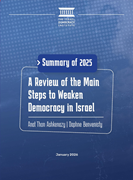
An analysis of legislation and initiatives that undermine democratic principles and institutions during the full 25th Knesset term, from November 2022 through July 2026.

The legislation expands the possibility of gender-separated studies in higher education, fundamentally altering the balance between the desire to make higher education accessible to the Haredi population and the principle of equality.

The latest proposal would undermine the binding force of the Attorney General’s legal opinions and abolish the AG's exclusive authority to decide whether to permit the government separate legal representation, removing two of the main tools that enable the institution to safeguard the rule of law.

The Supreme Court belatedly finds refusal to allow ICRC visits to Palestinian prisoners a blatant violation of Israeli and international law.

In light of the government's announcement that an interim order issued by the Supreme Court does not have binding force, the question arising in this case goes beyond the matter of the Second Authority and touches on the foundations of Israel’s democratic system of government.

The institution of the attorney general is one of the few checks on government power in Israel. Legislation making its way through Knesset would effectively remove the constitutional functions of the office to safeguard the rule of law in Israel's democratic system.

Nadav Dagan (PhD), Senior Researcher at the Israel Democracy Institute and Research Fellow at the Minerva Center (University of Haifa), together with Daphne Benvenisty, a researcher at the Israel Democracy Institute, join the Minerva Center for the Rule of Law under Extreme Conditions at the University of Haifa, for a seminar where they present findings from their comparative study on Autocratization and States of Emergency. Their study presents a show a clear link between the use of 'states of emergency' and accelerated erosion or dismantling of democracy, and autocratic consolidation.

Against the backdrop of the bills currently under consideration in the Knesset, which are intended to split the role of the Attorney General, IDI experts explain what is at stake.


A "special state of emergency" has been applied over the years due to security crises, the COVID pandemic, and now the war with Iran. How does this affect the regulation of the courts and the power of the Minister of Justice?

The Supreme Court is currently conducting a hearing that could signal a constitutional crisis—a contempt-of-court motion filed in the case of the Movement for Quality Government in Israel v. Minister of Defense (5819/24), which argues that the government has not complied with the Court’s ruling of November 19, 2025 requiring it to formulate an effective enforcement plan for ultra-Orthodox (Haredi) conscription.

This explainer reviews the background to the Court’s ruling, and considers whether Israel merely faces the risk of a constitutional crisis, or whether such a crisis is already here.

While the police shooting in Tarabin is still under investigation, the events leading up to the shooting reflect a systemic failure in the police's approach to combatting crime in Arab society, and raise concerns about politicization of the police.

The court’s ruling about who can oversee an obstruction of justice investigation into military officials has broad rule-of-law implications.

The proposal to advance a politically appointed commission of inquiry into the events of October 7 is a significant departure from the accepted model of an independent state commission of inquiry. This explainer compares the two models and lays out the key details of each one.

The Israeli government’s decision to establish its own committee to investigate the failures on October 7 is not enough.

The Israeli government recently announced its intention to establish its own commission of inquiry into the events of October 7, 2023, rather than forming a State Commission of Inquiry—the most authoritative, independent, and legally empowered investigative mechanism under Israeli law. As Dr. Dana Blander, a research fellow at the Israel Democracy Institute, explains, Israel’s legal framework provides for several types of investigative commissions, each differing in its degree of independence, statutory authority, and public legitimacy. Notably, the government’s recent decision does not establish a State Commission of Inquiry—the appropriate and legally grounded institution for investigating the events of October 7—nor does it create a governmental commission of inquiry. Instead, it proposes a vague, ad hoc body seemingly tailored to serve specific political interests rather than the public need for a credible and impartial investigation. This explainer outlines the existing commissions - as more information comes to light about the government's planned commission, additional analysis will be provided.

The High Court handed down a decision allowing the Minister of Justice choose the civil servant to oversee the investigation into the Sde Teiman video leak affair in the Attorney General's stead. This sets a concerning precedent and ignores the current political reality in Israel.

Israel currently has six government ministries with no ministers leading them. This is not only a breach of the fundamental duty of government, it also means decisions and regulations requiring ministerial approval cannot move forward, and key public services cannot be delivered to the citizens.

Dr. Amir Fuchs, Senior Researcher at the Israel Democracy Institute, speaks to BBC reporter James Coomarasamy on 'The World Tonight' on BBC radio, on what the death penalty law proposal means for Israel and it's legal implications.

Though Members of Knesset are granted immunity from prosecution under the law, legal precedent makes clear that this immunity does not apply to the stage of criminal investigations.

With Justice Minister Yariv Levin's recent appointment as Acting Minister of Jerusalem and Jewish Heritage, he now holds five ministerial portfolios. This situation, with Levin and other ministers, is harmful to public interest and raises important legal and procedural questions.

The Israeli Minister of Justice ordered the locks changed at the Tel Aviv office shared by the Attorney General, an action that blatantly violates the Supreme Court’s interim order prohibiting the dismissal of the Attorney General and any changes to the working arrangements between the government and the Attorney General.

The firing of the AG constitutes another escalation in the current government’s approach to the domestic rule of law institutions.

A bill expanding the powers of Israel's religious courts was approved for first reading in Knesset. This raises concerns about the rights of vulnerable population groups, such as women and low wage workers. As a Jewish and democratic state, it is not enough to say rights will be protect – there must be institutional protections.

This week's announcement of the resignation of the ultra-Orthodox parties from the coalition marks a fairly common case of parties resigning due to matters of religion and state. The following historical analysis looks at parties that have withdrawn from their governing coalitions over the years and the ideological disagreements that led them to do so.

This paper describes the procedure that has been laid out for dismissing the attorney general, its recent revision, and explains why the decision by the Netanyahu government to fire the attorney general at the current time is legally invalid.

The Knesset passed Amendment 44 in 2016 to regulate the possibility of impeaching MK's. An MK can be expelled if the Knesset finds that his or her actions constituted incitement to racism or support of an armed struggle against Israel.

Last week, it was announced that a man would lead Israel's Ministry of Social Equality—the ministry responsible for, among other things, gender equality. This, on its own, would not be problematic, but it leaves the total number of women Directors General of government ministries at zero. This lack of representation is not only misaligned with public opinion, it is also a blatant violation of a Supreme Court ruling and reflects disregard for the rule of law.

The Attorney General recently announced an agreement with Itamar Ben-Gvir in response to petitions challenging his reappointment as Minister of National Security. What is included in this agreement, can it be enforced, and is it an appropriate solution to ensure an independent police force?

When loyalty to the Prime Minister is seen as loyalty to the law itself, Israel risks replacing democracy with rule by decree—undermining the very foundations of the rule of law.

Ronen Bar’s affidavit exposes unprecedented attempts by Prime Minister Netanyahu to misuse the Shin Bet for political ends—pressuring it to track protesters, influence his trial, and prioritize loyalty to him over the rule of law—revealing a profound threat to Israeli democracy and the integrity of its security institutions.

Everything you need to know about yesterday's High Court hearing on Netanyahu's efforts to fire Shin Bet Director Ronen Bar went.

By shifting power from professional bodies to political appointees the new law restructuring the Judicial Selection Committee is likely to reduce Arab representation and exacerbate their exclusion.

The reappointment of Itamar Ben-Gvir as Minister of National Security, despite legal objections and a documented pattern of improper political interference in police operations, constitutes an "extremely unreasonable" decision that threatens the independence, professionalism, and democratic integrity of Israel’s law enforcement system.

Expanding the institutional arenas for democratic participation in Israel - through electoral and structural reforms - can help address the growing sense of political helplessness and strengthen the responsiveness of its democratic system. 

The Israeli government's current efforts to dismiss the head of the director of the Shin Bet and the Attorney General, alongside its attempt to restructure the Judicial Selection Committee, reflect a broader shift toward subordinating legal and security institutions to political authority, raising concerns about the erosion of the rule of law and the future of democratic governance in Israel.

Amidst the return to fighting in Gaza, the Minister of Justice is taking advantage of the public's eye being off the ball to hastily overhaul Israel's judicial system.

The amendment to the Immunity Law proposed by MK Tally Gotliv would allow MKs to grant themselves immunity from criminal and civil prosecution, undermining equality before the law and creating inherent conflicts of interest that disproportionately protect coalition members from accountability.

In just over a decade, Israel’s score in the report published by Freedom House has fallen by 8 points, a decline that now puts it alongside countries such as Brazil and Namibia.

A survey on women's representation conducted among men and women in Israel. Findings show that most (65%) consider equal representation when deciding on which party to vote for; 71% think the number of women in the Knesset, the government and in senior positions should be increased. 

An analysis and international comparison of women's representation in the Israeli political arena. 

The battle over Israel’s legal system has resumed, threatening judicial independence.

Changes in the composition of the Judicial Selection Committee threaten the independence of the judicial system. The current proposals would lead to a complete politicization of appointments to all courts and should be blocked. 

The proposed bill, which would change the selection process of the Ombudsman - responsible for investigating complaints about the conduct of judges and religious court judges - aims to intimidate judges and undermine their independence.

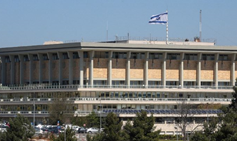
The Knesset, Israel's parliament, marks 76 years today. Over the decades, it has shaped the nation's laws, policies, and political landscape, evolving alongside Israel and the modern world. How much do you know about the Knesset and its history? Test your knowledge. 

Following Justice Isaac Amit's selection as Supreme Court President, Minister of Justice Levin immediately declared he would refrain from any collaboration between them, describing the selection process as unlawful. This announcement is both factually incorrect and a serious dereliction of his duties. 

The lack of cooperation between the Minister of Justice and the President of the Supreme Court has numerous consequences that will, among other things, harm the services provided by the judiciary to the citizens of Israel.

While the selection of Justice Amit as President of the Supreme Court was done in accordance with the relevant legislation, the Justice Minister has declared the procedure "fundamentally improper and illegal." His refusal to recognize the selection creates a precedent that may lead to the deterioration of the authority of other institutions. This is what the beginning of a constitutional crisis looks like. 

In recent years, it has repeatedly been claimed that “Israel has too many elections.” On the one hand, this is true, Israel has the highest frequency of parliamentary elections compared to all developed democracies. On the other, Israelis have fewer voting opportunities.

Justice Minister Yariv Levin and Foreign Minister Gideon Sa’ar presented their proposed changes to the composition of the Judicial Selection Committee (JSC) as a compromise aimed at achieving a gradual change in the judicial selection process, but many constitutional experts worry that the plan will have dire consequences resulting in the politicization of Israel’s judicial selection process.

Law enforcement and security agencies are central pillars of democratic rule, and therefore, their capture is a pivotal factor in democratic decline. A comparative analysis by IDI experts reveals that this takeover is often achieved quietly while striving to present all steps as lawful. 

The Sa'ar-Levin proposal represents a shift from prioritizing professional qualifications in the Judicial Selection Committee to emphasizing political loyalty as the basis for judicial appointments. This risks eroding judicial independence, compromising professionalism, and incentivizing ideological extremism.

In response to a petition filed against him regarding the intentional delay in appointing a president of the Supreme Court, Minister Levin claimed that it is impossible to sanction him because he enjoys “substantive immunity.” A closer examination of the law reveals that this is not the case.

When South Korean President Yoon Suk Yeol, who previously praised liberal democracy, declared martial law, a swift and decisive response from the general public, and subsequently parliament, thwarted the move within hours. These events illustrate that in order to increase the chances of recovery and inoculation against democratic backsliding, democratic institutions must be strengthened.

While it’s important to facilitate the integration of Haredim into academia and the workforce, seperate graduate program for men and women can be harmful to the rights of women and often clashes with the law that prohibits gender-based discrimination in public places.

A new bill proposes to amend Basic Law: The Knesset, by expanding the criteria that would disqualify candidates and lists from participating in elections based on minimal and even past expressions, interpreted as sympathy or support for armed struggle of an enemy state or terrorist organization. 

The proposed "Public Committee of Inquiry," for investigating the events of October 7th and its aftermath, is an attempt to circumvent the existing framework for such investigations and is unlikely to gain public trust.

At first glance, the dismissal of Minister of Defense Yoav Gallant is not unprecedented – prime ministers hold authority to fire ministers, and Prime Minister Netanyahu has done so in the past. However, the circumstances surrounding the current dismissal are especially intense.

The Police Commissioner's decision to terminate the Israel Police Legal Advisor without consulting the Attorney General to whom the Police Lega Advisor is professionally subordinate the most recent worrying sign of the problematic relations between the Attorney General and various government officials.

Establishing a State Commission of Inquiry is the civic, moral, and public duty at the highest order. And it must be done now.

A recent judgment of the Israeli Supreme Court held that conditions in a notorious detention center must comply with Israeli law.

Recently, Israel has faced a number of situations that could lead to a constitutional crisis. What is a constitutional crisis and why is it dangerous for the stability of democracy? IDI experts explain.

The diminished number of women in decision-making positions in government, coupled with the increase in attempts to implement gender segregation, threatens the right to equality.

How is the Chief Justice in Israel selected, what is the principle of seniority and how does this compare internationally? Dr. Guy Lurie explains the roles and responsibilities of the Chief Justice, an issue that is currently at the heart of a dispute between the Minister of Justice and the Courts.

To protect the credibility of the police as an impartial law enforcement agency, independent oversight over the police prosecution unit - the police unit that issues criminal charges - must be increased through the Attorney General's office.

The Israeli Supreme Court recently issued a pivotal ruling, instructing the Minister of Justice to convene the Judicial Selection Committee and select a new President of the Supreme Court. This decision come after nearly a year in which this permanent position has remained vacant. 

After the Minister of Justice Yariv Levin refrained from convening the Judicial Selection Committee to appoint a Supreme Court President, the Supreme Court ruled that the Committee must convene to appoint a President—Prof. Suzie Navot analyzes the Court's decision.

Israel is the only OECD member that has neither regional elections nor a personal element in the electoral system. This is not simply a technical issue but has far-reaching implications relating to the quality of representation and the obligation elected officials have toward their voters.

Disregard of the Attorney General’s authority to interpret the law by several government ministers is leading Israel toward a constitutional crisis.

In recent days the Attorney General has issued several warnings that decisions are being made using "flawed work processes." This explainer provides an overview of the role and importance of the Attorney General in Israeli democracy, and the current criticism directed by the AG at the government.

The 25th Knesset has recently completed its summer session, which began on May 19, 2024 and concluded on Sunday July 28, 2024. This article reviews and analyzes various aspects of the Knesset’s work during this period, comparing them to the previous two full sessions of the 25th Knesset.

With the outbreak of the war in October 2024, the Prime Minister announced that he was halting all legislation relating to the judicial overhaul, however, various government actions raise questions regarding its intentions in relation to the overhaul and whether it might be trying to advance it by other means beyond legislation.

The rule of law is a fundamental democratic principle, meaning that all governing bodies are subject to and must comply with the law. Despite the complexities inherent in ongoing war, this is true also of the IDF, and only decisive action against breaches of conduct may protect the rule of law in Israel and Jewish morality. 

The UN report paints a disturbing picture in which countries experience “autocratization”—an erosion of the foundations of democracy—through actions that undermine the judicial system’s independence. In Israel, the current government is aiming to undermine judicial independence in order to consolidate its power and authority at the expense of individual rights and the rule of law.

A state commission of inquiry is a vital step, but it is up to the public to ensure Israel's leaders are truly held accountable.

The Labor and Meretz parties recently announced their intention to merge. Though these are relatively small parties today—Meretz has no representation at all in the current Knesset, and Labor has just four seats—this is still a significant event from a historical perspective and within the Zionist left.

IDI experts outline the initiatives and measures undertaken by the government that, taken together, constitute a concentrated effort undermine Israel's democratic institutions. At the core of these efforts is a dramatic attempt to weaken the status of the Attorney General; increased politicization of the police; continued undermining of the independence of the judiciary and more.

Dr. Ariel Finkelstein warns that the proposed new "Rabbis Law" would weaken the standing of local communities, could lead to cronyism, reduce women's representation and more. 

While the Israeli public has been focusing on the war and on the hostages in Gaza, the government—led by the minister of justice—has been preparing an assault on the independence of the judicial system.

The discussion in the Supreme Court yesterday was not about whether a law exempting yeshiva students harms the principle of equality. It was about a much more basic question: is the State of Israel acting in accordance with the principle of the rule of law—that is, can yeshiva students be exempted from enlisting in the IDF, when there is no law allowing for this.

Women in senior government positions are leaving their roles, the number of victims of domestic violence is rising, and the prevailing spirit from the government does not bode well. Now more than ever, there must be a call for immediate and fundamental change in placing women's rights at the top of the national agenda.

The International Court of Justice in The Hague (ICJ) issued new temporary orders against Israel this week. Justice Barak’s dissenting opinion would seem to offer an important lesson for the future. Professional, focused, and well-founded legal criticism—as opposed to the very different means that are currently being widely discussed and pursued—is likely the best way to deal with the ICJ.

Demands to lower the flames of criticism cannot legitimately be made by a government taking actions driven by narrow political interests. If the government does not act in a nonpartisan manner, they cannot demand those who hold different views refrain from opposing political action. 

Judicial overhaul initiatives, along with other anti-democratic measures, have continued to be promoted by the government and the coalition in the Knesset. This document outlines the various actions taken in government that weaken the Israeli judiciary and democracy at large.

What has produced the rise in the President’s confidence rating? One explanation is the public’s yearning for nonpartisanship in a time of crisis. 

V-Dem's latest report downgraded Israel's status from a "liberal democracy" to an "electoral democracy." The change in Israel's category is concerning, but on its own, it does not necessarily indicate a clear democratic decline. 

The National Unity faction in the Knesset is disbanding and reverting into the two parties that composed its list of candidates in the last election. The splitting of joint lists does not contribute to political stability. It contributes to fragmentation within the political system and may be perceived as political cynicism.

The Israeli democracy regulates the operation of the judiciary through the constraints of formal rules that check the political actors, the individual judges, and the judiciary. Yet beyond these formal rules, informal institutions and practices are sometimes equally important in the operation of the judiciary, as they are in any constitutional system. This article discusses informal institutions that are important in the operation and independence of the Israeli judiciary.

Between 1996 and 2015, there was a real improvement in women's representation in the Knesset. Since 2015, however, it seems this upward trend has stalled and female legislative representation is faltering, especially compared to other democracies.

From a historical perspective, the proportion of female heads of local authorities in Israel has been extremely low—essentially negligible throughout most decades. How does women’s representation in local authorities during the first two decades of the 21st century compare?

All too often the Knesset amends Israel's Basic Laws - how does this compare with other parliamentary democracies?