

Operation Roaring Lion: A Special Home Front Situation
What are the implications of declaring a “special home front situation,” and what powers does such a declaration confer to Israeli authorities? What rights do citizens have in areas regarding which such a declaration has been made? What’s the difference between a “special home front situation” and the ongoing “emergency situation” that has long been in force in Israel? This article explains these issues, and more.
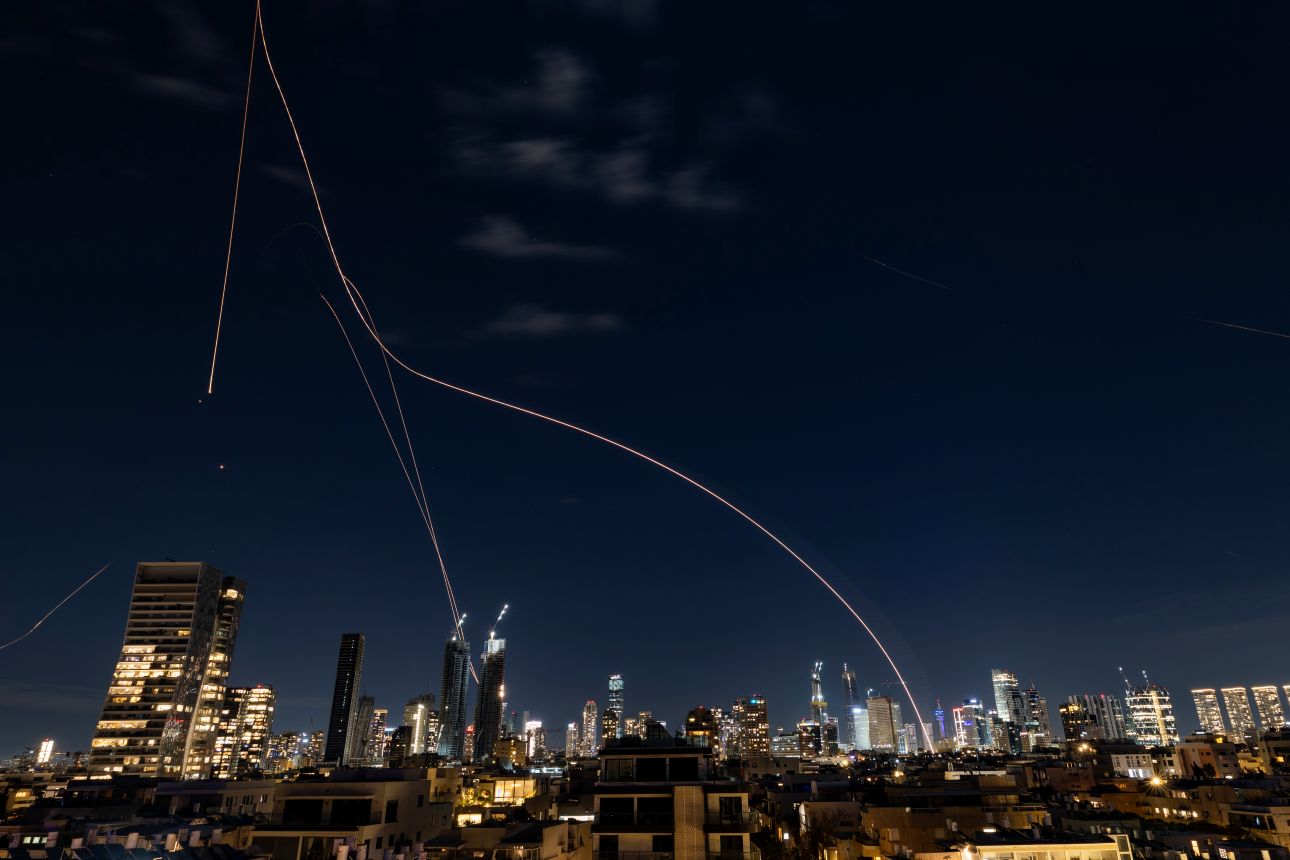
Photo by Chaim Goldberg/Flash90
On February 28, 2026, with the launch of the joint Israel-US Operation Roaring Lion against Iran, the Israeli minister of defense declared a “special home front situation” applicable to the entire territory of the State of Israel. The next day, the government passed a decision to extend this declaration through to March 12, 2026, after which the decision was approved by the Knesset’s Foreign Affairs and Defense Committee. This article provides a short explanation about the declaration of a special home front situation, its implications for Israel’s citizens, and the differences between this declaration and other declarations related to emergency situations and war.
What is a declaration of “special home front situation”?
The Civil Defense Law (1951) cites two situations involving armed conflict in which IDF forces are granted special powers on the home front:
- An “attack situation”—a period during which an attack on Israel takes place in a specific area, lasting up to 24 hours from the beginning of the attack (or less, if an all-clear is given).
- A “special home front situation,” which is declared when there is a high likelihood of an attack on the civilian population in all or part of the State of Israel.
A special home front situation has been applied to Operation Roaring Lion. The law grants the authority to declare such a situation to the government (or to the minister of defense, if the government has not used these powers).[1] A government declaration of a special home front situation must be ratified by the Knesset Foreign Affairs and Defense Committee within five days. A declaration made by the defense minister expires within 48 hours unless it is extended to five days by the government, in which case it will need to be further extended by the Foreign Affairs and Defense Committee.
In fact, during the term of the 37th government, a “special state of emergency on the home front” has been in effect for an extended period of more than two years (see here). Following the October 7, 2023 attack, the defense minister declared a special home front situation in the Gaza border region. Later that day, the defense minister declared an expansion of the special home front situation to apply to the entire country. Since then, throughout the Iron Swords war, the government decided to extend the defense minister’s declaration with respect to all or part of the territory of the State of Israel, and these decisions were subject to the approval of the Knesset Foreign Affairs and Defense Committee.[2]
With the launch of June 2025 war against Iran ("Operation Rising Lion"), the defense minister declared a special home front situation throughout the country and subsequently asked the government to extend this declaration until June 30. At the end of a prolonged period of more than two years, in late-October 2025, the Minister of Defense approved the removal of the restrictions associated with the special home front situation.[3] As noted above, with the launch of Operation Lion's Roar, the Minister of Defense once again declared a special home front situation throughout the entire territory of the state of Israel, and the government extended this declaration until March 12, 2026 — a declaration that received the approval of the Knesset’s Foreign Affairs and Defense Committee shortly after.
What are the implications of declaring a “special home front situation”?
Declaring a special home front situation allows the IDF to wield various powers in the area stated in the declaration. Examples include:
- Certain senior IDF officers are empowered to issue, as needed, any instruction to any individual, or to part or all of the Israeli public, necessary to safeguard or save human life or property. Among other powers, they can require that civilians remain in shelters, ban or restrict studies in educational institutions, and issue instructions about personal equipment and supplies for civil defense purposes. [4]
- Senior IDF officers are also empowered to order the evacuation of any equipment or property being held in public shelters. In this context, the law requires residents to remove their belongings from the shared building shelter, and to maintain the shelter in such a way that will facilitate its use at any given time to shelter from attacks. Similarly, during an attack, anyone who has a shelter is obliged to allow any person nearby to enter the shelter and to remain there throughout the attack.[5]
- IDF Home Front officers are empowered to issue any reasonable instruction to any person, and to prevent entry into or exit from a certain area in order to safeguard lives or property.[6]
- IDF Home Front soldiers are allowed to enter any location in order to perform their duties.[7]
Similarly, members of “auxiliary organizations” (including Magen David Adom and the Israel Fire and Rescue Authority), as well as volunteers in these organizations seeking to perform their duty, are required to assist military forces in civilian defense efforts.
In addition, declaring a special home front situation grants powers to government ministers, as laid down in various laws, some of which were already applied during Operation Roaring Lion. For example:
- The minister of labor is entitled to issue orders ensuring that work is carried out in essential factories or factories for essential services.[8]
- The minister of labor is entitled to permit the employment of workers beyond regular working hours.[9]
- The minister of communications can order media and communications organizations to cease their activities, to carry out certain activities, or to place their systems at the service of the security forces.[10]
- The minister of transport can order changes in the benefits applicable to air passengers, among other reasons due to the reduced capability of airlines to plan flight schedules and to the limited supply of passenger flights to and from Israel.[11]
- The minister of the interior can allow local authorities to operate outside of their area of jurisdiction and assist other local authorities.[12]
What rights are granted to citizens by declaring a special home front situation?
Declaring a special home front situation grants several rights to citizens in the area affected. For example, employers are not allowed to fire workers for being absent from work in a situation in which the IDF Home Front has forbidden citizens from going to work.[13] Similarly, the Supervisor of the Banks is entitled to rule that banks are not to place restrictions on bank accounts or account holders because of checks that are declined.[14] In addition, electricity providers are forbidden from disconnecting debtors from their electricity supply during a special home front situation.[15]
Regarding businesses that suffer losses or those whose property is damaged, declaring a special home front situation does not in itself give them the right to automatic compensation. These are separate arrangements, detailed in the Property Tax and Compensation Fund Law (1961), and the Regulations enacted under the law, according to which compensation can be received for war damage—that is, physical damage caused by acts of war[16]—and for indirect damage (losses or loss of profits incurred as a result of war damage) in certain local authorities, as declared by the minister of finance. However, some have argued that the list of declared local authorities is out of date and unsuitable for current circumstances.[17]
Following the June 2025 operation, this law was amended. The amendment, which applies temporarily until the end of 2027, was intended, among other things, to create an additional track for compensation for indirect damage incurred during the fighting in June 2025.[18] In addition to this law, over the years temporary regulations have been issued by the finance minister to enable case-specific and time-limited compensation mechanisms for damage caused by wars and operations in recent years.[19]
Beyond these compensation mechanisms, the government has, in the past, decided to establish assistance and grant mechanisms for residents who were affected in one way or another as a result of security-related events. For example, in connection with the events of the Iran conflict in June 2025, the government resolved to instruct the Ministry of the Interior to assist those local authorities in which residents’ homes had been damaged and rendered unfit for habitation. The assistance included a payment of NIS 500 for each person who had resided in the affected property, on the condition that the local authority transfer the amount, as soon as possible, to each such resident for the purpose of financing immediate needs.[20] The government has decided to provide similar assistance, according to media reports, during the current Operation Roaring Lion.[21] In addition, there are various governmental assistance mechanisms intended to support entities that require such assistance.[22]
What is the relation between the declaration of a special home front situation and the Security Cabinet's decision to launch Operation Roaring Lion?
According to section 40(a) of the Basic Law: The Government, the authority to decide whether to launch a war or to initiate “a significant military operation which is liable to lead, at a level of probability close to certainty, to war” lies with the government.[23] According to section 40(a1) of the Basic Law, the authority to decide whether to go to war can be delegated to the Ministerial Committee on National Security Affairs (“the political-security cabinet”), on a permanent basis or for a particular instance. In the past, the government has permanently empowered the cabinet to make decisions by virtue of section 40(a). The application of this power in each individual case is subject to the prime minister’s determination that it is required for reasons of security, foreign relations, or secrecy. It should be emphasized that the decision to go to war does not, in itself, confer special powers on bodies such as the IDF Home Front Command or the police regarding civilian matters.
The Basic Law: The Government does not define the term “war”, and there is no definition of war in any other Israeli law. In international law, “war” is defined as an armed conflict between two or more countries.[24] There is no doubt that Operation Roaring Lion meets the definitions of war between two states according to international law, though one could argue that the operation does not constitute “launching a war,” but is rather a new and more intensive stage of the ongoing armed conflict between Iran and Israel.
However, even if the operation is a continuation of existing armed conflict, in our opinion, it is appropriate to interpret the existing legislation in such a way that escalation in the conflict, as was done at the beginning of Operation Roaring Lion, requires discussion and a decision by the government (or at least by the Security Cabinet).
- According to the Basic Law: The Military, the IDF is subject to the authority of the government. Security Cabinet decisions to launch operations on the scale of Operation Roaring Lion are expressions of this authority, which has a dual purpose—to ensure that the military operates in accordance with government decisions, and to ensure that the military is not subject to the authority of only one element in the government.[25] If a security cabinet decision is not required for such an important operation, whose consequences may be so far-reaching, then the “authority of the government” is essentially meaningless.
- The spirit of the Basic Law: The Government suggests that this type of escalation requires a government decision. The explanatory notes to the amendment to section 40(a) of 2018, which stipulated the requirement for government approval also in relation to military operations that could lead to war, referred to “consequences such as significant harm to public security, including on the home front, extensive mobilization of reserves, damage to the state’s foreign relations, the state’s economy, or other aspects” as being characteristics of “war.” Thus, it would appear that a security cabinet decision should also be made regarding very significant military operations, even if they take place within the context of an ongoing war.
Indeed, it was reported that the launch of Operation Roaring Lion was approved by the ministers of the political-security cabinet. However, a lack of transparency and clarity applies with respect to the decision-making process. For example, it was reported in the media that the decision was initially approved by “a very small number of ministers, in order to prevent leaks,” and that the Security Cabinet was informed of the matter only shortly before the launch of the attack.[26]
It should be noted that according to the interpretation that we have proposed of the Basic Law: The Government, according to section 40(c), there is an obligation to notify the entire government as soon as possible of the launch of an operation, as well as the subcommittee of the Knesset Foreign Affairs and Defense Committee, and the Prime Minister must notify the Knesset as soon as possible.
What is the difference between a “special home front situation” and a “civil emergency event”?
According to the Police Ordinance, a civil emergency event is an event that causes severe harm to public safety, life, or property affecting a large area or population, including natural disasters, environmental disasters, chemical or biological disasters, large-scale accidents, or hostile terrorist activity. A civil emergency event is usually declared by the minister of national security, with this declaration being valid for two days and the minister entitled to extend it to up to four days. Extending a civil emergency event to a period of a week requires a government resolution to be passed, and further extensions require another government resolution and ratification by the Knesset Foreign Affairs and Defense Committee. In an area in which a special home front situation has been declared, it is the defense minister who has the sole power to declare a civil emergency event.
During a civilian emergency event, the Israel Police is responsible for command and control activities. Police powers in such an event can be divided into two main categories: First, the power to issue instructions to rescue organizations, including in regards to their activity and the operation of their equipment; and second, powers vis-à-vis the public which may infringe on certain human rights, such as freedom of movement and property rights, in order to save human life or safeguard human property. Thus for example, if an emergency event is declared, police officers may enter any domain if it is necessary for them to perform their duties, including with the use of reasonable force, as long as they identify themselves to the people there, announce the purpose for which their entry is necessary, and warn them that they are prepared to use force in order to enter.
By contrast, the minister responsible for declaring a Special Home Front Situation is the Minister of Defense, and the authority charged with the administration of this Situation is the IDF Home Front Command. In that capacity, it directs auxiliary organizations such as Magen David Adom (MDA) and the National Fire and Rescue Authority, and coordinates the activities of the other government ministries and emergency organizations in matters of civil defense.
What is the difference between a special home front situation and the ongoing emergency situation in Israel?
A special home front situation applies when there is a “special” emergency situation in which the IDF requires powers it does not normally possess.
By contrast, ever since the establishment of the state, Israel has continually been in an “emergency situation,” on the basis of section 38(a) of the Basic Law: The Government, a situation that the Knesset has renewed annually. In this unceasing emergency situation, several laws and ordinances remain in place which are predicated on an emergency situation, and the government is also able to pass emergency regulations—essentially, legislation by the executive branch—in order to protect state security and public safety, and ensure the provision of essential supplies and services. Emergency regulations usually apply for a period of three months (with the option for them to be extended), and they allow the government to override Knesset legislation and to introduce or increase taxes.
Over the years, emergency regulations have been passed by the government in various cases, including to enable the implementation of economic policy—for example, to provide rapid housing solutions in response to the waves of immigration from the former Soviet Union in the early 1990s. According to a ruling by the Supreme Court, the government is not to use emergency regulations in cases in which the Knesset can exercise its authority and pass a law quickly and in an orderly fashion, and consequently there has been a decline in the use of such regulations. However, following the outbreak of the COVID pandemic, the government used this power on an almost daily basis, among other things in order to place restrictions on social gathering, to extend financial aid to citizens, and more.[27]
[1] Section 9(c) of the Civil Defense Law (1951), henceforth referred to as the Civil Defense Law.
[2] See, for example, government resolution number 2654 from January 5, 2025, under the heading “Extension of the declaration of a special home front situation.”
[3] Elisha Ben Kimon, “For the First Time Since October 7: IDF Restrictions in the Gaza Envelope Have Been Lifted,” Ynet (28.10.2025). Following the expiration of the declaration, various arrangements enacted pursuant thereto also lapsed. See, for example: Administration for the Regulation and Enforcement of Labor Laws, “Expiration of the General Permit for the Employment of Security Personnel in Overtime (Temporary Order)” (30.10.2025).
[4] Section 9(d) of the Civil Defense Law grants these powers to the following officers: The IDF chief of general staff; his deputy; the head of the IDF General Staff Division; the head of the IDF Civilian Defense Corps; and any IDF officer with the rank of major general serving as the head of one of the IDF regional commands, regarding the region under their command.
[5] Sections 9(d), 14(a)(1), and 15(f) of the Civil Defense Law
[6] Section 9(e) of the Civil Defense Law.
[7] Section 9 of the Civil Defense Law.
[8] Emergency Employment Service Law (1967).
[9] Hours of Work and Rest Law (1951).
[10] Communications Law (Bezeq and Broadcasts) (1982).
[11] Section 9(a) of the Aviation Services Law (Compensation and Assistance for Flight Cancellation or Change of Conditions) (2012).
[12] Local Authority Ordinance (new version).
[13] Emergency Protection of Workers Law (2006).
[14] Declined Checks Law (1981).
[15] Electricity Market Rules (standards for the level, type, and quality of service provided by external service providers) (2018).
[16] On October 8, 2023, the Israel Tax Authority opened an online claims system to the public to apply for direct damage compensation, in the case of damage to property caused by Operation Swords of Iron: https://www.gov.il/he/service/online-direct-damage-claim.
[17] Knesset Foreign Affairs and Defense Committee legal team, Legal review: Declaring a special home front situation, May 12, 2021.
[18] Economic Assistance Program Law (Temporary Provision – “Swords of Iron”), 5785–2025.
[19] Ibid. See also: Israel Tax Authority website, “Compensation arrangements for indirect damage (financial damage) caused by the Iron Swords war,” https://www.gov.il/he/Departments/DynamicCollectors/compensation-tracks?skip=0.
[20] Government Decision No. 3153 of the 37th Government, dated 18 June 2025. Pursuant to the Government Decision, for the purpose of implementing this assistance, an amount of up to NIS 50 million in 2025 shall be allocated to the Ministry of the Interior, from the sum designated for Government decisions intended to advance Government policy that have not yet been implemented.
[21] Gad Lior, “As in ‘Am KeLavi’: Each Evacuee Will Receive Assistance of NIS 500,” Ynet (1.3.2026).
[22] For example, the Small and Medium Business Agency within the Ministry of Economy and Industry.
[23] See: Eran Shamir-Borer, “Embarking on military operations in Gaza without cabinet authorization is playing with fire,” Israel Democracy Institute website (19.5.2023).
[24] HCJ 6204/06, Beilin v. Prime Minister of Israel, August 1, 2006.
[25] See: Eran Shamir-Borer and Mirit Lavi, “50 years after the Yom Kippur War, the time has come to take security out of the hands of the security cabinet,” Israel Democracy Institute website, September 24, 2023; Amichai Cohen and Mirit Lavi, “The decision about bringing the hostages home cannot remain in the hands of a single person,” Israel Democracy Institute website, August 28, 2024.
[26] Suleiman Maswadeh, Itay Blumenthal, and Roi Kais, “In Israel’s Assessment: If the War with Iran Continues, It Will Last About a Week,” Kan News (28.2.2026).
[27] Guy Lurie, Amir Fuchs, and Daphne Benvenisty (2023), Emergency regulations: A proposal for constitutional reform, Policy Proposal 53, Israel Democracy Institute.