

Center for Security and Democracy

The Center for Security and Democracy addresses what is perhaps the greatest challenge facing the State of Israel: how to preserve a free society under conditions of permanent siege.  Its mission is to assist decision-makers to craft a proper balance between competing values: the imperative of preserving Israel's national security on the one hand, and the need to protect human rights and civil liberties on the other. The center works on questions of national security and the law, civil-military relations, counterterrorism policy and Israel's international legitimacy in the struggle against terrorism.
  • Default Image

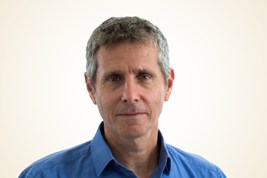
    Dr. Eran Shamir-Borer

    Director

    Read More

    Dr. Eran Shamir-Borer serves as the Director of the Center for National Security and Democracy since September 2022.

    Prior, Eran served for over 20 years in various positions in the International Law Department of the Military Advocate General's Corps in the Israel Defense Forces (IDF), including as the head of the department, and retired at the rank of Colonel.

  • Default Image

    Prof. Yuval Shany

    Senior Fellow

    Read More

    Among other things, he has researched questions of right to equality, security detention, interrogation techniques, on-line surveillance and content moderation, military investigations, proportionality in the application of force, jurisdiction of international criminal tribunals and counterterrorism.
  • Default Image

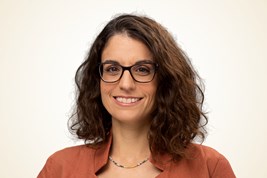
    Dr. Yael Litmanovitz

    Head, Policing and Law Enforcement Program; Senior Researcher

    Read More

    [email protected]

    Dr. Yael Litmanovitz holds an MSc and a doctorate from the University of Oxford.  Her thesis developed the evidence-base for police training in democratic societies. She worked with Israeli Border Police to design and trial a training intervention on procedurally just policing of protests.

  • Default Image

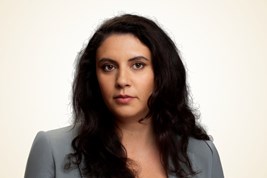
    Adv. Mirit Lavi

    Researcher

    Read More

    [email protected]

    Adv. Mirit Sharabi-Lavi holds a bachelor's degree in law from the Hebrew University in Jerusalem, and a master's degree (cum laude) in international dispute settlement and arbitration from Leiden University. Before she started working at the IDI, Mirit worked at the Israeli Embassy to the Netherlands, focusing on international law and the various international courts and organizations in The Hague. She also worked at the Office of the Deputy Attorney General (International Law) in the Israeli Ministry of Justice, in the fields of international economic law and international technology law. She previously conducted research in the fields of space law, cyber law and privacy law.

  • Default Image

    Prof. Elisheva Rosman-Stollman

    Guest Researcher

    Read More

    Prof. Elisheva Rosman-Stollman is a member of the Political Studies Department at Bar Ilan University, and until recently served as the head of the Argov Center for the Study of Israel and the Jewish People, and deputy Chair of the Department. Prof. Rosman-Stollman also serves as a senior researcher at the Begin-Sadat Center for Strategic Studies (BESA). In addition to being a founding member of the Civil-Military Researchers Association in Israel, she is the editor-in-chief of the Association of Military Researcher's journal 'The Israeli Journal of Society Military and National Security' (IJMNS). She serves as a member of various working groups advising bodies within the military system.
    Prof. Rosman-Stollman's research deals with a variety of issues including civil-military relations, the military as a social tool, women, religion and the state, religious feminism, relations between the Gulf States and Israel, issues of religion and the military, as well as the military and security. Her research projects include the image of the combat soldier in the Israeli media, religious soldiers in the IDF, soldiers in the civilian health system, religious feminism, and marriage outside the rabbinate.

  • Default Image

    Alon Blass

    Research Assistant

    Read More

    [email protected]

    Graduated with a BA in Political Science and Communications from the Hebrew University of Jerusalem.

    Currently a Master's student in Political Science, majoring in Law, Government and Society, in the research track at the Hebrew University.

  • Default Image

    Haim Hagai Gunder

    Research Assistant

    Read More
  • Default Image

    Adv. Ruth Ashur

    Research Assistant

    Read More

    Holds a BA and MA in Law from the Hebrew University of Jerusalem. Previously worked in the Advisory and Legislative Department and the State Attorney's Office at the Ministry of Justice.

    [email protected]

  • Default Image

    Dr. Manal Hreib

    Researcher, Project of Community Safety in the City of Rahat

    Read More

    [email protected]

    Dr. Manal Hreib is an applied policy researcher specializing in the development, design, and impact evaluation of social interventions and public policy. Her work emphasizes effectiveness, the reduction of social gaps, and evidence-based decision-making.

  • Default Image

    Dr. Zubaida Ezery

    Researcher, Project of Community Safety in the City of Rahat

    Read More

    [email protected]

    Dr. Zubaida Ezery holds a Ph.D. from the Department of Health Systems Management at the School of Public Health, Ben-Gurion University of the Negev. Her doctoral research focused on "One Health" challenges among Bedouin communities in the Negev with differing statutory status.

  • Default Image

    Elena Flegontov

    Research Assistant, Project of Community Safety in the City of Rahat

    Read More

    [email protected]

    Holds a BA in Sociology and Anthropology from University of Saint-Petersburg and a MA in Anthropology from University of Haifa. Her MA thesis focused on the management of personal and physical boundaries among women within the sex industry in Israel.


For Israel, national security and democracy are closely intertwined. The question facing the next leaders of the country is not only how Israel uses its security power, but who makes the decisions, through what process, and with what degree of accountability.

The government has decided to divert approximately NIS 500 million from the budget of a program to reduce disparities in Arab society and transfer the funds to the Shin Bet and the Israel Police to address crime and violence in Arab society. Is the Shin Bet – an agency whose mandate is to protect the security of the state and its institutions –suited for this task, and what might the consequences of its involvement be?

play

As Israel’s 2026 election campaign unfolds, IDI experts are examining the major questions shaping the campaign—and the country’s future. In the latest video in our special election series, Prof. Amichai Cohen, IDI’s newly appointed Vice President of Research, shares three key issues he’s watching.

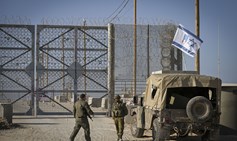
In response to claims that the Supreme Court tied the hands of the IDF along the Gaza border in the years leading up to the October 7 attacks, it must be stated clearly: these allegations are completely unfounded and serve as merely a pretext to avoid setting up a state commission of inquiry.

When and why was the Advisory Committee on Senior Civil Service Appointments established, what are its powers, and which appointments is it supposed to review? In light of the High Court hearing on petitions against the appointment of Maj.-Gen. Roman Gofman as head of the Mossad, this explainer reviews the role and composition of the “Grunis Committee,” as well as the meaning of “integrity” in senior public appointments.

On Wednesday, April 15, 2026, the High Court of Justice heard petitions filed against the continuation of MK Itamar Ben-Gvir’s term as minister of national security, against the background of allegations of his improper involvement in the activities of the Israel Police and violations of its professional independence. The hearing was an expanded panel of nine justices.

What are the implications of declaring a “special home front situation,” and what powers does such a declaration confer to Israeli authorities? What rights do citizens have in areas regarding which such a declaration has been made? What’s the difference between a “special home front situation” and the ongoing “emergency situation” that has long been in force in Israel? This article explains these issues, and more.

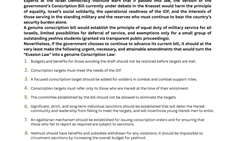
IDI experts argue for a universal obligation to serve, as opposed to the model of the latest "conscription" bill, which would be harmful to Israel's security and social solidarity. However, if the present legislation does move forward, the points presented here would mitigate the harm in the proposed bill.

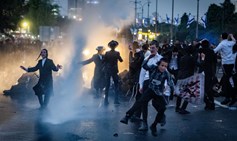
The government’s refusal to formulate an enforcement plan for drafting ultra-Orthodox men, in defiance of a ruling by the High Court of Justice, places Israel before an unprecedented crisis. The Court faces only bad options—but it may have no choice other than to step into the shoes of the executive branch and move toward active enforcement.

A bill that would subordinate the professional work of IDF's highest legal authority to the IDF Chief of Staff, rather than the Attorney General, would have grave consequences for the rule of law, the IDF, and all who serve in it.

The court’s ruling about who can oversee an obstruction of justice investigation into military officials has broad rule-of-law implications.

The opinion is correct that Israel violated international law by cutting ties with UNRWA, but some broader observations are questionable.

IDI Research Fellow Dr. Gilad Malach joins host Amanda Borschel-Dan on the Times of Israel weekly podcast, What Matters Now. They discuss the contentious matter of ultra-Orthodox (Haredi) conscription, including the history of Haredi exemption from IDF service, modern cultural norms in Haredi society, and the current Haredi conscription proposal making its way through Knesset.

All participants in Israel’s public discourse would do well to use this astonishing affair to repair the legal system, not to score points against ideological rivals.

Germany's recent decision to impose an embargo on the export of military equipment to Israel is a key example of the changing landscape of international law applicable to armed conflict over the last two decades.

At its core, this is a debate if there should be a blanket exemption for Haredi men and a target number of recruits from the community each year, or if there should be a requirement to serve with a limited number of annual. Counterintuitively, the compromise proposed by the coalition could lead to an outcome that would actually remove from the agenda a meaningful draft of Haredim.

Against the backdrop of reports indicating the possibility of Israel fully occupying the Gaza Strip, it is essential to address the moral, strategic, international, security, economic, and social ramifications associated with such a move.

Israel’s victory over Iran was not just a triumph of military strategy—it was a testament to democracy and moral clarity. In a region plagued by autocracy, it is Israel’s enduring commitment to freedom, pluralism, and the rule of law that gives it the resilience and strength to prevail.

International law stipulates that for a state to exist, there must be a territory, a defined population, a government controlling that territory, and independence from the management of another state over that territory. What are the implications for Israel of more countries planning to recognize a Palestinian state?

Kan English's Mark Weiss spoke to the Director of IDI's Center for Security and Democracy Dr. Eran Shamir-Borer over the potential of Israelis who have served in Gaza to be arrested and questioned when traveling abroad. They discuss why this is happening, the legal framework, the organizations involved, and steps soldiers can take to mitigate the risk of this happening to them while traveling.

BICOM's Richard Pater speaks with IDI's Professor Amichai Cohen about international law in the context of Israel's war with Hamas. In this episode, they cover Israel's conduct in Gaza, the rules of engagement, humanitarian assistance, and Israel's goals in Gaza.

The work of civilian defense squads serves a real security need and bolsters the functioning of the police. But an incident from the Israel-Iran war reminds us that, even in an emergency, they are still subject to the law and must still operate within the limits and frameworks set for them by the police.

What are the implications of declaring a "special home front situation", and what powers does such a declaration confer to Israeli authorities? Are the restrictions that the government has imposed on citizens leaving Israel legal? What rights do citizens have in areas regarding which such a declaration has been made? What’s the difference between a "special home front situation" and the ongoing "emergency situation" that has long been in force in Israel? This article explains these issues, and more.

Following Ronen Bar’s resignation and an HCJ judgment, Netanyahu has rushed to propose a new Shin Bet head, inviting legal challenges.

The Attorney General recently announced an agreement with Itamar Ben-Gvir in response to petitions challenging his reappointment as Minister of National Security. What is included in this agreement, can it be enforced, and is it an appropriate solution to ensure an independent police force?

The announcement by the government this week that it does not intend to form a state commission of inquiry is a grave error—this is not only a civic and moral failure, it also harms Israel's national security and prevents the nation from healing.

Polls reveal that despite apparent polarization, Israelis are remarkably united on almost every issue of importance, prioritizing hostage release, ending Haredi draft exemptions, and anchoring a constitutional framework—leaving only their leaders out of step with the national consensus.

Maintaining the Shin Bet’s independence from political influence is essential to preserving both Israel’s national security and the democratic rights of its citizens.

The Israeli Supreme Court rejected the Gaza Humanitarian Aid petition submitted by a number of Israeli human rights NGOs, stating that Israel's obligations are relative in nature and that the petitioners had failed to establish that these were generally violated during the Gaza war.

The reappointment of Itamar Ben-Gvir as Minister of National Security, despite legal objections and a documented pattern of improper political interference in police operations, constitutes an "extremely unreasonable" decision that threatens the independence, professionalism, and democratic integrity of Israel’s law enforcement system.

On March 20, 2025, Israel’s government voted in favor of Prime Minister Benjamin Netanyahu’s decision to dismiss Ronen Bar, head of the Shin Bet, citing "growing distrust" in the security chief. The following document answers key legal questions around this announcement.

Drastic budget cuts to Israel's National Authority for Community Safety jeopardize national security by eliminating essential violence prevention and community support services, disproportionately impacting vulnerable populations and exacerbating social instability.

On March 16, 2025, Prime Minister Netanyahu announced his intention to bring the dismissal of Ronen Bar, the head of the Israeli Security Agency (Shin Bet), Israel's internal security service, to a vote of the full cabinet. Though not a perfect comparison, the Shin Bet is often seen as comparable to the FBI in the US.  

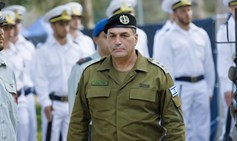
The incoming Commander-in-Chief of the IDF, Major General Eyal Zamir, faces a number of challenges as he takes up his role beyond the security of Israel. He must integrate the ultra-Orthodox, uphold the IDF's ethical values, and restore public trust in its senior command to preserve the military's identity as the 'people's army.' 

The battle over Israel’s legal system has resumed, threatening judicial independence.

Defense Minister Katz recent demand that the IDF Chief of Staff reprimand the Chief of the IDF Intelligence Directorate for presenting the possible security implications of the "Trump plan" for Gaza is the latest in several steps that threaten to politicize Israel's national security agencies, a process that could be disastrous for the country.

play

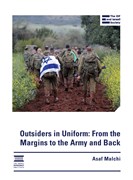
This study presents a survey of the distribution of reserve duty among the various religious groupings within the Jewish population, along with more in-depth analysis regarding the age and gender of reservists.

Dr. Eran Shamir-Borer of the Israel Democracy Institute joined the Tel Aviv Review podcast to discuss Israel's complex legal challenges under international law amidst the ongoing war in Gaza.

Amnesty International's report on the war in Gaza fails to prove acts of genocide by Israel, even when attempts are made to move the goalposts.

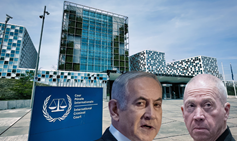
In the second installment of their two-part analysis of the ICC's decision to issue arrest warrants against Israeli leaders, Prof. Yuval Shany and Prof. Amichai Cohen examine the arguments behind the arrest warrants and steps Israel can take to prevent them from being realized. 

play

IDI's Prof. Yuval Shany and Prof. Irwin Cotler discuss the ICC arrest warrants issued against Israel's Prime Minister and former Defense Minister. The event was hosted by the International Jewish Lawyers organization in partnership with the American Association of Jewish Lawyers and Jurists (AAJLJ). 

play

The ICC's unprecedented arrest warrants against leaders of a democratic state carry severe and far-reaching consequences, yet Israel still has far-reaching options to mitigate the damage. 

On November 21, 2024, the Pre-Trial Chamber of the International Criminal Court (ICC) issued four decisions. These deal with various legal matters arising out of the Prosecutor’s May 20 request to issue arrest warrants as part of his ongoing investigation of the Situation in Palestine, in the context of the War in Gaza.

Israel will likely not succeed in forcing the Court to annul its orders, and attempting to do so will make it even harder for its allies to support it. Instead, it can conduct an independent and effective investigation, avoiding problematic statements, and adhere to the laws of armed conflict.

The Police Commissioner's decision to terminate the Israel Police Legal Advisor without consulting the Attorney General to whom the Police Lega Advisor is professionally subordinate the most recent worrying sign of the problematic relations between the Attorney General and various government officials.

IDI experts Prof. Amichai Cohen and Prof. Yuval Shany analyze the legality of the September explosions targeting Hezbollah pagers and walkie-talkies through three legal frameworks: the right to use force, principles of distinction and proportionality, and the legality of employing these devices under laws regulating choice of weapons. 

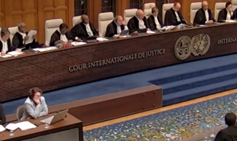
Prof. Cohen and Prof. Shany discuss three possible rationales for the ICJ's rejection of Israel’s security concerns and offer a few final observations on the appropriate balance that should hold between security considerations and continued presence in occupied territories.

A recent judgment of the Israeli Supreme Court held that conditions in a notorious detention center must comply with Israeli law.

To protect the credibility of the police as an impartial law enforcement agency, independent oversight over the police prosecution unit - the police unit that issues criminal charges - must be increased through the Attorney General's office.

A special survey conducted in July 2024 evaluated public opinion on the need to establish a commission of inquiry into the tragic events of October 7th, 2024.

The Prime Minister’s decision to retain the power to determine the parameters and scope of the hostage deal as a “policy issue” disregards the implications such a deal has on security issues. Israeli history underscores the importance of convening the security cabinet and upholding the appropriate democratic channels in times of war.

The rule of law is a fundamental democratic principle, meaning that all governing bodies are subject to and must comply with the law. Despite the complexities inherent in ongoing war, this is true also of the IDF, and only decisive action against breaches of conduct may protect the rule of law in Israel and Jewish morality. 

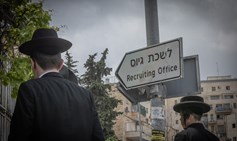
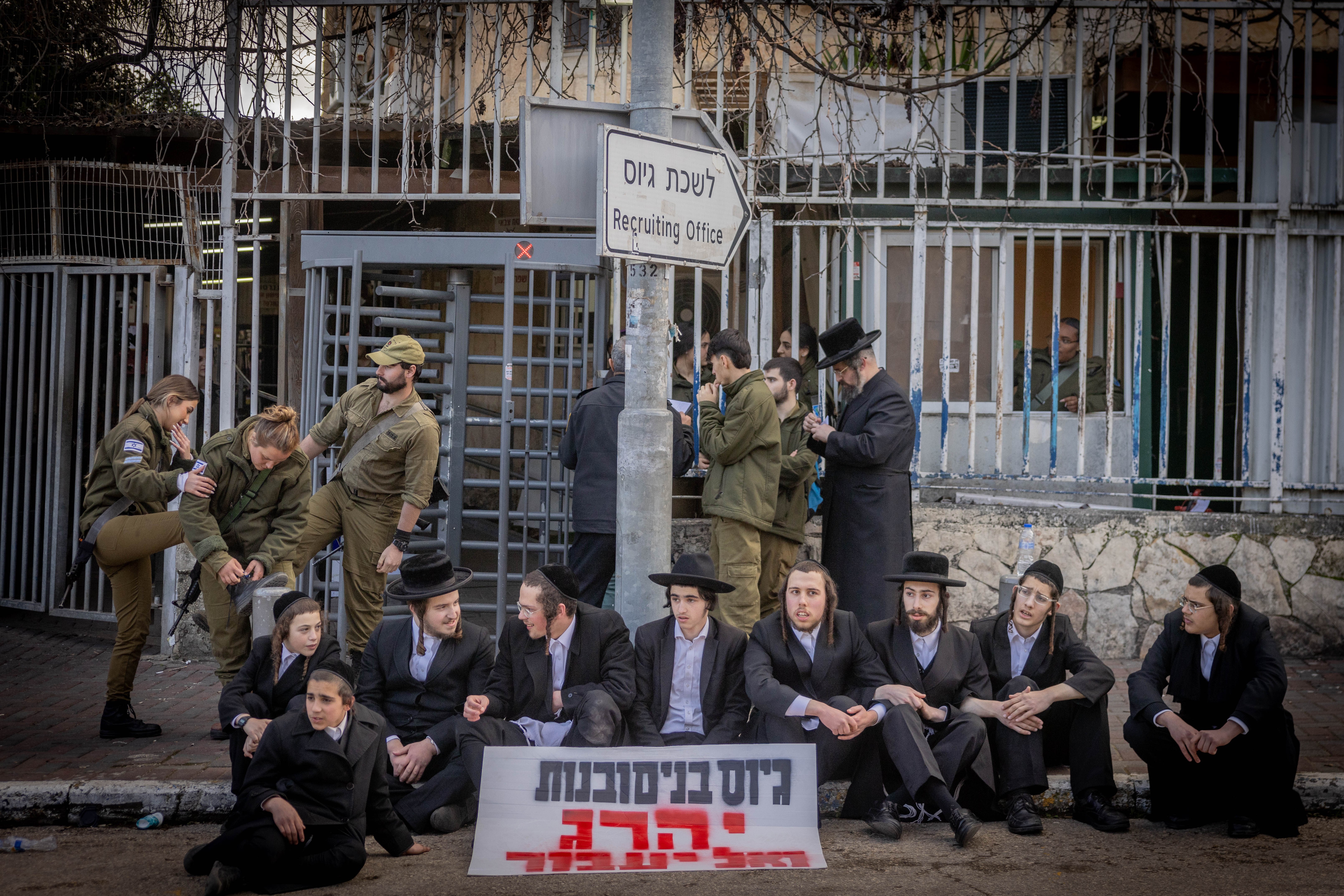
On Monday August 5, 2024 and Tuesday August 6, 2024—900 ultra-Orthodox yeshiva students were required to present themselves at IDF enlistment centers. Shlomit Ravitsky Tur-Paz, Dr. Eran Shamir-Borer and Mirit Lavi explain the next steps the IDF will need to take in order to enforce the legal obligation of conscription. 

An in-depth analysis of the advisory opinion of the ICJ on the legal consequences of Israel's policies and practices in the 'occupied Palestinian territory.'

Investigating allegations of abuse at the Sde Teiman detention facility is Israel's moral and legal duty as a rule-based democracy and protects the country on the international legal and diplomatic front. 

The ICJ Advisory Opinion on Israel's policies in the territories of the West Bank (Judea and Samaria) are illegal but was more divided on other salient factual and legal findings.

play

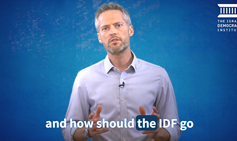
The Supreme Court’s landmark ruling determined that ultra-Orthodox men must serve in the army poses numerous challenges for the IDF. What are the challenges of drafting the ultra-Orthodox and how should the IDF go about overcoming them?

Nine Supreme Court Justices ruled unanimously that the state must act to enforce Israeli conscription legislation and apply it to Haredi men. For this to be realized the IDF and the defense establishment must also make significant changes. These are the issues the IDF should take into consideration.

If properly structured, both a commission of inquiry and a preliminary examination by the Israeli police could arguably meet existing complementarity standards.

The State Inquiry Commission on Naval Vessels was tasked with examining the decision-making processes at both the professional and political levels between 2009-2016 in relation to the acquisition of naval vessels during those years. 

play

"Basically we've entered into a new unknown terrain," says IDI President Yohanan Plesner.

The roots of the crisis between Israel and the United States are supposedly in Rafah. But the key to resurrecting the relationship lies far from Gaza, between Moscow and Beijing.

Ahead of the Shavuot holiday, the Israel Democracy Institute is releasing a series of source materials for study during the "tikkun leil Shavuot" (the traditional Shavuot eve study session).

Article 18 to the ICC Statute requires the Prosecutor to notify the relevant States regarding a decision to open an investigation, providing those States the opportunity to request deferral of the investigation, because of the existence of a domestic investigation. The Prosecutor’s approach of not issuing new notifications new charges emerged weakens the ability of the Pre-Trial Chamber to monitor the implementation of the complementarity principle.

The model that has supported the IDF and Israeli society since the state's founding and has been eroded over the years received renewed reinforcement in the current war. The avoidance of participation by Haredim places it at renewed risk.

A serious public and governmental discussion is needed regarding the privatization of internal security governance that we are currently witnessing, and its implications. This privatization threatens us all.

The issuance of additional interim orders in the genocide proceedings underway at the ICJ limits Israel’s operational wiggle room in Rafah, but leaves it with some flexibility in the interpretation and implementation of the new orders.

In this article, we wish to identify and discuss here some potential problems we identify in the part of the request pertaining to Netanyahu and Gallant, at least as it was presented in the Prosecutor’s short announcement and by the expert report supporting it. 

play

IDI's Prof. Amichai Cohen, an expert in international law, explains the repercussions that ICC warrants may have on Israel. Should these warrants be issued, 120 countries would be obligated to execute them. They could severely damage Israel's international image, impacting Israeli officials as well as economic and cultural cooperation

The proposed law ignores the dramatic change in Israel's security situation since October 7 and does not address the need for more combat soldiers, nor does it respect the burden on the populations that already serve.

Demands to lower the flames of criticism cannot legitimately be made by a government taking actions driven by narrow political interests. If the government does not act in a nonpartisan manner, they cannot demand those who hold different views refrain from opposing political action. 

The increase in the number of complaints of police violence submitted to the DIPI over the last year raises serious questions, especially in light of the timing in which the current Government and Minister of National Security took office. This research surveys the trends in complaints of police violence. 

From damage to scientific collaboration to cancellation of arms deals, arrest warrants for senior Israeli officials from the International Criminal Court in the Hague would pose a serious challenge to Israel

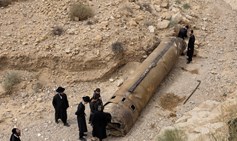
The Iranian missile attack on April 13th set a very dangerous precedent for the future. Had one of the few missiles that managed to penetrate Israel's air-defense shield been fitted with a nuclear warhead, the outcome would have been devastating. This is why the phenomenal achievement of the Israeli Air Force and its allies on Saturday night must not blind us to the danger ahead.

Response to the Government's Proposal for Haredi (non-) Conscription by Yohanan Plesner, President of the Israel Democracy Institute, and Dr. Gilad Malach, Head of IDI's Ultra-Orthodox in Israel Program

The government wishes to amend the Military Service Law and Reserve Service Law due to the new security circumstances arising from the outbreak of the war in Gaza. While recognizing the immediate imperative to respond to IDF's personnel needs, we oppose these legislative proposals. 

What is the connection between the expiration of the conscription law and the budgets for yeshivas? What exactly was discussed in the Supreme Court and is the state in violation of the law? Bottom line, will the ultra-Orthodox be recruited, or not?

The history of the ultra-Orthodox exemption from service in the Israeli Defense Force (IDF), from the 1948 until today. 

In a few days, Israel's Muslim citizens will begin celebrating the month of Ramadan. While safeguarding this ritual and protecting freedom of worship, security forces will face challenges in defending public security, as this is considered a sensitive time. With the influx Israeli citizens taking part in the civilian defense squads and licensing themselves, the police must make serious efforts to ensure all Israeli citizens feel safe. 

With US arsenals stretched to the limit and other allies lining up for their share, it's time to forge a new defense supply channel.

Arab-Israeli public officials are being increasingly targeted by criminals, hoping to get their way through threats, extortion and force ahead of Tuesday's local elections. Running for office shouldn't cost people their lives.

The US, the UK, France and other states have announced the imposition of economic sanctions on Israeli residents who are believed to be complicit in 'settler violence.' This document aims to outline the framework of international economic sanctions and contextualize the sanctions imposed on Israelis. 

Israeli reserve soldiers are making unimaginable sacrifices to protect their country. To rise to the challenge of meeting the IDF's expanded personnel needs, Israel's policy solutions must be as diverse as are the reservists serving this nation. A "one-size-fits-all" compensation approach will not cut it. 

In its order on provisional measures, the Court appeared to engage in transactional justice. It used harsh rhetoric to describe the catastrophic situation in the Gaza Strip while minimizing the impact of the order by adopting ambiguous language on the contents and scope of the plausibility test.