


















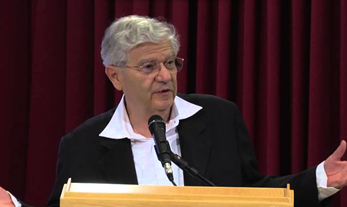














Prof. Suzie Navot
Former Vice President, Research
Written By: Prof. Suzie Navot,
The Pardons Department in the Ministry of Justice writes that they cannot determine the President of the State has the authority to pardon Prime Minister Netanyahu, nor can they recommend the extraordinary and far-reaching step of doing so.
Written By: Prof. Suzie Navot
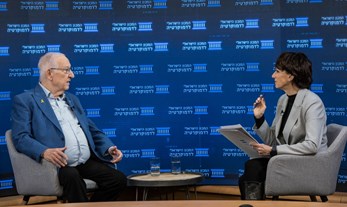
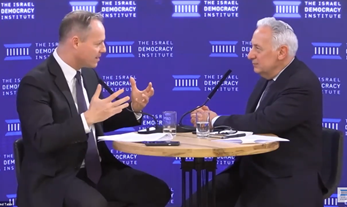
Former President Reuven Rivlin, IDI's Honorary Chair and Joan and Irwin Jacobs Distinguished Fellow, joined IDI's Vice President for Research Prof. Suzie Navot at the annual Shared Society Conference for a conversation on political polarization, the urgent need for genuine constitutional reform, and what it truly means to uphold the principles of a democratic and Jewish state.
Written By: Prof. Suzie Navot
The High Court handed down a decision allowing the Minister of Justice choose the civil servant to oversee the investigation into the Sde Teiman video leak affair in the Attorney General's stead. This sets a concerning precedent and ignores the current political reality in Israel.
Written By: Prof. Suzie Navot, Dr. Moran Kandelshtein-Haina
Though Members of Knesset are granted immunity from prosecution under the law, legal precedent makes clear that this immunity does not apply to the stage of criminal investigations.
Written By: Prof. Suzie Navot, Dr. Moran Kandelshtein-Haina
With Justice Minister Yariv Levin's recent appointment as Acting Minister of Jerusalem and Jewish Heritage, he now holds five ministerial portfolios. This situation, with Levin and other ministers, is harmful to public interest and raises important legal and procedural questions.
Written By: Prof. Suzie Navot, Adv. Mirit Lavi
The Attorney General recently announced an agreement with Itamar Ben-Gvir in response to petitions challenging his reappointment as Minister of National Security. What is included in this agreement, can it be enforced, and is it an appropriate solution to ensure an independent police force?
Written By: Prof. Suzie Navot
Ronen Bar’s affidavit exposes unprecedented attempts by Prime Minister Netanyahu to misuse the Shin Bet for political ends—pressuring it to track protesters, influence his trial, and prioritize loyalty to him over the rule of law—revealing a profound threat to Israeli democracy and the integrity of its security institutions.
Written By: Prof. Suzie Navot
Everything you need to know about yesterday's High Court hearing on Netanyahu's efforts to fire Shin Bet Director Ronen Bar went.
Written By: Prof. Suzie Navot
IDI VP of Research Prof. Suzie Navot shares key points to keep in mind in relation to the Supreme Court hearing on Ronen Bar's firing.
Written By: Prof. Suzie Navot, Adv. Mirit Lavi
The reappointment of Itamar Ben-Gvir as Minister of National Security, despite legal objections and a documented pattern of improper political interference in police operations, constitutes an "extremely unreasonable" decision that threatens the independence, professionalism, and democratic integrity of Israel’s law enforcement system.
Written By: Prof. Suzie Navot
On March 16, 2025, Prime Minister Netanyahu announced his intention to bring the dismissal of Ronen Bar, the head of the Israeli Security Agency (Shin Bet), Israel's internal security service, to a vote of the full cabinet. Though not a perfect comparison, the Shin Bet is often seen as comparable to the FBI in the US.
Written By: Prof. Suzie Navot
While the selection of Justice Amit as President of the Supreme Court was done in accordance with the relevant legislation, the Justice Minister has declared the procedure "fundamentally improper and illegal." His refusal to recognize the selection creates a precedent that may lead to the deterioration of the authority of other institutions. This is what the beginning of a constitutional crisis looks like.
Written By: Prof. Suzie Navot, Dr. Moran Kandelshtein-Haina
In response to a petition filed against him regarding the intentional delay in appointing a president of the Supreme Court, Minister Levin claimed that it is impossible to sanction him because he enjoys “substantive immunity.” A closer examination of the law reveals that this is not the case.
Written By: Prof. Suzie Navot
In September, the Supreme Court ordered the Minister to fulfill his duty to convene the Committee because the system cannot be paralyzed. Since then, the Minister has convened the committee, but refused to appoint the Supreme Court President. Now, the Court has ordered him to do so.
Written By: Prof. Suzie Navot
After the Minister of Justice Yariv Levin refrained from convening the Judicial Selection Committee to appoint a Supreme Court President, the Supreme Court ruled that the Committee must convene to appoint a President—Prof. Suzie Navot analyzes the Court's decision.
Written By: Prof. Suzie Navot, Adv. Sapir Paz
The rule of law is a fundamental democratic principle, meaning that all governing bodies are subject to and must comply with the law. Despite the complexities inherent in ongoing war, this is true also of the IDF, and only decisive action against breaches of conduct may protect the rule of law in Israel and Jewish morality.
Written By: Prof. Suzie Navot
The Supreme Court ruling on June 25th addresses the question of whether the government is operating in accordance with the law. It determined that the state must act in accordance with the law and act to draft ultra-Orthodox. It also connects between the issue of exemptions and the criteria for eligibility for yeshiva budget funds.
Written By: Prof. Suzie Navot
The discussion in the Supreme Court yesterday was not about whether a law exempting yeshiva students harms the principle of equality. It was about a much more basic question: is the State of Israel acting in accordance with the principle of the rule of law—that is, can yeshiva students be exempted from enlisting in the IDF, when there is no law allowing for this.
Written By: Prof. Suzie Navot
The International Court of Justice in The Hague (ICJ) issued new temporary orders against Israel this week. Justice Barak’s dissenting opinion would seem to offer an important lesson for the future. Professional, focused, and well-founded legal criticism—as opposed to the very different means that are currently being widely discussed and pursued—is likely the best way to deal with the ICJ.
Written By: Prof. Suzie Navot,
While the ICJ decision briefly mentions the immediate context of the lawsuit, namely the Hamas attack on October 7, 2023, Judge Barak directs them to the full picture that they did not address. He writes about the events of October 7 as Israelis know them to be true.
Written By: Prof. Suzie Navot
This decision refocused our attention not only on the specific law it struck down but also on the unfinished business of completing our country’s constitutional framework
Written By: Dr. Amir Fuchs, Prof. Suzie Navot
Fact Sheet: The Basic Law: The Nation-State
Written By: Prof. Suzie Navot
Israel's non-Jewish minorities—particularly those who are fighting and dying for the State of Israel—are worthy of appreciation and recognition, not separately, but as equals. The solution is to amend the Nation State Law, not to pass a new, separate basic law as is currently under consideration.
Written By: Prof. Suzie Navot
On the question of Unreasonableness, it appears that the dispute is not only between the Knesset and the Supreme Court, but also among the justices themselves. There are many possibilities, but only one ruling, which will be handed down no later than mid-January 2024.
Written By: Prof. Suzie Navot,
Less than 24 hours after the Knesset passed the “Reasonableness Law” the attorney general filed her professional opinion to the Supreme Court on an entirely different matter: the “Incapacitation Law.” What do the two amendments share in common?
Written By: Prof. Suzie Navot
The coalition launched the first stage in its judicial overhaul. The process by which the amendment to the Basic Law: The Judiciary was passed, releasing the government and its ministers from the duty to act with reasonableness, is the best possible evidence for what we can now expect.
Written By: Prof. Suzie Navot
Tel Aviv-based journalist and Israel Policy Forum Policy Advisor Neri Zilber hosts Prof. Suzie Navot, the vice president for research at the Israel Democracy Institute, to analyze the renewed push by the Netanyahu government to overhaul Israel's judicial system.
Written By: Prof. Suzie Navot
Only a government that wishes to make extremist and corrupt decisions would be afraid of the reasonableness test. While the test would certainly benefit from discussion of the framing of its boundaries and application, the legislation currently on the table hands the government unrestrained power.
Written By: Prof. Suzie Navot
Slowing the overhaul is a sham. It’s still a hostile takeover of the Supreme Court and its ability to restrain the coalition
Written By: Prof. Suzie Navot
5 other ideas for upgrading Israel's judicial system – without destroying democracy, doing away with the mechanisms for oversight of the government or harming our basic rights.
Written By: Prof. Suzie Navot
The recently published opinion by the Attorney General, Adv. Gali Baharav-Miara, makes clear that the proposal "reform" makes no attempt to enhance the balance among the branches of government: It is quite simply a demand for unlimited government power.
Written By: Prof. Suzie Navot
If Netanyahu's new government implements its plans, human rights may soon depend on majorities. Israel's delicate political structure makes this possible.
Written By: Prof. Suzie Navot
In this edited transcript of her conversation with BICOM Director Richard Pater, Vice-President of Research at the Israel Democracy Institute Professor Suzie Navot argues that judicial reforms proposed by the right-wing bloc – to Knesset override of the Supreme Court, executive immunity, and the appointment of judges – threaten Israeli democracy and the already fragile separation of powers.
Written By: Prof. Suzie Navot
Prof. Suzie Navot sits down with Richard Pater of Bicom, to discuss judicial reform. Prof. Navot explains the background of Israel’s legal system, its uniqueness among other parliamentary democracies and the significance of potentially implementing an override clause.
Written By: Prof. Suzie Navot
The problem with the Nation-State Basic Law is what it fails to mention - equality! Thus excluding Israel’s minorities who call the country home.
Written By: Prof. Suzie Navot
The proposal to hold the public hearing of the Judicial Selection Committee is a reasonable arrangement and the fact it was agreed to by the President of Supreme Court, indicates that it is intended to increase public confidence in the selection process of justices.
Written By: Yohanan Plesner , Prof. Suzie Navot, Prof. Karnit Flug
Yohanan Plesner, President of IDI, Prof. Suzie Navot, VP of Research, Prof. Karnit Flug, VP of Research and William Davidson Senior Fellow for Economic Policy, and the entire IDI team wish you all a happy New Year. Shana Tova!
Written By: Yohanan Plesner , Prof. Suzie Navot, Eric Fingerhut
Eric Fingerhut, CEO and President of the JFNA with Yohanan Plesner, President of IDI and Prof. Suzie Navot, VP of IDI discuss the new government's legislation proposals and the future of Israeli democracy. January 2023.
Why is the override clause at the heart of the forthcoming coalition's agenda and how does this relate to civil rights in Israel? Prof. Suzie Navot, Vice President of the Israel Democracy Institute explains the role of the Supreme Court in Israel's democratic system in just over two minutes.