

The Bill to Weaken Israel’s Attorney General Threatens a Key Safeguard of Democracy
The institution of the attorney general is one of the few checks on government power in Israel. Legislation making its way through Knesset would effectively remove the constitutional functions of the office to safeguard the rule of law in Israel's democratic system.
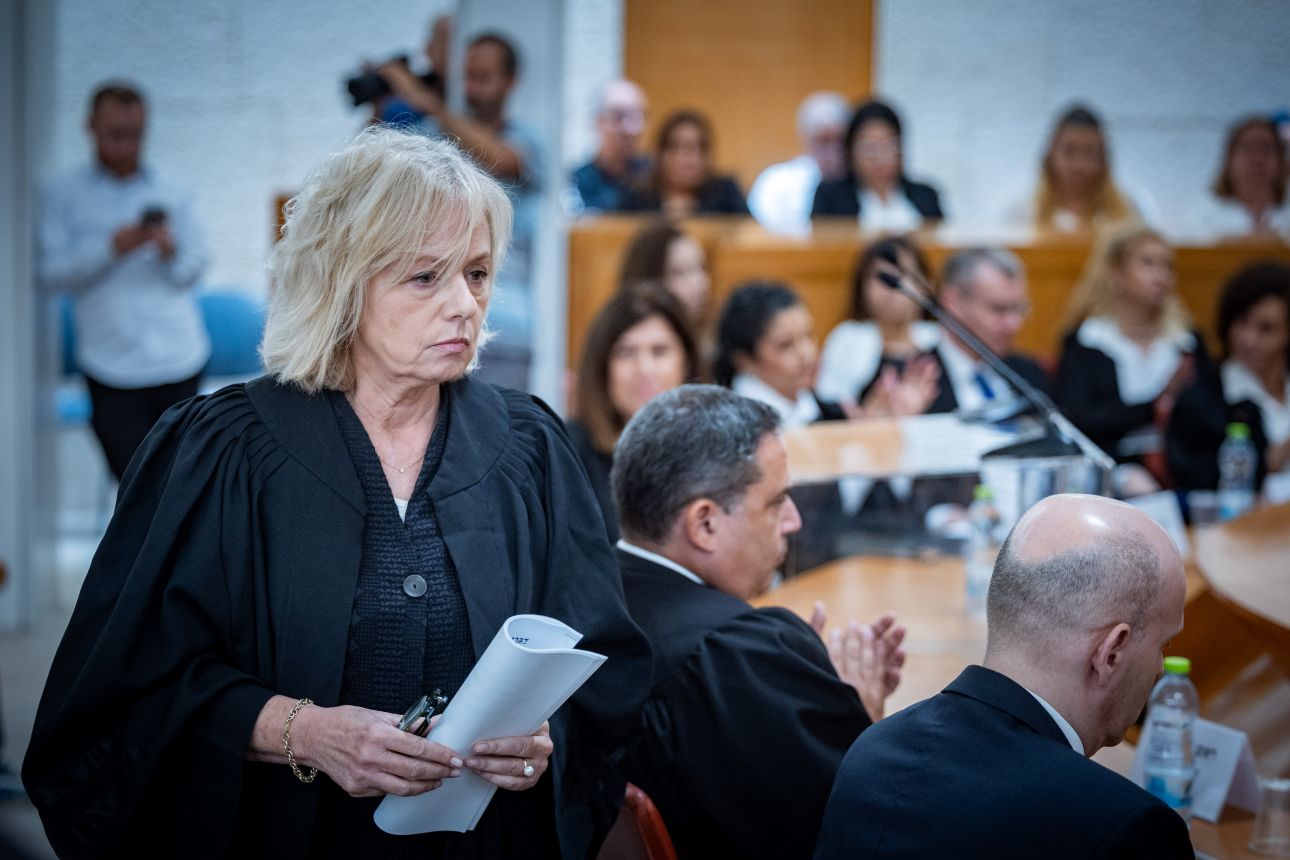
Photo by Yonatan Sindel/Flash90
Amidst an uncertain security situation, war fatigue, and looming elections, legislation is moving through Knesset, almost entirely under the radar, that would have major implications for the state of democracy in Israel. The legislation has been referred to as “splitting the role of the attorney general” (AG), but it in fact goes far beyond a simple "split" between the AG's role as a prosecutor and the AG’s role as the government's legal adviser. This bill goes much further than simply splitting the role – it would significantly weaken the office and effectively remove the constitutional functions it performs to safeguard the rule of law in the Israeli democratic system.
In Israel today, the attorney general has several critical roles: heading the criminal prosecution, representing the state in court, representing the public interest in court, and providing legal counsel to the governing authorities as the authorized interpreter of the law. Currently, the attorney general serves as a critical check in a system with few limits on government power.
The bill, which is close to passing its first reading in the Knesset, would turn the professional civil-service official who assists the government in fulfilling its role within the bounds of the law into an entirely political figure, whose method of appointment, dismissal, and term of office would be tied solely to the government in power at any particular moment.
The attorney general would no longer be an independent figure who objectively interprets the law for the government and represents the state before the courts. Even if this political legal adviser were to show an independent spirit, the government would be able — contrary to the current legal situation — to disregard their legal opinion and, of course, dismiss them. In addition, if the government does not like the state’s representation in court, not only would it be able, whenever it wishes, to hire a private lawyer in their place; it would also be able to prevent them from presenting their position.
This move would cause systemic harm to Israeli democracy. For many decades, the Israeli system of government has been based on the conception of the attorney general's role as that of a professional civil servant who makes decisions independently. The nature of this role is one of the factors that protects the rule of law and human rights, despite Israel’s shortage of mechanisms for balancing the government’s power vis-à-vis the citizens. The court as well, one of the only mechanisms of checks-and-balances in Israeli democracy, relies on the facts presented to it by the attorney general when it conducts judicial review.
No less important, the protection of the rule of law in many fields and in many pieces of legislation has been built around the current nature of the attorney general's role. Other democracies have safeguards that Israel lacks, such as an entrenched constitution, the need for legislation to pass two houses of the legislature, a separation of powers between the executive and the legislative branch, or even a presidential veto. In Israel, judicial review and the authority of the attorney general is one of the very few checks on executive power. Other such checks did not develop, in part because of this reliance on the institution of the AG, which the coalition now seeks to politicize, without proposing alternative checks.
For example, the legal advisory system, under the attorney general's professional guidance, is responsible, among other things, for safeguarding the rule of law in the Shin Bet and the police. These bodies may exceed the bounds of the law, even by mistake, when carrying out the tasks assigned to them by political officials. This balancing role, including with respect to a significant part of the police’s duties, such as handling demonstrations in ways that uphold the right to protest, will henceforth be entrusted to the political legal adviser: the fox will be guarding the henhouse.
No less important, the attorney general is responsible for safeguarding the rule of law during election periods, out of awareness of the fundamental nature of the power a government holds and its ability to exploit that power to advance narrow partisan interests, including harming equality of opportunity in elections. It is prudent to have professional, honest, and independent legal advice to ensure compliance with election laws and with rules of administrative law intended to prevent an unfair advantage for coalition parties. These are only a few examples. Political interference with the powers of the AG will lead to systemic harm to Israeli democracy that will affect the rights of its citizens.
The bill proposes the creation of a Prosecutor General, which would receive the powers of criminal prosecution that are removed from the attorney general. Though the method of appointment for this role involves a somewhat better mechanism, the bill gives politicians a foothold. For instance, under the legislation, the Minister of Justice, with the approval of the Knesset Constitution, Law and Justice Committee, would be able to transfer powers from the prosecutor to the political legal adviser.
An additional problematic provision has been added to the bill establishing a committee controlled by politicians, which will be authorized to approve the opening of criminal proceedings against serving politicians. In other words, alongside the legislation's implications for the rule of law and human rights, politicians are also granting themselves privileges and undermining their equality before the law.
At the heart of democracy is not only majority rule, but also the understanding that power, including executive power, requires safeguards, checks and balances. Israel’s democracy has for decades relied on the current position of the attorney general as one of the few institutions providing these safeguards. Removing it, without providing an alternative mechanism for upholding the rule of law and human rights, undermines Israel's democratic system.
This article was pubished in The Times of Israel.