

Happy 250th America. Love, Your Sister-Democracy
As America celebrates 250 years of independence, Israel’s tribute should be more than gratitude; it should be a recommitment to the democratic ideals that gave birth to our alliance and remain essential to its future.
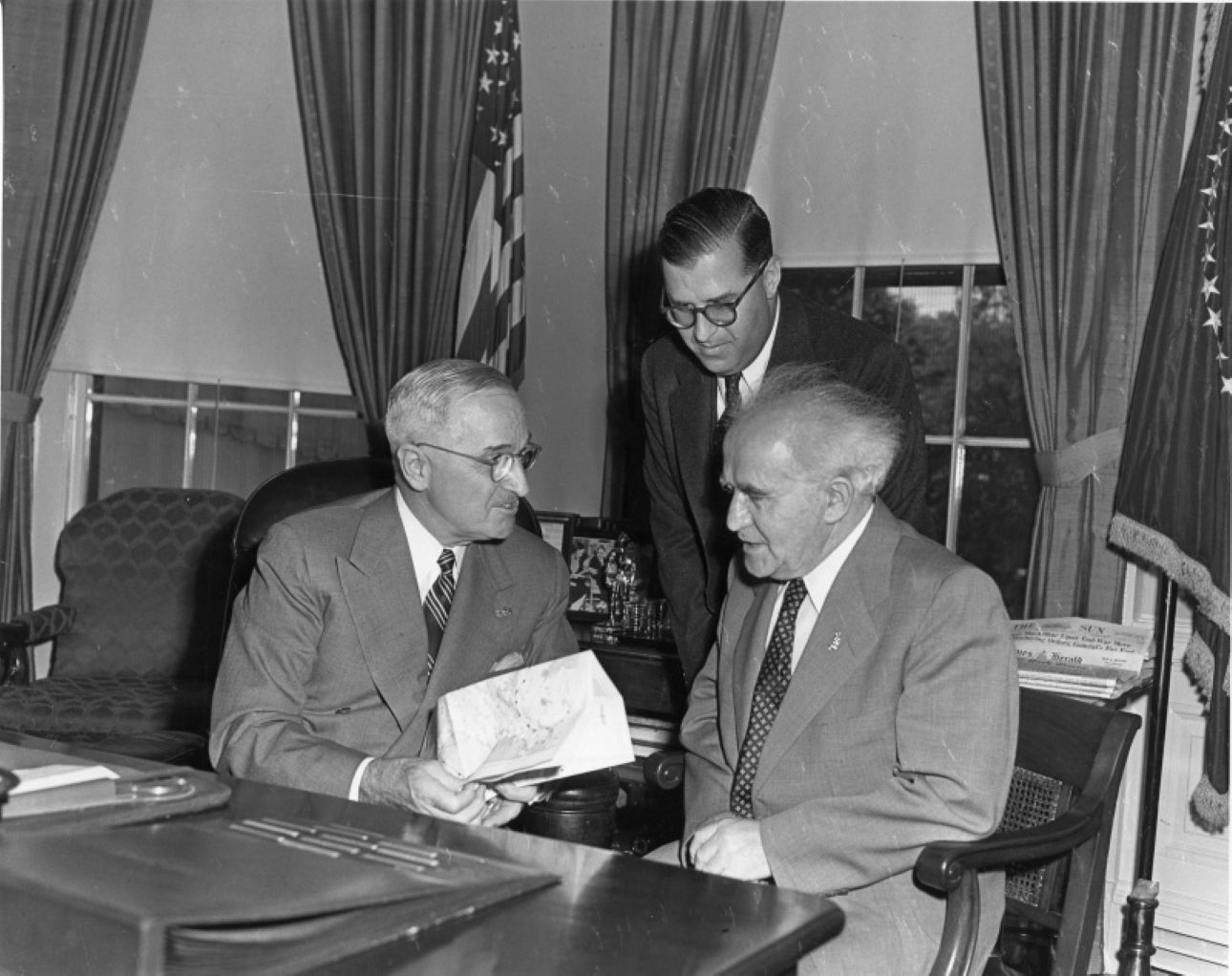
Photo by Abbie Rowe, National Park Service; Harry S. Truman Library & Museum
Two hundred and fifty years is a long time in the life of a democracy.
It is long enough for founding promises to be tested, challenged, renewed and argued over by generation after generation. Long enough for ideals to face confrontations with division, inequality, ambition, fear and even war. Long enough for citizens to discover that their democracy will not necessarily survive on the strength of its brilliant design. It survives because the people keep choosing it over far worse alternatives.
This July 4th, as Americans celebrate 250 years of independence, Israelis have reason to look across the ocean with gratitude and admiration. The United States of America has been the State of Israel’s indispensable ally for more than half a century, building up our strength, standing with us in war when necessary, and opening doors for peace when possible. The relationship between our two countries is sometimes described as “strategic,” and rightly so. In our dangerous neighborhood, alliances matter.
But we all know the relationship runs deeper.
The founding of the United States of America marked the beginning of a revolutionary project to promote a unique set of ideals and values around the world. From the French Revolution to the rebirth of the modern State of Israel, America successfully spread the principles of freedom, equality, self-government, rule of law, and the separation of powers. Those shared principles have always been the true core of the American-Israeli alliance.
Israelis are ever-conscious of the essential nature of America’s support. That was true in 1948 when Harry Truman decided against the advice of his foreign policy establishment to recognize the fledgling State of Israel. It was true on October 7, when Joe Biden responded to worst massacre of Jews since the holocaust with compassion, support and a much-appreciated Presidential visit. And it was true in October 2025 and in January 2026, when Donald Trump put an end to the agonizing hostage crisis and brought our loved ones home from captivity in Gaza—first the living and then the fallen. Israelis are grateful for all this and more.
But gratitude may not be enough to secure the future of our most important alliance. Faced with abundant indicators that American public opinion is turning away from the Jewish state, Israelis must launch a serious effort to salvage the relationship. To be sure, some of the factors that are undermining US support for Israel have little to do with Israel and require American soul-searching. But Israelis must take a long and hard look in the mirror. If they look carefully, they will see that they have work to do to shore up the shared values that link the project of 1776 to that of 1948. Indeed, Israel must tend to the democratic foundations that made this partnership so natural in the first place.
That task is urgent.
The past few years have exposed deep divisions in Israeli society over these very questions. Before the war, hundreds of thousands of Israelis filled the streets in response to the government’s proposed judicial reforms, which they interpreted as an attempt to curtail judicial independence and concentrate power in the executive branch. Even many who disapproved of the protest movement understood that the argument was about something larger than any single reform. It was about the very fundamentals of our democracy: the mechanisms for distribution of power, the checks and balances in our system, the guarantees for our individual rights, and the balance between the Jewish and democratic components of our national identity.
Remarkably, that debate has continued, after a brief pause in the aftermath of the October 7th massacres, over the course of the longest war in Israel’s history. Israel undoubtedly needs a strong army. But that army will be hard-pressed to defend Israel without broad national consensus surrounding the country’s leadership, its governing institutions and the national purpose. In a way, the tragedy of October 7th created a historic opportunity to revisit some of the unresolved questions that attended Israel’s founding. Israel, famously, is one of the only democracies in the world without a constitution or a bill of rights. It is high time to fix that lacuna. A new constitutional arrangement would afford Israelis the opportunity to redesign the balance of power among the three branches of government, to define the rules of the game that might prevent upheavals of the sort that occurred in 2023, to guarantee their rights, and to build that missing consensus around a reimagined vision of Israeli democracy. These things are not “nice to have”—they are the very things that allow a democracy to ask so much of its people. And they also happen to be the very things that tie Israel to its greatest ally.
America's constitution was not completed in 1776. It took 13 years and no small amount of conflict and compromise to move from a Declaration of Independence to a constitutional framework capable of holding a large and diverse republic together. 78 years after the State of Israel's Declaration of Independence was signed, we too must complete this critical missing piece in our national infrastructure.
America’s 250th birthday should therefore be a moment of gratitude for Israelis, but also of self-examination. It should be a moment to honor our closest ally and rededicate ourselves to the founding ideals that bind our two democracies together.
So yes, on this historic Fourth of July, we say to America: happy birthday, and thank you. Thank you for everything you have done to make the reestablishment of Jewish sovereignty in the Land of Israel possible. Thank you for inspiring us with your commitment to freedom. And thank you for reminding us of the hard work that still lies ahead of us.
This article was published in The Times of Israel.