

Review of the Key Measures to Weaken Democracy in Israel
An analysis of legislation and initiatives that undermine democratic principles and institutions during the full 25th Knesset term, from November 2022 through July 2026.
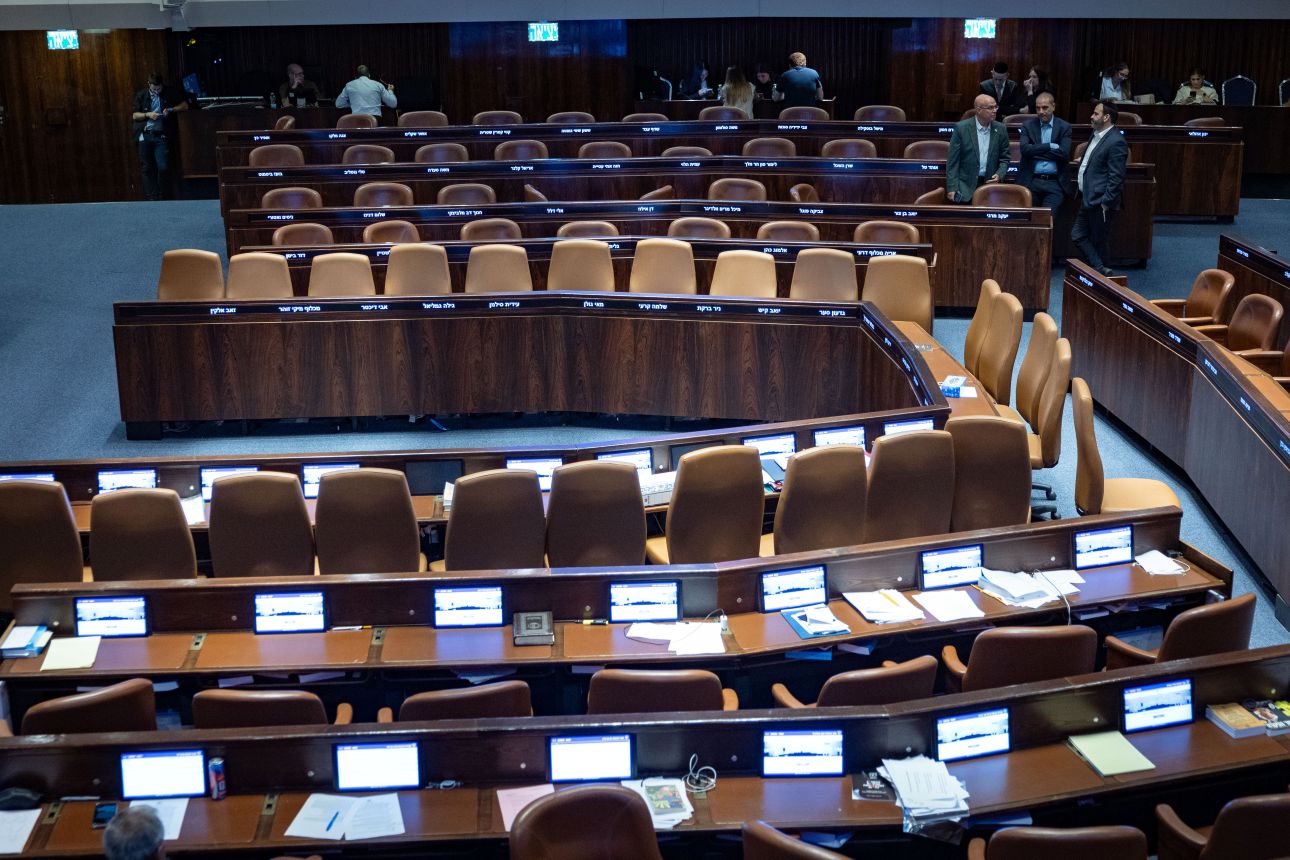
Photo by Yonatan Sindel/Flash90
Summary of the 25th Knesset, November 2022–July 2026
The term of the 25th Knesset was marked by a wide-ranging series of legislative and policy measures that eroded Israel’s democratic institutions. This was one of the most complex periods Israel has experienced since its establishment, during which numerous legislative and policy initiatives with far-reaching implications for the country’s system of government were advanced. Although historic watershed events, foremost among them the October 7, 2023 massacre and the war that followed, transformed the public climate, they did not lead the coalition to abandon these efforts. While some of the principal legislative amendments were initially blocked by rulings of the Supreme Court and by widespread public protest, the focus subsequently shifted to a strategy combining targeted legislation in the Knesset with administrative measures, appointments, the dismissal of institutional gatekeepers[1], and the growing weakening of oversight mechanisms.
A cumulative assessment of the four-year term of the 25th Knesset shows that, even though the coalition’s original objectives were not fully realized, the accumulation of measures that did succeed brought about a significant erosion of Israel’s democratic system of checks and balances. Looking ahead, restoring Israeli democracy will require proactive measures to strengthen the country’s democratic resilience by entrenching constitutional safeguards for democratic rights and values.
The following are the key measures taken over the past four years to weaken Israeli democracy.
Arena One: Undermining Judicial Independence
An independent judiciary is a cornerstone of every democracy. During the term of the 25th Knesset, a series of measures was advanced to increase political control over the judicial system.
- Amending the composition of the Judicial Selection Committee: In March 2025, an amendment to a Basic Law was passed, changing the composition of the Judicial Selection Committee. The amendment, which will take effect upon the convening of the next Knesset, gives elected politicians veto power over appointments to the Supreme Court and reduces professional considerations in the selection process. It will therefore severely undermine judicial independence and the separation of powers, which are fundamental values of Israeli democracy.
- Politicizing the selection process of the Ombudsman for Complaints against Judges: In March 2025, the Knesset enacted legislation changing the procedure for selecting the Ombudsman for Complaints against Judges, so that the Ombudsman is appointed by a committee on which the majority of members have political—and even coalition—affiliations. This change undermined the independence of the Ombudsman’s Office and threatens the principle of judicial independence.
- The law abolishing the reasonableness standard: In July 2023, an amendment to a Basic Law was enacted that deprived the courts of the authority to review the reasonableness of decisions made by the government, the prime minister, and government ministers. This measure was intended to dramatically curtail administrative judicial review, which helps ensure integrity and proper governance. In January 2024, the Supreme Court declared the amendment void, establishing in a landmark decision that it has the authority to exercise judicial review over Basic Laws.
- Refusal to appoint judges, delays in appointing a president of the Supreme Court, and the boycott of the elected president: For most of the current term, the Minister of Justice prevented the Judicial Selection Committee from convening, even though the judicial system was short dozens of judges. These vacancies included four of the Supreme Court’s 15 judicial positions, as well as the position of a permanent president of the Court. The Committee was convened only following petitions to the Supreme Court.
Arena Two: Undermining the Rule of Law
The rule of law requires all branches and authorities of government to act in accordance with the law. During the term of the 25th Knesset, a series of measures was taken to curtail the powers of independent oversight officials, undermine the status of the government legal advisory system, and weaken the executive branch’s accountability mechanisms, in an effort to remove legal constraints on government action.
- Undermining the government legal advisory system: In July 2026, legislation was enacted that dramatically curtailed the authority of the government legal advisory system, including by stipulating that the government may disregard its legal opinions. In addition, in July 2025, the government decided to dismiss the Attorney General through an entirely political mechanism. The Supreme Court unanimously invalidated this decision. In practice, however, the government increasingly disregarded the legal opinions of the Attorney General and even acted contrary to them, despite well-established Supreme Court precedent holding that the attorney general’s legal opinions are binding on the executive branch.
- The unlawful dismissal of the head of the Shin Bet: In March 2025, the government decided to terminate the tenure of Shin Bet Director Ronen Bar. The Supreme Court invalidated the decision, ruling that it had been made unlawfully, under a conflict-of-interest surrounding investigations into the Prime Minister’s Office, and through an improper procedure. The ruling emphasized that the head of the Shin Bet is a “quintessential gatekeeper” who owes a duty of loyalty to the public rather than to the political echelon. Ultimately, the head of the Shin Bet announced his resignation.
- Increasing calls by government officials to defy Supreme Court rulings: Throughout the government’s term, ministers and members of the coalition increasingly called for the defiance of Supreme Court rulings, undermining the government’s fundamental obligation to obey the law and judicial decisions.
- Refusal to establish a State Commission of Inquiry into the events of October 7: The coalition began advancing a bill to establish an alternative, politically appointed commission to investigate the events of October 7, rather than using the existing statutory mechanism under which the president of the Supreme Court appoints the members of a State Commission of Inquiry. This measure risked preventing an independent and authoritative state investigation of the events.
Arena Three: Undermining Fundamental Rights
The protection of fundamental rights and the principle of equality is a cornerstone of every democratic system. During the term of the 25th Knesset, numerous bills that infringed upon fundamental rights were advanced, alongside discriminatory budgetary measures targeting Arab society.
- Expanding the jurisdiction of religious courts: In March 2026, legislation was enacted expanding the authority of rabbinical and Sharia courts to serve as arbitrators in civil disputes. There is concern that, in many cases, parties will not provide genuinely free consent to the arbitration proceedings, and that the religious courts will not uphold fundamental rights and the laws of the state.
- The law imposing the death penalty on Palestinian terrorists: In March 2026, legislation was enacted establishing the death penalty as the default sentence for Palestinians who commit an act of terrorism. The law creates a blatantly discriminatory legal framework, constitutes the gravest possible infringement of the right to life and human dignity, and runs counter to the international trend toward abolishing the death penalty.
- Expanding gender segregation in academia: In July 2026, the Knesset enacted legislation expanding gender segregation in institutions of higher education to include graduate degree programs and, in certain cases, public spaces on campus rather than classrooms alone. The legislation also allows segregation on general religious grounds, rather than limiting it to programs for the Ultra-Orthodox (Haredi) population.
- The “Conscription Exemption Law” and Basic Law: Torah Study: The Knesset enacted legislation stipulating that no arrest proceedings would be initiated against yeshiva students who failed to report for military service, thereby effectively exempting them from the law requiring them to enlist. The Supreme Court issued an interim order suspending the law. At the same time, Basic Law: Torah Study was enacted, with the aim of providing constitutional protection for measures exempting yeshiva students from military service.
- Budget cuts targeting Arab society: Since the outbreak of the “Swords of Iron” War, several measures have been advanced to cut funding from the five-year plan for the socioeconomic development of Arab society – without any factual basis or evidence demonstrating that a lack of funding is indeed the primary obstacle to combating crime, nor that the projected benefits outweigh the severe harm to critical civilian programs being cut, such as education, employment and welfare. In particular, in July 2026, the government approved the diversion of approximately NIS 500 million from budgets earmarked for reducing gaps in Arab society to the Israel Police and the Shin Bet. The measure involves expanding the Shin Bet’s mandate into non-security civilian law enforcement. This blurs the distinction between national security threats and civilian policing, and threatens fundamental rights, particularly given the lack of safeguards in place to protect the civil rights of those who may be impacted by the expansion of the Shin Bet's role.
Arena Four: Undermining the Independence of the Israel Police
During the term of the 25th Knesset, political influence over the police expanded, particularly through increasing interference in operational activities, appointments and dismissals within the organization, and the policing of demonstrations. This runs counter to the obligation of the police in a democratic system to enforce the law professionally and independently, without political considerations.
- Amending the Police Ordinance to expand the authority of the Minister of National Security: In late 2022, legislation was enacted expanding the Minister of National Security’s influence over the police. At the beginning of 2025, the Supreme Court invalidated the provision allowing the minister to intervene in criminal investigations and clarified that the minister is prohibited from interfering in the operational work of the police.
- Operational interference and the politicization of police work: Throughout his term, the Minister of National Security acted contrary to the binding legal opinions of the Attorney General, through direct interference in appointments, issuing operational instructions to commanders in the field, intervening in investigations, and attempting to restrict police discretion regarding demonstrations.
- The law politicizing the Police Internal Investigations Department: In June 2026, legislation was enacted detaching the Police Internal Investigations Department from the State Attorney’s Office and establishing it as a separate unit within the Ministry of Justice, whose director would be appointed by a politically affiliated committee. This change raised serious concerns about the independence of investigations of police officers and the risk of political bias.
- Curtailing freedom of protest and escalating police violence: The role of the police is to maintain public order while protecting freedom of expression and the right to demonstrate. In practice, the police restricted the right to demonstrate, and numerous recorded instances of arrests without cause and attempts to suppress political messages.
Arena Five: Politicization of the Civil Service
A professional and independent civil service is essential to proper public administration. During the term of the 25th Knesset, the politicization of the civil service increased through delays in appointing officeholders, the prolonged use of temporary appointments, and growing pressure on professional civil servants.
- Temporary appointments and failure to fill key positions: The government’s term was marked by frequent changes in personnel throughout the civil service, while key positions remained unfilled. For example, the position of civil service commissioner remained unfilled for an extended period, the position of state comptroller remained vacant, the National Insurance Institute has operated without a permanent director general since November 2022, and a number of government companies continue to operate without permanent management.
- Failure to appoint women to senior civil-service positions: There was a sharp decline in the representation of women serving as directors general of government ministries. The Supreme Court ruled that the government had violated its obligation to ensure appropriate representation and instructed it to formulate guidelines to remedy the situation. In practice, however, the government continued to appoint almost exclusively men to these positions.
Arena Six: Undermining the Free Press
During the term of the 25th Knesset, regulatory and administrative measures were advanced that increased government influence over the media market and weakened independent sources of scrutiny. This ran counter to the central role of a free press in overseeing government and ensuring open public discourse in a democratic system.
- The Broadcasting Law: During the Knesset’s final days, a broadcasting reform was passed that included abolishing the requirement to operate separate news companies, establishing a new regulator, and granting broad regulatory exemptions. The legislation was advanced through an expedited and flawed process, despite the opposition of both the Knesset Legal Adviser and the Attorney General.
- The law limiting the freedom of foreign broadcasting organizations: In 2024, the Knesset enacted legislation granting the minister of communications expansive powers over foreign media outlets, including the authority to shut down their broadcasts. The law was subsequently made more stringent through additional legislation, and its validity was extended.
- Attacks on media organizations and journalists: Throughout the government’s term, there was a significant rise in threats and harassment directed at journalists, as well as several physical attacks on news organizations.
Arena Seven: Politicization of Education, Academia, and Civil Society
During the term of the 25th Knesset, measures were advanced with the aim of increasing political control over these institutions and restricting freedom of expression within them, despite the importance of education, academia, and civil society as central spaces for critical thought, independent research, and civic participation.
- Legislation restricting freedom of expression in education and academia: In November 2024, legislation was enacted allowing funding to be withheld from educational institutions and teachers to be dismissed if the minister of education or the Ministry’s director general determined that expressions of identification with terrorism were permitted at the institution. This legislation could open the door to politically motivated dismissals.
In addition, bills were advanced to restrict freedom of expression in academia, including by authorizing institutions to dismiss academic faculty members for expression-related offenses. These proposals singled out the academic sphere as posing a special risk, without any factual basis.
- Undermining civil-society organizations: The coalition advanced legislation imposing a tax of up to 23% on donations from foreign state entities to civil-society organizations, with earlier versions proposing a tax of 80%. Eligibility for a tax exemption was made conditional on nonprofit organizations committing to refrain from criticizing government policy. This measure could have required organizations to refrain from almost any critical activity in the democratic sphere as a condition for receiving a tax exemption.
Conclusion
This review points to a cumulative and sustained process carried out through legislation, government resolutions, budget reallocations, and the reshaping of institutions. This process altered the balance of power among the branches of government, weakened centers of scrutiny and oversight, and expanded the political majority’s ability to act without effective institutional constraints.
This complex state of affairs requires the advancement of measures for the substantive restoration of democracy in Israel, going beyond a mere return to the previous situation. Proactive action based on broad consensus is required, comprising two complementary steps: repealing key measures that undermined institutional independence and fundamental rights, and advancing structural reforms to fortify the constitutional rules of the game and safeguard democracy in Israel.
[1] In the context of this analysis, "gatekeeper" refers to the role of an institution serving as a check to prevent overconcentration or abuse of power.