

Patterns of Fasting and Synagogue Attendance on Yom Kippur
Approximately three-quarters of Jewish Israelis fast on Yom Kippur and a majority of Israelis attend synagogue on Yom Kippur.
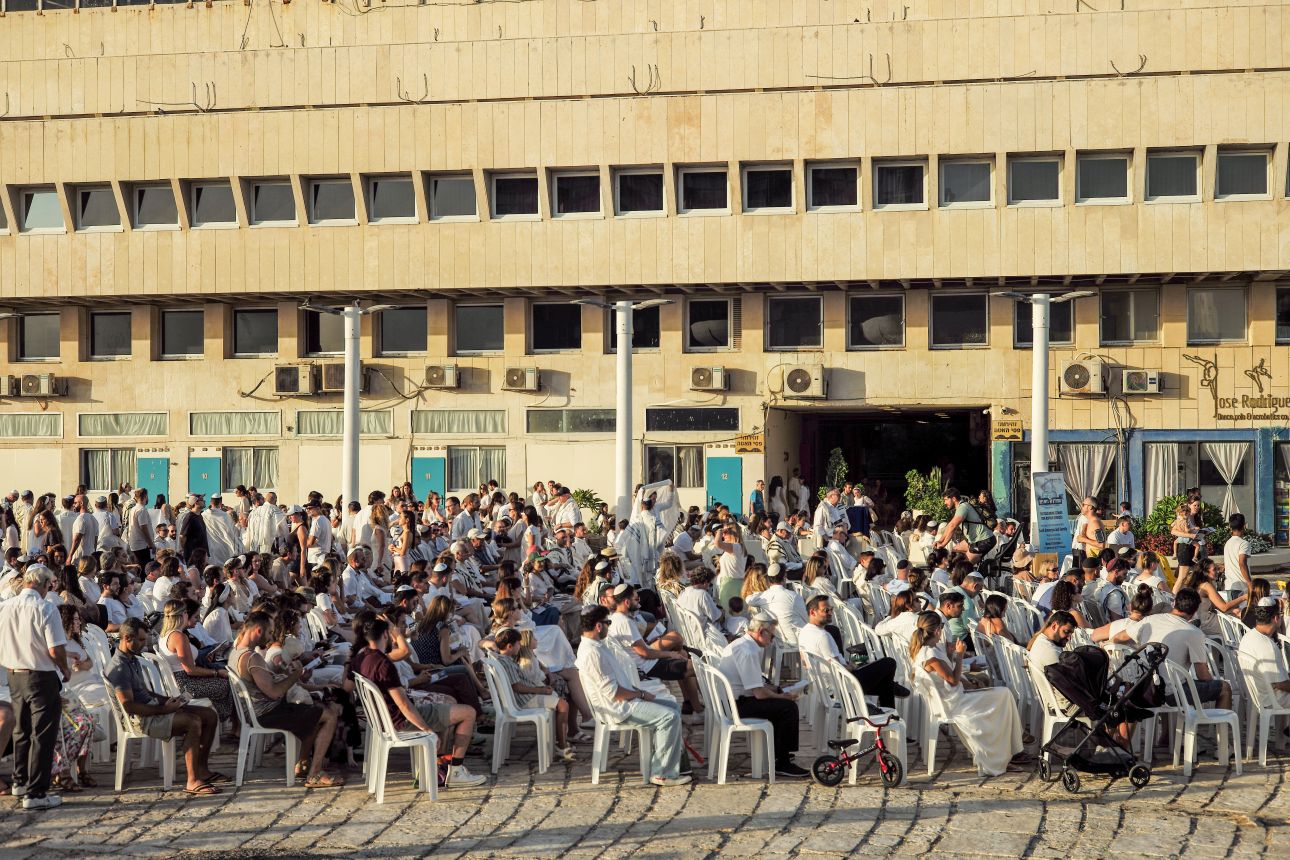
Photo by Erik Marmor/Flash90
As of August 2026
- Approximately three-quarters (74%) of Jewish Israelis fast on Yom Kippur: 63% observe the full fast, and 11% fast partially, either for part of the day or in some years but not others.
- Among secular Jews, 47% fast on Yom Kippur: 28% observe the full fast, and a further 19% fast partially. Among traditional non-religious Jews, the corresponding share is 90%: 77% observe the full fast, and 13% fast partially. Among Haredi (ultra-Orthodox), religious, and traditional religious Jews, 97%–98% observe the full fast.
- Fasting is more common among Mizrahi Jews (88%, including 81% who observe the full fast) than among Ashkenazi Jews (64%, including 50.5% who observe the full fast) or Jews of mixed ethnic origin.
Attendance at Yom Kippur Services
As of August 2026
- A majority of Jewish Israelis (57%) usually attend Yom Kippur services: 51% attend Orthodox services, and 6% attend Reform or Conservative services.
- Among traditional religious Jews, 90% attend Yom Kippur services, including 8% who attend non-Orthodox services. Among traditional non-religious Jews, 67% attend, including 9% who attend non-Orthodox services. Among secular Jews, 20% attend, including 7% who attend non-Orthodox services.
- Orthodox services draw participants from across the religious spectrum: Haredi, religious, traditional religious, and traditional non-religious Jews each account for between one-fifth and one-quarter of attendees, while secular Jews account for 11%. By contrast, 50% of those attending Reform or Conservative services are secular, and 48% are traditional: 19% traditional religious and 29% traditional non-religious.
- Gender differences in attendance are particularly pronounced among traditional Jews, especially the traditional non-religious: 76% of men in this group attend Yom Kippur services, compared with 56% of women.
- Mizrahi Jews are more likely to attend Yom Kippur services (68%) than Ashkenazi Jews or Jews of mixed ethnic origin (50% and 51%, respectively).
- For 18% of Jewish Israelis, attending synagogue on Yom Kippur is typically their only synagogue visit of the year. This is the case for 37% of traditional non-religious Jews, 21% of traditional religious Jews, and 16% of secular Jews.
- Among those who attend synagogue on Yom Kippur, approximately one-third (32%) do not usually have other synagogue visits during the year.
Introduction
Yom Kippur, the Day of Atonement, occupies a unique place in Jewish culture and society in Israel. Jewish tradition regards it as the holiest day of the year. It is also the day on which the 1973 war broke out, giving the Yom Kippur War its name. Two practices rooted in Jewish tradition are particularly associated with the day: fasting and attending prayer services. Many people observe both, at least to some extent. These practices represent two different forms of traditional observance. Fasting is a private act that does not require social interaction. Attending Yom Kippur services, particularly at their high points, such as Kol Nidrei, which opens the evening’s observances, and Ne’ilah, the closing service, involves entering a shared public space and joining a community.[1]
This review examines patterns of fasting and synagogue attendance on Yom Kippur among Jewish Israelis, analyzing differences by religious self-definition, gender, ethnic origin, and age. It is based on an extensive survey conducted by the Israel Democracy Institute in July–August 2026 for the Biennial Statistical Report on Religion and State in Israel, edited by Ariel Finkelstein, Shlomit Ravitsky Tur-Paz, and Ya’ari Padan, with the assistance of IDI’s Viterbi Family Center for Public Opinion and Policy Research. The survey included 1,002 Jewish respondents aged 18 and over, constituting a representative sample of Jewish society in Israel. Fieldwork was conducted by iPanel. Respondents were asked, among other questions, whether they usually fast on Yom Kippur and whether they usually attend services that day. The maximum sampling error was 3.1 percentage points.[2]
1. Fasting on Yom Kippur
1.1. Overall Findings
To examine fasting practices among Jewish Israelis, the survey asked: “Do you usually fast on Yom Kippur?” Respondents could choose one of three answers: “Yes, I observe the full fast”; “Yes, partially (in some years or for part of the day)”; or “I do not fast.” The second option recognizes that fasting on Yom Kippur is not necessarily an all-or-nothing practice. Some people fast for only part of the day, while others fast in some years but not others. Figure 1 presents the overall findings.
Figure 1. Fasting on Yom Kippur (%)
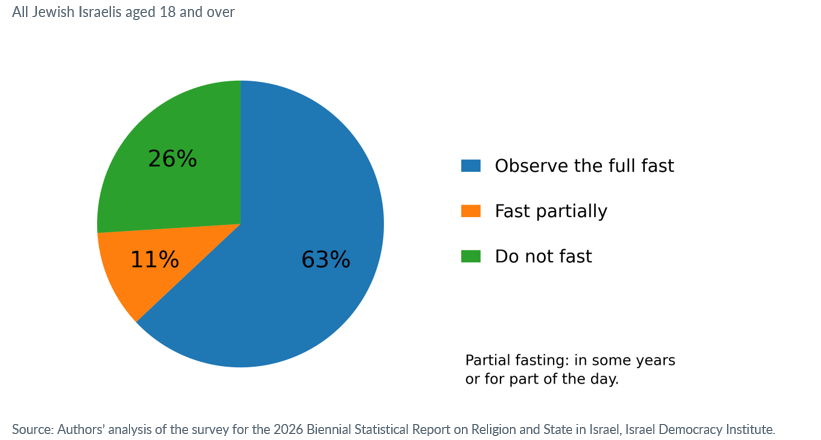
Approximately three-quarters of Jewish Israelis (74%) fast on Yom Kippur: 63% observe the full fast, and 11% fast partially. Figure 2 breaks down the responses by religious self-definition.
Figure 2. Fasting on Yom Kippur, by religious self-definition (%)
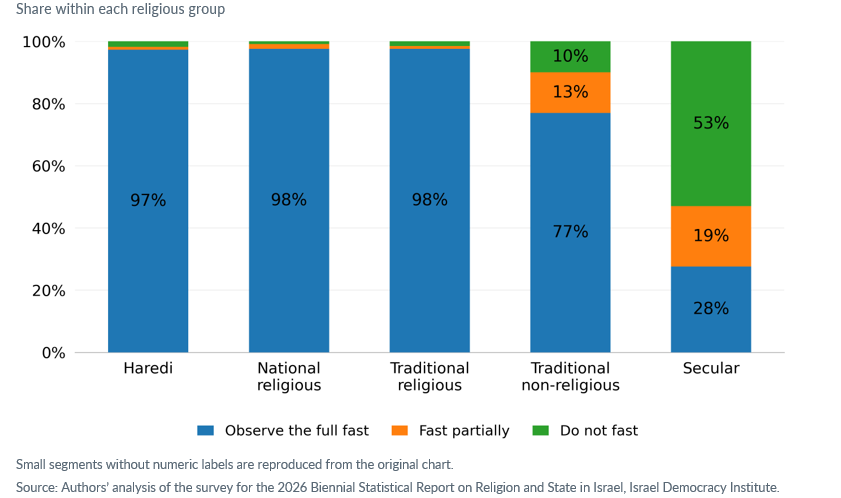
Fasting is almost universal among Haredi, national religious, and traditional religious Jews, with 97%–98% observing the full fast. Further analysis shows that the few respondents in these groups who fast partially or do not fast are almost all older people, suggesting that their reasons may be related to health rather than a principled decision not to fast.
Fasting is also very common among secular and traditional non-religious Jews, the two largest groups in Jewish Israeli society, although their practices are more varied. Among traditional non-religious Jews, 90% fast on Yom Kippur: 77% observe the full fast, and a further 13% fast partially. In this respect, their practices more closely resemble those of Haredi, national religious, and traditional religious Jews than those of secular Jews. Yet even among secular Jews, almost half (47%) usually fast fully or partially: 28% observe the full fast, and 19% fast partially. By contrast, 53% of secular Jews and 10% of traditional non-religious Jews do not fast at all.
1.2. Gender
Figure 3 presents fasting practices by gender and religious self-definition.
Figure 3. Fasting on Yom Kippur, by gender and religious self-definition (%)
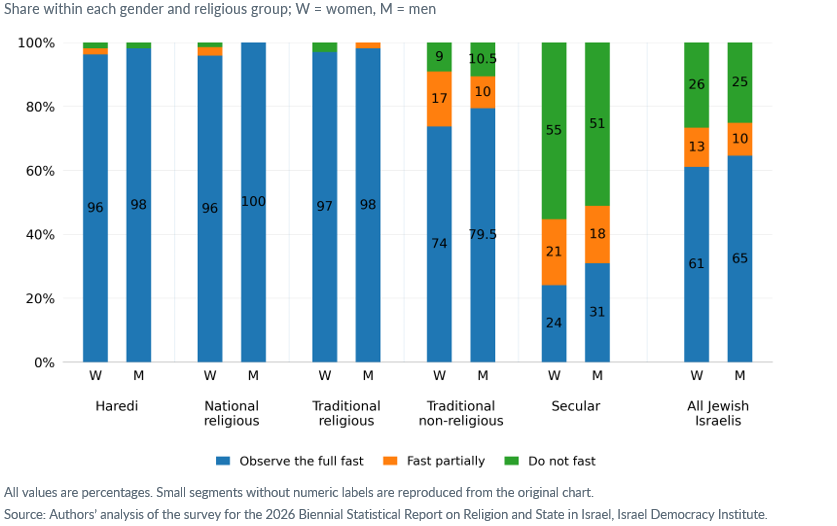
Men are more likely than women to observe the full fast: 65%, compared with 61%. Women, however, are more likely to fast partially: 13%, compared with 10% of men. Consequently, the shares who do not fast at all are almost identical: 25% of men and 26% of women. A breakdown by religious self-definition shows that the main gender differences are among the non-religious groups. Among secular Jews, 31% of men observe the full fast, compared with 24% of women. Among traditional non-religious Jews, the corresponding figures are 79.5% of men and 74% of women. In the other groups, almost everyone fasts, although here too the share of women who observe the full fast is slightly lower.
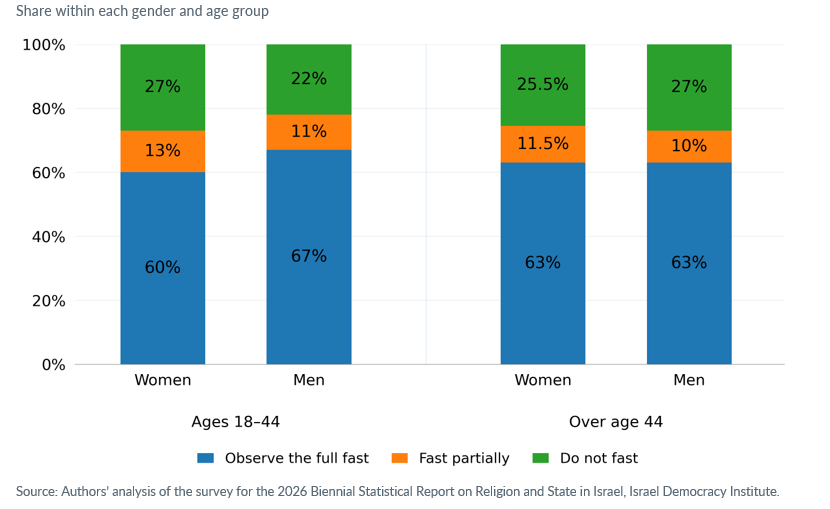
The lower proportion of women who observe the full fast is likely related to health concerns, particularly during pregnancy or breastfeeding. Rabbis or doctors sometimes advise women in these circumstances not to fast, or to fast only partially. The age breakdown in Figure 4 shows that the gender gap in observing the full fast is confined to the younger population, aged 18–44: 67% of men in this age group observe the full fast, compared with 60% of women. Among those over 44, the shares of men and women who observe the full fast are identical (63%), while women are slightly more likely to fast partially (11.5%, compared with 10% of men).
Figure 4. Fasting on Yom Kippur, by gender and age group (%)
1.3. Ethnic Origin
Figure 5 presents the findings by respondents’ ethnic origin, distinguishing among three groups: Ashkenazi, Mizrahi, and mixed ethnic origin.
Figure 5. Fasting on Yom Kippur, by ethnic origin (%)
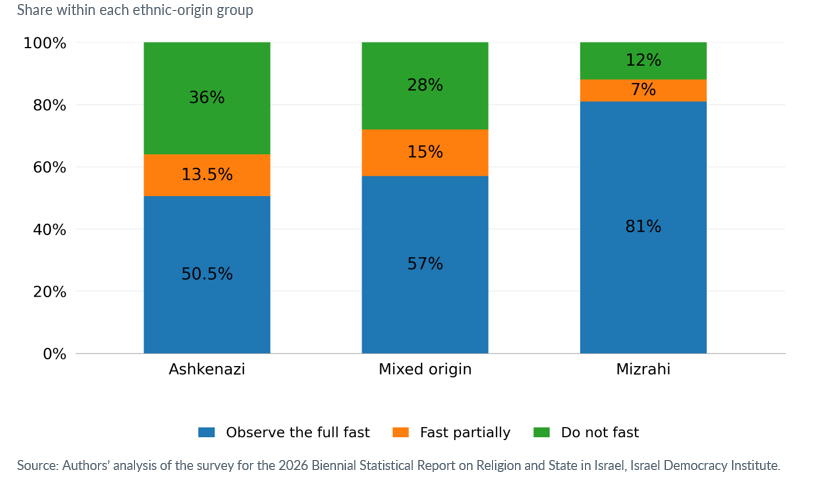
Mizrahi Jews have the highest rate of fasting (88%), and particularly of observing the full fast (81%). Jews of mixed ethnic origin are more likely to fast than Ashkenazi Jews: 72% fast, including 57% who observe the full fast, compared with 64% and 50.5%, respectively, among Ashkenazi Jews. Nevertheless, the rate among those of mixed origin is closer to that of Ashkenazi Jews than to that of Mizrahi Jews.
Because religious self-definition and ethnic origin are partly correlated, the next figure presents the findings by both variables, allowing comparisons between respondents of different ethnic origins who share the same religious self-definition. Since fasting is almost universal among Haredi, national religious, and traditional religious Jews, the comparison is limited to secular and traditional non-religious Jews.
Figure 6. Fasting on Yom Kippur, by ethnic origin and religious self-definition (%)
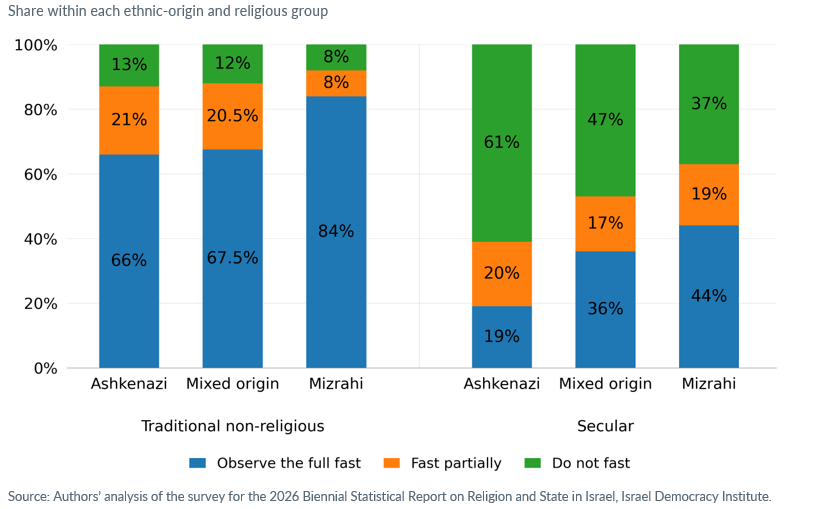
Even when Mizrahi and Ashkenazi Jews with the same religious self-definition are compared, fasting is more common among Mizrahi Jews. The difference is especially pronounced among secular Jews, whose attachment to tradition remains strong when it comes to fasting on Yom Kippur. Among secular Mizrahi Jews, 63% usually fast, including 44% who observe the full fast, compared with 39% and 19%, respectively, among secular Ashkenazi Jews. Among traditional non-religious Jews, the practices of those of mixed ethnic origin are almost identical to those of Ashkenazi Jews: 88% of the mixed-origin group fast, including 67.5% who observe the full fast. Among secular Jews, however, those of mixed origin are much more likely to fast than Ashkenazi Jews, although less likely than Mizrahi Jews: 53% fast, including 36% who observe the full fast.
2.1. Overall Findings
To examine attendance at Yom Kippur services among Jewish Israelis, the survey asked: “Do you usually attend prayer services on Yom Kippur?” Given the substantial differences between Orthodox and non-Orthodox services, respondents were offered three options: “Yes, Orthodox services”; “Yes, Reform or Conservative services”; or “No.” Figure 7 presents the overall findings.
Figure 7. Attendance at Yom Kippur services (%)
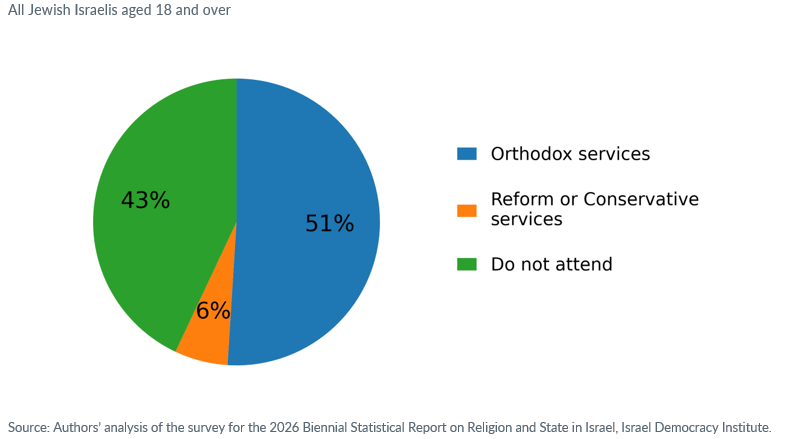
A majority of Jewish Israelis (57%) usually attend services on Yom Kippur: 51% attend Orthodox services, and a further 6% attend Reform or Conservative services. The remaining 43% do not attend Yom Kippur services. Figure 8 presents the findings by religious self-definition.
Figure 8. Attendance at Yom Kippur services, by religious self-definition (%)
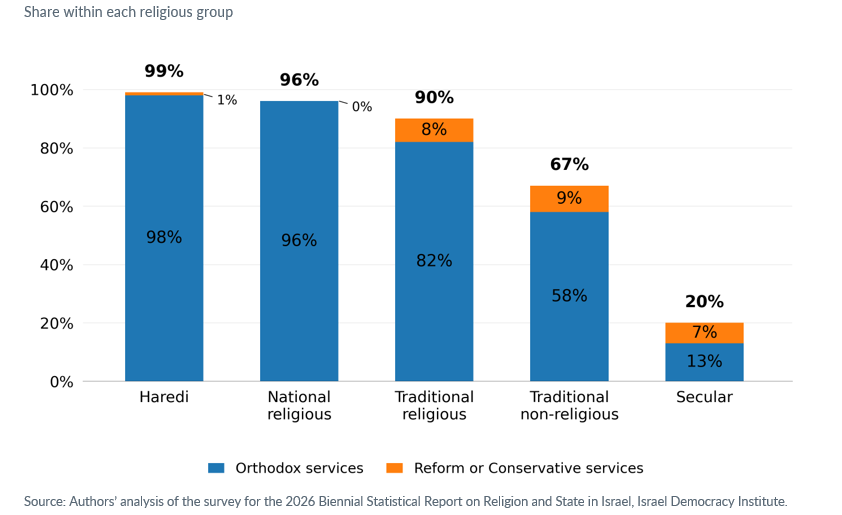
Almost all Haredi and national religious Jews attend Yom Kippur services, as do 90% of traditional religious Jews. Among traditional non-religious Jews, the attendance rate is 67%. Secular Jews have the lowest attendance rate, at 20%.
The figure also shows that between 7% and 9% of secular, traditional non-religious, and traditional religious Jews attend Reform or Conservative services. Figure 9 approaches the question from the opposite direction, showing the religious composition of the attendees at each type of service.
Figure 9. Religious composition of attendees at Orthodox and at Reform or Conservative Yom Kippur Services (%)
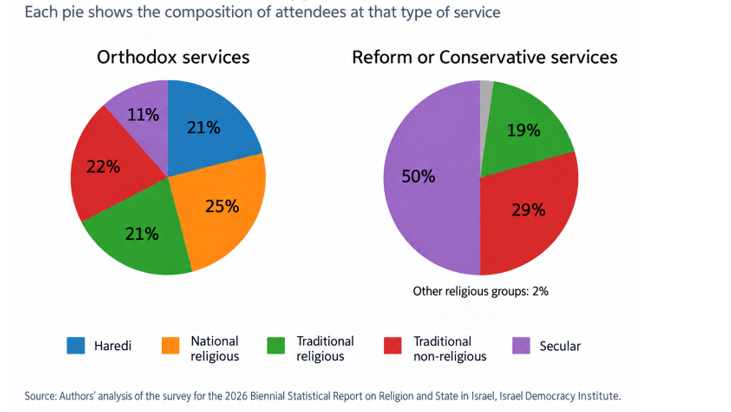
Those attending Orthodox services are distributed relatively evenly across four groups: Haredi, national religious, traditional religious, and traditional non-religious Jews each account for between one-fifth and one-quarter of attendees. Secular Jews account for 11%. By contrast, half of those attending non-Orthodox services are secular, and almost half are traditional: 29% traditional non-religious and 19% traditional religious. Only a very small proportion identify as religious.
2.2. Gender
Figure 10 presents attendance at Yom Kippur services by gender.
Figure 10. Attendance at Yom Kippur services, by gender (%)
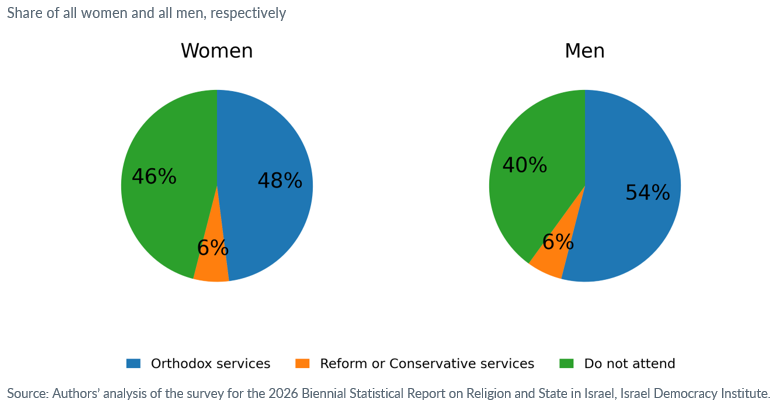
Men are somewhat more likely than women to attend Yom Kippur services, with the difference concentrated in Orthodox services: 54% of men attend Orthodox services, compared with 48% of women. A further 6% of men and 6% of women attend Reform or Conservative services. Figure 11 presents overall attendance at Yom Kippur services, combining Orthodox and non-Orthodox services, by gender and religious self-definition.
Figure 11. Attendance at Yom Kippur services, by gender and religious self-definition (%)
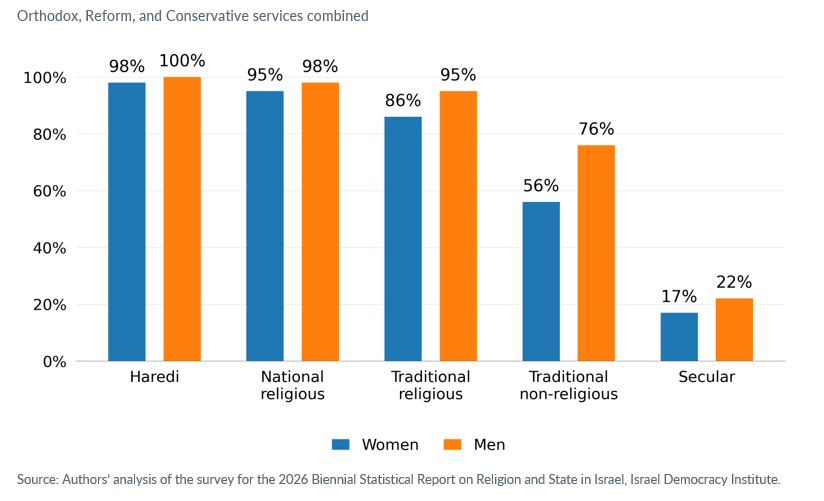
In every religious group, men are somewhat more likely than women to attend Yom Kippur services. The gender gaps are particularly pronounced among traditional Jews, especially the traditional non-religious: 76% of men in this group attend, compared with 56% of women.
As noted above (Figure 3), women are less likely than men to observe the full fast on Yom Kippur. This gender gap is confined to the younger population, aged 18–44, and is likely related to the health challenges that fasting poses during pregnancy and breastfeeding. By contrast, our age-based analysis of attendance at Yom Kippur services finds almost no age differences. Attendance rates are nearly identical among women aged 18–44 and women over 44 (53% and 54%, respectively), and there is no difference between younger and older men.
Several other explanations may account for women’s lower attendance at Yom Kippur services. One possibility relates to Jewish law, as understood in Orthodox practice: the obligation to pray communally with a minyan, a quorum of ten Jewish males aged 13 or over, applies to men alone, while women have greater flexibility regarding how and where they pray. However, the small gender gaps in Yom Kippur attendance among Haredi and national religious Jews suggest that this explanation is insufficient.
Another possible explanation is men’s dominance of synagogue life in the vast majority of Orthodox communities: leading services, counting toward the minyan, and receiving synagogue roles and ritual honors. These arrangements create a welcoming environment for religious, traditional, and secular men who wish to attend Yom Kippur services. Many women, by contrast, feel less at home in this setting and are therefore less inclined to attend. The particularly large gender gap among traditional non-religious Jews may lend support to this hypothesis.
2.3. Ethnic Origin
Figure 12 presents attendance at Yom Kippur services by ethnic origin.
Figure 12. Attendance at Yom Kippur services, by ethnic origin (%)
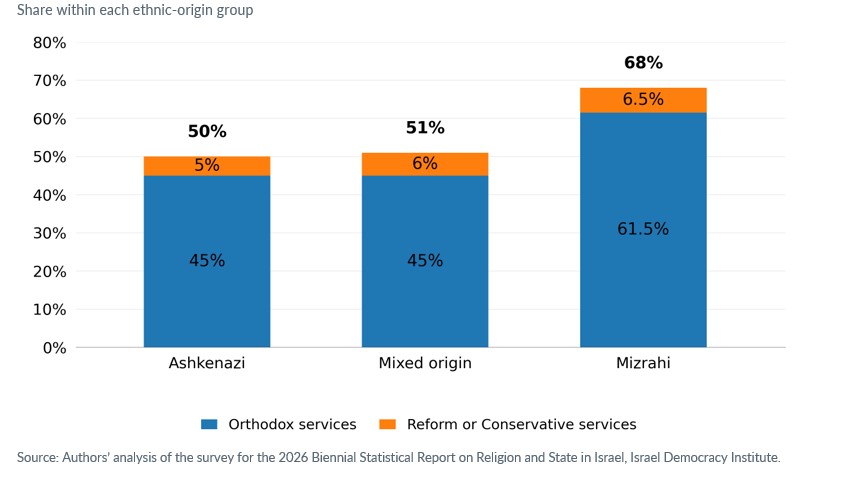
Mizrahi Jews have the highest attendance rate, at 68%. By contrast, there is almost no difference between Ashkenazi Jews and Jews of mixed ethnic origin, whose attendance rates are 50% and 51%, respectively. The share attending Reform or Conservative services is between 5% and 7% in each ethnic-origin group.
Because religious self-definition and ethnic origin are partly correlated, the next figure presents the findings by both variables, allowing comparisons between people of different ethnic origins who share the same religious self-definition. Given the high attendance rates among Haredi, national religious, and traditional religious Jews, and the smaller sample sizes for these groups, the comparison is limited to secular and traditional non-religious Jews.
Figure 13. Attendance at Yom Kippur services, by ethnic origin and religious self-definition (%)
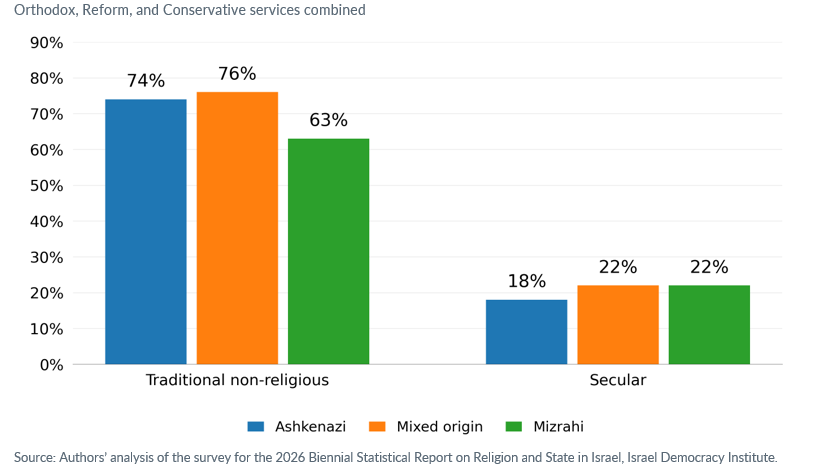
Although Mizrahi Jews have a higher attendance rate overall, a different picture emerges when ethnic-origin groups are compared within the same religious category. Among traditional non-religious Jews, attendance is actually lowest among Mizrahi Jews: 63%, compared with 74% of Ashkenazi Jews and 76% of those of mixed ethnic origin. This finding may be related to Ashkenazi attendees at Reform and Conservative synagogues who identify as traditional non-religious. Among secular Jews, attendance is identical among Mizrahi Jews and those of mixed ethnic origin (22%), and slightly higher than among Ashkenazi Jews (18%).
2.4. Yom Kippur Attendance and Attendance During the Rest of the Year
The findings above show that a majority of Jewish Israelis (57%) usually attend Yom Kippur services. This section examines how many do so without usually attending synagogue services during the rest of the year. To this end, responses to the question on Yom Kippur attendance were cross-tabulated with another survey question on attendance at services throughout the year. We examined respondents who reported attending Yom Kippur services but also reported that they did not attend services regularly during the year, at least on Sabbaths and Jewish holidays.
Figure 14. Yom Kippur attendees who do not usually attend services during the rest of the year, by religious self-definition (%)
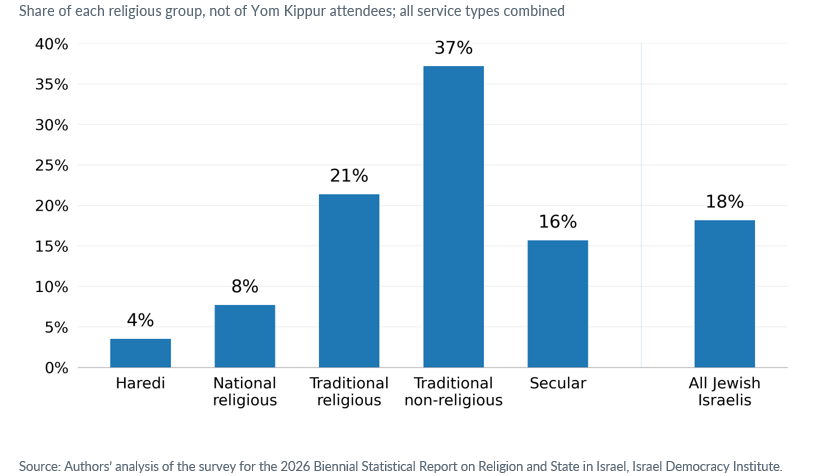
The findings show that 18% of Jewish Israelis usually attend Yom Kippur services even though they do not usually attend synagogue services during the rest of the year. This pattern is particularly pronounced among traditional non-religious Jews: 37% attend services only on Yom Kippur, as do 21% of traditional religious Jews and 16% of secular Jews. The shares who attend only on Yom Kippur are much lower among national religious and Haredi Jews (8% and 4%, respectively).
Another notable finding is that almost all Haredi and national religious Jews who attend services only on Yom Kippur are married women (86%). This can be understood in light of the fact that women with children sometimes attend services less frequently. By contrast, among secular and traditional non-religious Jews who attend services only on Yom Kippur, men constitute a small majority (51.5%).
When those who attend only on Yom Kippur are considered as a share of all Yom Kippur attendees, rather than of the Jewish Israeli population as a whole, approximately one-third (32%) do not usually attend synagogue services during the rest of the year. This pattern is particularly pronounced among secular Jews: 79% of secular Yom Kippur attendees do not usually attend synagogue services during the rest of the year, compared with 55% of traditional non-religious attendees and 24% of traditional religious attendees.
The findings show a strong attachment to Jewish tradition, as expressed through fasting and synagogue attendance on Yom Kippur, across broad sections of Jewish Israeli society. Almost half of secular Jews fast, at least partially, and approximately one-fifth attend services, including many for whom this is their only synagogue visit of the year. On Yom Kippur, traditional non-religious Jews appear to adopt practices more closely resembling those of traditional religious Jews than those of secular Jews. Mizrahi Jews show a stronger attachment to tradition than Ashkenazi Jews, particularly in their fasting practices.
[1] This data review focuses on synagogue attendance on Yom Kippur. It does not examine prayer practices more generally, including individual prayer as a private activity.
[2] Data on attendance at synagogue services were also collected for the 2024 Biennial Statistical Report on Religion and State in Israel, edited by Ariel Finkelstein, Ayala Goldberg, Shlomit Ravitsky Tur-Paz, and Ya’ari Padan. For a review of the 2024 findings, see Ayala Goldberg, “Public Participation in Synagogue Services,” Israel Democracy Institute website, September 29, 2025 [Hebrew]. The 2024 survey examined synagogue attendance in general, using several frequency categories: daily; several times a week; mainly on Sabbaths and Jewish holidays; once or twice a year; and not at all. It did not focus specifically on Yom Kippur services.