

Joan and Irwin Jacobs Center for Shared Society Conference
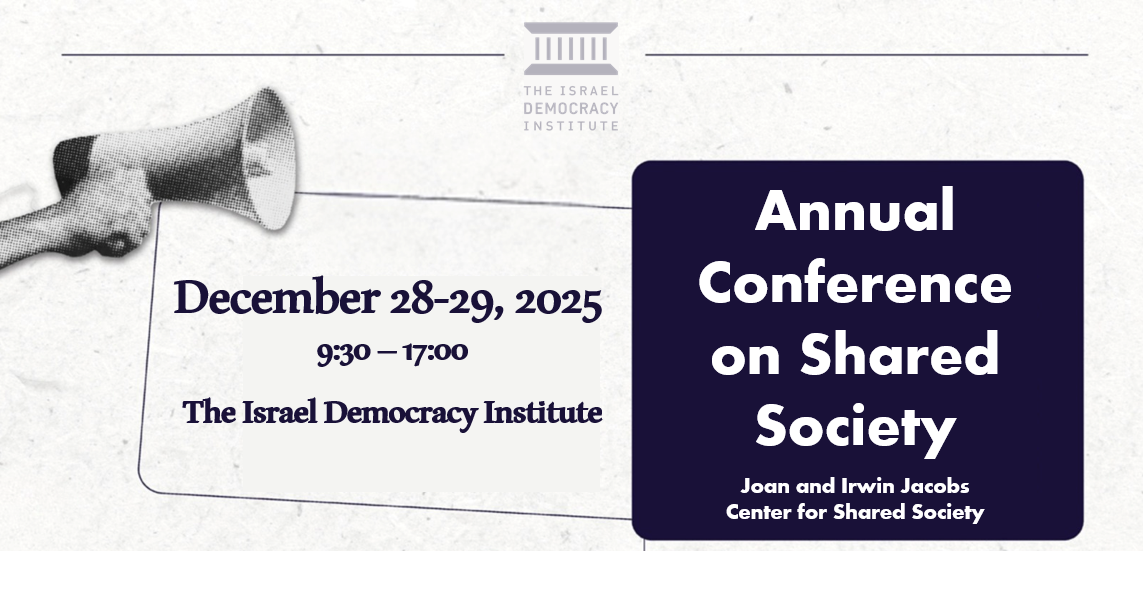
IDI Convenes Thought Leaders; Policy Makers for Annual Conference on Shared Society
Hosted by the Israel Democracy Institute's Joan and Irwin Jacobs Center for Shared Society.
So many of the deep divisions we see in Israeli society today come down to matters of religion and state. Each year IDI experts convene with policymakers, thought leaders, journalists, and experts from all sectors of society to consider how all Israelis – religious and secular; Jewish, Muslim, Christian and beyond – can live together in a shared democratic society.
As Shlomit Ravitsky Tur-Paz, Director of IDI's Joan and Irwin Jacobs Center for Shared Society noted while opening the conference, “Israeli society has always been divided, but it seems that today more than ever, the rules of the game have collapsed. The danger to the resilience of Israeli society is present.” Through the diverse views expressed by speakers from differing political camps, religious backgrounds, and walks of life, all speakers were unified behind this idea of preserving said resilience in Israeli society.
Selected Quotes:
Former President Reuven Rivlin, IDI Honorary Chair and Joan and Irwin Jacobs Distinguished Fellow in a conversation with Prof. Suzie Navot, IDI's Vice President of Research:
Speaking about divisions in Israeli society and referencing his iconic 2015 "Four Tribes" speech: “We knew that we were establishing a state composed of tribes, but I came to fear that a system might develop in which the tribes would think they have a state, rather than the state having tribes. The Tribes Speech was delivered as a warning sign. Very few saw it as a warning, and today we find ourselves in terrible days in which democracy is shaking beneath our feet. Citizens are being incited by one system or another against one another, in order to seize control of a system that today has become more important than the state itself.”
On the question of a possible presidential pardon for Prime Minister Netanyahu:
“A pardon is granted after a court judgment. Under no circumstances is it an appeal against the court or its ruling. When we find ourselves in a situation in which a public figure is in confrontation with the public itself and with the authorities—the judicial authority and the investigative authorities—we are in an almost impossible situation: a person accuses the state of conspiring to persecute him, and the state has filed an indictment. When you are a defendant and you accuse the state, someone must determine who is right. Can the President of the State serve as a judge between the contending sides? Of course not. It is the court that must make that determination.”
Israeli journalist and commentator Amit Segal in a conversation with IDI President Yohanan Plesner provided analysis on the issue of Haredi integration and the political implications: “We are reaching a point of no return. Although there isn't a dramatic growth in ultra-Orthodox political power [in the Knesset], there is a nightmare scenario in which 47–49% of the population does not study core curriculum subjects, does not serve in the army, and does not participate in the workforce. This is a situation that cannot be sustained, and therefore we must think differently about what to do about it. If we want to change this reality, the obvious step is the formation of a government based on a 'coalition of those who serve' and the removal of the [political] boycott of Netanyahu."
MK Avigdor Liberman, Chair of Yisrael Beiteinu party on this same issue: “What is needed is a conscription law for everyone: Jews, Muslims, Christians, and Circassians... My legislative proposal is simple: conscription at age 18 with no exemptions for anyone. Everyone reports to the induction center; the army decides whom it wants for the military track, and the rest go to a civilian service track, which will also be administered by a department within the Ministry of Defense.”
Dr. Khader Sawaed, Head of IDI's Arab Society in Israel Program, on a panel on closing the gaps and integrating Arab Israelis and the recent government decision to divert funding for the Arab sector to additional policing and security measures : "The cuts being made (to Resolution 550) constitute a double sin: on the one hand, they weaken the underlying drivers of crime and violence reduction in the medium and long term; on the other hand, in the short term they increase and expand both the number and scope of students and young people...who fall into cycles of poverty and, as a result, into the world of crime.”
MK Ohad Tal (Religious Zionist Party) and Deputy Speaker of the Knesset MK Michael Biton (Blue and White) on a panel on polarization and the role of political leaders in seeking moderation:
MK Ohad Tal (Religious Zionist Party): “The discourse of division is largely intended to silence the right. Take the term "judicial revolution," for example - it can be argued that it is divisive because it assumes there are good and bad actors, rather than a principled disagreement between two sides that both want what is best for the country… Anyone who truly cares about polarization needs to talk about how we avoid turning the other side into a demon.”
MK Michael Biton (Blue and White): “In this war, we have buried left-wingers and right-wingers, Haredi, religious and secular Jews, Ashkenazim and Mizrahim. We buried them all together, in the same cemetery. In death, we know how to be together; to be equal and heroic. But living and fighting together, sustaining a shared framework—that is much harder. And when a soldier says to her commander, ‘I will not go into battle with you because you are left-wing’—that is where something broke in Israel...”
Dr. Nechumi Yaffe Vice President, the Tatya Institute, on a panel on the tenth annual Statistical Report on Ultra-Orthodox Society published by IDI: “One of my consistent research findings is that there is a personal willingness among Haredim to integrate, but their identification of the social norm is mistaken. They hold in their minds an image of a…highly controlling society that dictates what is normal and appropriate, and this prevents them from realizing what they would like for themselves and for their children. Haredim love the state, love being Israeli, and feel that they belong—but they think that others around them do not feel the same way.”
Dr. Ariel Finkelstein, Head of IDI's Local Government Project: “When I was younger, Likud campaigns spoke about peace, and Peres’s campaign was ‘A Strong Israel with Peres.’ Each party tried to appeal to the political center and sought to appeal to the other side. Today, parties appeal only to their base.
In local government, it isn’t like that. In Jerusalem, Moshe Lion formed as broad a coalition as possible; in Tel Aviv, Huldai insisted on bringing in the Haredim as well as the single mandate of Religious Zionism. Politicians who grow out of local government behave differently—they are more pragmatic, and their spirit is different.
Zehava Galon, President of the Zulat Institute for Equality and Human Rights; Former Chair, Meretz party on a panel on how the different sectors contribute to polarization and cohesion: “I am secular, and I understand the fear of polarization, but we must not allow that fear to blur the differences between us. The questions we are dealing with today are questions of survival, and we must not evade them in the name of cohesion… The ideology of those currently in government is ‘now it’s my turn to eat,’ while they pay lip service to cohesion, to love of Israel, to the Jewish people. They say they will do everything to prevent rifts and polarization—and I’m telling you, I’ve had it up to here with this lip service.”
MK Mansour Abbas, Chair of the Ra’am Party, on the same panel said the following in the conference's closing session: “We must demand more from our leaders: to stand before the public, to keep their promises, to look to the future, and to give people hope and vision. I believe that Israeli leadership in recent years has made grave mistakes and has led us into a culture that accepts corruption, fragmentation, disqualification, and delegitimization. We have suffered from delegitimization, and the left also suffers from it. Today, when someone wants to insult another person, they say that he has ‘become left-wing.’ And on the day when the question of Ra’am joining a coalition is taken off the table, believe me, that same question will arise in relation to Israel’s left-wing party."
Photos are courtesy of Oded Karni.
Eric Goldstein, CEO of UJA-Federation of New York, joined Yohanan Plesner, President of the Israel Democracy Institute, and Shlomit Ravitsky Tur-Paz, Director of IDI’s Joan and Irwin Jacobs Center for Shared Society, for an online conversation on “The Fifth Tribe,” the challenges facing American Jewry, and the relationship between Israel and the Jewish diaspora during the war and beyond.
9:30 – Gathering
10:00 – Opening
Adv. Shlomit Ravitzky Tur-Paz, Director, Joan and Irwin Jacobs Center for Shared Society, Israel Democracy Institute
10:15 – 11:30
The 10th Annual Statistical Report on Ultra-Orthodox Society – What Have We Learned?
Chair:
Dr. Lee Cahaner, Research Fellow, Israel Democracy Institute, Editor of the Statistical Report
Presentation of the Annual Report:
Dr. Gilad Malach, Research Fellow, Israel Democracy Institute, Editor of the Statistical Report
Discussion:
- Shahar Ilan, Commentator on Haredi Affairs, Calcalist
- Gabriel Gordon, Researcher, Israel Democracy Institute
- Dr. Nechumi Yaffe, Vice President, Tatya Institute; Researcher, Tel Aviv University
- Rabbi Bezalel Cohen, Founder and Co-Director, Haredi Institute for Democracy
- Prof. Nissim Leon, Head of the Department of Sociology & Anthropology, Bar-Ilan University
11:30 – 11:15
Yohanan Plesner, President of the Israel Democracy Institute
in conversation with
Amit Segal, Journalist and Political Analyst, Channel 12 News, Israel Hayom.
11:55 – 12:10 – Break
12:10 – 13:30
A New Paradigm for the State's Relationship with Haredi Society
Chair:
Ronny Barboy, Head of the Ultra-Orthodox in Israel Program, Israel Democracy Institute
Presentation of the New Paradigm:
- Gilad Cohen Kovacs, Researcher, Ultra-Orthodox in Israel Program, Israel Democracy Institute
- Dr. Gilad Malach, Israel Democracy Institute
- Dr. Shlomit Shahino Kesler, Senior Researcher, Ultra-Orthodox in Israel Program, Israel Democracy Institute
Discussion:
- Neta Bar-Ziv, Employment Coordinator, Budget Department, Ministry of Finance
- Prof. Manuel Trajtenberg, Tel Aviv University, Formerly: Chair, National Economics Council; Chair, Planning and Budget Committee, Council on Higher Education; Member of Knesset, Executive Director, INSS
- Shai Calderon, Director of the Haredi Sector, Ministry of Education
- Dalit Stauber, Faculty Member, Mandel School for Educational Leadership; Former Director-General, Ministry of Education
13:30 – 13:55
Yohanan Plesner in conversation with
MK Avigdor Liberman, Chair of Yisrael Beitenu Party
13:55 – 14:25 – Lunch
14:25 – 15:45
Reducing Gaps in Arab Society: Is the Road to Integration and Equality Still Long?
Chair:
Adv. Anat Thon Ashkenazy, Director, Center for Democratic Values & Institutions, Israel Democracy Institute
Presentation of Arab Society Annual Report Data:
- Dr. Khader Sawaed, Head of the Arab Society in Israel Program, Israel Democracy Institute
- Dr. Muhammed Khalaily, Researcher, Arab Society in Israel Program, Israel Democracy Institute
- Dr. Arik Rudnitzky, Researcher, Arab Society in Israel Program, Israel Democracy Institute
Discussion:
- Dr Safa Aburabia, Program Director, Arab Community, Yad Hanadiv
- Raed Daka, Mayor, Baqa al-Gharbiyye
- Hassan Towafra, Former Head, Authority for Economic Development of Arab Society, Ministry for Social Equality
- Shahira Shalaby, Co-Director, Abraham Initiatives
- Noa Shukron, Coordinator for Interior & Local Government, Budget Department, Ministry of Finance
15:45 – 17:00
Shared Society: From Private Rooms to Shared Living Spaces
Chair:
Prof. Benny Porat, Senior Fellow, Israel Democracy Institute; Director of the Israel Matz Institute for Jewish Law, Hebrew University
Participants:
- Roni Alon, Founder, “Israel Between Jordan and the Sea”; Former Director-General, Ministry for Regional Cooperation; Former Strategy Director for President Rivlin
- Ronny Barboy, Israel Democracy Institute
- Mohammad Darawshe, Director of Strategy, Givat Haviva Center
- Rabbanit Malka Piotrokovsky, Halakhic Educator, Public and Educational Leader
- Rabbi Yosef Kaminer, Head of the Chochmat HaTorah Institute
- Prof. Mordechai Kremnitzer, Senior Fellow, Israel Democracy Institute; Faculty of Law, Hebrew University
9:15 – Gathering
9:45 – 10:10
Prof. Suzie Navot, Vice President for Research, Israel Democracy Institute
in conversation with
The Tenth President of the State of Israel Reuven Rivlin
10:10 – 11:25
How Polarized Is Israel, and Should We Be Worried?
Chair:
Prof. Daniel Statman, Senior Fellow, Israel Democracy Institute; Department of Philosophy, University of Haifa
Participants:
- Dr. Tzili Elitzur Nae, Head of Consensus-Building, Menomadin Center for Jewish and Democratic Law; Faculty of Law, Bar-Ilan University
- Dr. Lior Yohanani, Viterbi Center for Public Opinion & Policy Research, Israel Democracy Institute
- Prof. Jeff Spinner-Halev, Department of Political Science, University of North Carolina; Author of the book: Respect and Resistance in Diverse Societies
Click here to watch the conversation - Dr. Ariel Finkelstein, Researcher, Religion and State Program; Head of the Local Authority Project, Israel Democracy Institute
- Dr. Keren Tsuriel Harari, Director of Methodological Development, a Chord Center and Researcher, University of Haifa
11:25 – 11:50
Micah Goodman, Author of “The Attention Revolution”, on the challenges of Israeli polarization
11:50 – 12:05 – Break
12:05 – 14:00
Politics, Media, Law, and Education – Arenas of Polarization and Moderation
Chair:
Adv. Shlomit Ravitzky Tur-Paz
The Media Arena:
- Noa Barak-Weschler, Director of Marketing and Media, Israel Democracy Institute
in conversation with
Aviad Glickman, Legal Affairs Correspondent, Channel 13 News
And
Yehuda Schlesinger, Political Commentator, Walla News; News Anchor, Channel 14
- Dr. Tehilla Shwartz Altshuler, Senior Fellow, Israel Democracy Institute
- Tomer Avital, Social Entrepreneur & Independent Journalist; Author of Truth or Fake
The Education Arena:
- Dr. Tammy Hoffman, Head of the Education Policy Program, Israel Democracy Institute
- Dr. Neri Horowitz, Researcher of Haredi Society
The Law Arena:
- Prof. Suzie Navot, Israel Democracy Institute
- Iddo Porat, Associate Professor of Constitutional Law, College of Law & Business
The Politics Arena:
- Adv. Shlomit Ravitzky Tur-Paz in conversation with
MK Michael Biton, Deputy Speaker of the Knesset; Chair, Committee for Oversight of Barrier-Removal Processes; Blue and White, The National Unity Party
And
MK Ohad Tal, Chair, Religious Zionist Party
- Rachel Goldberg, Married to Captain Rabbi Avi Goldberg (z"l) who was killed in Lebanon in October 2023.
- Tzippi Khouri, “The Speech Project” – Promoting Clean, Constructive Discourse
- Dr. Chen Friedberg, Research Fellow, Israel Democracy Institute, Senior Researcher, Ariel University
14:00 – 14:30 – Lunch
14:30 – 14:50
Artistic Interlude
Dana Wohlfeiler-Lalkin, Founder and Chief Curator, Local Testimony – Annual Photojournalism & Documentary Exhibition
14:50 – 16:20
How the Different Sectors Contribute to Polarization and Cohesion
Chair:
Dr. Asaf Malchi, Senior Researcher, Israel Democracy Institute
Data:
Hodaya Ben Ari, Research Assistant, Center for Shared Society, Israel Democracy Institute
TED-Style Sectoral Talks:
- Prof. Rabbi Yehuda Brandes, President, Herzog College; Chair, National Religious Education Council; Author of The Hyphen and the Ellipsis
- Zehava Galon, President of the Zulat Institute for Equality and Human Rights; Former Chair, Meretz
- Dr. Gali Sembira, Director, Ono-Impact for Social Cohesion; Former Director-General, Ministry of Intelligence; Shaharit Institute
- Zeev Sklar, CEO, Telem – Strategic Initiatives in Haredi Society
- MK Mansour Abbas, Chair, Ra’am Party
- Alex Riff, CEO, “Lobby HaMillion”; Author of More Jewish Than You
16:20 – Closing Summary
Online Panel:
The "Fifth Tribe", the challenges facing American Jewry and the relationship between Israel and the diaspora during the war and beyond.
Eric Goldstein, CEO of UJA-Federation of NY, in conversation with
Yohanan Plesner, President of IDI
And
Shlomit Ravitsky Tur-Paz , Director of IDI's Joan and Irwin Jacobs Center for Shared Society