

Crime in Arab Israeli Communities: Cutting Prevention Undermines Security
Diverting hundreds of millions of shekels from the five-year plan for Arab society toward enforcement and security will harm both the effort to reduce socioeconomic gaps and personal security.
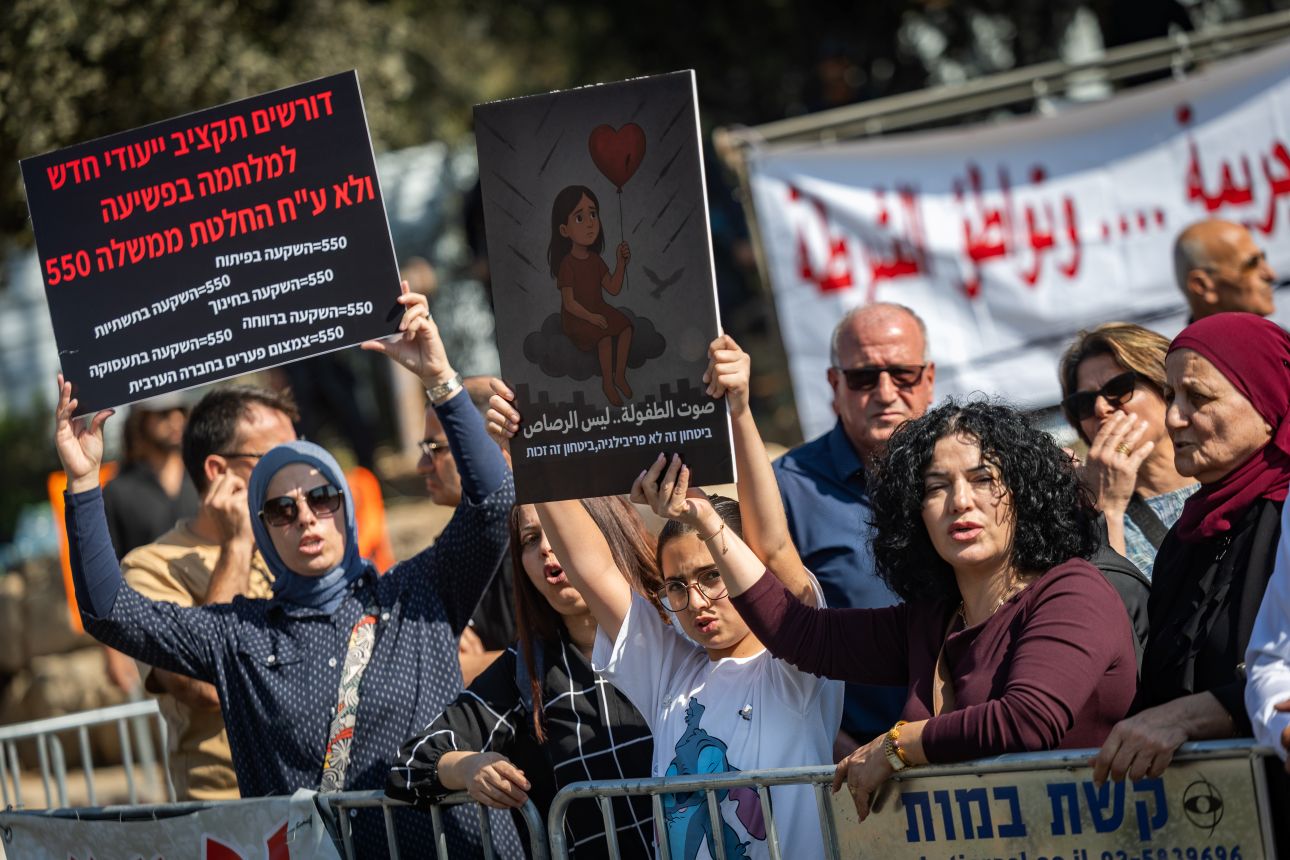
Photo by Yonatan Sindel/Flash90
In October 2021, the government passed Resolution 550 – a plan for Arab society that, rather than a patchwork of short-term solutions to crime and socioeconomic challenges, offered a comprehensive investment of 30 billion shekels aiming to serve as an integrative growth engine connecting education, employment, welfare, health, and transportation into a clear path for the full integration of Arab citizens into the Israeli economy.
This week, the Israeli government passed a decision to cut 220.7 million shekels from this five-year plan for Arab society and divert the funds to activities of the Israel Police, and for the first time also to the Shin Bet (Israel Security Agency), ostensibly to combat the rise in violence in Arab society. Yet a careful examination of the budget sources, the method of diversion, and its implications shows that this is not a technical correction or a minor shift in priorities, but a broad move that undermines the strategic logic on which Government Resolution 550 rested from the outset.
Resolution 550 was designed to reduce gaps in Arab society, not a specific response to violence and crime. Still, while reducing disparities in education, employment, planning, public services, and community resilience is, first and foremost, a matter of democratic values and equal opportunity, consistent investment in all these areas also get to the core causes of crime and violence. They advance medium- and long-term systemic solutions, not just temporary fixes.
An initial proposal earlier this month to cut roughly 3 billion shekels from the plan’s budget was rejected – fortunately, in the end, the decision was made to cut “only” 200 million shekels. But even this amount will be a hit to the program’s viability. These are essential funds explicitly designated for reducing gaps. Cutting them directly harms the ability to implement the plan and empties the state’s policy commitments of substance.
The symbolic meaning of the decision is no less significant than its budgetary impact. Cutting targeted budgets without a structured professional justification and without presenting a public impact analysis sends local authorities, civil-society actors, and the Arab public a message of instability and lack of state commitment – they can no longer be confident that long-term funding will come in as committed. In such a reality, it is difficult to expect local authorities to plan long-term, for civic partnerships to deepen their work, or for an entire public to believe that reducing disparities is viewed as a consistent goal that rises above partisanship.
Cuts to classroom and kindergarten construction, harm to cultural institutions, and blocking the activities of the Youth Authority are not marginal issues; they are direct blows to investments in diverse populations and at critical stages in which life trajectories are shaped. The statement by the Minister for Social Equality May Golan that “sports facilities and cultural centers won’t help, nor will building a plaza or handing out pizzas at the community center, when people are dying,” reflects a narrow and misguided understanding of crime-prevention policy and an ignoring of the importance of investing in deep-rooted factors to prevent the spread of violence. In practice, combating violence requires a complex socio-economic process.
In Glasgow, for example, shifting from a “policing approach” to one that included investment in education and employment for at-risk youth led to a roughly 50% drop in homicides between their peak in 2002 and 2015—an achievement that we don't see law enforcement alone produce. Studies in the United States showed that targeted employment programs for youth dramatically reduced arrests for violent crime and proved far more cost-effective than incarceration. In Israel, the State Comptroller reinforced this conclusion when he found that programs aimed at combating violence in Arab society partially failed because they focused too heavily on opening police stations while neglecting the root causes: gaps in education, housing, and employment. The overarching conclusion is that policing without welfare and education is like mopping the floor while the pipe is still leaking.
No less troubling is the cut to the budget of the Economic Development Authority, which is responsible for managing, monitoring, and evaluating the five-year plan. Policy that does not know how to measure its success will struggle to succeed.
The inclusion of the Shin Bet within a civilian budgetary framework also requires further thought. This is a question of boundaries. Such a move demands a deep and transparent parliamentary debate, not incidental regulation through a budget amendment. In the absence of such debate, there is a real concern about deepening the trend of securitizing complex civilian issues.
Fighting crime is a legitimate and urgent national goal. But precisely for that reason, it requires consistency, depth, and a systemic perspective. Cutting civilian prevention components in the name of security risks weakening both objectives. The question before us is not whether to fight crime, but how—and whether the state is willing to invest in the long-term foundations of community safety, not only in the immediate measures that are most visible.
This article was published in The Times of Israel