
Special Review of Public Opinion Ahead of 2026 Elections (IDI's Israeli Democracy Index)
Following the release of the IDI's Israeli Democracy Index earlier this week, we're pleased to present the findings of a special chapter on Israeli public opinion ahead of 2026 national elections in Israel.
Photo by Liron Moldovan/Flash90
Lowest recorded share of Israelis reporting no political party closely represents their views
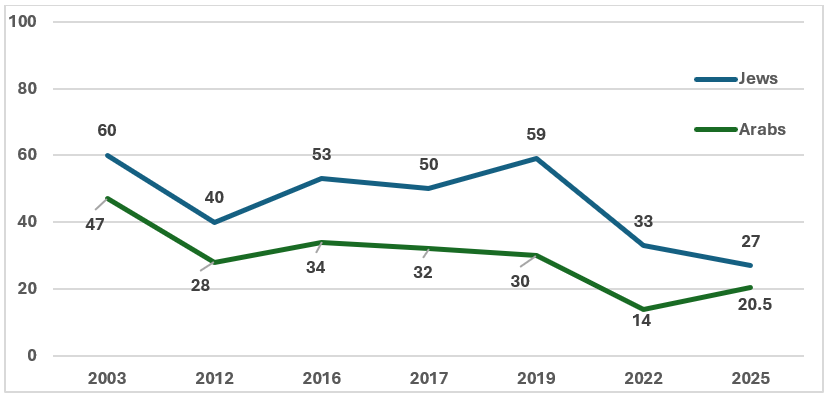
This year, the share of respondents who report that there is a political party in Israel that closely represents their views is the lowest recorded since 2003. In the total sample, only 26% feel that there is a party that properly represents them, 35% say that there is a party that partly represents them, and 34% that there is no party that represents their views.
The percentage of Arabs who feel that there is a party that closely represents them has always been lower than the corresponding percentage of Jews. However, in recent years, there has been a gradual convergence of the Jewish and Arab samples in terms of their sense of being represented by a political party, mainly due to the decline in the share of Jews who feel represented by a party.
Agree that there is a political party in Israel that closely represents their views, 2003–2025 (%)
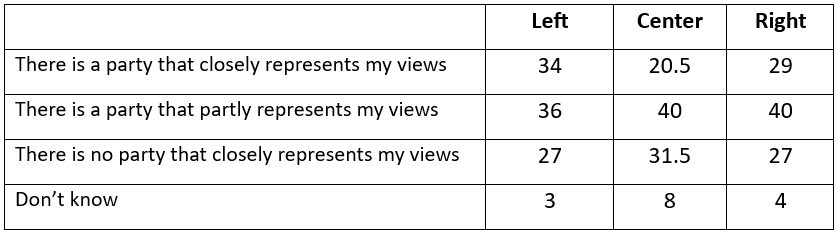
Breaking down responses in the Jewish sample by political orientation reveals that the Center has the smallest share of respondents who feel that there is a party that closely represents their views, while the Left has the largest, and the Right is somewhere in between.
Is there a political party in Israel today that closely represents your views? (Jews, by political orientation; %)
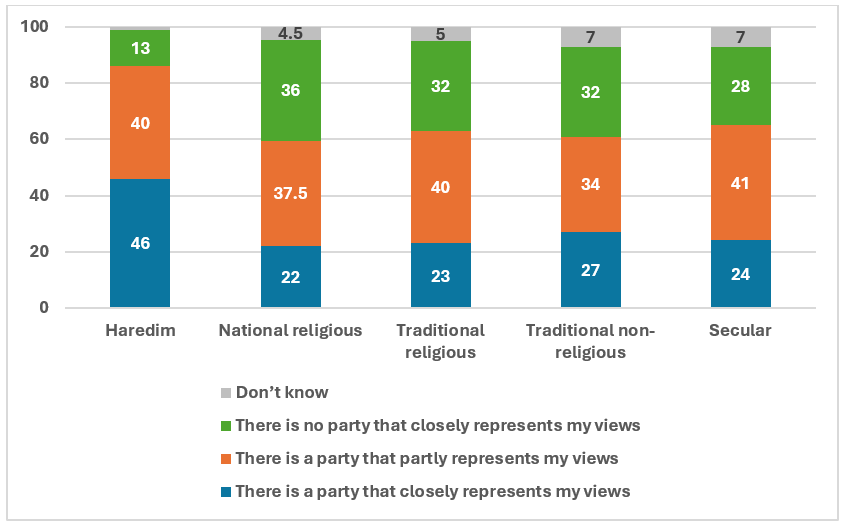
Segmentation of the Jewish sample by religiosity shows that the ultra-Orthodox (Haredim) feel the most represented by some party or other, while the national religious group has the highest percentage who feel that there is no party that represents them well. With the exception of the Haredim, the largest share of respondents in all groups say that there is a party that partly represents their views.
Is there a political party in Israel today that closely represents your views? (Jews, by religiosity; %)
Most Israelis think the elections will be free and fair
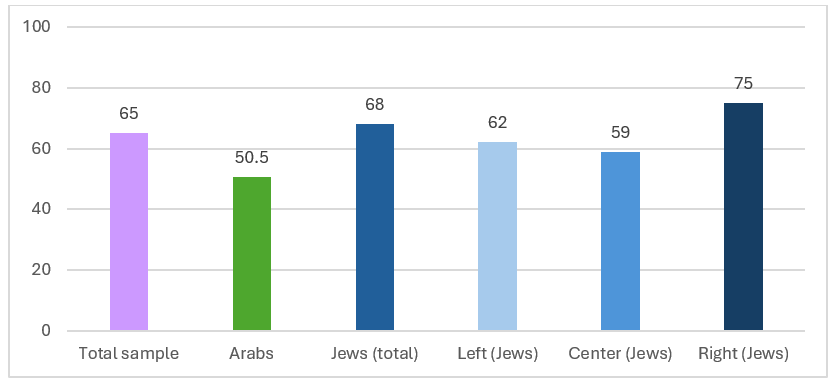
We asked, “Do you think the next Knesset elections will be fair and free?” A clear majority of the total sample (65%) responded in the affirmative. However, while a majority (68%) of Jews say that they expect the next elections to be free and fair, only about one-half (50.5%) of Arabs hold the same view. A breakdown of the Jewish sample by political orientation finds a majority in all three camps who think or are certain that the next elections will be free and fair, though this majority is particularly large on the Right.
Think or are certain that the next Knesset elections will be free and fair (%)
Large Share of Israelis Think Foreign and Domestic Entities Will Attempt to Sway the Elections
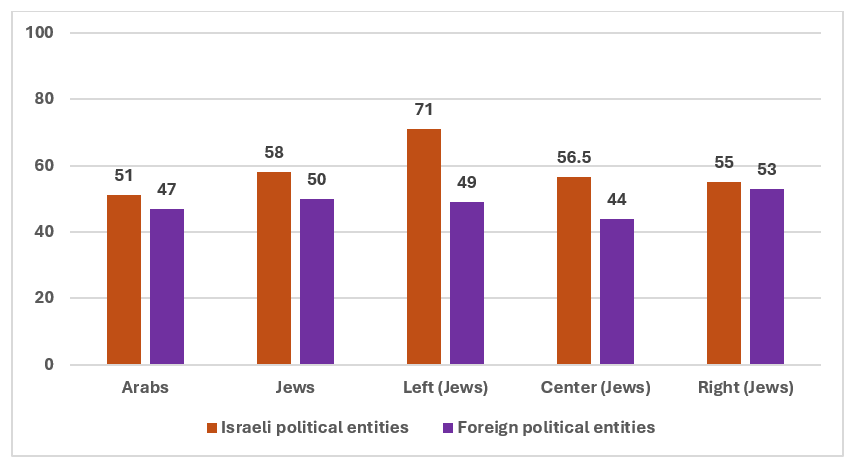
We asked two further questions: “How likely is it that political individuals or groups in Israel will attempt to sway the results of the next elections by improper means?” and, “How likely is it that foreign political entities (for example, other countries) will attempt, in various ways, to sway the results of the next elections in Israel?” We found that, in general, Arabs are slightly less suspicious than Jews about the likelihood of internal or external attempts to sway the election results, though in both cases almost half or more of the respondents rate this as quite or very likely.
When it comes to the possibility of internal interference in the process, the Left is more suspicious than the Right and the Center (Jewish sample). On the other hand, regarding interference by foreign entities, the proportion of those who rate this as likely is highest on the Right and lowest in the Center, with the Left in between. In all three camps, there is greater concern about the prospect of interference by internal elements than by external actors.
Think that it is very likely or quite likely that Israeli or foreign entities will attempt to improperly sway the results of the next elections (%)
Variety of Influences Voters’ Choice of Party
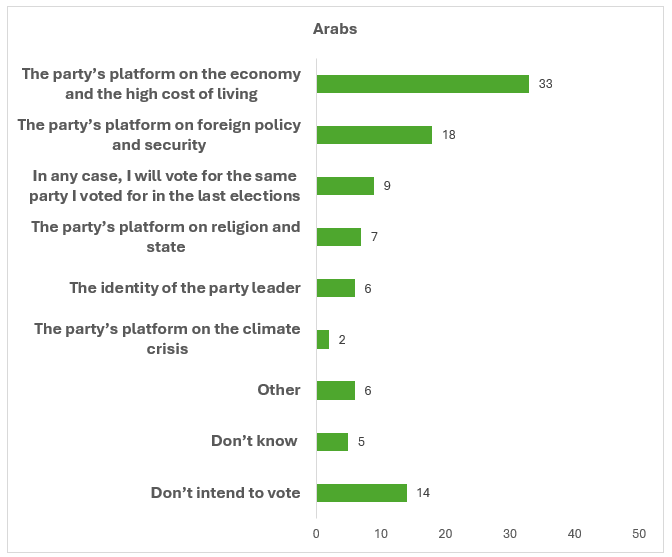
We wanted to know what influences voters’ decision on which party to vote for. We asked two questions, the first being: “Which of the following factors will most strongly influence your decision about which party to vote for in the next elections?” Among Jews, three factors top of the list: the party’s platform on foreign policy and security (20%), its platform on religion and state (19%), and its platform on the economy and the high cost of living (19%). Ranked slightly lower is the personal factor—the identity of the party leader (17%). Among Arab respondents, one issue stands out above all others: the party’s platform on the economy and the high cost of living (33%).
Factors most strongly influencing the decision about which party to vote for in the next elections (Jews and Arabs; %)
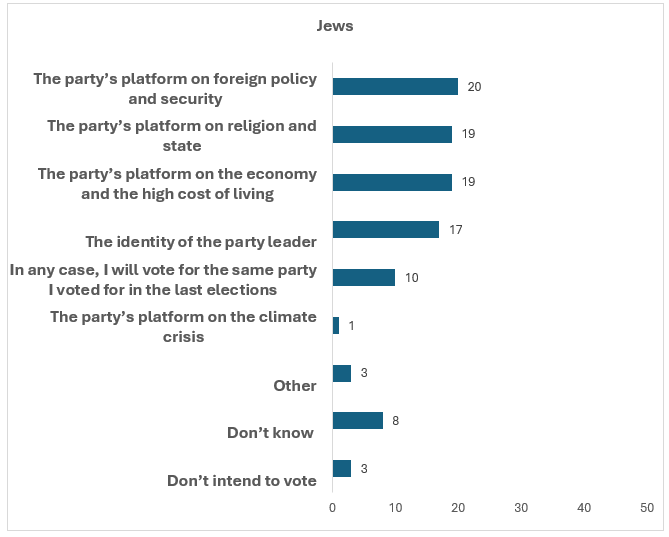
On the Left (Jewish sample), the largest share of respondents say that the most decisive factor is the party’s platform on issues of religion and state (24%). Respondents in the Center reported that the party’s platform on the economy and the cost of living (25%) is the most important factor for them when deciding which party to vote for, while for those on the Right, the factor that most strongly influences their decision is the party’s platform on foreign policy and security (22%).
The second question we asked in this context was “Which of the following issues/events will have the greatest impact on your decision about which party to vote for in the next elections?” The options we presented were:
- The events of October 7
- The judicial reform/overhaul
- Legislation on Haredi conscription
- Anti-government protests
- The Netanyahu trial
- The high cost of living
- The return of the hostages
On this question as well, the largest share of Arab respondents (49%) reported that the cost of living is the most important issue for them when deciding who to vote for. Among Jews, five issues/events were selected by very close (16-18%) shares of respondents as the dominant factors in determining which party they would vote for: the return of the hostages, the events of October 7, legislation on Haredi conscription, the high cost of living, and the judicial reform/overhaul.
Issues/events with the greatest impact on the decision about which party to vote for in the next elections (Jews and Arabs; %)
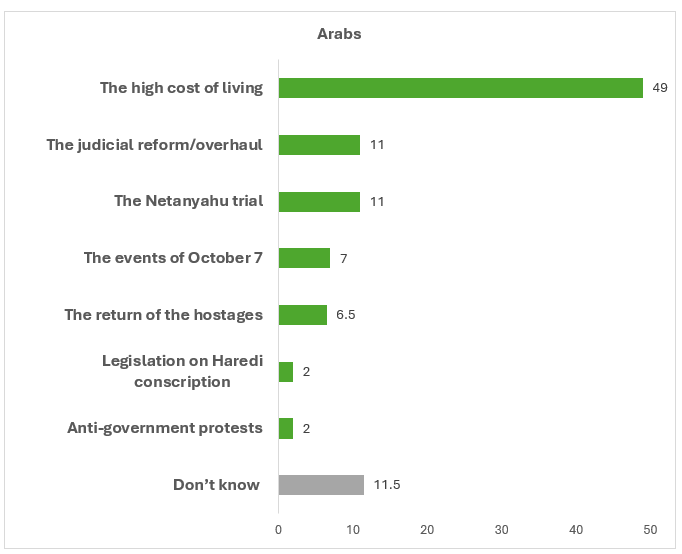
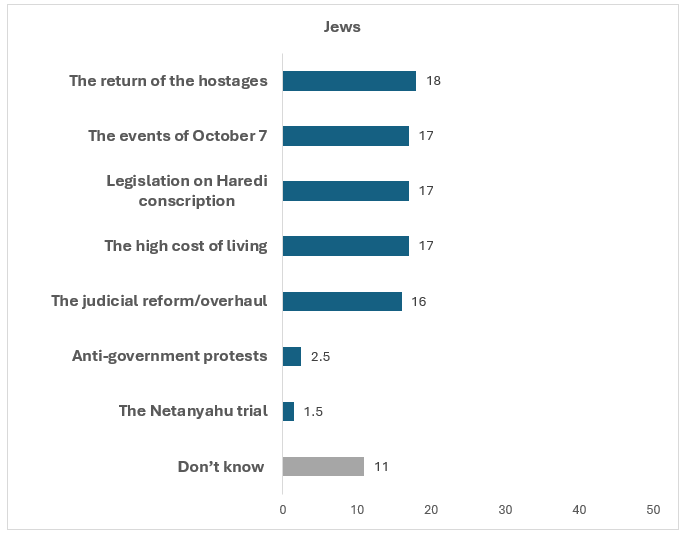
Breaking down responses in the Jewish sample by political orientation reveals that, for respondents on the Left, the two most important issues/events for deciding how to vote are the return of the hostages and the judicial reform/overhaul. In the Center, the return of the hostages and legislation on Haredi conscription are the most crucial issues, while on the Right, the cost of living ranks highest, followed by the events of October 7. Another notablea finding is the discrepancy between the greater importance attributed to the return of the hostages on the Left and the Center (27% and 28%, respectively) and the lesser importance attributed to it on the Right (12%). This gap is a good illustration of the politicization that this issue has undergone.
Majority of Arabs Say Political Parties’ Platform on Crime and Voting in Elections is Important
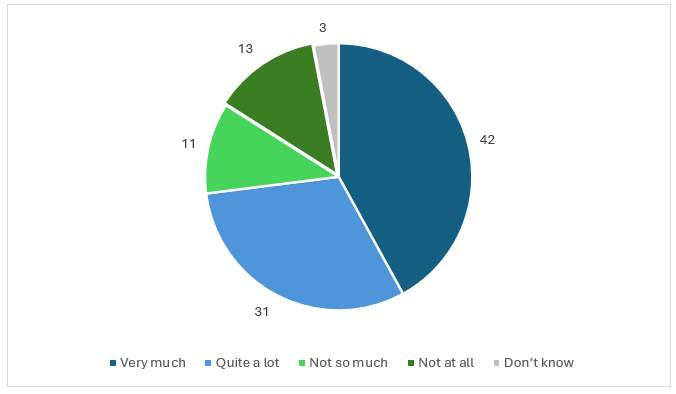
We asked only our Arab respondents another question about what influences their electoral preferences: “To what extent will their platform on the fight against crime [in Arab society] be a major factor in deciding which party to vote for in the next elections?” We found that a clear majority of around three-quarters attribute great importance to this issue.
To what extent will their platform on the fight against crime be a major factor in deciding which party to vote for in the next elections? (Arabs; %)
It Makes No Difference Who You Vote For; It Doesn’t Change the Situation
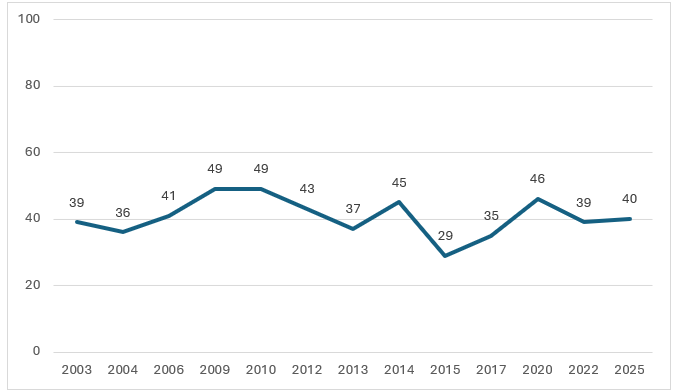
We asked our respondents to what extent they agree or disagree with the following statement: “It makes no difference who you vote for; it doesn’t change the situation.” This question has already been asked 13 times in Democracy Index surveys. In the 2025 survey, 40% of the total sample agreed with this statement and 56% disagreed with it. Among Jews, a much larger share of respondents disagree than agree, but Arab respondents are almost evenly divided between the two opposing views.
Agree that it makes no difference who you vote for, as it doesn’t change the situation, 2003–2025 (total sample; %)
Breaking down responses in the Jewish sample by political orientation reveals that the share of respondents who agree that “it makes no difference who you vote for, as it doesn’t change the situation” is smallest on the Left (15%) and highest on the Right (43%), with the Center somewhere in between (36%).
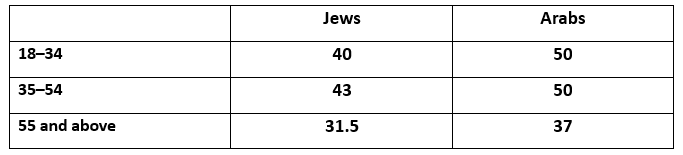
Segmentation by age finds that among both Jews and Arabs, the level of agreement with the statement is much higher in the two younger age groups than in the older group.
Agree that it makes no difference who you vote for, as it doesn’t change the situation, by age (%)