

Can this year’s elections reverse the decline in women’s representation in Israel?
The regression in women’s representation in Israel is not a decree of fate but the result of political choices, and precisely in an election period, parties have a real opportunity to reverse this trend.
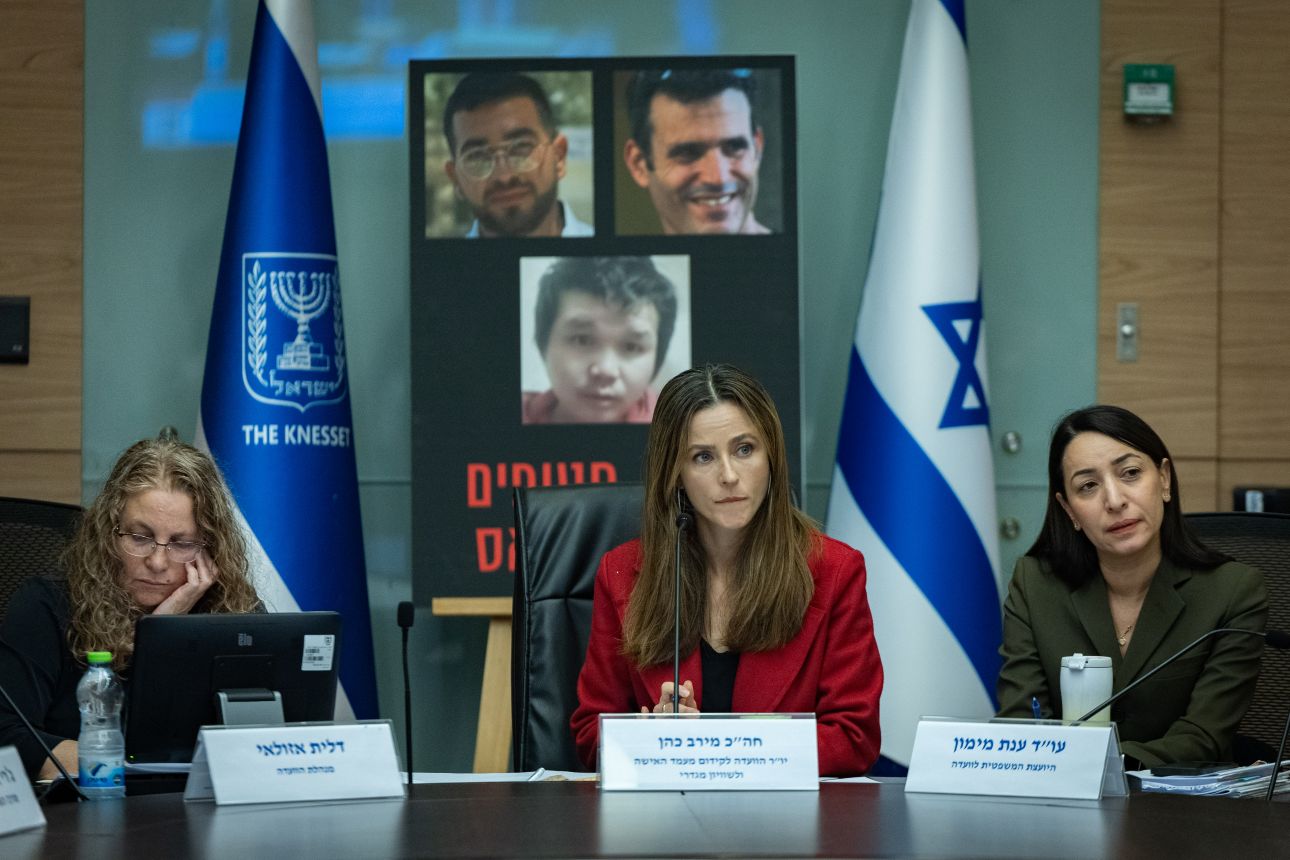
Photo by Yonatan Sindel/Flash90
In the latest Global Gender Gap Index published by the World Economic Forum, Israel was ranked 104th out of 148 countries in the category of political empowerment. This category examines the extent of women’s representation in government and parliament, and the low ranking reflects a troubling reality: only 16% of government ministers are women, and only 24% of Knesset members are women. Not included in this already-low ranking is women’s representation in senior public service positions – currently, not a single woman serves as director general of a government ministry, and only 14% of deputy directors-general in government ministries are women.
Israel has not always been ranked so low on the index of women’s political representation. This is a significant regression: in 2022 Israel was ranked 61st, and previously 48th. The sharp decline in the ranking reflects a real retreat in women’s representation in Israel. Since this is a relative index, it is also influenced by the fact that many other countries have improved their standing in parallel, while Israel has fallen behind.
There are various trends, local and global, that can help explain Israel's negative shift – foremost among them is the strengthening of deeply conservative worldviews within Israel that do not recognize women’s place in the public sphere.
A prominent expression of these views can be seen in the current struggles surrounding women’s service in the military. Even measures framed as limited, such as calls to exclude women from certain units to promote the integration of ultra-Orthodox Israelis, are deeply problematic. The discourse has gone even further, with some calling into question not only women’s service in combat roles, but even their very place in the military, as though the IDF were inherently a male sphere. These positions seek to roll back a basic conception of civic equality and challenge the very presence of women in public spaces, while ignoring, for example, the heroism of many women on October 7th.
This same worldview is also reflected in the government’s ongoing failure to appoint women to key positions in the civil service, foremost among them the role of director general of government ministries, as previously noted. This is despite legislation and unequivocal judicial rulings requiring adequate representation. Indeed, since the Court ruled that the government is violating the law by failing to appoint women directors general, eight male directors-general have been appointed. In this context, it is difficult to avoid the conclusion that these measures signal not only a lack of meaningful commitment to women’s equal participation, but also appear to reflect a view that the public sphere is not a natural place for women.
This picture is further reinforced by legislation that significantly broadens and normalizes already problematic forms of gender segregation in academic institutions, as well as Knesset conferences dealing with the “preservation of women’s modesty.” These steps no longer appear marginal or technical; they express an attempt to reshape the boundaries of women’s legitimacy in the public sphere, returning them to defined and restricted roles. These trends are not unique to Israel. In countries such as Hungary, Romania, and Croatia, struggles for gender equality that had already gained public and institutional recognition have in recent years been replaced by conservative discourse emphasizing the “traditional” family and the importance of women’s historical role in the home rather than in the public sphere. Accordingly, the regression in women’s representation is part of a broader process of ideological change.
Women's representation is a fundamental principle of liberal democracy, in which all sectors of society are represented, as the legitimacy of democratic decision-making depends on the inclusion of all segments of society in positions of power and authority. And indeed, in the context of democratic backsliding, we see the role of women in the public sphere come increasingly under question as institutions that protect women’s rights—courts, government bodies tasked with advancing equality, and civil society organizations—are themselves under attack.
In the current political and social context, particularly since the outbreak of the war, the issue of gender equality has been pushed even further down the public agenda. Even among groups that in principle support gender equality, there is a noticeable tendency to relinquish it as a secondary issue in times of crisis, which undoubtably deepens existing gaps. Recently, the argument has increasingly been heard that since there are women who do not advance gender equality, and even act to undermine women’s rights, equal representation isn't the answer to protecting women's rights, policy is the answer. But this argument misses the point: representation is a necessary but insufficient condition for advancing women's rights. First, the very existence of diverse women with different, sometimes opposing views does not diminish the value of equal representation. Second, studies show that even with some women working against equal representation, women do ultimately advance more legislation related to equality in the Knesset. Thus, the struggle for representation does not replace the struggle for equitable policy, but rather complements it. One should not assume that the mere presence of women will necessarily lead to equality, but in the absence of representation, the chances of this happening are significantly lower.
Looking ahead to the upcoming elections, the picture is not encouraging. As always, there are no women in the ultra-Orthodox parties, and none are expected. In the rest of the political system, not a single party is led by a woman, and most parties have yet to commit to equal representation on their candidate lists. Moreover, most parties have yet to articulate a meaningful commitment to advancing gender equality as a central platform for the elections. Data from IDI's Israeli Democracy Index show that women are more concerned about the possibility that the next elections will not be equal and fair: 31% of women express such concern, compared to 22% of men. It can be assumed that this concern stems, among other things, from a sense of exclusion and the lack of representation in decision-making centers. This is further evidence of the importance of equal representation of women as a foundational condition for a functioning democracy.
The picture that emerges in Israel is clear: regression in women’s representation is not a decree of fate but the result of political choices, and precisely in an election period, parties have a real opportunity to reverse the trend and strengthen democracy.
This article was published in the Jerusalem Report.