

Public Opinion Pre-War and in Week One of Operation Roaring Lion
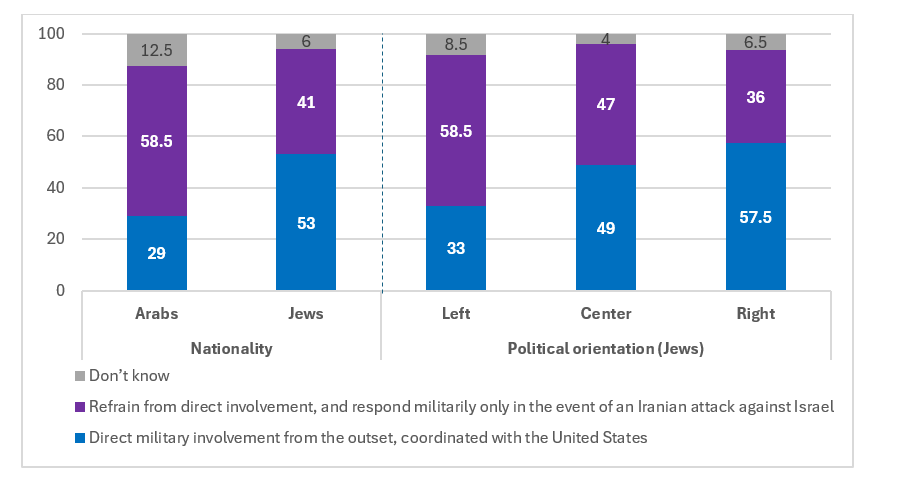
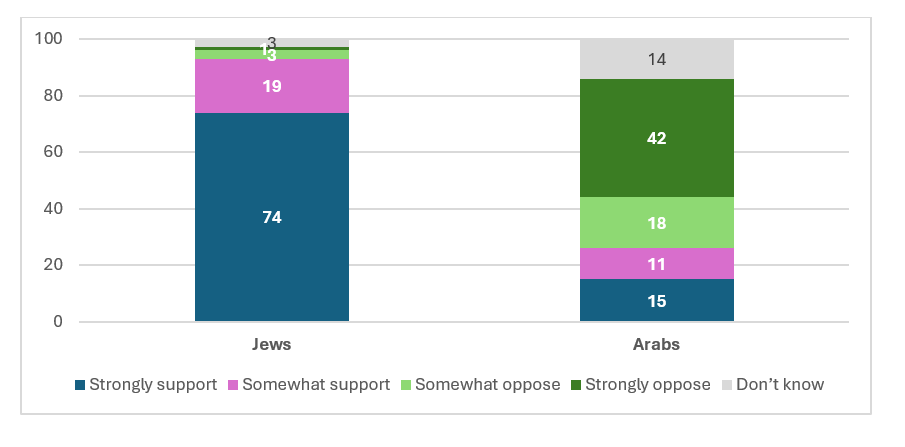
Just before the launch of the war, 53% of Jews and 29% of Arabs supported direct military involvement with the US in an attack against Iran, while 41% of Jews and 58.5% of Arabs supported responding only in the event of a direct Iranian attack against Israel. After Operation Roaring Lion was launched, in close coordination with the US, the overwhelming majority of Jews (93%) and minority of Arabs (26%) supported it.
Photo by Chaim Goldberg/Flash90
Methodology
This survey combines findings from the Israeli Voice survey conducted at the end of February with findings from a flash survey carried out immediately after the launch of Operation Roaring Lion, at the beginning of March.
Israel’s Participation in the Attack on Iran
- Just before Operation Roaring Lion, at the end of February, 53% of Jews said they supported direct Israeli military involvement in an attack on Iran in coordination with the United States, an increase of 5 percentage points from the previous measurement in January 2026. In February, 41% expressed a preference for Israel refraining from direct involvement and only responding militarily in the event of an Iranian attack, compared to 46% in January.
- Among Arabs, the level of support for direct Israeli military involvement (29%) was significantly lower in February than among Jews, but this was also an increase of 4 points compared to January. In both surveys, the majority preferred Israeli involvement only in response to an attack by Iran.
- Differences among political camps (Jews): As in January, the majority on the Left preferred Israeli involvement only in response to an Iranian attack, while a similar majority on the Right supported direct involvement from the outset in a combined attack alongside the United States. The Center was evenly divided.
In the event of an American attack against Iran, what do you think should be the extent of Israel’s involvement? (%), February 2026
Public Support for Operation Roaring Lion
- After the launch of the operation, a large majority of the Jewish public (93%) supported it, as contrasted with a small minority (26%) of the Arab public (total sample, 82%).
- A breakdown by political orientation (Jewish) finds majority support for the operation in all three camps, though this majority is smaller on the Left than in the Center and on the Right (Left, 76%; Center, 93%; Right, 97%).
Do you support or oppose Operation Roaring Lion (the joint US-Israeli military attack on Iran)? (%), March 2026
Netanyahu and Directing the Operation
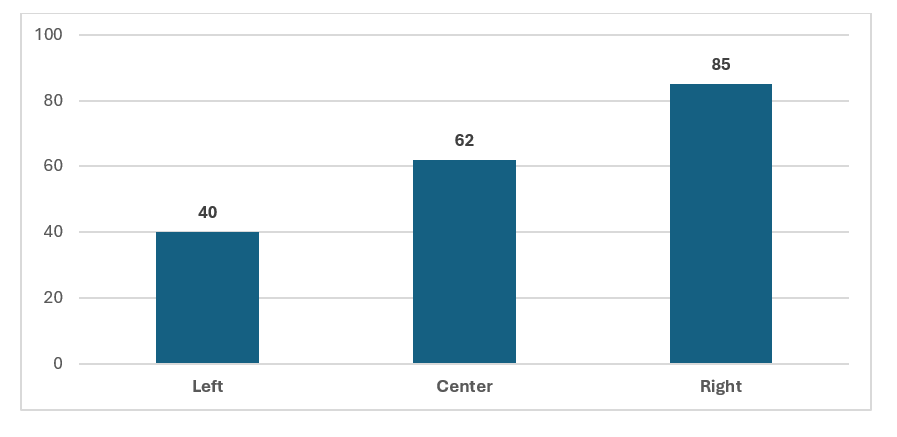
- During the first few days of the operation, we found that about three-quarters (74%) of the Jewish public trusted Netanyahu to do a good job of directing the operation. Among Arabs, only 16% expressed a similar faith (total sample, 64%).
- Segmentation by political orientation (Jews) reveals that a minority of those on the Left trust the prime minister (40%), compared to a majority of those in the Center and on the Right (62% and 85%, respectively).
Trust Prime Minister Netanyahu to very large or fairly large extent to direct the operation properly (Jews; %), March 2026
Feeling Protected
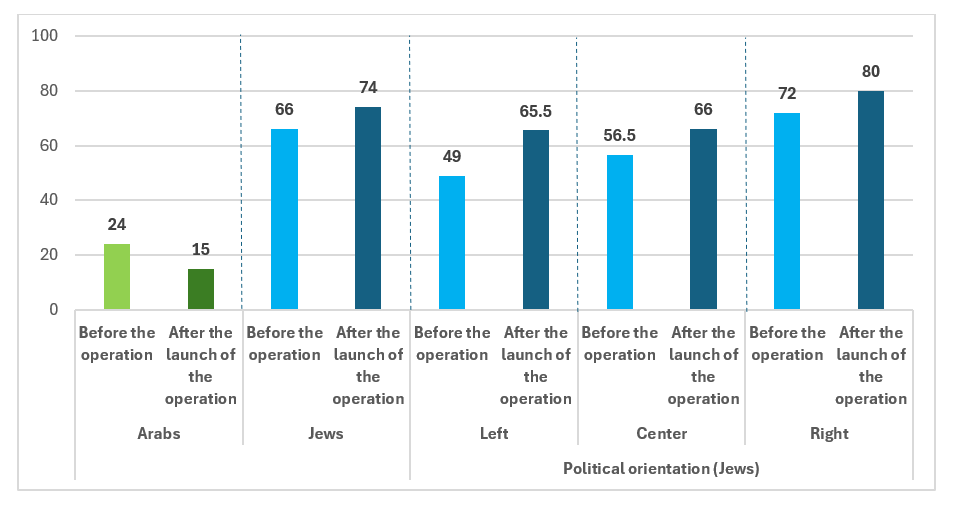
- In the Jewish public as a whole, and in all political camps (Jews), there has been a significant increase since the beginning of the operation in the share of respondents who feel protected from Iranian attacks. The largest rise was found on the Left, where the percentage of those who feel protected was the lowest before the operation but drew level with the Center after the fighting began. It is possible that the small damage caused by the Iranian attacks in the first days of the operation, compared to the damage caused during Operation Rising Lion in June 2025, led to this increase in the sense of feeling protected among Jews.
- Among Arabs, we found an opposite trend: Only around one-quarter felt protected before the operation, and this proportion fell even lower after the operation began.
Feel protected to a very large or fairly large extent from Iranian attacks (%), February and March 2026
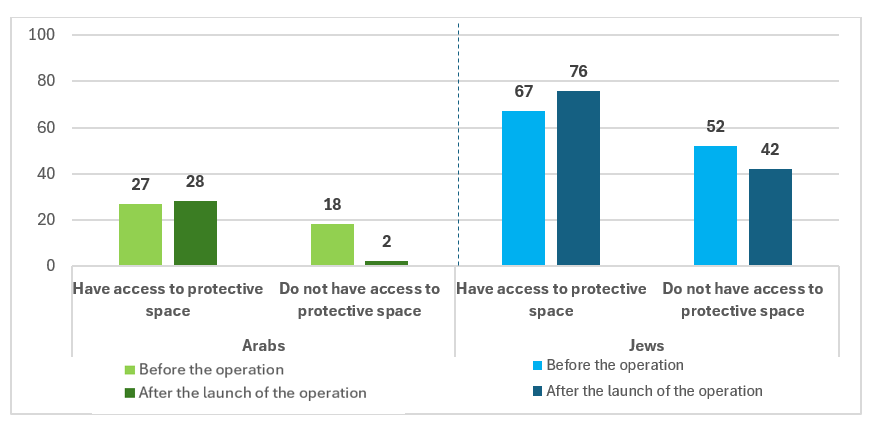
- Among Jews with access to protective spaces (a safe room in their home or public shelter nearby), there was a sizable increase in the sense of feeling protected after the start of the operation (up 9 percentage points), while there was almost no change among Arabs with access to a protective space.
- Among those who do not have access to a protective space, among both Jews and Arabs, there was a significant decline in the sense of feeling protected following the launch of the operation.
Feel protected to a very large or fairly large extent from an attack by Iran (%), February and March 2026
Israel’s Preparedness to Protect Vital Infrastructure
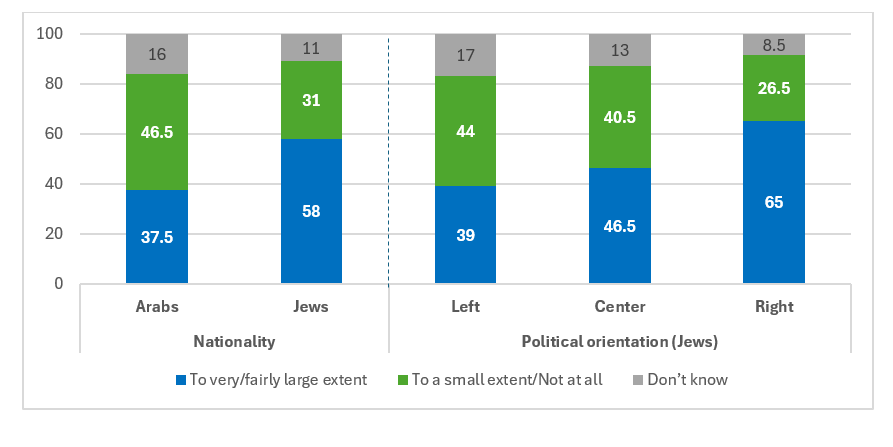
- Prior to the operation, 55% of the Israeli public thought that the state was well prepared to protect vital infrastructure from attack by Iran, while 34% thought that it had not made sufficient preparations.
- Among Jews, a majority thought that the state was well prepared, while among Arabs, the largest share (though not the majority) held the opposite view.
- Two-thirds of those on the Right (Jews) said that the state was well prepared to protect vital infrastructure, compared to less than half of the respondents in the Center, and an even smaller share of those on the Left (40%).
To what extent do you think that the state has made preparations to defend vital infrastructure (electricity, water, communications, etc.) in the event of an attack by Iran (%), February 2026
President Trump’s Commitment to Israel’s Security
- Following the launch of Operation Roaring Lion, there was a slight increase in the proportion of Jews who think that Israel’s security is a central consideration for President Trump, relative to October 2025. By contrast, there was a decline in the corresponding share of Arabs.
- This is presumably related to the different levels of support and opposition in both publics with regard to the current combined operation against Iran.
Think that Israel’s security is a central consideration for President Trump (%)
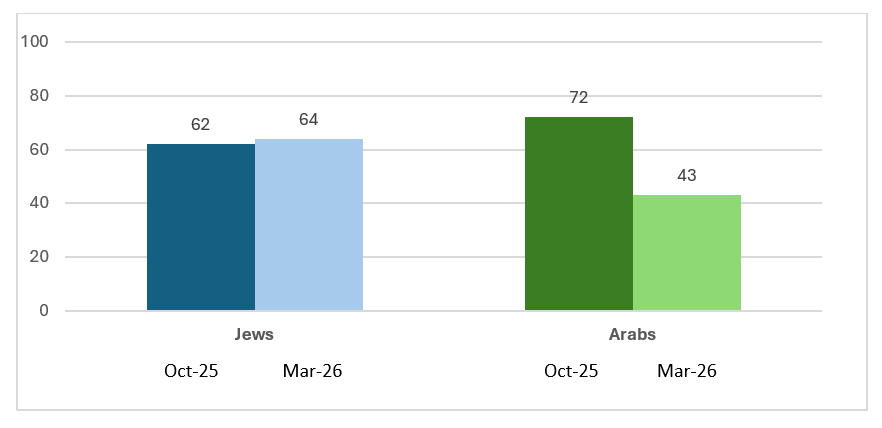
- We also found large differences on this question between political camps in the Jewish public. On the Left, only a minority (34.5%) think that Israel’s security is a central consideration for President Trump, while this view is held by a majority of those in the Center and on the Right (62% and 70%, respectively).
Pardoning Netanyahu
Recently, US President Trump has referred on several occasions to the issue of granting a pardon to Prime Minister Netanyahu, and even rebuked Israeli President Herzog for not having done so. We asked our respondents whether this intervention by the American president in Israeli affairs is legitimate or not legitimate.
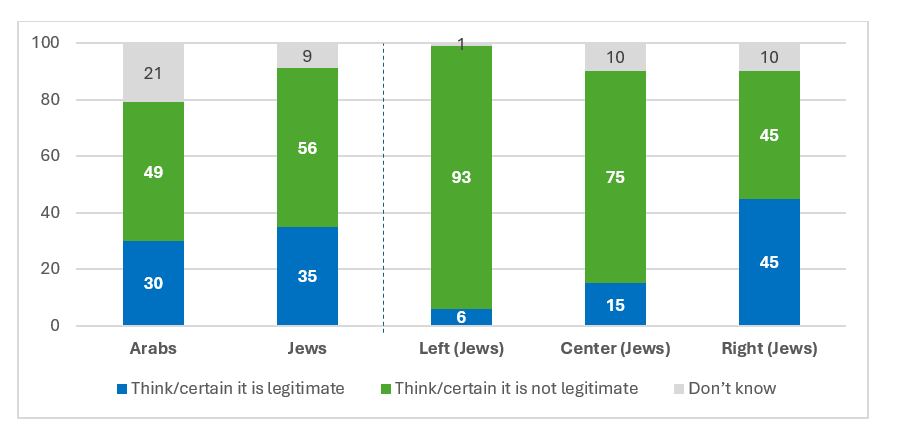
- The majority of the public thinks this intervention is not legitimate. This is the view of the largest share among both Jews and Arabs.
- Breaking down the responses in the Jewish sample by political orientation finds an equal divide on the Right between those who hold each of these views, compared to a considerable majority in the Center, and an even larger majority on the Left, who think that Trump’s intervention is not legitimate.
Recently, US President Trump said that Israeli President Herzog should be ashamed of his refusal to grant a pardon to Prime Minister Netanyahu. In your opinion, is this intervention in Israeli affairs legitimate or not legitimate? (%), February 2026
How Long Should the Operation Against Iran Continue?
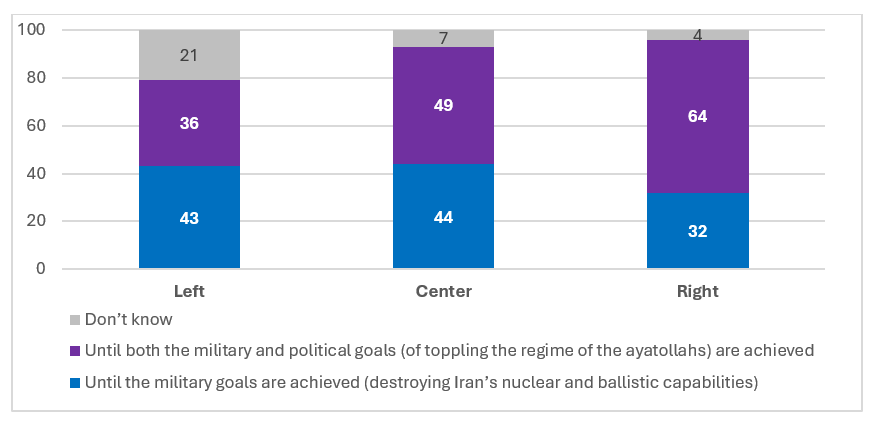
We presented our survey participants with two response options: (1) the operation should continue until all its military goals are achieved (destroying Iran’s nuclear and ballistic capabilities); and (2) the operation should continue until both the military goals and political goals (of toppling the regime of the ayatollahs) are achieved.
- Among Jews, the majority think that the operation should continue until both the military and political goals are achieved (57%). By contrast, 36% think that it should be stopped after achieving only the military goals.
- Among Arabs, the largest share by far (52%) selected the “don’t know” response, and therefore we did not conduct further segmentation of the data.
- A breakdown by political orientation (Jews) reveals that the largest share of those on the Left (43%) are in favor of ending the operation after achieving its military objectives alone. In the Center, about half think that the operation should continue until the political goals are achieved as well (49%), while on the Right, a majority of about two-thirds think that it should be stopped only after achieving both military and political goals.
How long should the operation against Iran continue? (Jews; %), March 2026
Investigating the Events of October 7
In the survey held after two years of war (in September 2025), we found that while the majority of the public supported the establishment of a state commission of inquiry (Jews, 75.5%; Arabs, 68%), there were considerable differences between political camps in the Jewish public, with support for such a commission of inquiry standing at 97% on the Left, 85.5% in the Center, and 68% on the Right.
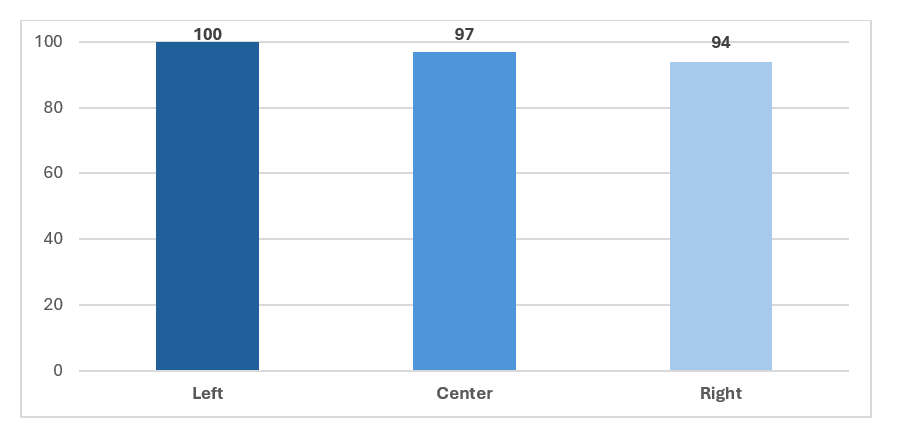
We decided to ask respondents about their desire for an investigation per se to be held, without specifying which body would do so, and we found that the percentage of those who support holding an investigation of the events has increased considerably. In response to the question, “Regardless of the method, whether a commission or any other form of inquiry, how important is it in your opinion to investigate what led to October 7 and what happened on October 7, in order to draw conclusions for the future?”:
- 92% of the total sample (95% of Jews and 76% of Arabs) said that it is important to investigate. There was almost no difference between the different political camps (Jews), with the sharpest increase being found on the Right (from 68% to 94%).
This finding supports the hypothesis that the main bone of contention is not whether or not the events of October should be investigated, but rather the mechanism used for such an inquiry, reflecting the political polarization regarding this issue.
Think that it is important now to investigate what led to October 7 and what happened on October 7, in order to draw conclusions for the future, regardless of the method of inquiry (Jews; %), February 2026
Israeli Voice Index – February 2026
The Israeli Voice Index for February 2026 was prepared by the Viterbi Center for Public Opinion and Policy Research of the Israel Democracy Institute. In the survey, which was conducted on the internet and by telephone (supplements of groups that are not sufficiently represented on the network) between February 23 to March 1, 2026, 608 men and women were interviewed in Hebrew and 157 in Arabic, constituting a representative national sample of the entire adult population of Israel aged 18 and older. The maximum sampling error for the entire sample was ±3.54% at a confidence level of 95%. The fieldwork was done by the Shiluv-i2r Research and Polling Institute. For the full data file see: https://dataisrael.idi.org.il
"Operation Roaring Lion" Survey
The survey was prepared by the Viterbi Center for Public Opinion and Policy Research of the Israel Democracy Institute. In the survey, which was conducted on the internet From March 2 to March 3, 2026, 500 men and women were interviewed in Hebrew and 99 in Arabic, constituting a representative national sample of the entire adult population of Israel aged 18 and older. The maximum sampling error for the entire sample was ±4.00% at a confidence level of 95%. The fieldwork was done by iPanel.. For the full data file see: https://dataisrael.idi.org.il