

A Majority of Jewish Israelis Believe that the Iran War Goals are Attainable; Majority of Arab Israelis Believe they are not
A majority of Jews (82%) and just over one-half of Arabs (52%) think that the interests of the US and Israel are very strongly or fairly strongly aligned in the joint operation in Iran. Around 70% of Jews think that Iran’s nuclear project and the threat of ballistic missiles can be eliminated. A smaller, though still large, share (61%) believes that the regime of the ayatollahs can be overthrown; Arabs are more pessimistic - just over a quarter, but less than a third, think that each of these goals can be achieved.

Photo by Nati Shohat/Flash90
Methodology
The survey was conducted by the Viterbi Family Center for Public Opinion and Policy Research at the Israel Democracy Institute between March 9–11, 2026. It was based on a representative sample of the population in Israel aged 18 and above, comprising 502 respondents interviewed in Hebrew and 101 in Arabic.
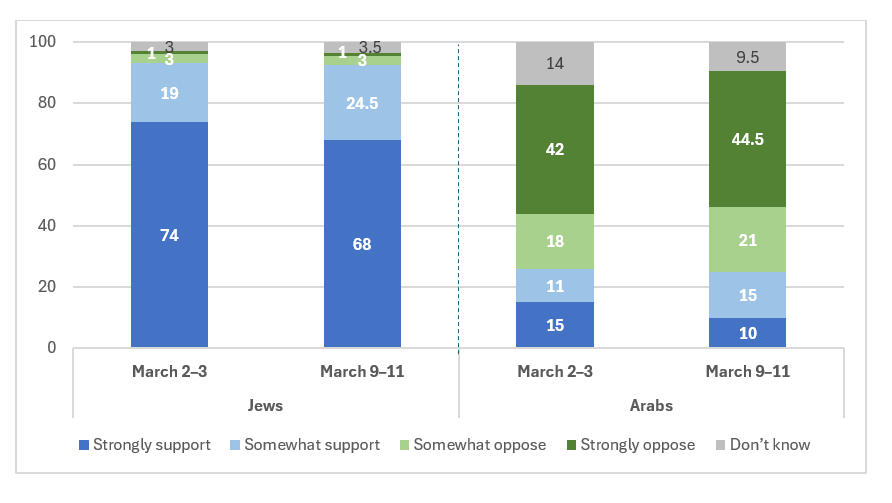
- After 12 days of the operation, a large majority of Israelis still support it (total sample, 81%).
- Among Jews, we found almost no change in support since the first few days of the operation (92.5% now, compared to 93% in the previous survey). However, the proportion of respondents who “strongly support” the operation has declined from 74% to 68%.
- Among Arabs, too, the situation has not changed: As in the previous survey, the majority oppose the operation, and the size of this majority has even increased (65.5% now, compared to 60% in the previous survey). This rise has come at the expense of those who selected the “don't know” response, whose share this time is smaller than before.
- Again, as in the previous survey, there is majority support for the operation in all three political camps (Jews), but this majority is lowest among those who define themselves as on the Left (68%), and is much higher in the Center (95%) and on the Right (96%).
- Age was not found to be a factor influencing support for the operation. Gender was found to be influential, but only among Arabs: Arab women support the operation much less than do Arab men (14% versus 36%, respectively). Among Jews, no gender difference was found.
Do you support or oppose Operation Roaring Lion (the joint US-Israeli military attack on Iran)? (%), March 2026
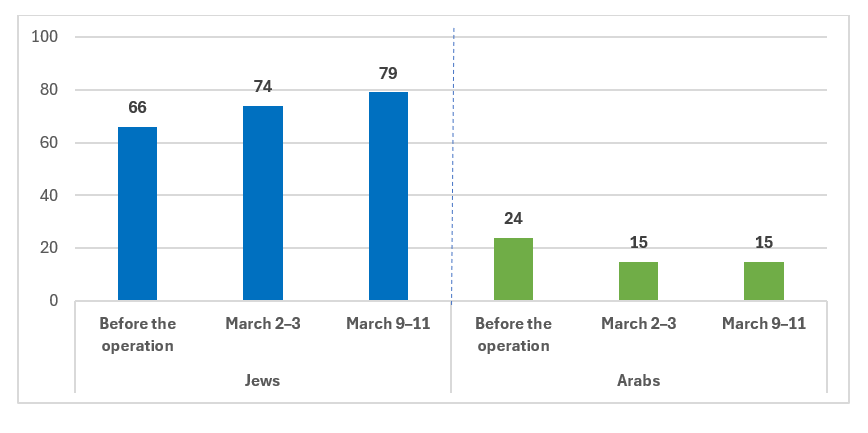
- Among Jews, the level of feeling protected from Iranian attacks remains high, and even increased by 5 percentage points relative to the previous survey, conducted in the first week of the operation, from 74% then to 79% who feel protected now.
- Breaking down responses in the Jewish sample by political orientation finds that the share of those who feel protected remains similar on the Left (66% in both surveys) and on the Right (80% in the first week and 83% now), while in the Center, this share has risen from 66% to 74%.
- Among Arabs, the sense of feeling protected remains low and unchanged.
Feel protected to a very large or fairly large extent from Iranian attacks (%), February and March 2026
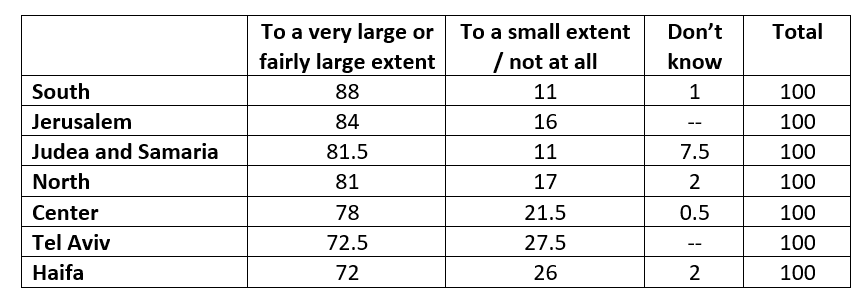
- Breaking down responses in the Jewish sample by area of residence reveals that the districts where residents least feel protected are Tel Aviv, Haifa, and the center of Israel. In the north, despite the high exposure to Hezbollah attacks, a relatively low proportion of residents do not feel protected. A similar analysis of the Arab sample was not possible due to the small number of respondents in certain geographical areas.
On a personal level, to what extent do you feel protected from Iranian attacks? (Jews; %),
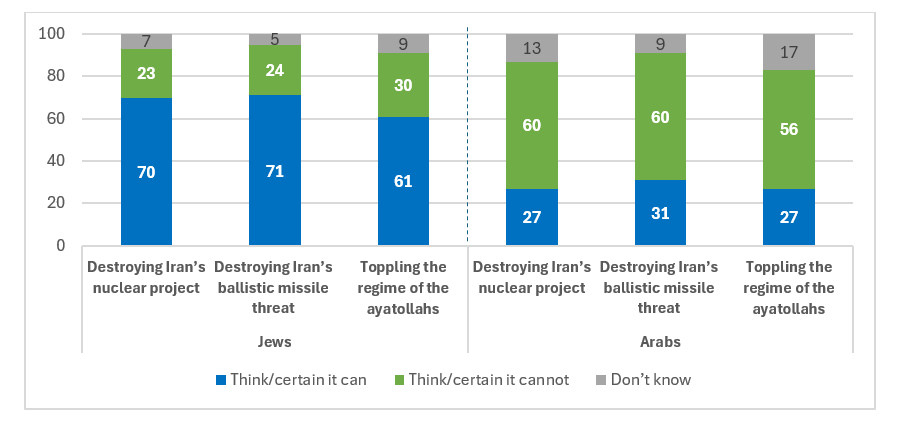
- Around 70% of Jews think that Iran’s nuclear project and the threat of ballistic missiles can be eliminated. A smaller, though still large, share (61%) believes that the regime of the ayatollahs can be overthrown.
- The Arab public is much more pessimistic: Only just over a quarter, but less than a third, think that each of these goals can be achieved.
In your opinion, can each of the following goals of the operation be achieved? (%)
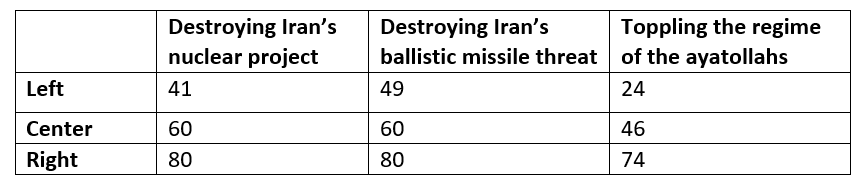
- Breaking down responses in the Jewish sample by political orientation reveals significant differences between the camps. On the Right, some three-quarters or more think that each of the goals can be achieved; in the Center, 60% think that destroying Iran’s nuclear project and its ballistic missile threat can be achieved, but only less than half hold the same view regarding the overthrow of the regime; while on the Left, around one-half think that the ballistic threat can be eliminated, less than half think that Iran’s nuclear project can be destroyed, and only around one-quarter think that toppling the regime is an achievable goal.
Think/certain that each of the following goals of the operation can be achieved (Jews; %)
- A majority of Jews (82%) and just over one-half of Arabs (52%) think that Israel’s interests and those of the United States are very strongly or fairly strongly aligned, in the context of the joint operation in Iran.
To what extent are Israel’s interests and the interests of the United States currently aligned, in the context of the operation in Iran? (%)
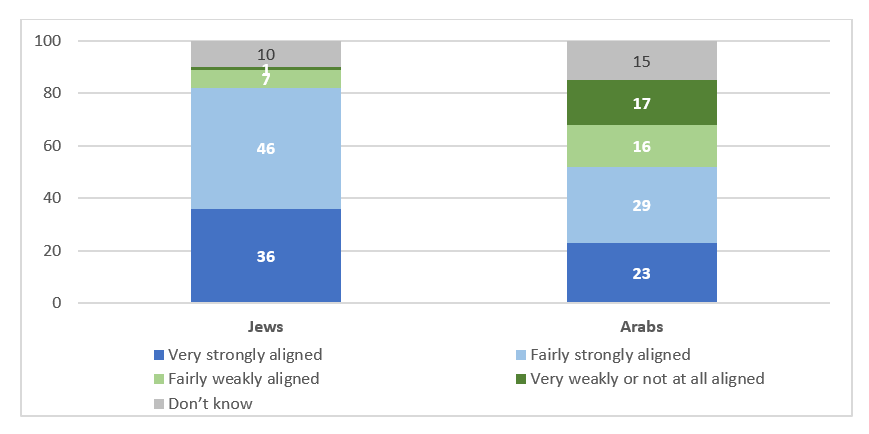
- Assessments of the alignment of interests differ among the three political camps (Jews). On the Left, slightly more than one-half (52.5%) think that Israeli and US interests are aligned, compared to a large majority (86%) in the Center and on the Right.
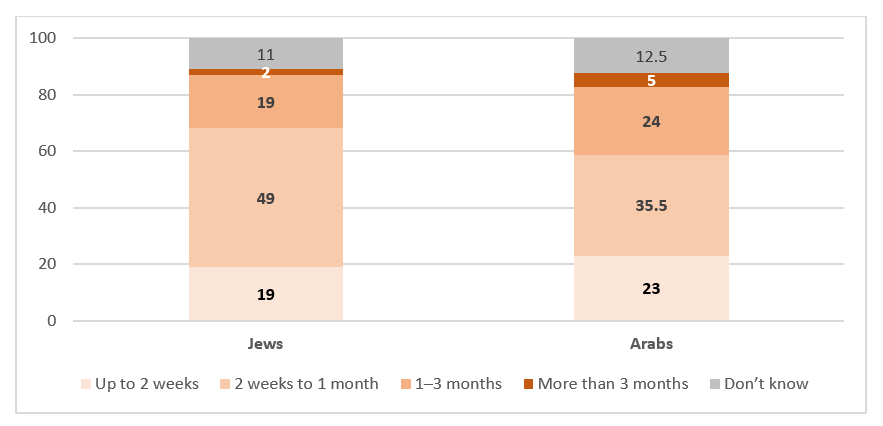
- A clear majority—just over two-thirds of Jews (68%), and a slightly smaller majority of Arabs (58.5%)—estimate that the operation will end either within two weeks or within two weeks to a month.
- The differences in estimates on this issue between political camps (Jews) are small.
How long do you think Operation Roaring Lion will continue? (%)
The survey was prepared by the Viterbi Center for Public Opinion and Policy Research of the Israel Democracy Institute. In the survey, which was conducted on the internet from March 9 to March 11, 2026, 502 men and women were interviewed in Hebrew and 101 in Arabic, constituting a representative national sample of the entire adult population of Israel aged 18 and older. The maximum sampling error for the entire sample was ±3.99% at a confidence level of 95%. The fieldwork was done by iPanel. For the full data file see https://dataisrael.idi.org.il.