How Votes Become Knesset Seats
Learn the basics of how the votes Israelis cast on election day are counted and turned into seats in Israel's Knesset.
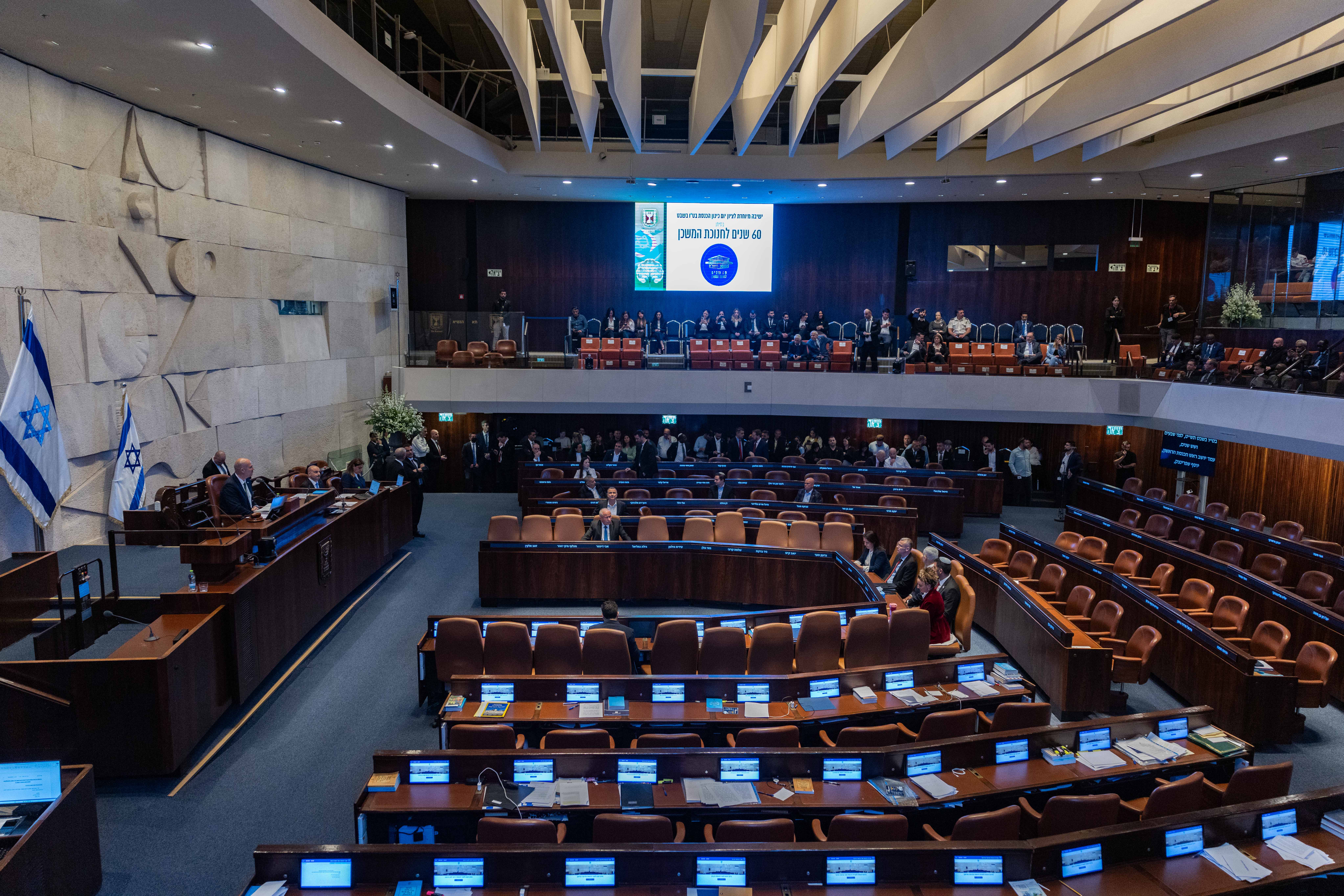
Photo by Yonatan Sindel/Flash90
In Israel's unicameral parliament—that is, a legislative body with one chamber—the 120 members of Knesset (MKs) are elected in a single, nationwide constituency. Voters elect party lists, not members of Knesset, and seats are allocated in a proportional representation system. The following are the steps taken that turn the votes of Israeli voters into seats in Knesset.
Step one: calculating the valid votes
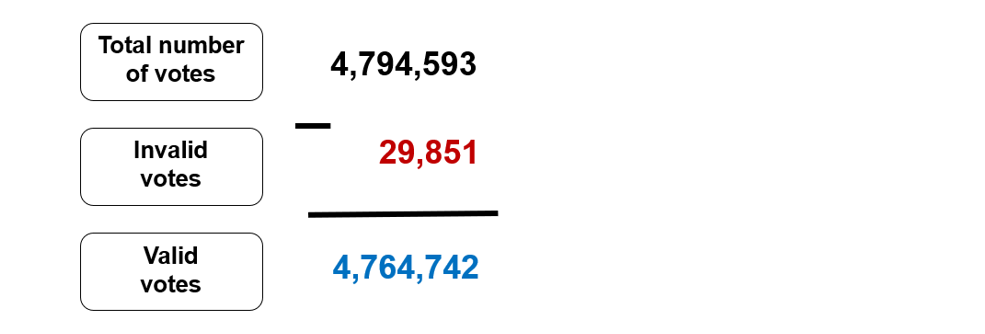
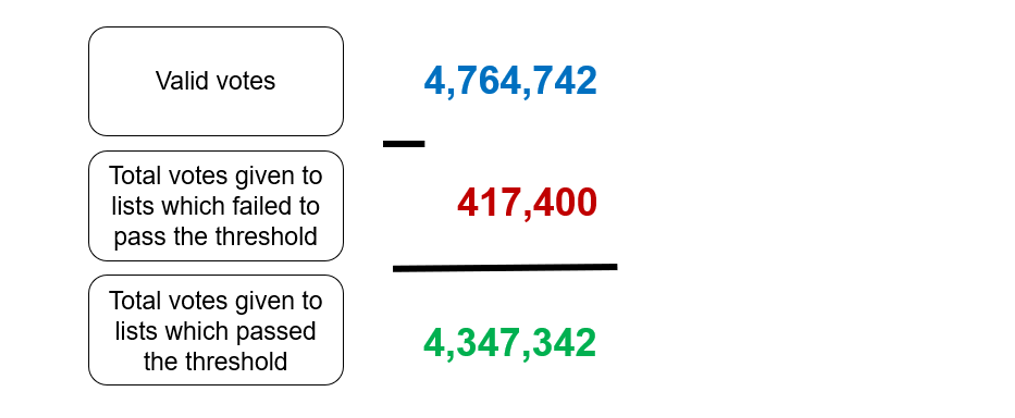
At the end of the elections, all ballots are counted to determine the total number of votes. Invalid votes, such as blank votes or envelopes with multiple ballots, are subtracted, and the total number of valid votes is calculated.
For example, this was the calculation in the 2022 elections:
Step two: calculating how many votes are needed to meet the electoral threshold
Israel applies a nationwide electoral threshold, which determines the percentage of the vote needed in order to have a party list represented in Knesset. This means that party lists that have not met this minimum threshold of votes is not entitled to parliamentary seats.
Since the 2015 election, the electoral threshold has been set at 3.25% of the valid votes. Therefore, to determine the number of votes needed to gain Knesset seats, the following calculation is applied (with the 2022 election results as an example).

Step three: calculating the votes won by party lists that passed the threshold
This stage looks at the number of votes given to each party list to determine whether it passed the threshold.
All the votes given to lists which did not pass the threshold are summed. These votes won’t count in the next stages.
These votes are subtracted from the total number of valid votes. The result is the total votes allotted to party lists which passed the threshold.
Step four: determining the seat quota
At this stage, the seat quota is determined – this is the number of votes required per seat in Knesset. The total votes given to lists which passed the threshold is divided to 120.
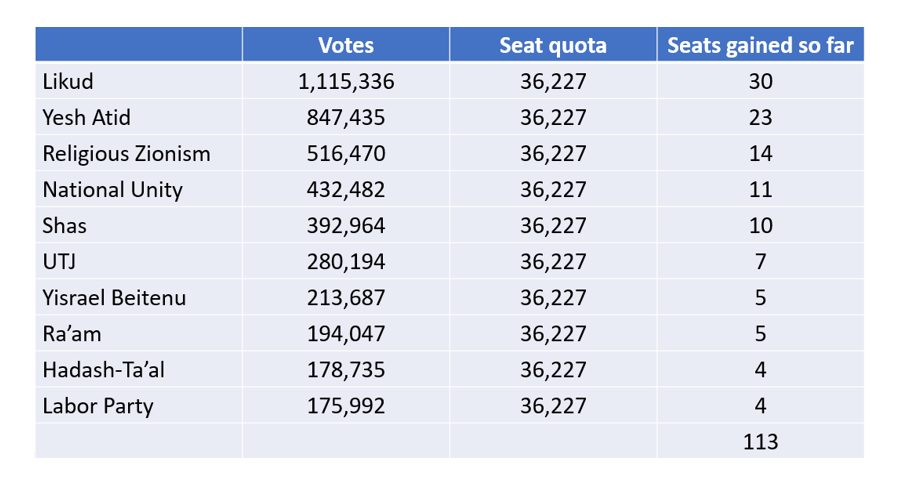
In the 2022 elections, for example, the quota was 36,227 votes.

Step five: the first allocation of seats
At this stage, the first allocation of seats is conducted. The total votes given to each party list are divided by the seat quota determined in the previous stage.
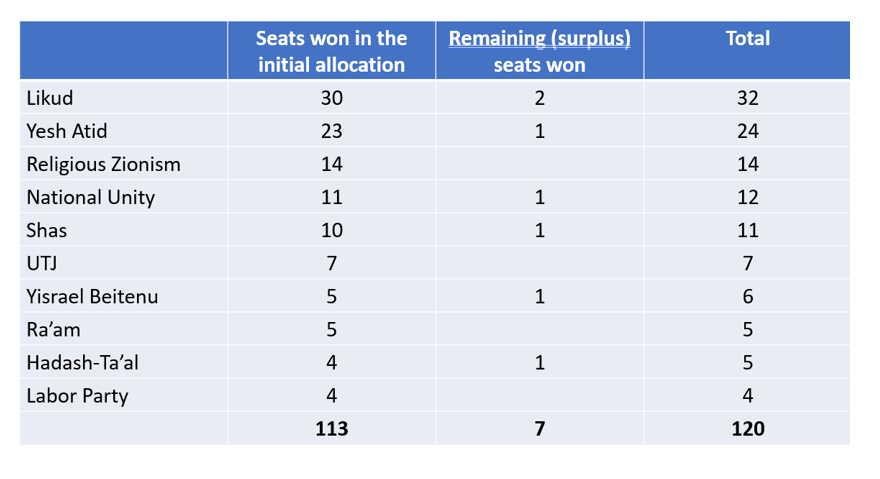
At the end of this process, most Knesset seats are already allocated, but there are small number of “remaining” seats that will be determined in the next stages. The following was the first seat allocation for the 2022 elections:
Step six: allocating the remaining seats
In this stage most seats have been already allocated, but there is always a small number of remaining (surplus) seats yet to be allocated. (In 2022 elections 7 seats remained, as shown in the chart above)
The remaining seats are allocated using the D’Hondt method, according to the highest average formula:
Each list’s vote total is divided by (number of seats it already has + 1). The next seat goes to the list with the highest average result. This process repeats until all 120 seats are allocated.
In Israel, however, at this stage the surplus agreements between party lists are considered. Prior to the elections, two lists may sign a surplus agreement which gives them advantage (the D’Hondt system is somewhat biased in favor of large lists). In the 2022 elections these pairs of lists signed surplus agreements:
- Likud <> Religious Zionism
- Yesh Atid <> National Unity
- Shas <> UTJ
- Labor Party <> Meretz (this agreement was annulled after Meretz failed to pass the threshold)
So how was the 114th seat determined in the 2022 election?
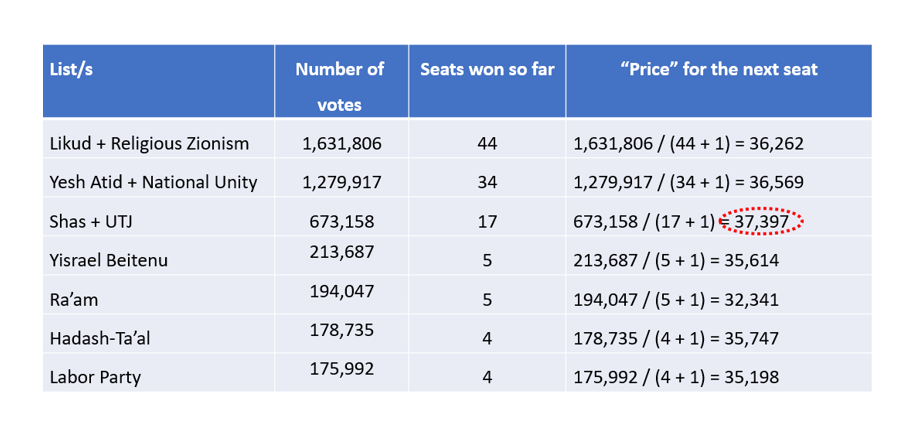
The process is then repeated with the new average – so how was the 115th seat determined?
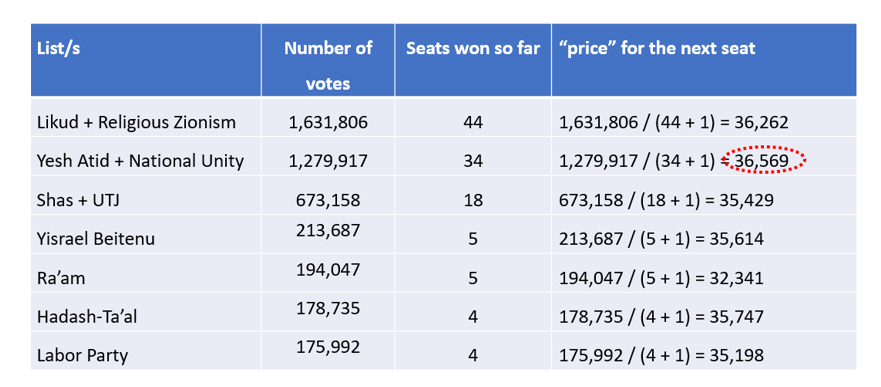
Now the Yesh Atid + National Unity parties have the highest average, so the 115 seat will go to one of these lists
…and so on until all 120 seats are allocated.
After completing the allocation of the remaining seats, the final stage is to determine which list (within each pair of lists that signed surplus agreement) is entitled to the seat/s. This is also done by applying the D’Hondt formula.
Looking at the 2022 elections as an example, the allocation of the remaining seats resulted in:
- 2 more seats to Likud + Religious Zionism
- 2 more seats to Yesh Atid + National Unity
- 1 more seat to Shas + UTJ
- 1 more seats to Hadash-Ta’al
- 1 more seat to Yisrael Beitenu
This formulates the final allocation of seats.
In the 2022 elections, this is how it looked: