

Most Jewish Israelis Think PM Netanyahu's Motivation in the War is Security Related; Most Arabs Think It's Personal
Over three-quarters of the Jewish public supports continuing the war, while among Arabs, only 19% support it – this marks a decline in both publics since the first week of the war. Among both Jews and Arabs, Operation Roaring Lion has improved assessments of the level of solidarity in Israeli society as a whole. Both Jews and Arabs think that Iran’s resilience has proven to be somewhat stronger or much stronger than anticipated by the operation’s planners.
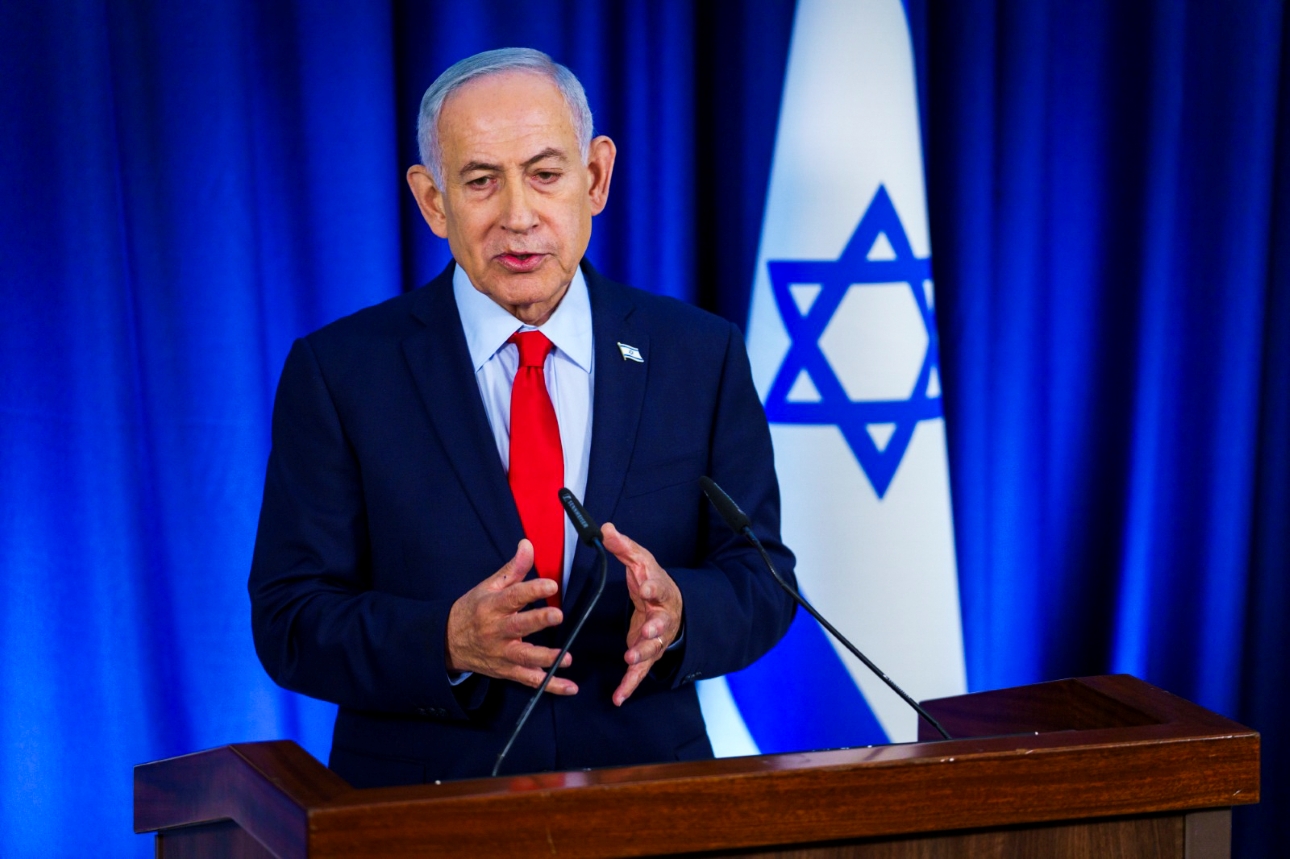
Israeli Prime Minister Benjamin Netanyahu speaks during a press conference in Jerusalem, March 19, 2026. Photo by Shalev Shalom/POOL
Methodology
The survey was conducted by the Viterbi Family Center for Public Opinion and Policy Research at the Israel Democracy Institute between March 22–26, 2026. It was based on a representative sample of the population in Israel aged 18 and above, comprising 604 respondents interviewed in Hebrew and 152 in Arabic.
- This month saw a rise in optimism about the future, in the total sample, for three of our regular topics, with the largest increase found in optimism regarding cohesion in Israeli society (up 8 percentage points), though this remains the lowest of the four. This rise is not surprising, as the Israeli public’s sense of cohesion is always strengthened in times of armed conflict (see below). Optimism about the future of democratic rule rose by 5 points, and about the future of the economy by 3 points. There was no increase in optimism about the future of national security, which has the highest rating of all, in contrast to the public’s reaction after Operation Rising Lion last year (June 2025), when there was a significant jump in optimism about national security.
Optimistic about the future of democratic rule, national security, the economy, and social cohesion (total sample; %)
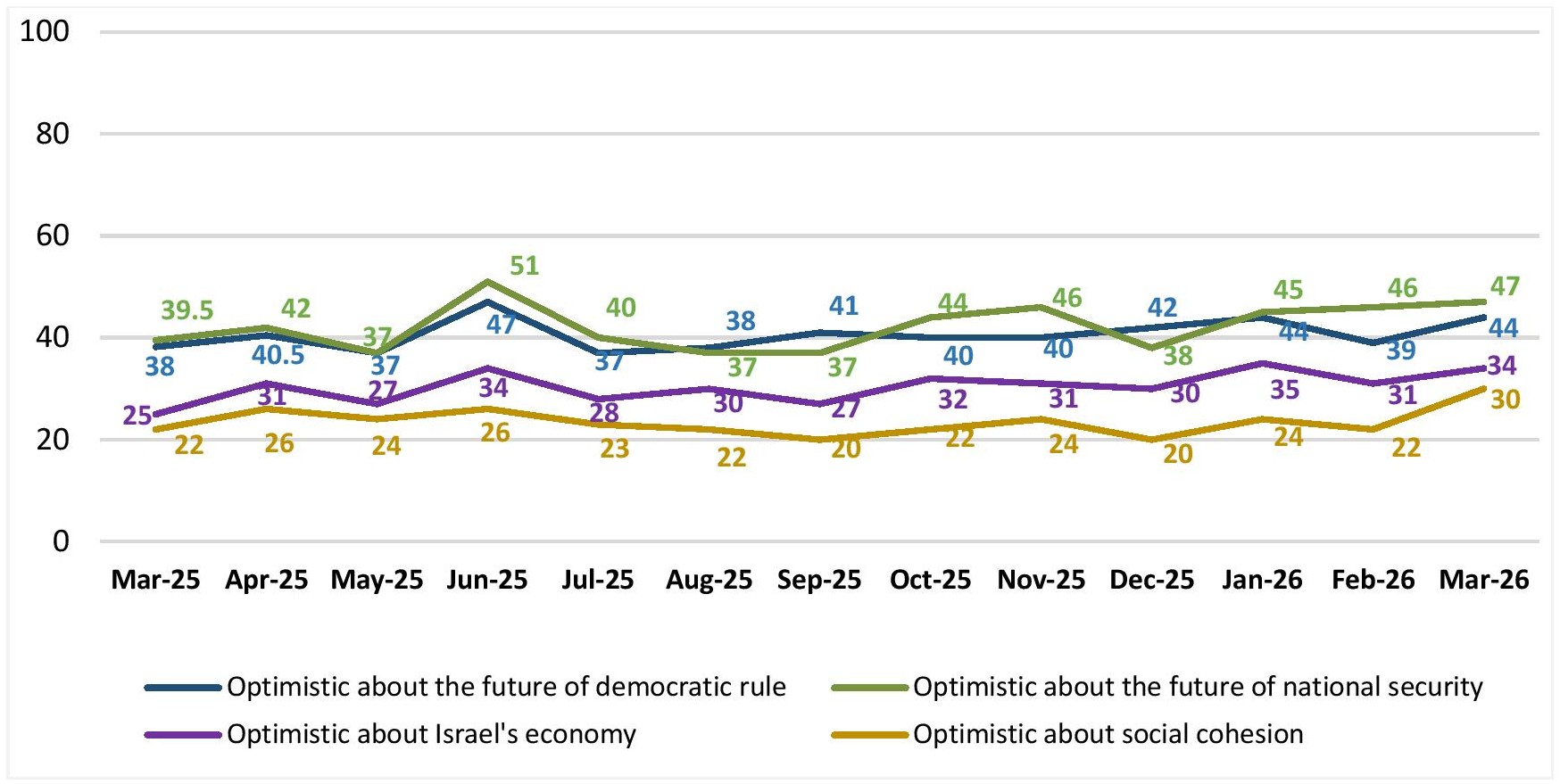
- As in previous months, the share of optimists among Jews is larger than that among Arabs on all topics, with only a minority of Arabs optimistic regarding each of the four topics. Among Jews, a small majority are optimistic about the future of national security, and around one-half are optimistic about the future of democratic rule.
Optimistic about the future (%)
| Future of national security | Future of democratic rule | Future of the economy | Future of social cohesion | |
| Jews | 54 | 50 | 38 | 33 |
| Arabs | 13 | 11 | 12 | 17 |
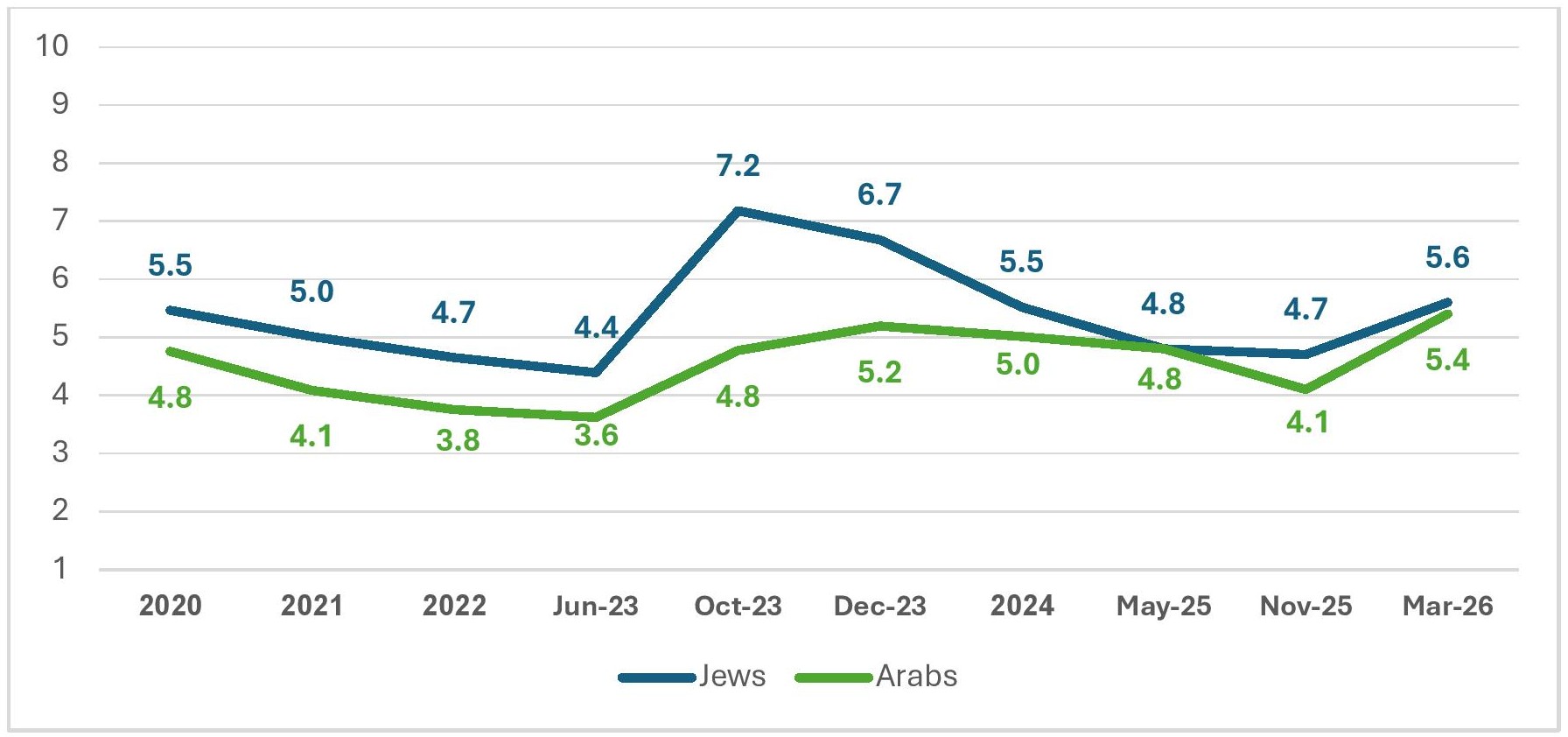
- Among both Jews and Arabs, Operation Roaring Lion has improved assessments of the level of solidarity in Israeli society as a whole (including Arabs, Haredim, and so on), and brought the average scores in both groups to a very similar point. On a scale from 1 = no solidarity at all to 10 = very high level of solidarity, the average score given by Jews is 5.6, and the average given by Arabs is 5.4. In light of the significant differences that we will see below in the degree of support or non-support of these two publics for the operation, this is an interesting and perhaps even encouraging finding.
Average scores for solidarity in Israeli society, 2020–2026
- In the Jewish sample, the average score given for social solidarity is 4.9 among those on the Left, 5.2 in the Center, and 5.9 on the Right. In other words, the Left has the lowest assessment of solidarity in Israeli society, and the Right, the highest.
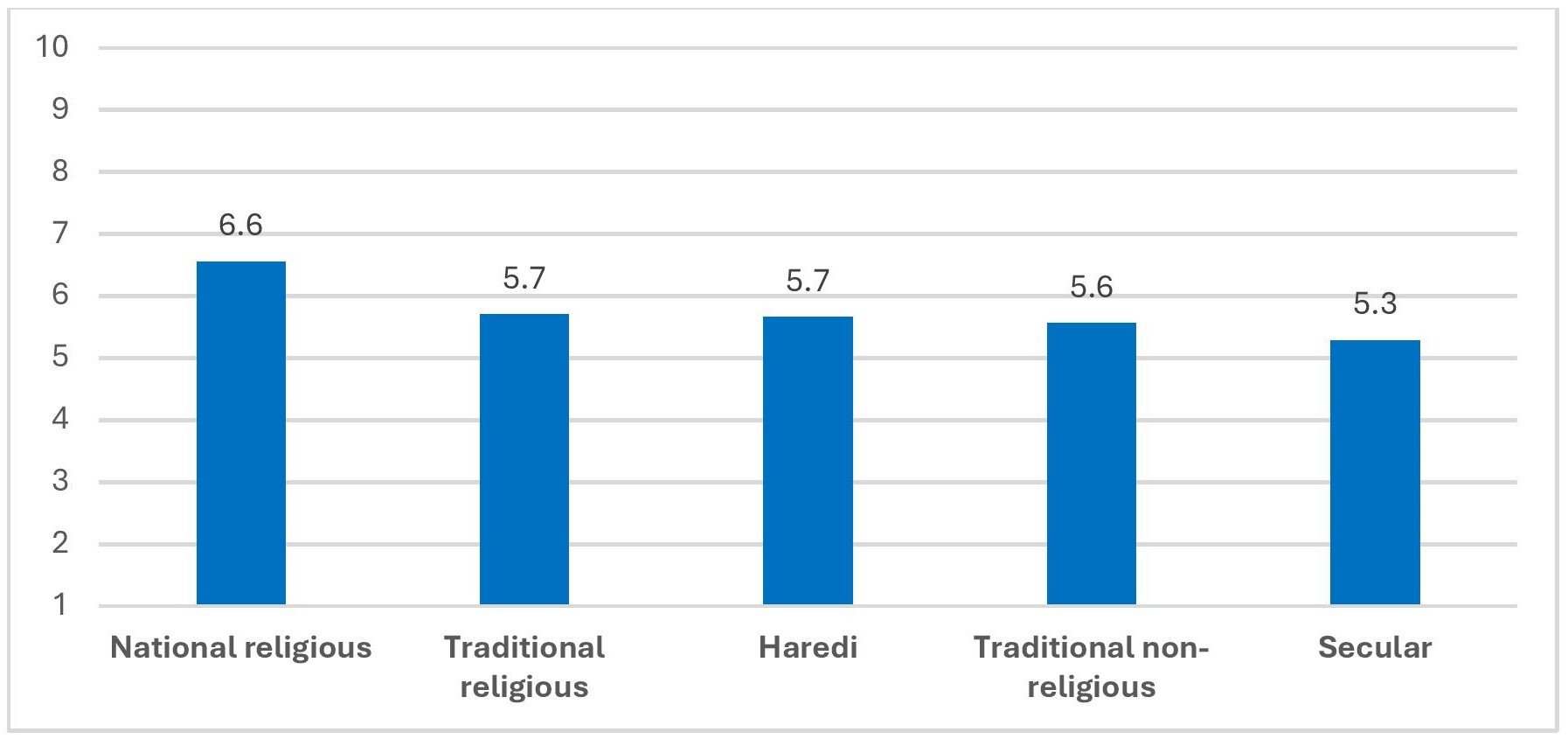
- Breaking down responses in the Jewish sample by religiosity reveals that the average score for solidarity in Israeli society is highest among the national religious and lowest among the secular.
Average scores for solidarity in Israeli society, 2020–2026 (Jews, by religiosity)
- A large majority—over three-quarters—of the Jewish public support continuing Operation Roaring Lion against Iran (in the United States: Operation Epic Fury).In previous surveys, we asked about support for the operation; this time, we asked about support for its continuation. However, the share of those opposed to the operation has risen, from 4% in the two previous surveys during the war, to 11.5% in the current one. There has also been a clear decline in the strength of support: The proportion of those who strongly support the operation dropped from 74% at the beginning of March when fighting began to 68% mid-month, and to just 50% in the most recent measurement toward the end of the month.
- As in previous surveys, only a minority of Arab respondents support the operation, and this share has also declined—from roughly one-quarter in earlier measurements to 19% currently.
- In the total sample, the level of support stands at 68%, though this largely represents the views of the Jewish respondents, due to their numerical superiority over the Arab respondents.
Do you support or oppose the continuation of Operation Roaring Lion (the joint US-Israeli military attack on Iran)? (%)
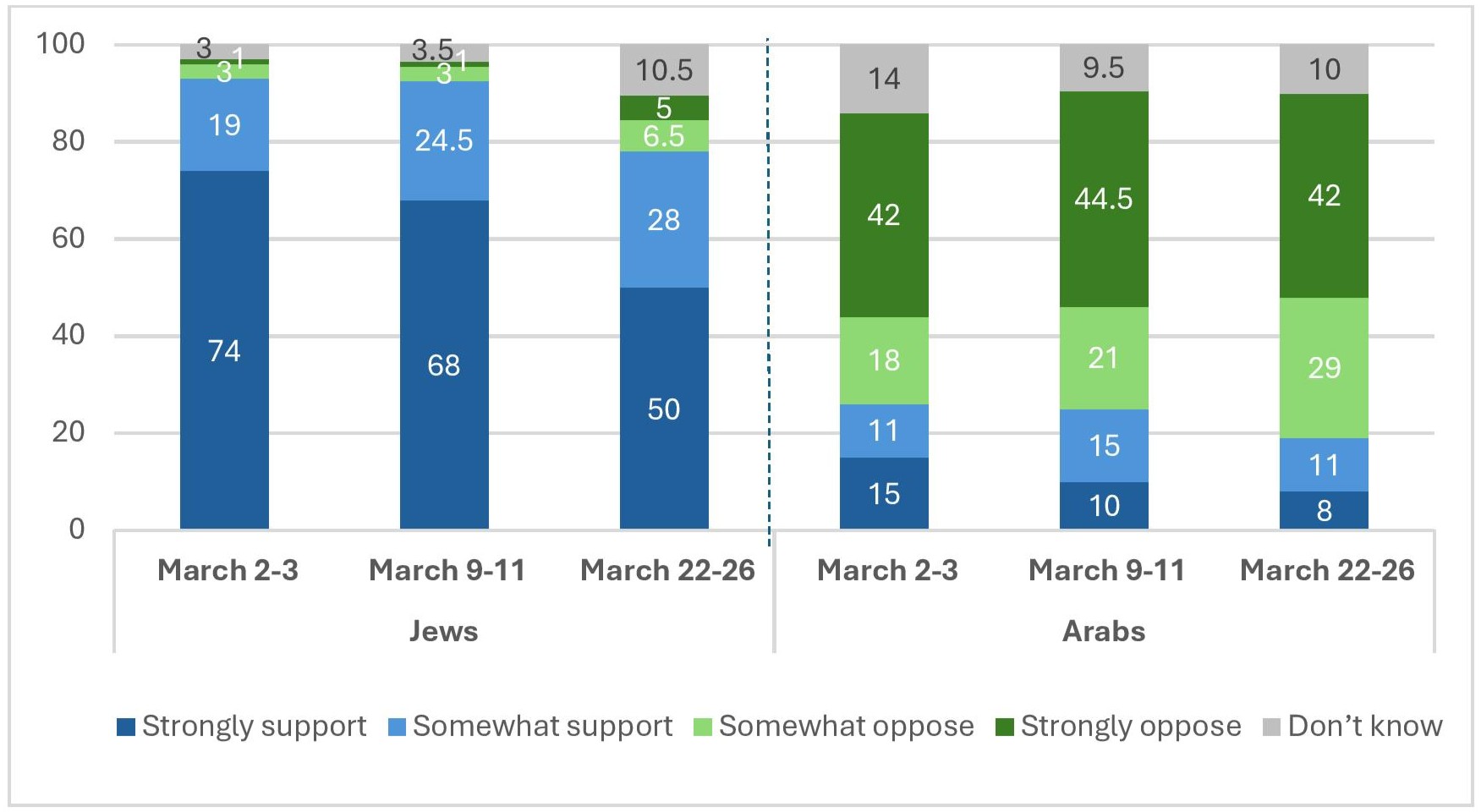
- Breaking down responses in the Jewish sample by political orientation, about half of those on the Left support the operation (only 14% strongly support it), compared to a majority in the Center (69.5%, including 28% who are strongly supportive), and a very large majority on the Right (87%, including 67% who strongly support it).
- Segmentation by religiosity (Jews) reveals majority support in all groups, though this majority is smaller in the secular group (Haredi, 84.5%; national religious, 87%; traditional religious, 85%; traditional non-religious, 84%; secular, 67.5%).
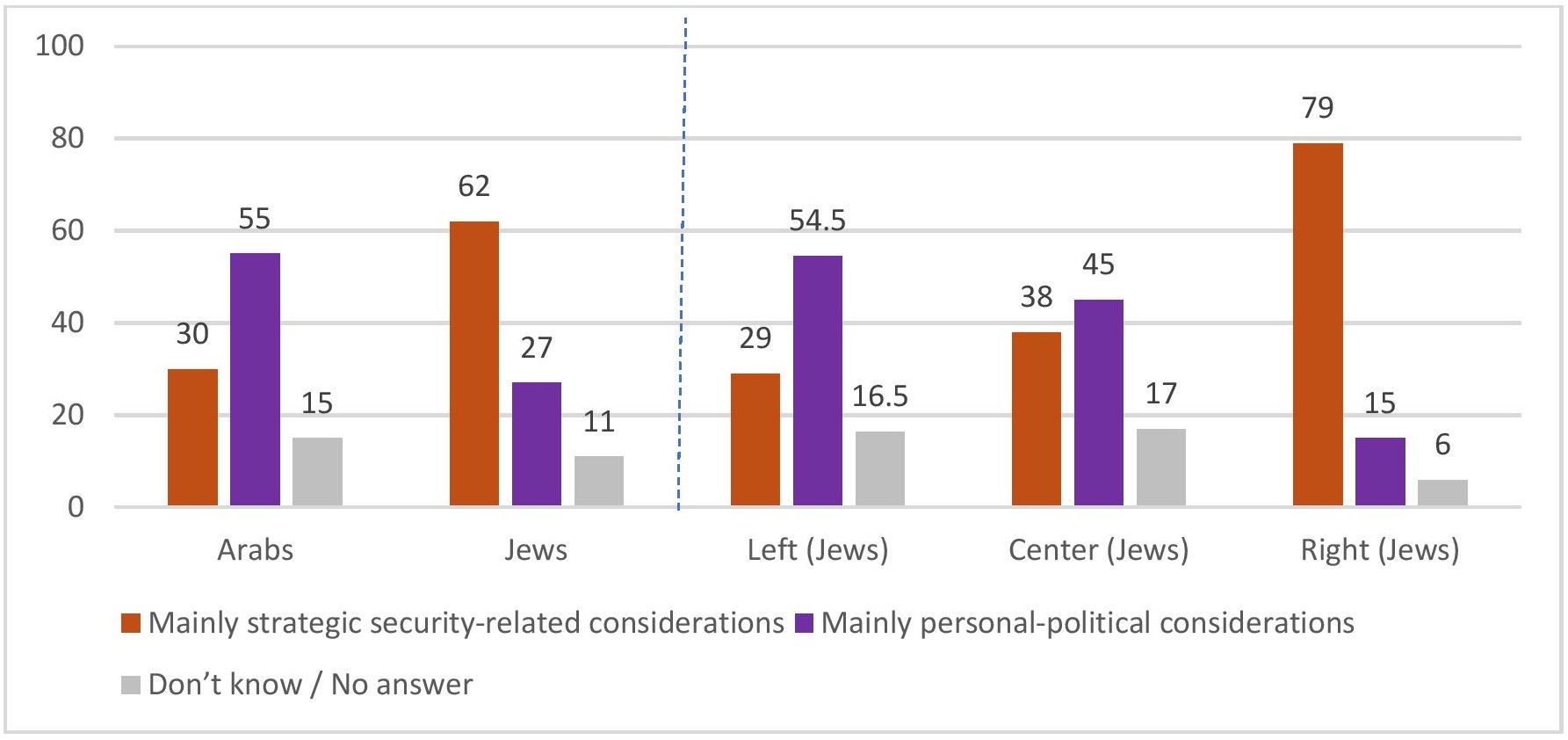
- A majority of Jewish respondents (62%) think that Prime Minister Benjamin Netanyahu was driven primarily by strategic security-related considerations in deciding to launch Operation Roaring Lion. By contrast, a majority of Arab respondents (55%) think that his motivations were mainly personal and political.
- On the Left (Jews), more than half attribute the decision to personal-political considerations. Among those in the Center, the largest share hold the same view (45%, versus 38% for strategic security-related consideration). On the Right, however, a large majority (79%) think that the decision was driven primarily by strategic and security-related concerns.
In your estimation, which considerations were most important in Prime Minister Netanyahu’s decision to launch an attack on Iran at the current time (%)
- Segmentation by vote in the 2022 elections (total sample) reveals that among voters for all the coalition parties, a large majority think that that Netanyahu was mainly motivated by strategic security-related considerations (United Torah Judaism, 96%; Likud, 84%; Religious Zionism, 84%; Shas, 81%). By contrast, among those who voted for opposition parties in 2022, only a minority hold the same view (National Unity, 45%; Hadash-Ta’al,* 40%; Yisrael Beitenu,* 39%; Yesh Atid, 34%; Ra’am,* 26%; Labor,* 24.5%).
*The number of voters for these parties in our sample is small, and thus does not support broader generalizations.
- The largest share of Jewish respondents (35%) estimate that Israeli society can sustain the operation for up to one month. Another 20% think it can continue for 1–3 months, 6.5% for 3–6 months, and fully 28% think that Israeli society can bear this burden for as long as necessary to achieve the operation’s goals.
- Among Arab respondents, assessments of resilience are lower: one-third (33%) estimate Israeli society’s endurance to be up to one month, 16% say 1–3 months, 8% put it at 3–6 months, and only 5% believe the Israeli public can sustain this effort for as long as necessary. 38% of Arabs selected the "don’t know" response.
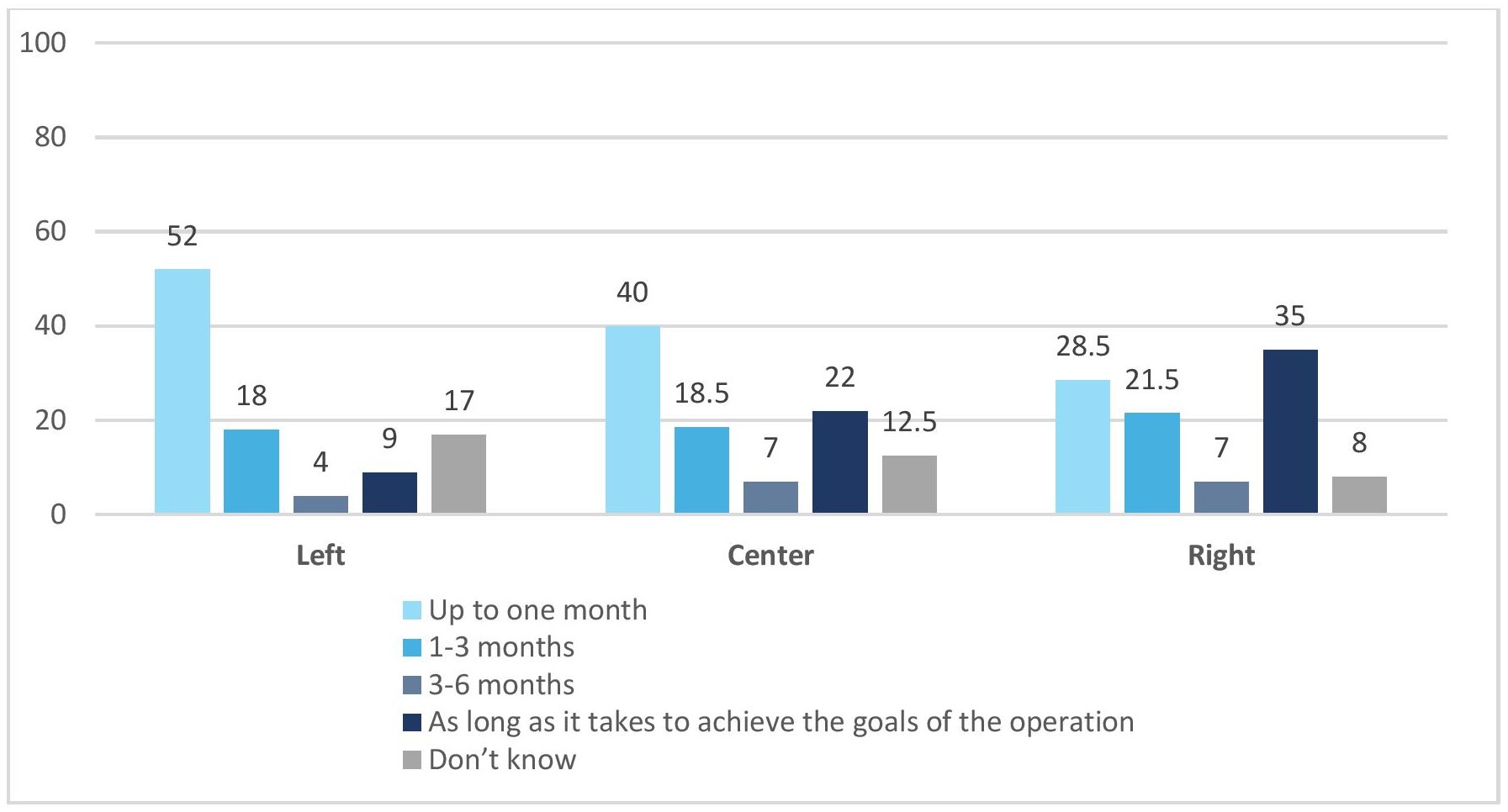
- A breakdown by political orientation (Jews) shows that a small majority on the Left think that Israeli society can put up with the operation for up to a month. This is also the most common assessment in the Center, though around one-fifth (22%) think that the public could endure for as long as required. On the Right, the largest share (35%) believe Israeli society can bear the burden for as long as necessary.
In your estimation, how long will Israeli society be able to bear the burden of continuing Operation Roaring Lion against Iran? (%, Jewish by political orientation)
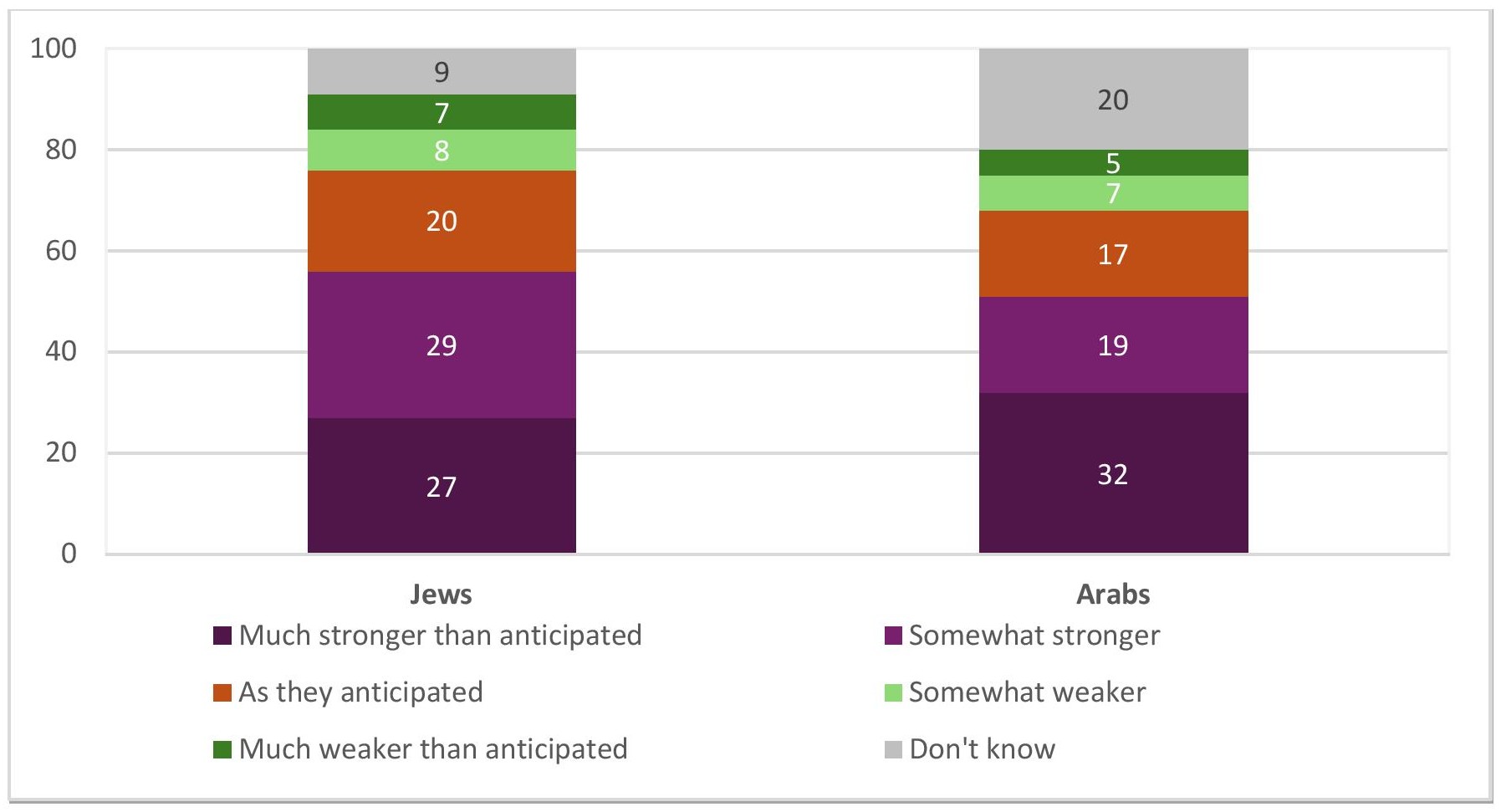
- This is one of the few issues in this survey on which there is agreement between Jewish and Arab respondents. In both groups, the majority think that Iran’s resilience has proven to be somewhat stronger or much stronger than anticipated by the operation’s planners (Jews, 56%; Arabs, 51%).
- A breakdown of responses in the Jewish sample by political orientation reveals a majority in all three camps who think that Iran’s resilience has turned out to be stronger than expected. This view is held by around two-thirds of respondents on the Left (66%), and only a slightly smaller share of those in the Center (61%). On the Right, around one-half have the same opinion (51%).
In your estimation, relative to the expectations of the Israeli and American planners of the operation, has Iran’s resilience and fighting capability so far been:(%)
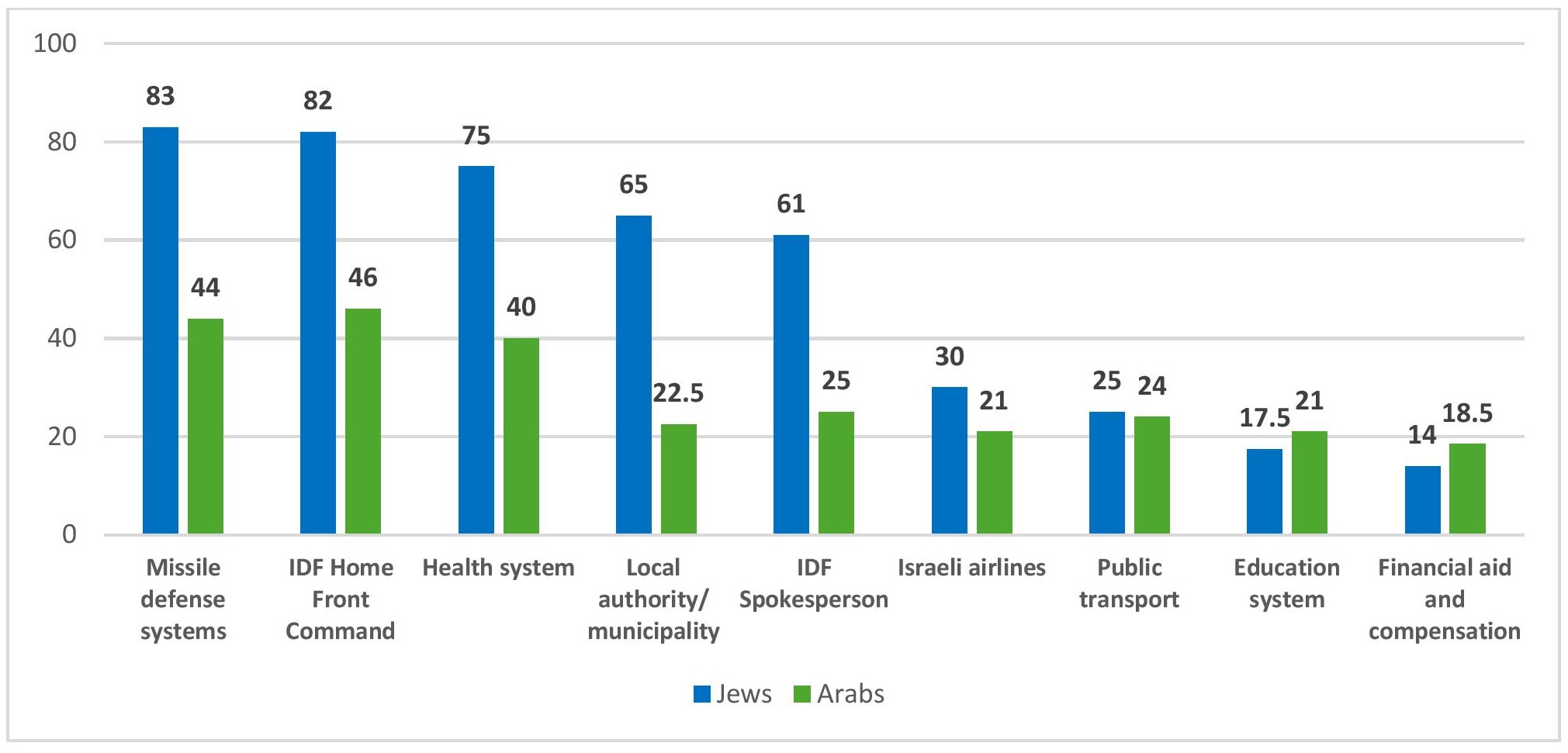
- The systems we examined were: Israel’s missile and rocket defense systems, the IDF Home Front Command, the IDF Spokesperson, the health system, the education system, local authorities/municipalities, public transport, Israeli airlines, and the financial aid and compensation system. Respondents ranked the functioning of each of these systems on a scale from 1 = very poor to 5 = excellent.
- The systems that received the highest scores among Jews were the missile and rocket defense systems (83%) and the IDF Home Front Command (82%), closely followed by the health system (75%). Around two-thirds gave high scores to their local authority/municipality and to the IDF Spokesperson; less than a third of the respondents gave a high score to the Israeli airlines, which are responsible for the return flights of Israelis from abroad; and a quarter gave a high score to the public transport system. Less than one-fifth of Jews rated the functioning of the education system highly, and this system also received the largest share of respondents who rated its performance as poor or very poor (50.5%). Rounding out the list is the financial aid and compensation system, which received a high score from only 14% of Jews, although it is worth noting that the share of those selecting the "don’t know" response was particularly large (18%), perhaps due to a lack of knowledge about the functioning of this system.
- In general, Jewish respondents gave higher scores than Arab respondents for seven of the nine systems we examined. The exceptions were the education system and the financial aid and compensation system, which received the lowest scores in both groups, though the share of those who gave them high scores was slightly larger among Arabs than among Jews.
- In the Arab sample, the systems that stand out relatively positively are the IDF Home Front Command, the missile and rocket defense systems, and the health system—all three with positive ratings from at least 40% of respondents. For all other systems, the proportion of respondents giving high scores was considerable smaller (between 18.5% and 25%).
Rate the functioning of each of the following systems as good or excellent (%)
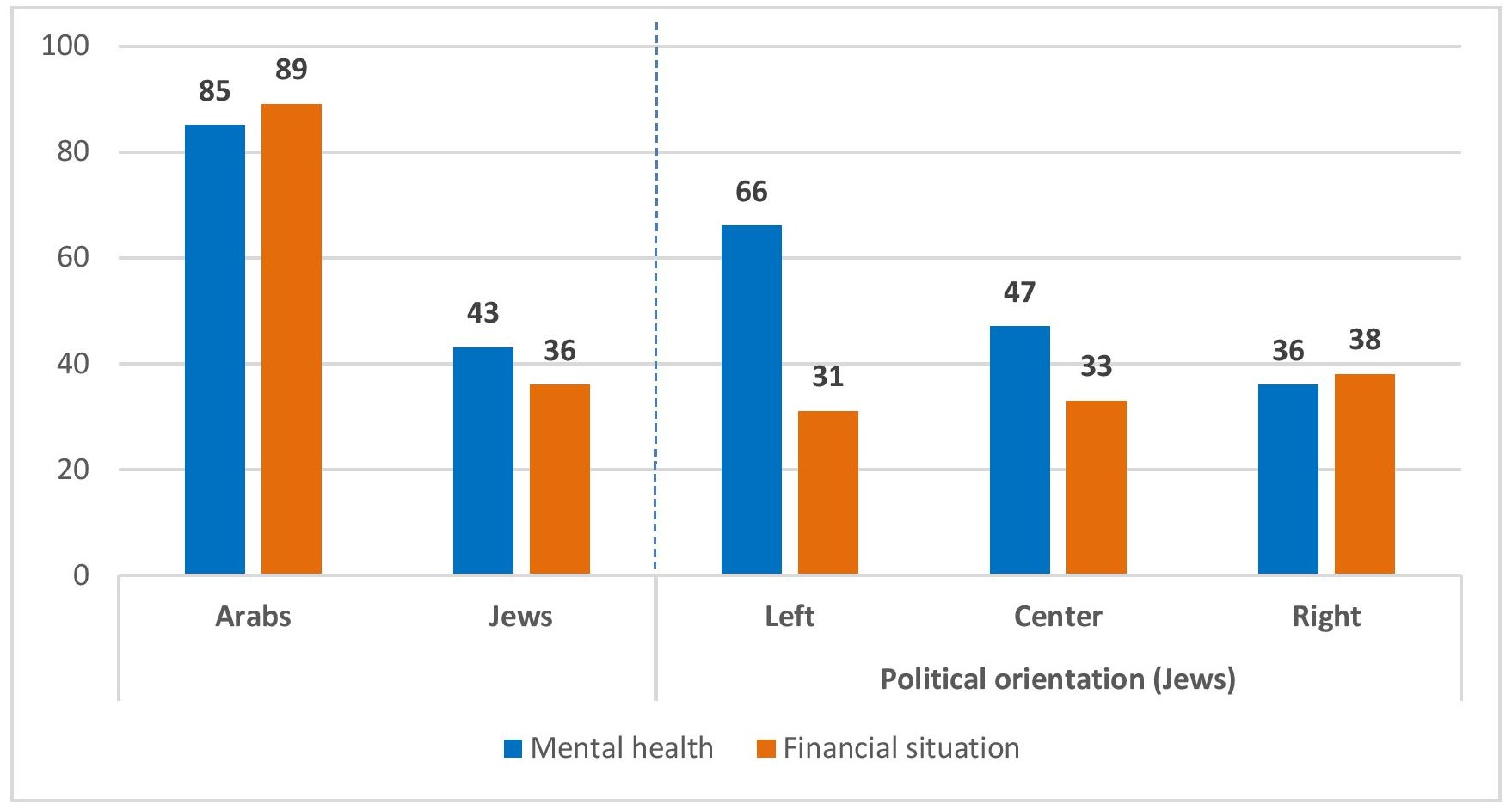
- In the Arab sample, very large shares of respondents report a deterioration in both their mental health (85%) and their financial situation (89%). This represents a slight increase since the last time we asked this question, in November 2025, when 81% said that their mental health had been negatively affected, and 86%, their financial situation.
- Among Jews, the proportion of respondents reporting a deterioration in both areas is lower but still significant: over 40% say that their mental state has been negatively affected, and more than a third, their financial situation. These findings are almost identical to those of November 2025.
- Segmentation by political orientation (Jews) reveals large differences with regard to mental health, and smaller differences regarding financial situation. On the Left, where the negative financial impact has been smallest (31%), two-thirds report harm to their mental health. In the Center, the discrepancy between impact on financial situation (one-third) and on health level (around one-half) is smaller, but still noticeable. On the Right, similar shares of just over one-third reported worsening in both areas.
Share of respondents who report that the events of the last three years have negatively affected their mental health and financial situation to a very large or fairly large extent (%)
- More than half of the Israeli public (55%) think that the government’s decision to suspend the proposed Military Service Exemption Law and to transfer billions of shekels to Haredi institutions is a political deal that prioritizes sectoral interests over the good of the public (Jews, 57%; Arabs, 44.5%). Less than one-quarter (23%) think it is a responsible decision designed to facilitate fighting the war and ensuring economic stability (Jews, 24.5%; Arabs, 18%), while 11% think that both descriptions are equally correct (Jews, 9.5%; Arabs, 16.5%). Fully 11% select the "don’t know" response, and this share was particularly large among Arab respondents (Jews, 9%; Arabs, 21%).
- Among Jews, 51% of Haredim think it is a responsible decision, while 18% believe it is a political deal. A particularly large share (22.5%) selected the "don’t know" response. Among secular Jews, the picture is quite different: 82.5% believe that this is a political deal that favors narrow sectoral interests, and only 8% believe that it is a responsible decision intended to facilitate a stable economy and conducting the war.
Recently, the government decided to suspend the Military Service Exemption Law and to transfer billions of shekels to Haredi institutions. In your opinion, which of the following descriptions best fits this decision? (Jews; %)
| Religiosity | A responsible decision designed to facilitate fighting the war and ensuring economic stability | A political deal that prioritizes sectoral interests over the good of the public | Both to the same extent | Don’t know | Total |
| Haredi | 51 | 18 | 8.5 | 22.5 | 100 |
| National religious | 34 | 37 | 15 | 14 | 100 |
| Traditional religious | 43 | 37 | 11 | 9 | 100 |
| Traditional non-religious | 25 | 54 | 14 | 7 | 100 |
| Secular | 8 | 82.5 | 5.5 | 4 | 100 |
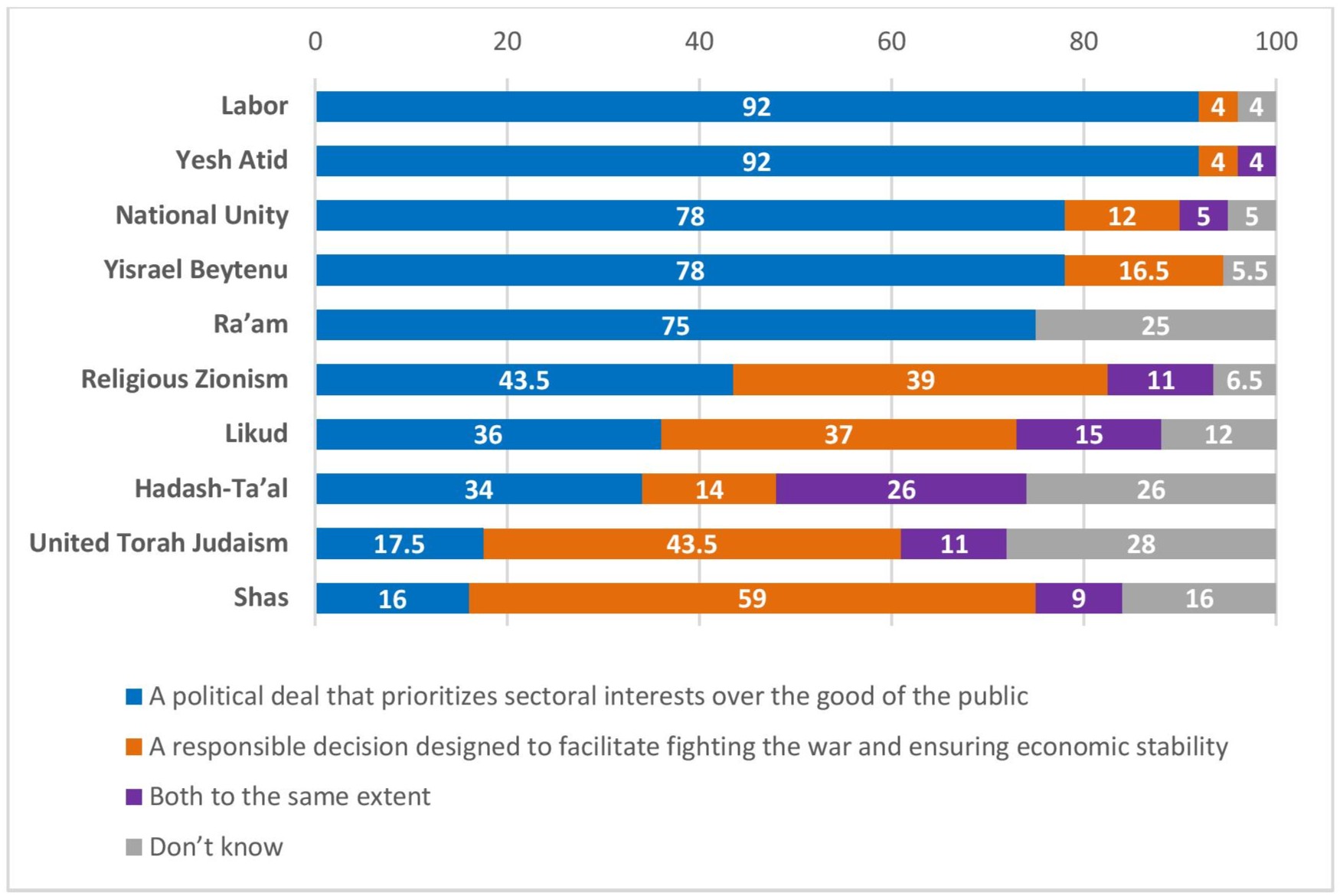
- Breaking down responses by vote in the last elections (total sample) reveals that among Religious Zionism voters, the largest share (43.5%) think this is a political deal that prioritizes sectoral interests over the public good. Likud voters are evenly divided on this question. Shas is the only coalition party the majority of whose voters think it is a responsible decision (59%). The largest share of United Torah Judaism voters think it is a responsible decision (43.5%), though more than a quarter selected the “don’t know” response. Among voters for opposition parties, as expected, the large majority think that this is a narrow political deal that goes against the interest of the general public (with the exception of Hadash-Ta’al, the number of whose voters in the current survey is too small to support generalizations).
Recently, the government decided to suspend the Military Service Exemption Law and to transfer billions of shekels to Haredi institutions. In your opinion, which of the following descriptions best fits this decision? (total sample; %)
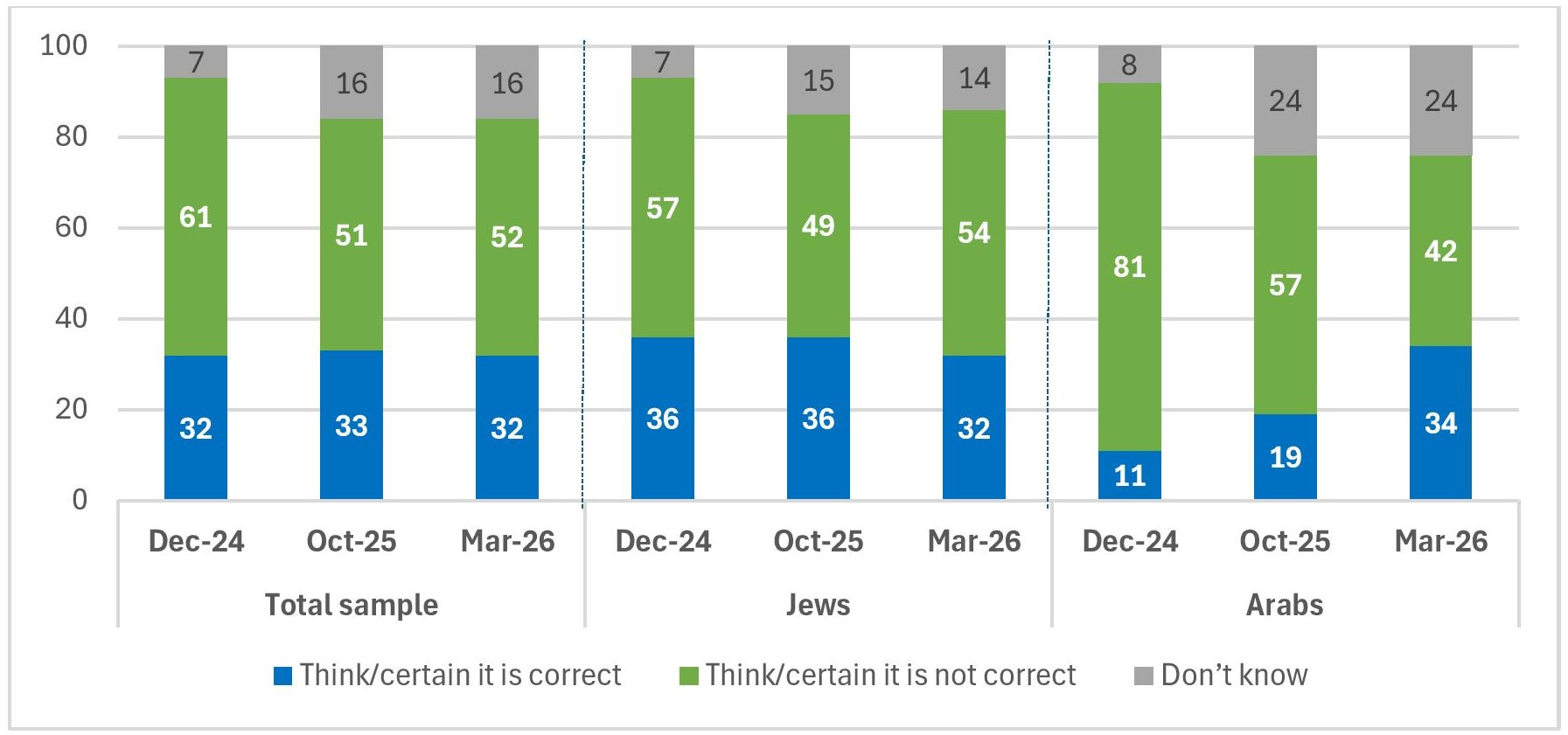
- As in previous surveys, we found only about one-third of the Israeli public support advancing the judicial overhaul at this time, while more than one-half oppose it. Among Jews, there has even been a slight decline in the percentage of those in favor, and a rise in the share of those opposed, since the previous measurement in October 2025. Among Arabs, there has been a significant, and unexpected, leap in the share of supporters, though additional measurements will be required in order to establish whether this is the start of a trend or an irregularity.
In the current circumstances, in your opinion, is it correct or not correct at this time to advance the judicial overhaul initiated by Justice Minister Yariv Levin? (%)
- Segmentation by vote in the 2022 elections (total sample) reveals that among voters for all the coalition parties, there is greater support for advancing the judicial overhaul than opposition. Among voters for each of the opposition parties, the majority oppose advancing the judicial overhaul at the current time.
In the current circumstances, in your opinion, is it correct or not correct at this time to advance the judicial overhaul initiated by Justice Minister Yariv Levin? (total sample; %)
| Vote in 2022 elections | Think/certain it is correct | Think/certain it is not correct | Don’t know | Total |
| United Torah Judaism | 63 | 17 | 20 | 100 |
| Likud | 55 | 30 | 15 | 100 |
| Shas | 50 | 25 | 25 | 100 |
| Religious Zionism | 45 | 39 | 16 | 100 |
| Hadash-Ta’al | 29 | 52 | 19 | 100 |
| Ra’am | 24 | 59 | 17 | 100 |
| National Unity | 15 | 74 | 11 | 100 |
| Yesh Atid | 5 | 87 | 8 | 100 |
| Labor | 4 | 87.5 | 8.5 | 100 |
| Yisrael Beytenu | -- | 72 | 28 | 100 |
The Israeli Voice Index for March 2026 was prepared by the Viterbi Center for Public Opinion and Policy Research of the Israel Democracy Institute. In the survey, which was conducted on the internet and by telephone (supplements of groups that are not sufficiently represented on the network) between March 22-26, 2026, 604 men and women were interviewed in Hebrew and 152 in Arabic, constituting a representative national sample of the entire adult population of Israel aged 18 and older. The maximum sampling error for the entire sample was ±3.56% at a confidence level of 95%. The fieldwork was done by the Shiluv-i2r Research and Polling Institute. For the full data file see: https://dataisrael.idi.org.il.