

Haredi Society During the War: Who Issues the Guidelines Matters
In Haredi society, the question of whether or not to follow IDF Home Front Command instructions can sometimes be far from straightforward. The Haredi leadership needs to speak up clearly and uniformly and call for full obedience to these instructions.
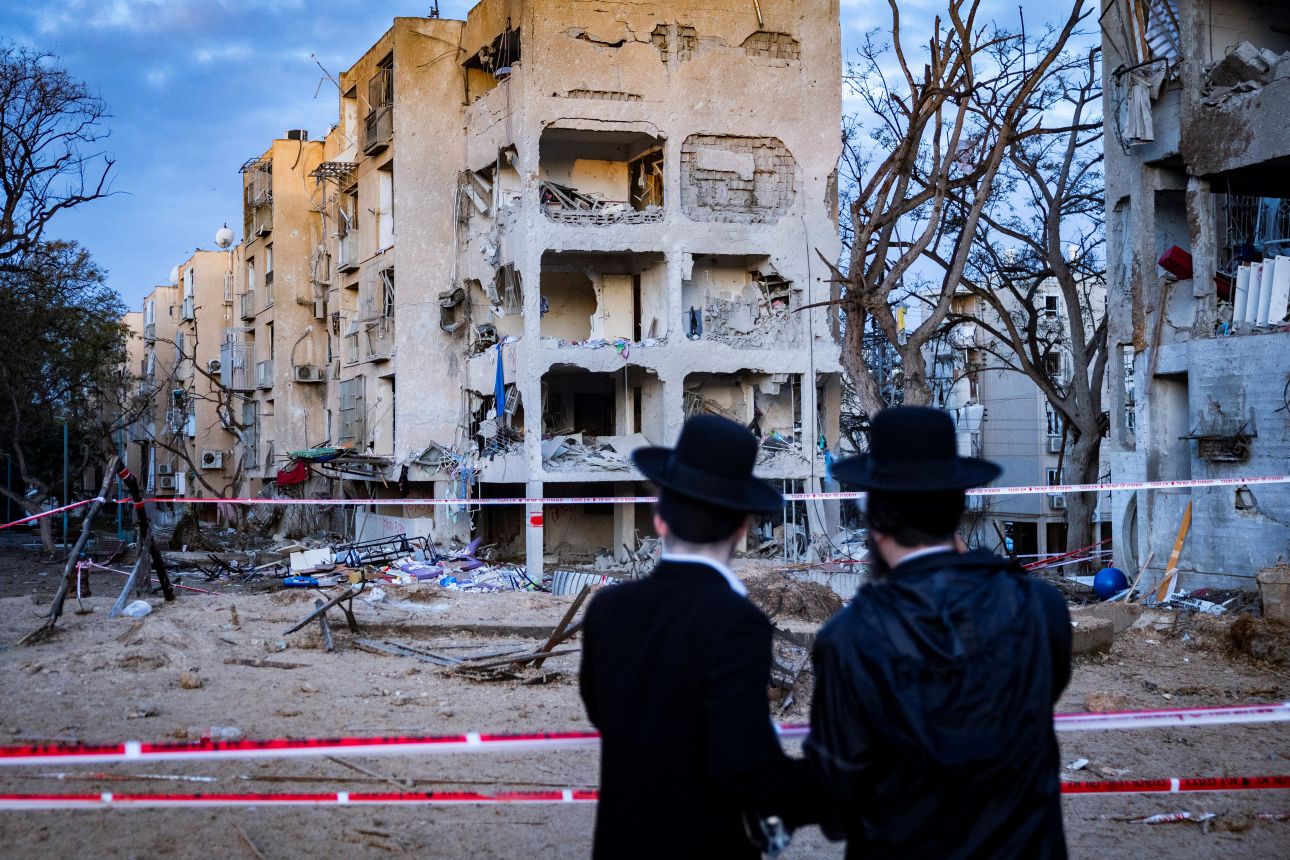
Photo by Chaim Goldberg/Flash90
After the recent missile strike on Arad, which, thankfully, did not result in any loss of human life, the Gur Hasidic community issued a brief instruction to its members: If there is a warning or siren, enter a shelter. It’s hard to think of a more obvious statement. Which only begs the question: If it’s so obvious, why did they only issue this directive after the terrible hit, and why did it have to be said at all?
Disregard for the IDF Home Front Command’s instructions is not necessarily an ultra-Orthodox phenomenon. Israeli society as a whole is suffering from fatigue and burnout, as well as being characterized by a culture of yihye beseder (“don’t worry about it, it’ll be fine”). Still, in Haredi society, this problem is sometimes more acute. Not because Haredim are less concerned about protecting life, but because the issue here is not just a question of civic behavior. It also relates to the provision of protective spaces, the structure of the family, attitudes toward the state, and most importantly, the question of authority.
In this sense, the question of taking cover from missile attacks does not stand on its own. It is part of a broader set of frictions regarding safety, enforcement, and governance: COVID, the Mount Meron disaster, and the recurring tension between the state’s directives and the authority of Haredi rabbis and fixers. This is not just a series of individual failures; there is a deeper pattern here. Time and time again, it becomes clear that the question is not only what the instruction is, but who conveys it, who interprets its boundaries, and who is perceived as truly worthy of being obeyed.
In terms of taking cover from missile attacks, it is important to start by noting that even on the most practical level, this is not a simple matter. Some of the new Haredi neighborhoods have safe rooms within each apartment, but in many older centers of Haredi life—such as the older neighborhoods in Jerusalem and Bnei Brak, and in Haredi concentrations in the periphery—residents are dependent on communal shelters, at best in the basement of their building, and at worst, somewhere nearby. Adding further complication is the well-known fact that Haredi society is very young, with a high percentage of children. Getting one or two children into a safe room in the family apartment is very different from having to wake up several small children in the middle of the night, pick them up and calm them down, and take them down several flights of stairs (or even down the street) to a communal shelter. This is not a justification, but an explanation of the dynamics involved. Complacency in matters of safety is not a cultural position—it is a very real danger.
However, this practical difficulty is not the whole story. In Haredi society, there is also a deeper element: the religious language through which life itself is interpreted. The tension between belief in divine providence and the “duty to make an effort” (that is, to look out for one’s own affairs without relying on divine intervention) has been a feature of Jewish religious thought for many generations. From a halakhic perspective, the picture is quite clear: one is commanded to keep oneself safe and act with common sense. But culturally, things are less straightforward. When “trust in God” is a turn of phrase used daily, practical caution may sometimes be perceived as hysteria, and adherence to public directives as a lack of faith in divine providence.
This is exactly where the leadership comes in. A few years ago, Rabbi Yitzchok Zilberstein, one of the most important halakhic figures in Bnei Brak, published an opinion which implied that there was no need to wake children up when sirens sounded (in the context of rocket fire from Gaza) and that they could be allowed to continue sleeping in their beds. Later, a clarification was published that emphasized the duty of caution and protecting human life, also taking into account children’s mental state. The very need for this clarification demonstrates a fundamental aspect of Haredi society: wording has enormous significance. An ambiguous statement does not remain ambiguous, but it is quickly translated into a practical dispensation not to obey instructions. And when it comes to human life, the price of ambiguity is far from theoretical.
In the current war, too, it would be incorrect to say that no clear voices have been heard stating the opposite view. Rabbi Landau, the most senior and respected Lithuanian sage, defined observance of the Home Front Command’s instructions as an obligation from the Torah, and other rabbis have also called for full obedience. Nevertheless, in practice, banned social gatherings and other violations have been documented. The main issue, then, is not the complete absence of appropriate statements, but the absence of messaging from the leadership that is uniform, clear, and sufficiently binding for the entire Haredi public.
True, the Home Front Command still has much to learn about public information campaigns for Haredi society, and the state is responsible for the unequal provision of protective structures. But these two claims do not get to the root of the problem: Haredi leadership itself. In a society in which rabbis, Hasidic rebbes, fixers, and court secretaries have much deeper authority than the state, the responsibility lies first and foremost with them. When the missiles fall, the question is not just whether the public hears the siren. The question is whether their leaders have told them in advance how to respond, in simple, straightforward language, without any asterisks. As long as this is not the case, the problem won’t just be an issue of protective spaces and safety procedures. It will be, once again, a leadership problem.
This article was published in The Jerusalem Post.