

Our Memories of the Holocaust Risk Being Rewritten
For the first time in history, it is possible to turn an old photograph into a living video and to generate a voice that sounds exactly like a lost loved one. If digital tools can reconstruct and fill in our memories, they are also capable of rewriting them.
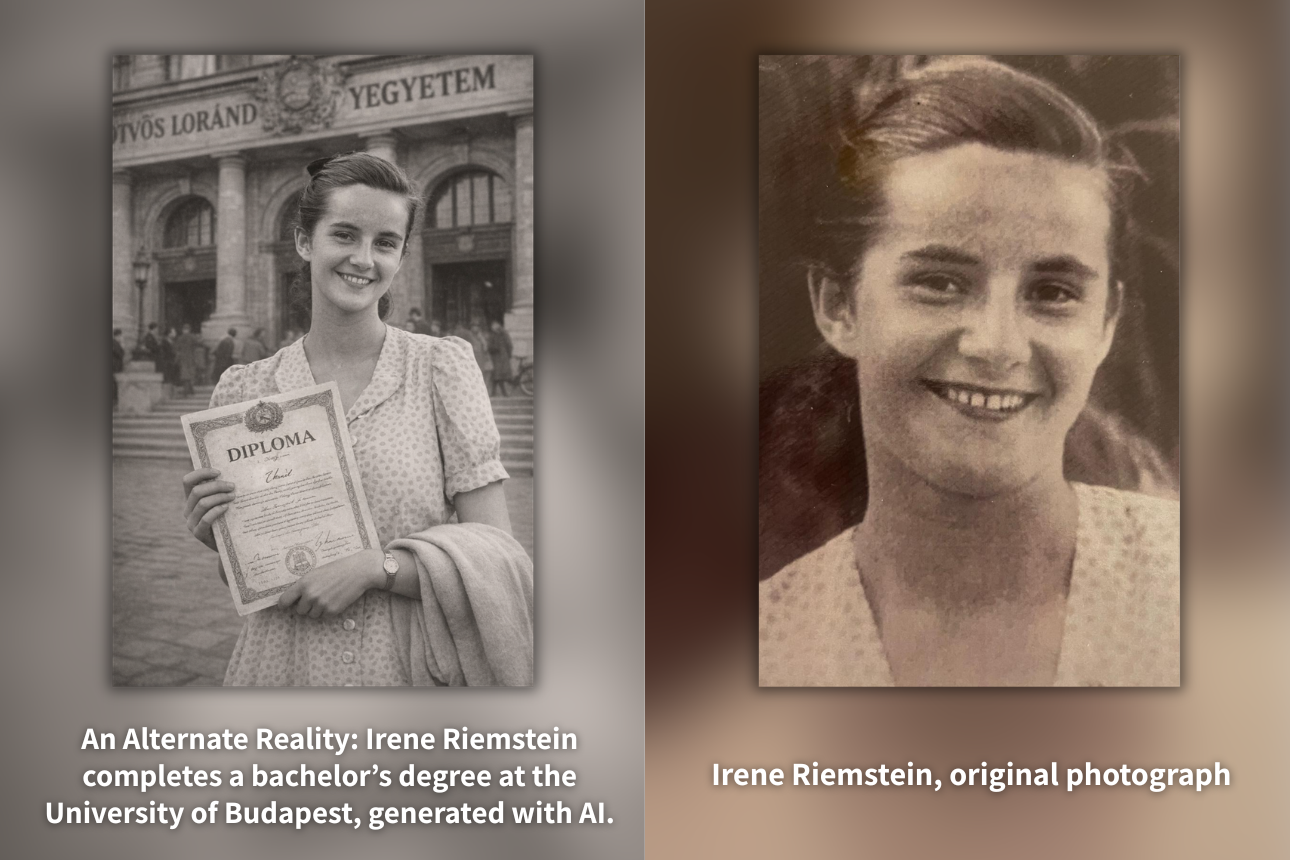
My grandmother, Irene Riemstein, was born in 1929 in the town of Dunajská Streda in Slovakia. There stood a church tower and two synagogues, as well as the family printing house from which her parents earned their livelihood. It was a small yet complete world, in which a child knew where she was and to whom she belonged. At the age of thirteen, she was sent alone to Budapest in order to survive, with a cross around her neck and a small suitcase. Two years later, she stepped off the train at Auschwitz, lost her parents, her brother, and her sister, and clung with difficulty to what remained of her world. At seventeen, she immigrated to the Land of Israel on an illegal immigrant ship, met my grandfather, started a family, planted an orchard, and built a life. In 2021, she passed away at a good old age of ninety-two.
My grandmother is no longer with us, and what remains are memories: a few photographs, recorded fragments of testimony, stories told around the kitchen table. As in any life story, there are gaps. There are moments that were not documented, details that were not recorded; silences that were never filled. These gaps, together with the fact that my grandmother is no longer here to tell her story herself, invite us to fill them in: to imagine what was not photographed, to lend continuity to what was interrupted. This is where technology enters the picture. For the first time in history, it is possible to take an old photograph and turn it into a living video, to generate a voice that sounds exactly like the loved ones we've lost, to reconstruct accent, expression; presence. One can create a memory that appears more complete than the actual memory. And the temptation to use artificial intelligence to commemorate the Holocaust in a post-testimony world is great—not in order to lie, but to draw nearer; not to distort, but to repair what is missing.
But if a story can be filled in with technology, it can also be rewritten. If one can generate scenes that were never documented, one can also generate an entirely different life story, for example, one in which there was no Holocaust, in which Irene was not sent away alone, did not step off the train at Auschwitz; did not lose her family. Such a story could appear no less credible, coherent, and persuasive. And on social media, it might even receive more attention.
We are accustomed to thinking about Holocaust Remembrance Day in terms of the intergenerational transmission of memory through human testimony, even if partial or secondary. At first, it was the survivors themselves; today, members of the second generation recount their parents’ stories through initiatives such as “Zikaron BaSalon” (“Memory in the Living Room”), where families open their homes to share their stories.
But on Holocaust Remembrance Day 2026, we must ask ourselves what Holocaust memory will look like in an era in which the very ability to distinguish between testimony and its artificial fabrication is being undermined. Historical memory does not exist only through stories, but first and foremost through the capacity to distinguish between truth and fiction. When that capacity erodes, memory itself becomes vulnerable. This is not because there are no witnesses, but because there is no clear criterion for what counts as testimony. In a world where every image can be rendered with near-perfect accuracy, every voice can be reconstructed, and every story can be reassembled, truth loses its advantage and becomes just one possibility among many.
In this sense, the fate of Holocaust memory today is not decided in memorial institutions, ceremonies, or living rooms, but elsewhere: in the tech headquarters where systems for generating content, images, and voices are developed; in the companies that design the tools through which we perceive the world; and in regulatory debates that surround AI. It is in these places that the question of whether we will have a right to factual security, cognitive security, and perceptual security is answered—that is, whether we can rely on a reality that cannot be edited. If these rights erode, memory will not endure. Instead of “Never forget,” we will be left with “Never know.”
This column is dedicated to the loving memory of my grandparents Irene Riemstein and Yehuda Klein, survivors of the concentration camps during the Holocaust.
This article was published in The Times of Israel.