

Everything You Need to Know About How a Government is Formed Following Elections

Photo by Olivier Fitoussi/Flash90
The State of Israel belongs to the family of parliamentary democracies, in which the executive branch (the government – i.e., the prime ministers and his or her cabinet) draws its authority from the legislative branch (the parliament, known as Knesset in Israel), and so requires its confidence. Thus, the question of who will serve as head of the executive branch – the prime minister – is not decided directly by the voters, but depends instead on a bargaining process among the various factions (i.e., parties or joint lists after they are elected to Knesset) elected to parliament. In democracies with “first-past-the-post” electoral systems (such as Canada or the UK), the winning party usually holds an absolute majority in parliament, and thus forming a government is a relatively simple and quick task: the leader of the party with a parliamentary majority forms the government and becomes prime minister. However, in most parliamentary democracies (including Israel), no single party holds most of the seats in parliament, so that the process of forming a government is longer and more complicated. The first stage in this process relates to the decision as to who should be charged with attempting to form the government.
Conferring the Task of Forming the Government
The complex process of government formation is laid out in the Basic Law: The Government.
First, following consultations with the representatives of the factions elected to serve in Knesset, the President of the State of Israel nominates one of the leaders of the factions to form a government. The wording of the legislation on this matter is somewhat vague: it does not provide the President with clear guidance on how to perform this important task, leaving considerable room for his or her discretion. Typically, the President appoints the leader of the largest faction (i.e., the faction that earned the highest number of seats in Knesset), but this is by no means mandatory, and the deciding factor is generally who seems to have the best prospect of forming a government that will receive the Knesset’s confidence.
For example, following the 2009 elections, President Shimon Peres appointed Benjamin
Netanyahu, the leader of the second-largest party (Likud, with twenty-seven seats), to form a government, rather than the leader of the largest party, Tzipi Livni (Kadima, with twenty-eight seats).
Coalition Negotiations
Having been charged with the task of forming a government, there is no guarantee that the Knesset member assigned to the job will indeed succeed. Now, he or she must begin negotiations with potential partners in order to form a coalition that will win the confidence of the Knesset in the investiture vote.
Once the President formally assigns the leader of one of the factions with forming a government, a 28-day time limit is set for this task to be completed, but if needed, he or she may request a 14-day extension. If the nominee is unable to form a government after this extension, the ball returns to the President’s court, who may now ask another member of Knesset to try to form a government. This time, the allotted period is 28 days, with no possibility of extension. If this MK is also unsuccessful, then a group of 61 Knesset members can ask the President to give the task to a third candidate. In this case, a period of 14 days is granted, after which, if no government has been formed, a new Knesset elections is announced.
In sum, the law allows for three “attempts” at forming a government. However, history tells us that in almost all cases, the leader who was given the first chance to form a government succeeded in doing so.
Investiture Vote
If the coalition negotiation were successful, the Knesset then convenes a special session during which the designated Prime Minister presents the new government, its policy agenda and its composition. Thereafter, a formal vote is held. If the new government wins the vote, it is formally invested and starts its tenure.
The Basic Law does not explicitly state that the proposed government must enjoy the support of an absolute majority of Knesset members. In other words, the law allows for the establishment of a minority government, if the relative majority that will support it is larger than the minority which opposes it. However, historical experience in Israel shows that governments established after elections have almost always enjoyed the confidence of a majority of Knesset members (at least 61 MKs), and have usually enjoyed far more solid majorities.
How long does it take to form a government?
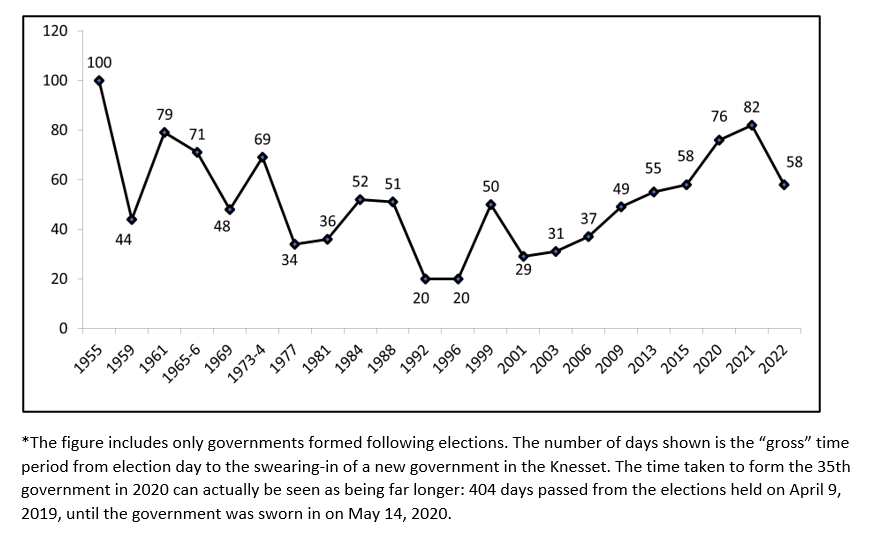
The period of time taken to form a government in Israel has ranged between 20 and 100 days. Compared to other countries, this is not unusually long. In Belgium no fewer than 541 days passed between elections in June 2010 and the swearing-in of a new government in December 2011. In Germany, the previous national record was broken following the 2017 elections, when it took Angela Merkel 171 days to form her fourth government. In Sweden too, the results of the 2018 elections were inconclusive, making it difficult to form a government, and four and a half months passed before agreement on a new government could be reached.
Figure 1 below shows that the process of forming a government during the first two decades of the State of Israel took longer than today, largely because in those days, the process was not limited in time. In 1955, no fewer than 100 days passed between the elections for the third Knesset and the swearing-in of the new government, and in 1961, it took 79 days from the elections for the fifth Knesset until the new government was sworn in. Subsequently, the time taken became much shorter, but since 2001, these periods have become longer again. It should be noted that the numbers given are the “gross” number of days, that is, the time that passed between election day and the swearing-in of the government. If we subtract the number of days between the elections and the time at which the President formally charged a particular candidate with the task of forming a government, then these periods are a bit shorter.
Figure. Time taken to form governments in Israel (number of days after elections held) *
How Many Factions Are Included in the Coalition?
Since incoming governments must seek the confidence of the Knesset, and given that no single party has ever enjoyed an overall majority of seats, all of Israel’s governments have been coalitions. The number of factions included in coalitions formed following elections has ranged over the years from three to nine.
The record is held by the unity government formed in 1984, which included seven other factions in addition to the Alignment and Likud factions: Mafdal, Shas, Agudat Yisrael, Yamhad, Shinui, Morasha, and Ometz. Similarly, the coalition that supported the Bennett-Lapid government in 2021 comprised eight factions: Yesh Atid, Yamina, Blue and White, Yisrael Beytenu, Labor, New Hope, Meretz, and Ra’am. By comparison, the coalition formed by Yitzhak Rabin following the 1992 elections included just three factions: Labor, Meretz, and Shas.1
Table 1 shows the number of factions in each coalition since 1992, and also presents the relative size of the prime minister’s own faction, an indication of the level of control the prime minister has over the coalition. If this percentage is low, the prime minister’s faction is to some degree constrained, and must maneuver between a greater number of coalition partners and pay a higher price to each. This gives the partners greater bargaining power and deals a significant blow to the prime minister’s ability to govern effectively and maintain a stable coalition.
Table 1. Data on the coalitions formed following elections, 1992–2015
|
Year |
Prime Minister |
Factions in the coalition |
MKs in the coalition |
Relative size of the Prime Minister's faction |
|
1992 |
Rabin |
3 |
62 |
70% |
|
1996 |
Netanyahu |
6 |
66 |
49% |
|
1999 |
Barak |
7 |
75 |
35% |
|
2001 |
Sharon |
7 |
78 |
24% |
|
2003 |
Sharon |
4 |
68 |
56% |
|
2006 |
Olmert |
4 |
67 |
43% |
|
2009 |
Netanyahu |
6 |
74 |
37% |
|
2013 |
Netanyahu |
4 |
68 |
46% |
|
2015 |
Netanyahu |
5 |
61 |
49% |
|
2020 2021 |
Netanyahu Bennett |
7 8 |
73 61 |
49% 10% |
|
2022 |
Netanyahu |
6 |
64 |
50% |
*The numbers shown are correct as of the day on which the government was sworn in and up to a week afterwards (additional factions were sometimes added to the coalition several days after the official swearing-in of the government).
Government Appointments: Handing Out Ministerial Positions
Many comparative studies on ministerial appointments in coalition governments have pointed to a principle of proportionality. According to this principle, the distribution of ministerial positions reflects the relative size of each coalition partner, such that the larger partners receive more ministerial positions than the smaller ones.
In Israel, the principle of proportionality generally predominates when it comes to coalition partners, but the ruling party does tend to gain a larger number of ministerial positions than its relative size in the coalition would imply. For instance, when the last cabinet was formed (late December 2022) 17 of the 31 members, including the Prime Minister, were from Likud – higher share than Likud’s relative size within the coalition.
The total number of cabinet members (the prime minister and the ministers) serving in the government has risen considerably over the years (see Figure 2 below). The first government, sworn in in 1949, included only 12 members. In all the governments up to 1966, there were no more than 18 ministers. A sharp rise in the number of ministers came with the government formed following the 1969 elections, mainly due to this being a broad coalition comprising the two large factions – the left-wing Alignment faction and the right-wing Gahal faction. This government, which was considered a national unity government, included 24 members. The national unity governments of the 1980s also had inflated ranks of ministers.
Figure 2. Number of cabinet members in governments formed following elections
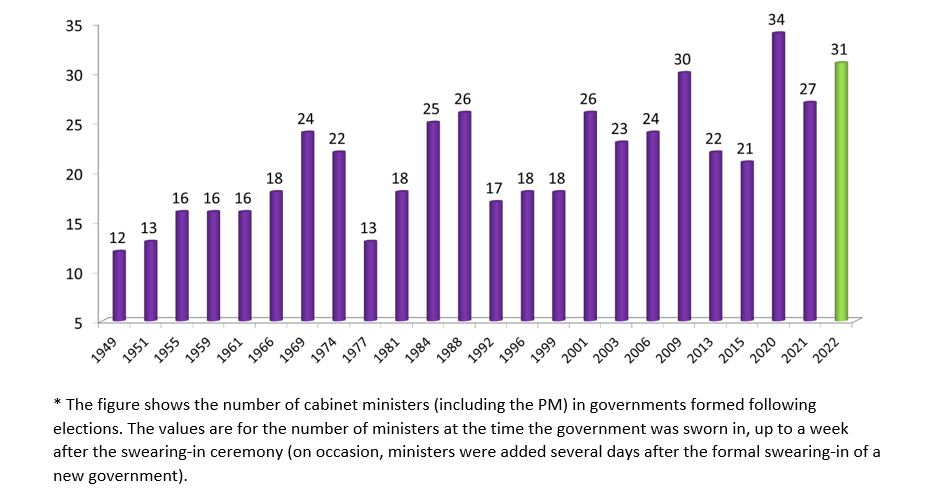
In 2014, an amendment was introduced to the Basic Law: The Government, limiting the number of government ministers to a maximum of 19, including the prime minister. This amendment was intended to prevent the creation of an oversized and cumbersome government and the establishment of new ministries whose real contribution is questionable, resulting in a waste of public funds. Having a large number of ministers can also hinder the proper functioning of the Knesset: The greater the number of Knesset members serving in the government, the fewer are available for the important parliamentary work of serving on committees and overseeing the executive branch.
In practice, one of the first steps taken by the 20th Knesset following its election was to cancel the limitation on the number of ministers. Thus, the government that was sworn in on May 14, 2015, numbered 21 ministers. The Netanyahu-Gantz government established in 2020 included (at the time of its formation) no fewer than 34 ministers, while the current government included in its peak an all-time record of 39 ministers.