

Elections 101: Forming A Government After Elections
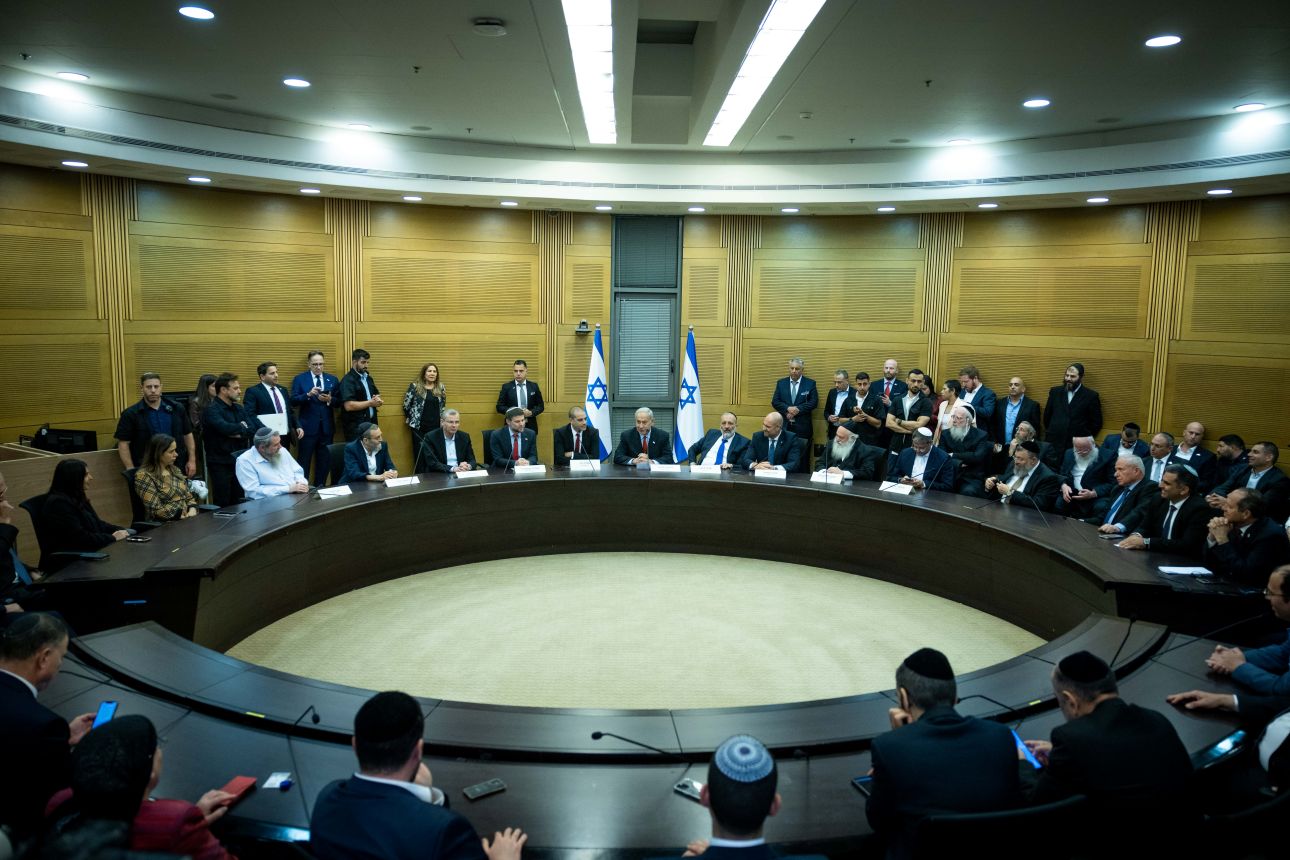
Photo by Yonatan Sindel/Flash90
The State of Israel belongs to the family of parliamentary democracies, in which the executive branch (the government – i.e., the prime ministers and his or her cabinet) draws its authority from the legislative branch (the parliament, known as Knesset in Israel), and so requires its confidence. Thus, the question of who will serve as head of the executive branch—the Prime Minister—is not decided directly by the voters, but depends instead on a bargaining process among the various factions (i.e., parties or joint lists after they are elected to Knesset) elected to parliament. In most parliamentary democracies (including Israel), no single party holds most of the seats in parliament, so that the process of forming a government is longer and more complicated. In Israel, the following are the steps that take place after the votes are counted to form the government.
Step one: The President of the State of Israel nominates one of the factions’ leaders to form the government
Following consultations with the representatives of the factions elected to the Knesset, the President of the state nominates a candidate (an MK who is one of the factions’ leaders) to form a government. The law does not provide the President guidelines in doing so, thus affording him or her broad discretion. Typically, the President appoints the leader of the largest party, but this is by no means mandatory, and the deciding factor is generally who seems to have the best prospect of forming a government that will receive the Knesset’s confidence.
Step two: coalition negotiations
The candidate who was given the task by the President negotiates with potential coalition partners.
A 28-day time limit is in place for the negotiations, after which a 14-day extension can be requested from the President.
If the candidate failed to form a coalition, the decision is returned to the President, who can give the task to another MK. This time, there is a 28-day time limit to form a coalition, with no possibility for extension.
If the 2nd candidate is also unsuccessful, then a group of 61 Knesset members can ask the President to give the task to a third candidate. In this case, a period of 14 days is granted, after which, if no government has been formed, the Knesset is dissolved and a new round of elections is called.
Step three: a coalition agreement is signed
The coalition agreement details the commitments of each coalition partner, outlines a policy agenda, and allocates various positions, such as government ministers, Speaker of the Knesset, etc.
Step four: Investiture vote
The Knesset convenes a special session during which the designated Prime Minister presents the new government, its policy agenda and its composition. Thereafter, a formal vote is held. If the new government wins the vote, it is formally invested and starts its tenure.
All told, the full process in Israel has ranged from 20 to 100 days – in the past two decades, no government has been sworn in in less than 50 days.