

Explainer: The High Court of Justice Hearing on the Continuation in Office of MK Ben-Gvir’s as Minister of National Security
On Wednesday, April 15, 2026, the High Court of Justice heard petitions filed against the continuation of MK Itamar Ben-Gvir’s term as minister of national security, against the background of allegations of his improper involvement in the activities of the Israel Police and violations of its professional independence. The hearing was an expanded panel of nine justices.
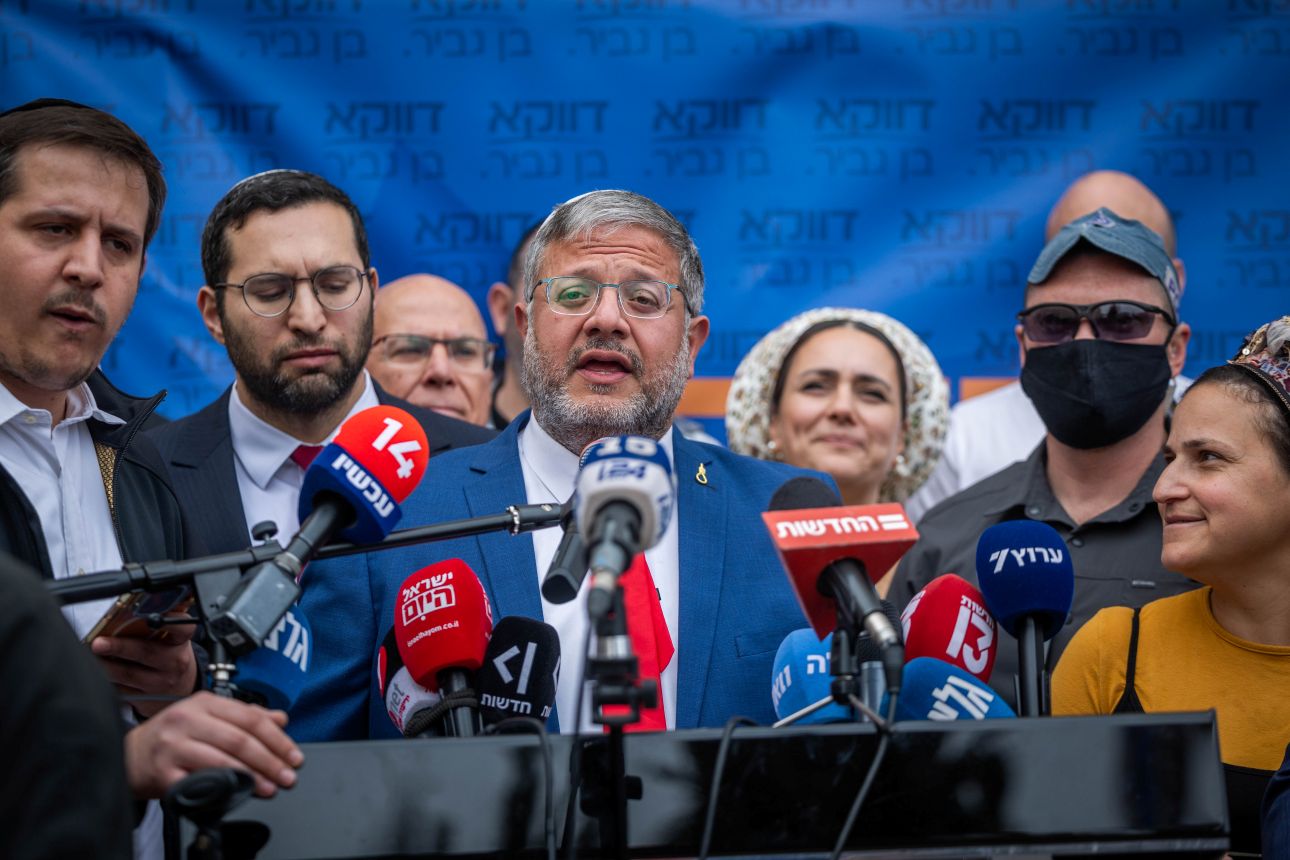
Photo by Yonatan Sindel/Flash90
What has been the course of events that led to the High Court of Justice hearing?
In December 2022, in response to the proposed appointment of MK Itamar Ben-Gvir as minister of national security, a petition was filed seeking to prevent this appointment on the grounds that it was “extremely unreasonable,” given his history of racist remarks and his criminal record. In its ruling, delivered in February 2024, the Court agreed that the appointment raised difficulties, but did not find it to be extremely unreasonable at that stage—among other reasons, following MK Ben-Gvir’s statement that he had changed his ways. The ruling was based on the premise that the minister does not serve as a “super commissioner” of the Israel Police, and that “the independence of the police and other bodies subordinate to the Ministry of National Security will be preserved.”
Subsequently, in response to the minister’s conduct, private citizens submitted four new petitions to the High Court of Justice, asking the justices to instruct the prime minister to exercise his authority under section 22(b) of the Basic Law: The Government and to order the removal of MK Ben-Gvir from his position as minister of national security. Following this, and after a series of events relating to the minister’s conduct that indicated difficulty in ensuring that the police would act based on its duty to the general public, the attorney general asked the prime minister to reconsider his position on the minister’s continuation in office.
At the beginning of 2025, Ben-Gvir resigned from his position in response to the signing of a deal for the release of the hostages. Shortly after he returned to his post (despite the attorney general’s position that he could not be re-appointed), and following a dialogue between his office and the Attorney General’s Office, a document of principles was formulated in April 2025 regarding the interface between the minister of national security and the Israel Police.
Though this agreed framework had the potential to serve as a creative compromise that would immediately define clearer boundaries for the relationship between the minister and the police, in September 2025, the attorney general informed the Court that the agreement had not helped to ensure the independence of the police, and at the beginning of December she wrote to the prime minister that the independence of the police could no longer be protected from the minister’s interference and from harms to the rule of law and the rights of Israel’s citizens.
At the beginning of January 2026, the attorney general submitted her preliminary position to the High Court of Justice regarding the petition, and requested the issuance of an order nisi that would shift the burden of persuasion to the prime minister, requiring him to explain and justify why he should not act immediately to halt the harm to the independence of the police and to its state-oriented and non-political character by removing the minister from office—after having refrained from doing so to date.
Approximately one month later, the justices of the High Court of Justice decided to issue an order nisi directed at the prime minister, instructing him to appear and explain why he should not order the removal of Ben Gvir from his position as minister of national security. This decision was made after the justices had examined the parties’ arguments, and in light of the fact that the prime minister had not (at least up to that point) addressed the substance of the central claims in the case.
The question that is expected to be the focus of the upcoming High Court hearing, is whether the prime minister’s decision not to exercise his authority to remove MK Ben-Gvir from his position as minister of national security is extremely unreasonable, in light of Minister Ben-Gvir’s conduct as minister. The prime minister, for his part, argues that the Court lacks the authority to intervene in the composition of the government solely on the basis of a minister’s ideological position and his efforts to advance policy within his ministry. The minister himself rejects the allegations, asserting that he acted within the scope of his authority and that the petition constitutes an infringement of his political rights.
To what extent is the minister permitted to intervene in police activity?
The question of the independence of the Israel Police from the minister to whom it is subordinate has been the subject of numerous discussions over the years. On the one hand, the minister has public responsibility for the actions of the police, while on the other hand, it is vital to detach the police from any particular political outlook, so that it does not abuse the broad powers it has vis-à-vis citizens, such as the power to conduct searches, use force, make arrests, and conduct investigations. The Supreme Court addressed this matter at length as part of the ruling it issued around a year ago, regarding the constitutionality of Amendment No. 37 to the Police Ordinance—an amendment that was advanced by MK Ben-Gvir in an expedited proceeding on the eve of the establishment of the current government. In their January 2025 ruling, the justices clarified that the exercising of police powers must be carried out in a non-partisan manner and detached from the political arena, since politicization of the police could lead, according to then-Acting President Justice (ret.) Vogelman, to over-enforcement against groups that oppose the government, or to over-policing or under-policing of groups based on their religious or national affiliations, and could even result in the use of criminal investigation tools against political opponents.
The court ruled, in view of the unique role of the police, that it is essential to distinguish between the authority of the minister in charge of the police to lay down general policy, and the executive level of policy implementation, which is the responsibility of the police commissioner and of the professional staff of the police. Justice Sohlberg proposed several ways to differentiate between the minister setting general policy and the minister engaging in prohibited operational involvement:
- Is the action in question a policy relating to a broad set of principles that affects a category or a group of cases, or is it a decision that will affect just a few select events?
- Is it a policy formulated with a high level of abstraction, without reference to a particular context, or is it a decision that addresses specific circumstances?
- Is it a policy that looks toward the future, or is it a decision concerning an event that is still occurring or that will take place at a specific time or period?
- Is it a policy that sets guidelines and allows the police to exercise independent discretion in particular cases, or is it a decision that relates to the manner in which the policy is implemented, without giving the police scope for independent discretion?
What rules apply to the minister’s overall policy?
In the ruling regarding Amendment No. 37 to the Police Ordinance, the justices clarified that when the minister sets a general policy, the entire body of administrative law applies to it. Among other things: The minister’s decision must not be made based on irrelevant considerations; rather, it must have an appropriate and solid factual basis (six of the nine judges in the case were of the opinion that the minister is even required to consult with the police commissioner); the minister is obligated to publish his policy (three of the justices in the case even ruled that without publication, any policy set by the minister is invalid); and his decision must be reasonable, and must not disproportionately harm fundamental rights.
With regard to two particularly sensitive areas—demonstrations and investigations— additional rules apply: Five of the nine justices on the panel held that the minister is also required to consult with professional legal authorities in formulating policy on demonstrations. With respect to investigations—a domain in which the politicization of police activity may lead to a serious violation of the rights of suspects—all of the justices on the panel agreed that the involvement of the attorney general in shaping policy in this area is important (with five of the nine justices holding that the minister is obligated to consult with her in formulating such policy, and some even taking the view that her consent is required in this domain, inter alia, in order to ensure alignment between investigation policy and prosecution policy, for which the attorney general is responsible). Accordingly, by a majority opinion, the Court invalidated the provision in the amendment to the Police Ordinance advanced by Ben Gvir, which provided that the minister would determine the police’s investigation policy after merely “hearing” the attorney general.
Finally, and no less important, if the minister has outlined a general policy that complies with the aforementioned rules, he is not permitted to give specific instructions, either directly or indirectly, regarding its implementation in practice, in order to ensure that the police exercise their powers in a professional and non-partisan manner and without the political influence of the minister. In particular, according to Justice Grosskopf, the minister must not instruct the police, under the guise of policy, to use its powers in contravention of the provisions of the law, to act in a partisan or unequal manner, or to refrain from enforcing the law. This is especially relevant with regard to investigations. Indeed, according to Justice Elron, the minister is not allowed, neither explicitly nor implicitly, to intervene in police decisions in relation to specific investigations.
What claims have been made regarding the conduct of MK Ben-Gvir throughout his term as minister of national security?
We present here several prominent examples of conduct by MK Ben Gvir during his tenure as minister of national security. However, this is not an exhaustive list.
- Though the minister has insisted throughout his term on the need for the police to act in accordance with his policy, this often related to issues that were not published as part of his official general policy (for example, his “policy” on noise from mosques), despite the existence of an obligation to publish policy, which is designed to prevent the provision of operational guidance under the guise of policy.
- At the end of August 2025, the minister circulated a draft document titled “The Policy of the Minister of National Security—Demonstrations.” However, this document significantly restricted the scope of the police’s independent discretion, and no proper consultation process was carried out with the police commissioner and the attorney general.
- Beyond that, there has been a great deal of specific and operational involvement on the part of the minister. In the ruling on Amendment No. 37 to the Police Ordinance, Justice Sohlberg wrote that applying the criteria for distinguishing between general policy and specific cases to the minister’s actions during the period of time that had elapsed since the filing of the petitions clearly shows that in at least some of those cases, the minister had exceeded his authority, because his actions could not be viewed as policy decisions. For example, publishing operational instructions relating to the conduct expected of the police in specific incidents, such as closing certain roads, the manner in which force is used in particular cases, or a specific investigation that had been initiated, does not constitute general policy.
- One of the most prominent examples of the minister improper involvement in operational activity was his involvement in the police operation in the Negev Bedouin village of Tarabin. As reported by the police, “the minister of national security and the police commissioner assigned” the task of conducting a large-scale operation in Tarabin. In other words, this was not the issuing of a general policy outline containing various principles, but rather involvement in a specific operation, concerning activity at a specific time and in relation to a specific group of citizens, and relating to the manner in which the police activity was to be carried out. Moreover, shortly after a resident of the village, an Israeli citizen, was shot during the operation, Minister Ben-Gvir automatically expressed his support for the policeman who shot him, thus intervening in a specific investigation, while also conveying a message to other Israel Police officers that he views such conduct in a positive light. This intervention was not an isolated incident. According to the attorney general, the minister has repeatedly violated the law prohibiting interference in, or influence over, criminal investigations—particularly in cases where he supports the suspect or where the matter aligns with his political positions—in a manner that conveys a message to the police regarding the conduct he expects.
- In another example, the minister appointed an officer to head a unit he established, together with the police commissioner, to address incitement outside the police’s Investigations Division, while attempting to exert impermissible influence over investigations. This matter is currently under review by the High Court of Justice.
- More broadly, the issue of police appointments is one of the central examples of the minister’s deep involvement in police activity. One of the principal concerns in this regard is the use of the minister’s appointment powers to advance political interests and impermissible “policy,” as well as a tool for indirect interference in operational activity and police investigations. A particularly well-known example is Minister Ben Gvir’s unsuccessful attempt to block the promotion of Superintendent Rinat Saban due to her involvement in proceedings relating to the prime minister and his advisers. In this regard, the Jerusalem District Court held that Minister Ben Gvir’s conduct gave rise to “a reasonable and tangible concern regarding the existence of improper and self-interested considerations underlying the decision to refrain from promoting” Superintendent Saban.
What is the position of the prime minister?
The prime minister, who is privately represented in the High Court hearing, argued in a preliminary response submitted to the Court in December 2025 on his behalf and on behalf of the Israeli government that the court cannot intervene in a decision about the composition of the elected government, simply on the basis of a particular minister’s ideological position and his attempts to set policy in the ministry he oversees. A significant portion of the response focuses on various procedural arguments, including the claim that the reasonableness doctrine cannot be used to apply judicial review to a prime minister’s decision on whether to remove a minister from office, as such decisions are largely made according to political-public considerations. It further argues that each administrative decision made by the minister should be examined on its merits and in a separate proceeding, in accordance with the rules of administrative law, and not as part of a petition regarding the minister’s continuation in office.
Finally, in a fairly brief manner, the prime minister responds to two of the substantive allegations regarding MK Ben-Gvir’s conduct. First, with regard to the minister’s public remarks about particular investigations of police officers, the prime minister argues that “the attempt to prevent an elected official, a government minister, from having the opportunity to express his opinion (which would seem also to represent many of his constituents) or to support police officers who are part of the system he is charged with overseeing (even if they have erred in some case or other) violates the basic right of freedom of political expression,” and should certainly not have any influence on whether or not to remove the minister from his position. Second, with regard to the minister’s policy document on demonstrations, the prime minister states that “the issue of illegal demonstrations that severely disrupt public order in the State of Israel is of considerable concern to the government of Israel and to many citizens in the Israeli public, whose lives and daily routines are severely harmed due to the policy of non-enforcement led by the attorney general”; and further, that the draft document formulated by the minister, which advances “the policy that the entire government wishes to promote,” does not constitute the minister overstepping his powers.
The prime minister’s more detailed position in the petitions was submitted several days before the High Court of Justice hearing. The prime minister argues in his response, inter alia, that the authority to appoint ministers or to remove them from office is vested in him alone, and that he accepted Ben Gvir’s position that no operational instructions were issued by the minister to the police before he decided to reappoint him to the position of minister of national security—a decision that was subsequently approved by the government plenary and by a majority in the Knesset.
What is Minister Ben Gvir’s position?
During the month of January, Minister Ben Gvir submitted a preliminary response to the petitions. In this response, he argues, inter alia, that the petitions constitute an attempt “to remove a sitting minister solely on account of ‘the manner in which he performs his duties’ and his political rhetoric,” and that the petition infringes upon the political rights of the minister and of those who voted for the list on which he ran in the most recent Knesset elections. He further contends that no incidents occurred in which he issued operational instructions to the Israel Police. Rather, according to him, the conduct in question consisted of “support” for suspects, permissible criticism of the conduct of the Police Internal Investigations Department in a particular investigation, mere “inquiries” conducted on the ground regarding police activity, and the redeployment of forces responsible for addressing crime in Arab society, or simply “dialogue” held with senior officers during an incident.
In his submission, the minister also refers to several instances in which previous ministers allegedly intervened in police work. However, according to the attorney general, parts of this account are presented without context and in a manner that is factually or legally inaccurate, and in any event are not comparable to the cumulative scope and intensity of operational intervention or intervention in specific investigations attributed to the current minister.
It should be noted that throughout this submission, the minister describes instances in which he claims to have acted pursuant to a “general policy” that he had set for the police.
What is the position of the attorney general?
At the beginning of March 2026, the attorney general submitted her detailed position to the Court regarding the petitions seeking to remove Minister Ben Gvir from his position. According to the attorney general, Minister Ben Gvir has been acting systematically “to undermine the independence of the police through a variety of methods and means, while abusing the considerable powers vested in him, and exerting improper influence—direct and indirect—over the use of force and operational decision-making in concrete incidents, including in particularly sensitive matters such as specific criminal investigations and protests against the government; as well as through his conduct on the ground, presenting himself as a kind of ‘super–Commissioner’.” No less importantly, in her view, his conduct has created a perception among police officers that their promotion depends on acting in alignment with the minister’s political interests.
In her submission to the Court, a troubling picture emerges of improper and serious conduct (at times even concealed from view) on the part of the minister of National Security. This conduct spans a wide range of areas relating to police powers, includes violations of judicial decisions and of directives issued by the attorney general, and opens a very broad door to the misuse of the law enforcement apparatus by the government for the political and personal interests of its members (particularly at a time when the prime minister is standing criminal trial, various ministers and their associates are under criminal investigation, and large-scale protests against the government are taking place).
This submission by the attorney general (as well as previous submissions) details dozens of events that present ongoing harm to police independence on the part of the minister: operational intervention in anti-government demonstrations; operational intervention on the ground in contravention of decisions by the government or the security cabinet (for example, regarding the Temple Mount); interference in operational activity in relation to orders to demolish specific houses; involvement in police operational activity in the field that entails friction with civilians (and in particular with Arab citizens) while creating a causal connection between the police’s actions vis-à-vis civilians and his political activity; public statements regarding specific criminal investigations and judicial decisions; delegitimization of judicial decisions made by justices of Arab origin (which includes a racist dimension); issuing instructions in specific cases to arrest suspects or take action against police officers; and making decisions about appointments and dismissals of particular police officers, using prohibited political considerations — in a manner that conveys an improper message to all police officers and commanders regarding what is expected of them for the purposes of promotion. In this context, the attorney general also responds to the factual account presented by Ben Gvir in his submission to the Court, and sets the record straight both factually and legally.
According to the attorney general, the government—and the prime minister in particular—bear heightened responsibility to ensure the lawful and independent functioning of the Israel Police. In practice, however, their prolonged silence provides tailwind to the minister’s conduct and lends legitimacy to the continued serious harm to the foundations of the system of governance.
Conclusion
The necessary conclusion of the attorney general's submission to the Court is that it should be determined that Minister Ben Gvir cannot continue to serve as minister of national security—the minister responsible for the Israel Police—because he is directly, seriously, and potentially irreversibly undermining the foundational principles of the system of governance over which he is entrusted. The prime minister argues that this is an exceptional request, as there is no precedent for removing a minister on the basis of the manner in which he performs his duties, but only in cases where criminal proceedings have been initiated against the minister (as also argued by Minister Ben Gvir).
However, according to the attorney general, the High Court of Justice has previously held that, in certain circumstances, the authority vested in the prime minister to remove a minister from office transforms from a discretionary power into one that must be exercised. In other words, it is possible that a minister’s conduct in a given case may be so severe—particularly where there is harm to the fundamental constitutional values of the State of Israel—that it would be manifestly unreasonable to allow him to continue in office, such that the prime minister’s authority to remove a minister becomes an administrative duty. In her view, the situation that has arisen with respect to Minister Ben Gvir is exceptionally severe—even more so than the cases previously considered by the High Court of Justice—since this is not merely a matter concerning a minister’s criminal past, but rather a pressing need to halt the harm to the core foundational values of Israeli democracy and to human rights.
The question before the court is whether the minister’s real, ongoing, and cumulative harm to the independence of the police obligates the prime minister to remove him from his position, in the sense that refraining from doing so would be extremely unreasonable.