

Together (Beyachad): The Bennett-Lapid Merger and History of the Two Parties
Watch the video explainer here
Naftali Bennett and Yair Lapid announced they will run jointly in the coming elections, in a framework of a joint list labeled Together (Beyachad in Hebrew).
Both Bennett and Lapid made their first entrance to politics in 2012 and ran for the first time in the 2013 elections. Although the two politicians have a long history of coordination and co-operation (most recently as the two senior figures of Israel’s 36th government, the so-called Bennett-Lapid government), they have never run together under one list.
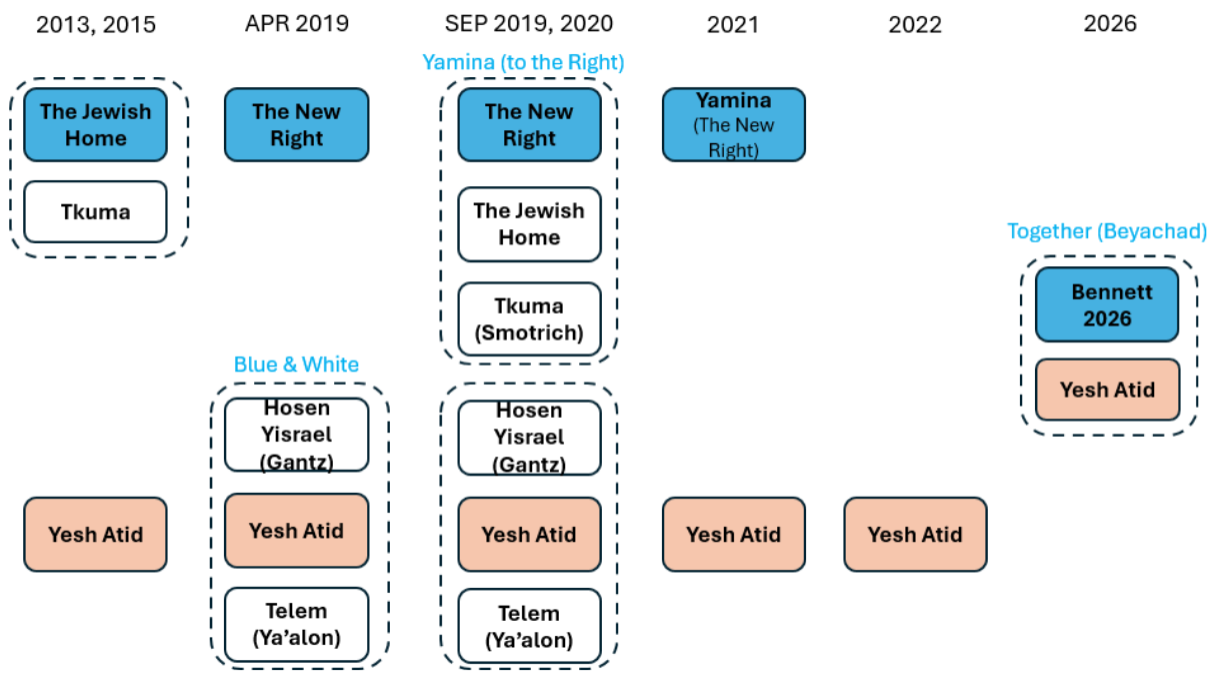
The chart presents the various political platforms Bennett and Lapid competed within since the 2013 elections. The various parties of Bennett are blue-shaded, while Lapid’s Yesh Atid party is red-shaded. The dashed frameworks stand for electoral alliances (joint lists of more than one party).
History of the Two Parties
Naftali Bennett was elected in 2012 as the chairman of The Jewish Home party (formerly the National Religious Party, NRP). In the 2013 elections, The Jewish Home ran in a joint list with the far-right Tkuma party. The name of this joint list was also The Jewish Home, which is unusual when parties join together. The list won 12 seats – 8 for Bennett’s party and 4 for Tkuma. The cooperation between the two parties continued in the 2015 elections, but this time the list won only 8 seats – 6 for Bennett’s party and 2 for Tkuma.
In the end of 2018 Bennett, along with his political partner Ayelet Shaked, left The Jewish Home to establish a new party: The New Right. The party competed in the April 2019 elections but failed to pass the electoral threshold. Fortunately for them, new elections were called for September that year. This time The New Right ran jointly with Tkuma and The Jewish Home in a joint list labeled Yamina (“to the right”). The list won 7 seats, 3 of them went to The New Right. 3rd consecutive elections were called in 2020 and the cooperation within Yamina’s joint list continued this time as well. The list won 6 seats, 3 of them went to The New Right.
In the 2021 elections The New Right ran independently, but under the name Yamina. It won 7 seats, and Bennett was nominated as the 13th prime minister of Israel, under a rotation arrangement in which Bennett would serve as prime minister for the first half of the four-year term and Lapid would take over as prime minister for the second half (though due to the political reality at the time, it did not play out as such). This was under the framework of a coalition agreement, not a party merger.
In the 2022 elections Bennett and his party did not compete. In 2025 he registered a new party with the temporary name Bennett 2026. This party will run together with Yesh Atid in the 2026 elections, under the name Together (Beyachad).
Yair Lapid made his political debut in 2012, after establishing a new party: Yesh Atid (There’s a Future). The new party was the big surprise of the 2013 elections, winning 19 seats. In the next elections its power decreased to 11 seats. Towards the April 2019 election, Yesh Atid ran together with Benny Gantz’s and Moshe Ya’alon’s parties (Israel Resilience and Telem, respectively) in a joint list called Blue & White. The list won 35 seats, 15 of them went to Yesh Atid. The cooperation continued in the next two elections, in which the list won 33 seats, 13 of those – for Yesh Atid.
In the 2021 and 2022 elections Yesh Atid ran independently, winning 17 and 24 seats, respectively. Following the 2021 elections Lapid formed the 36th government. Bennett served as prime minister for a year, and was replaced by Lapid for the last 6 months of the government term.