

Majority of Israelis Think Ending the Iran War Under Current Conditions is Not Compatible with Israel's Security Interests
64% of Jewish Israelis and 48.5% of Arab Israelis think ending the Iran war is not compatible with Israel's security interests. 51% of Israelis think the US administration has greater influence over Israel's defense decisions than the Israeli government. A plurality of Israelis believe settler violence against Palestinians is handled too leniently.

Photo by Nati Shohat/Flash90
Methodology
The survey was conducted by the Viterbi Family Center for Public Opinion and Policy Research at the Israel Democracy Institute between April 26–30, 2026. It was based on a representative sample of the population in Israel aged 18 and above, comprising 601 Jewish interviewees and 150 Arab interviewees.
The National Mood
- In the total sample, there was a sharp decline this month in optimism about the future of Israel’s national security, down to one of the lowest levels we have found in recent times (from 47% in March to just 39% in April). The share of optimists about social cohesion also fell this month (from 30% in March to 22.5% in April). At the same time, this month’s survey found that optimism has remained stable about both the future of democratic rule in Israel and the future of the economy.
Optimistic about the future of democratic rule, national security, the economy, and social cohesion (total sample; %)
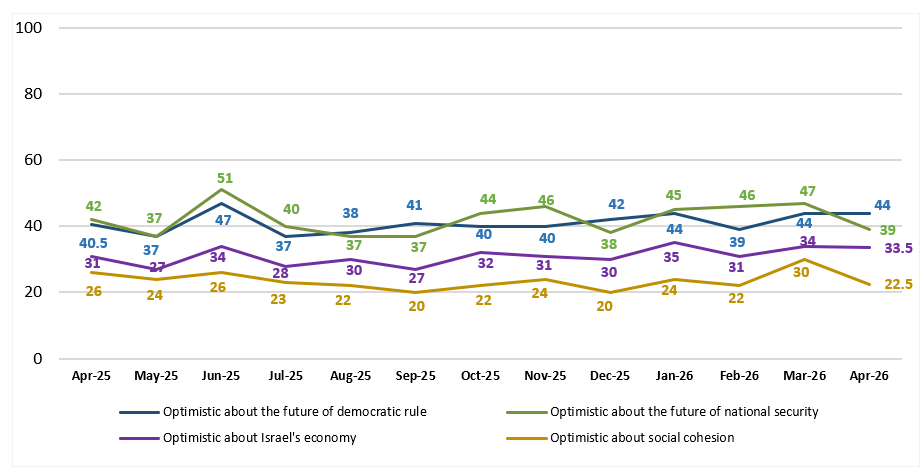
- A breakdown of findings by political orientation (Jews) reveals once again that the Left has a lower share of optimists than the other two camps for all four topics, in particular relative to the Right, and especially with regard to the future of democratic rule (Left, 16%; Center, 33%; Right, 60%) and the future of national security (Left, 15%; Center, 27%; Right, 58%).
- As in previous months, the share of optimists among Jews is larger than that among Arabs for all topics, with the exception of social cohesion, with regard to which the shares of optimists in each group are fairly similar. However, it is worth noting that there is not a majority of optimists in either the Jewish or the Arab samples for any of the four topics we assess.
Optimistic about the future (Jews and Arabs; %)

Israel: More Successes or Failures?
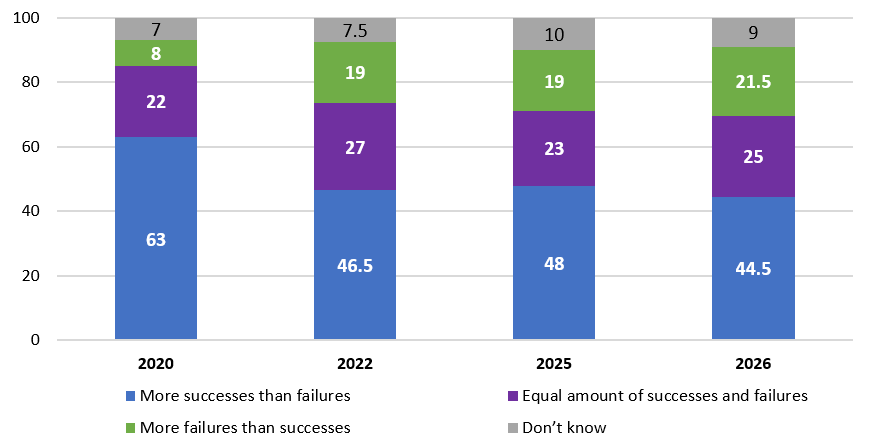
- We asked: “Last week, Israel celebrated its 78th Independence Day. In general, what has been the balance between its successes and failures until now?” In the total sample, the largest share of respondents think that there have been more successes than failures, though not an overall majority (44.5%). Moreover, this represents a slight decline from last year, when 48% indicated more successes than failures, and a fall of 18.5 percentage points since 2020.
Last week, Israel celebrated its 78th Independence Day. In general, what has been the balance between its successes and failures until now? (total sample; %)
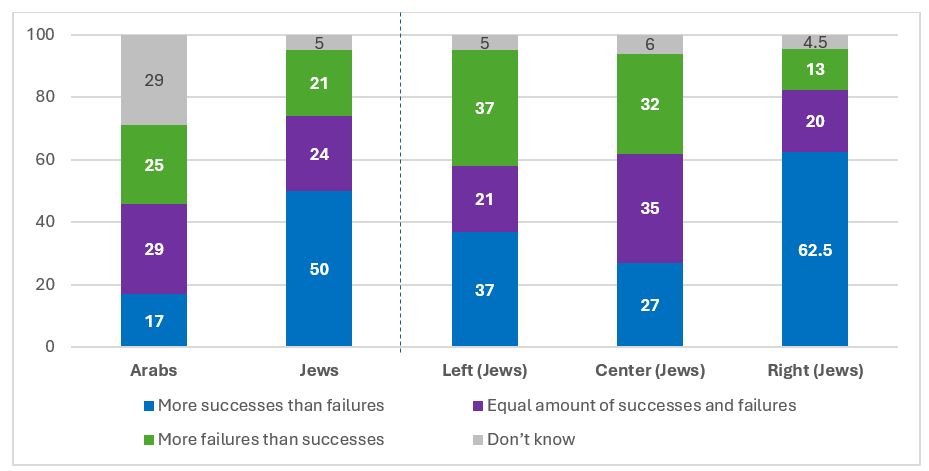
- At the current time, one-half of Jewish respondents think that there have been more successes than failures. Among Arabs, a very high percentage selected the “don’t know” response (about 30%). Of those who did know what to respond, the largest share (29%) said that Israel has had an equal amount of successes and failures.
- A comparison between the political camps (Jews) reveals that a majority of those on the Right think there have been more successes than failures. In the Center, the most common opinion is that there have been an equal amount of successes and failures. meanwhile, on the left, the share who think there have been more failures than successes and the share who think there have been more successes than failures are the same.
Balance between Israel’s successes and failures until now (%)
The War With Iran
Likelihood of a return to conflict:
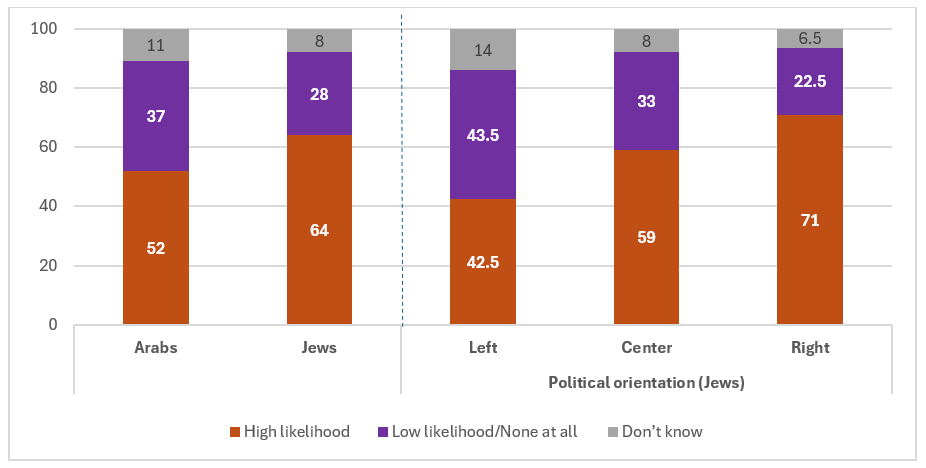
- In light of the failure to reach an agreement and President Trump’s repeated extensions of the ceasefire with Iran, the majority of the total sample (62%) think that the likelihood of a return to widescale conflict is high. Less than half of this share (30%) think that the chances of this happening are low.
- Among Jews, around two-thirds think that the likelihood of a return to widescale conflict is high, while the corresponding proportion of Arabs is smaller, at just over half (52%).
- On the Right (Jews), a large majority rate the likelihood of a return to widescale conflict as high, as is the case in the Center, though there the majority is smaller. The Left is divided on the likelihood of renewed fighting.
How would you rate the likelihood of a return to widescale conflict with Iran? (%)
Does an end to the war serve Israel’s security interests?
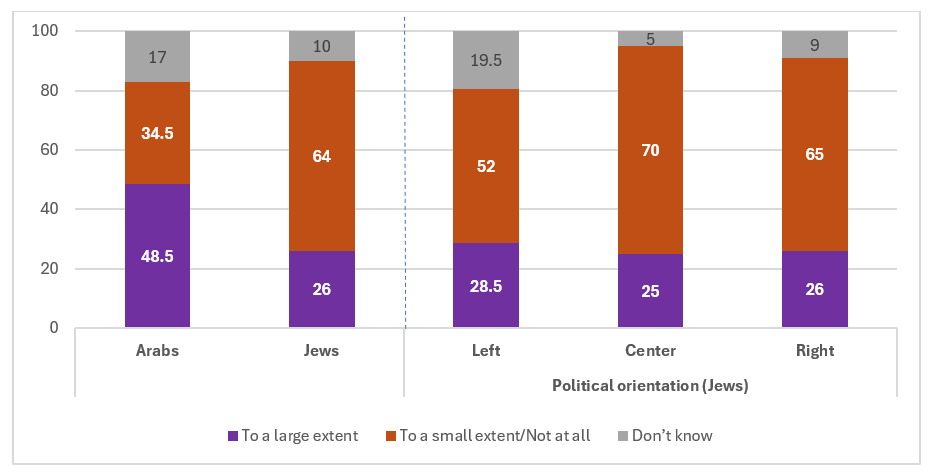
- A majority of the total sample (59%) think that ending the war with Iran under the current conditions is only slightly or not at all compatible with Israel’s security interests.
- Among Jews, around two-thirds think that ending the war does not serve Israel’s security interests. By contrast, almost half of the Arab respondents take the opposite view.
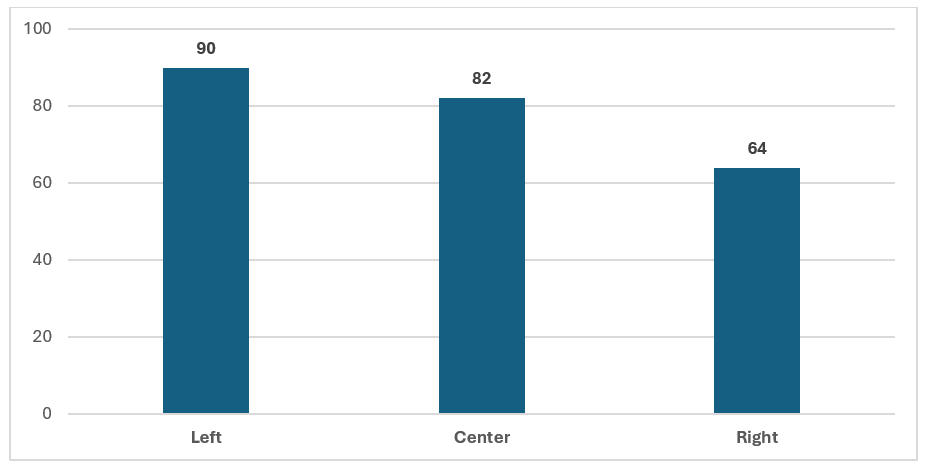
- In all three political camps (Jews), the majority think that ending the war is not in Israel’s security interests. This majority is largest in the Center (70%) and on the Right (65%), while on the Left it is only just over one-half.
If the war with Iran has indeed ended, to what extent do you think this serves Israel’s security interests? (%)
Negotiations with the Lebanese Government
- The Israeli public is pessimistic about the chances of reaching a stable diplomatic-defense arrangement with the Lebanese government that includes the disarming of Hezbollah. Almost three-quarters of the total sample rate the likelihood of this happening as low or non-existent.
- Among Jews, pessimism is even greater, with almost 80% thinking that the likelihood of reaching such an arrangement is low. Among Arabs, opinions are divided: 45% think that the likelihood of such an agreement with Lebanon is high, and precisely the same percentage rate this likelihood as low.
In your opinion, what is the likelihood of reaching a stable diplomatic-defense arrangement with the Lebanese government, that will include the disarming of Hezbollah? (%)
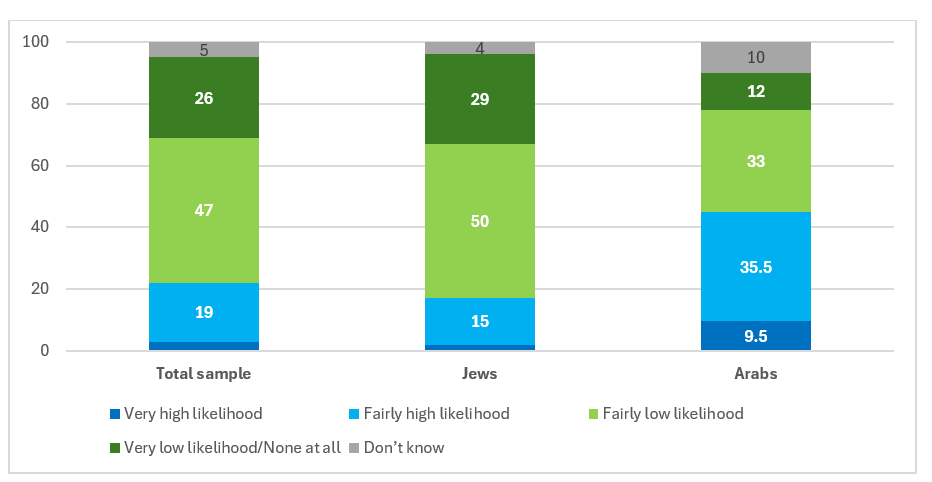
- Segmentation of the Jewish sample by political orientation reveals that a large majority in all three camps think that the likelihood of such an arrangement is low (Left, 71%; Center, 80%; Right, 79.5%).
Who Has Greater Influence Over Defense Decisions Relating to Israel?
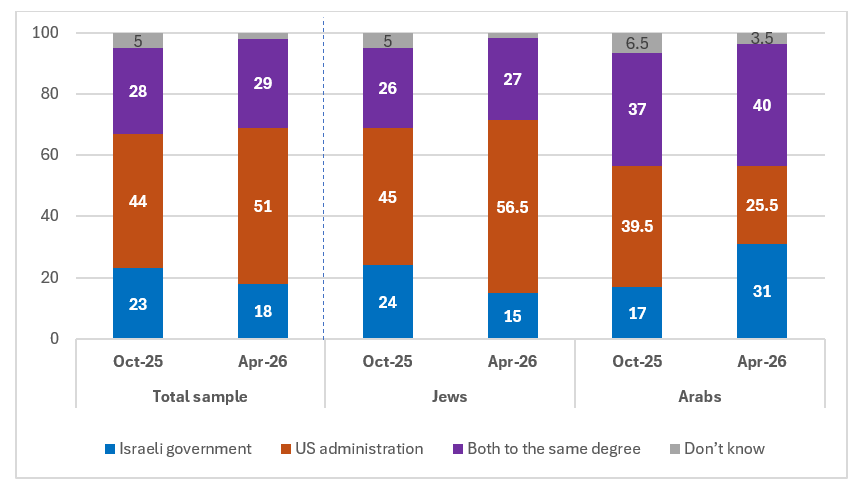
- In the total sample, the US administration is perceived as having greater influence over defense decisions relating to Israel. The share of respondents who hold this view even increased between October 2025 (44%) and April 2026 (51%). Correspondingly, the share who think that the Israeli government has greater influence has declined, from 23% to 18%.
- Among Jews, the proportion who think that the US administration has greater influence increased sharply from 45% to 56.5%, while the proportion who think that the Israeli government is more influential has fallen from 24% to 15%.
- Among Arabs, the largest share of respondents on both occasions have said that the two administrations have an equal degree of influence. In addition—and we cannot yet tell whether this is a trend or an outlying finding—the share who think that the US administration is more influential has decreased significantly, while the share who think that the Israeli government has greater influence has increased significantly.
In your opinion, who has greater influence today over defense decisions relating to Israel? (%)
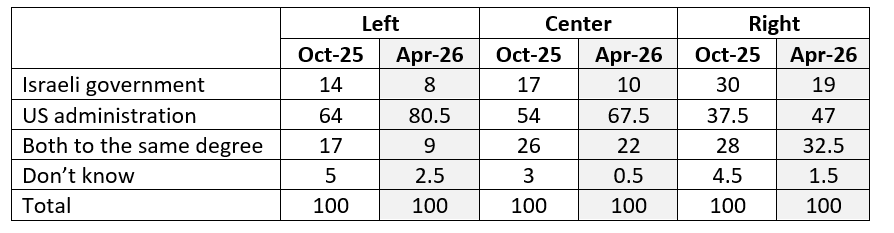
- In all political camps (Jews), the proportion of those who think that the US administration has greater influence over defense decisions has risen sharply, while the proportion who think that the Israeli government is more influential has declined correspondingly. On the Left and in the Center, the majority of respondents think that the US administration is more influential. On the Right, however, while the largest share of respondents hold this view, this share is less than half.
In your opinion, who has greater influence today over defense decisions relating to Israel? (Jews; %)
Decline of Israel’s Standing in American Public Opinion
- In the total sample, a clear majority of respondents (72%) think that the recent decline in positive attitudes toward Israel among Americans, as well as the corresponding increase in negative attitudes toward Israel, are somewhat or very worrying for Israel. On this issue, there was almost no difference between Jews and Arabs.
- In all three political camps (Jews), a majority of respondents think that these developments are worrying, though this majority is particularly large on the Left.
Think that the increase on the proportion of the American public who have a negative view of Israel is somewhat or very worrying for Israel (Jews; %)
Greater Military Power or Diplomatic Agreements?
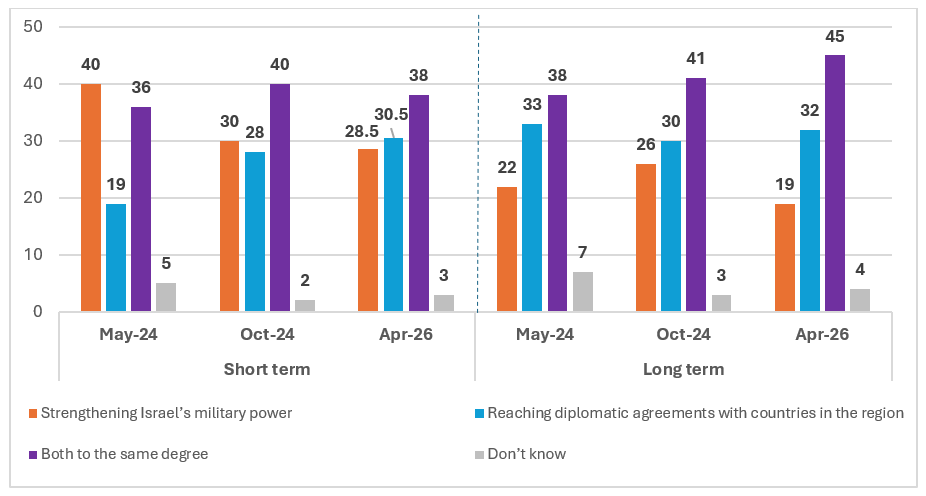
We once again asked our respondents what they think will better ensure the future of Israel’s security in the short term and in the long term.
- Regarding the short term, there has been a change in trend in the total sample over the last two years: In May 2024, strengthening Israel’s military power was the preferred option (40%), but support for this view declined gradually down to 28.5% in April 2026. Over the same period, share who think that Israel’s security will be better served by reaching diplomatic agreements with countries in the region has risen, from 19% to 30.5%. Support for the view that these two options are equally important has remained relatively stable since May 2024, and in the last two measurements, the largest share of interviewees have selected this response.
- Regarding the long term, the largest share of respondents in all three measurements have rated the two options as equally important, with this share actually increasing steadily over this period. The share who think that diplomatic agreements are the most important factor has remained stable at around one-third in all measurements, while the share who prefer strengthening Israel’s military power has been the smallest in all three surveys.
Which of the following will better ensure the future of Israel’s security in the short term and in the long term? (total sample; %)
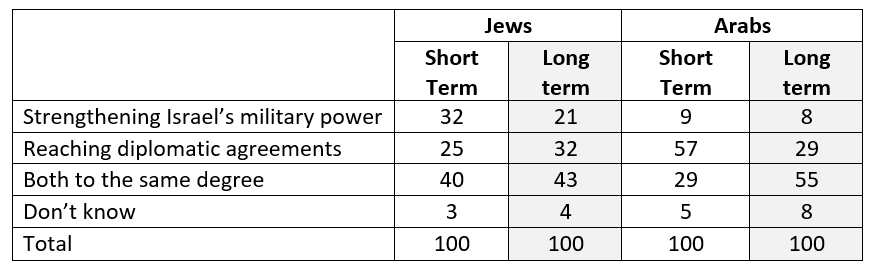
- Among Jews, both in the short term and the long term, the largest share think that both options are equally important. In the short term, strengthening military power (32%) is perceived as preferable to diplomatic agreements (25%), but in the long term, the trend is reversed: reaching diplomatic agreements (32%) is preferred to strengthening Israel’s military power (21%).
- Among Arab respondents, the picture is different: in the short term, a clear majority prefer diplomatic agreements, while in the long term, the majority think that both options are equally important.
Which of the following will better ensure the future of Israel’s security in the short term and in the long term? (%)
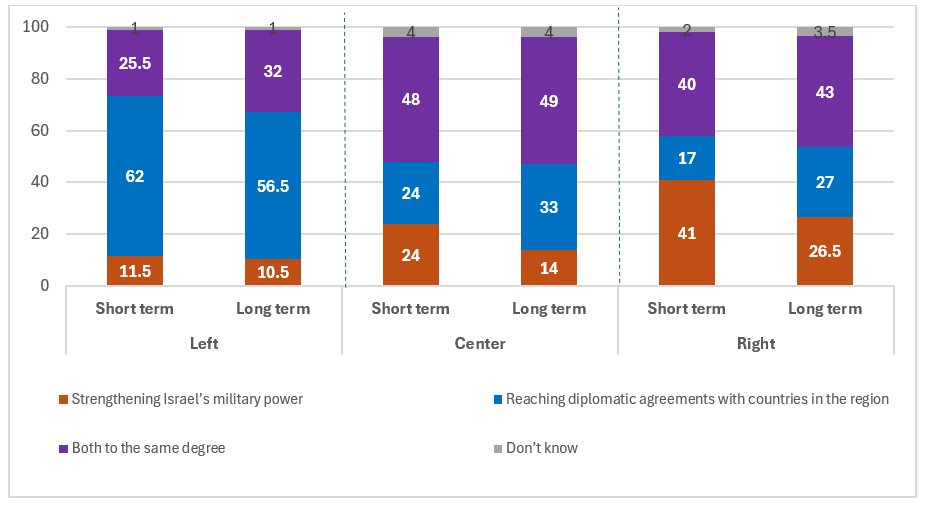
- Segmentation by political orientation (Jews) reveals that on the Left, for both the short and long term, reaching diplomatic agreements is the much preferred option. In the Center, in the short and long term, almost half of the respondents think that both options are equally important. On the Right, in the short term, around 40% prefer strengthening Israel’s military power and a similar proportion think that both options are equally important; but in the long term, equal shares support reaching diplomatic agreements and strengthening Israel’s military power, while the share who think that the two options are equally important remains the largest, at a similar level to the short term.
Which of the following will better ensure the future of Israel’s security in the short term and in the long term? (Jews; %)
Main Motivation Behind the Appointments of the Heads of the Shin Bet and the Mossad
- We asked, “What was the main factor guiding Prime Minister Netanyahu when he recently appointed new heads of the Shin Bet (Major General David Zini) and the Mossad (Major General Roman Gofman)?” In the total sample, only one-third of respondents cited the candidates’ professional capabilities as the main factor involved, while the largest share (48%) think that these appointments were mainly guided by considerations of the candidates’ personal closeness and loyalty to Netanyahu.
- Among Arab respondents, by far the largest share (42%) said that the main factor behind these appointments were considerations of the candidates’ personal closeness and loyalty to Netanyahu, while only 18% think that the main factor was the candidates’ professional capabilities. Fully 40% selected the “don’t know” response.
- Segmentation of responses in the Jewish sample by political orientation reveals a large majority on the Left (87%) and in the Center (72.5%) who cited personal closeness and loyalty to Netanyahu as the main motivation for these two appointments. On the Right, on the other hand, only about a third thought that this was the main factor, while a small majority (51%) thought that Netanyahu was guided by the candidates’ professional capabilities.
Is the Character of the IDF Changing?
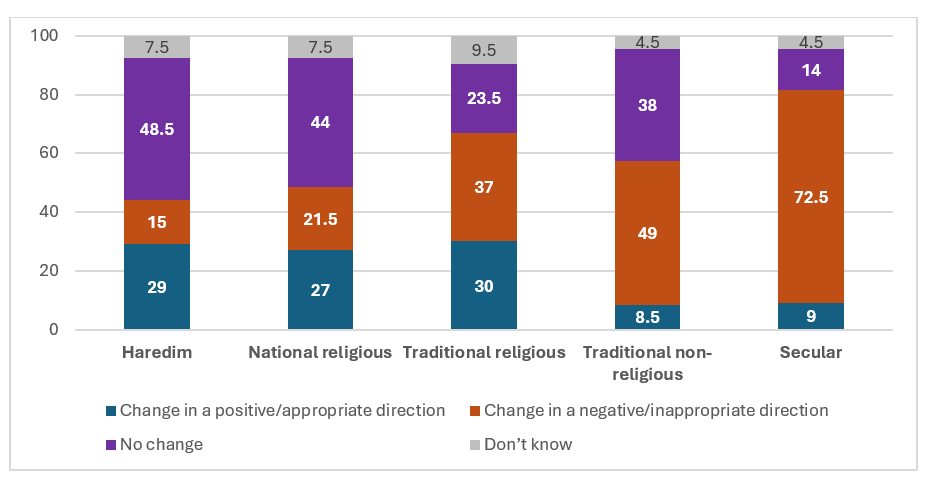
- We asked: “Do recent events—including disciplinary action against soldiers for lighting a barbecue on Shabbat, and punishment of female soldiers on the grounds that they were dressed immodestly at an event marking the end of their military service—indicate or not indicate a substantial change in the character of the IDF?” In the total sample, the largest share of respondents (47%) think there has been a change in a negative/inappropriate direction. Around one-quarter (26%) think there has not been a substantial change, and the smallest share (18%) think that these events indicate a change in a positive/appropriate direction.
- Among both Jewish and Arab respondents, the largest share think that these events indicate a change in the character of the IDF in a negative/inappropriate direction, but this share is larger among Jews (50%) than among Arabs (35%). One-fifth of Arabs selected the “don’t know” response.
- Breaking down responses in the Jewish sample by religiosity reveals that the largest share of the Haredi public (48.5%) think that these events do not indicate a substantial change in the character of the IDF (which, of course, is not to their liking). The same view is held by the largest share of national religious respondents (44%). In the traditional religious sample, the largest share, albeit a minority (37%), think that these events indicate a change in the character of the IDF in a negative/inappropriate direction, as do 49% of traditional non-religious Jews. In the secular group, a clear majority (72.5%) view these events as indicating a substantial change in the IDF’s character in a negative/inappropriate direction.
Do recent events—including disciplinary action against soldiers for lighting a barbecue on Shabbat, and punishment of female soldiers on the grounds that they were dressed immodestly at an event marking the end of their military service—indicate or not indicate a substantial change in the character of the IDF? (Jews; %)
The Security Forces’ Treatment of Settlers Involved in Violence Against Palestinians
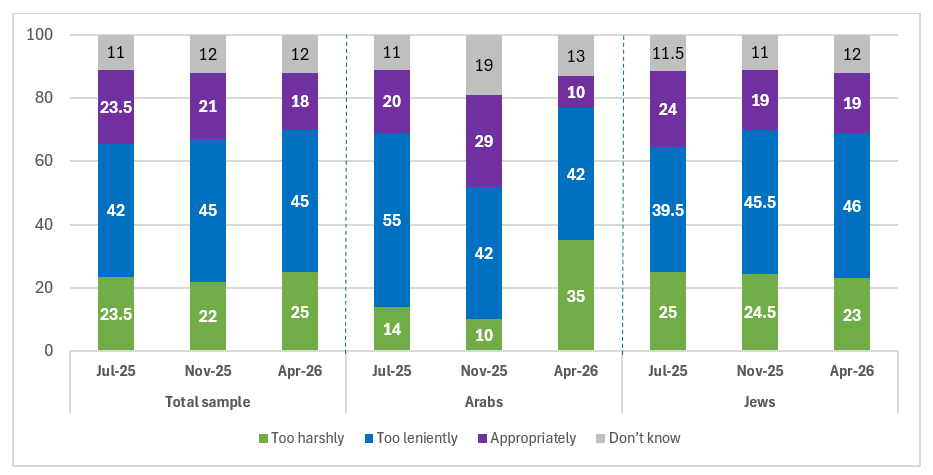
- For the past year or so, we have been monitoring the public’s views regarding the question of how the security forces treat settlers who commit violent acts against Palestinians in the West Bank. Among Jews, we have found relative stability in opinions: in all three measurements we conducted, the largest share of respondents have said the security forces are acting too leniently, and this share has even increased, from 39.5% in July 2025 to 46% in the current survey.
- For a reason that we cannot explain, in the current survey there has been an increase in the percentage of Arab respondents who say that the security forces are treating these settlers too harshly. To understand this finding better, we will need to wait for the next measurement, as this may be a sampling error.
Are the security forces and enforcement agencies treating groups of settlers who are involved in acts of violence against Palestinians too harshly, too leniently, or appropriately? (%)
- As expected, there are large differences on this issue between political camps (Jews): On the Left and in the Center, a clear majority think that the treatment of settlers involved in violence in the West Bank is too lenient (84% and 65.5%, respectively). On the Right, by contrast, this view is held by only 29% of respondents, while a similar share think that the security forces treat these settlers too harshly (33%).
Are the security forces and enforcement agencies treating groups of settlers who are involved in acts of violence against Palestinians too harshly, too leniently, or appropriately? (%)

The April 2026 Israeli Voice Index was prepared by the Viterbi Family Center for Public Opinion and Policy Research at the Israel Democracy Institute. The survey was conducted via the internet and by telephone (to include groups that are under-represented on the internet) between April 26–30, 2026, with 601 men and women interviewed in Hebrew and 150 in Arabic, constituting a nationally representative sample of the adult population in Israel aged 18 and over. The maximum sampling error was ±3.58% at a confidence level of 95%. Field work was carried out by Shiluv I2R. The full data file can be found at: https://dataisrael.idi.org.il.