

Explainer: The Role of the Central Elections Committee and its Director General
In the wake of the announcement by the director-general of the Central Elections Committee, Orly Adas, of her resignation: What is the role of the Committee, what is the role of the director-general, what is the significance of this resignation, and what challenges will need to be addressed?
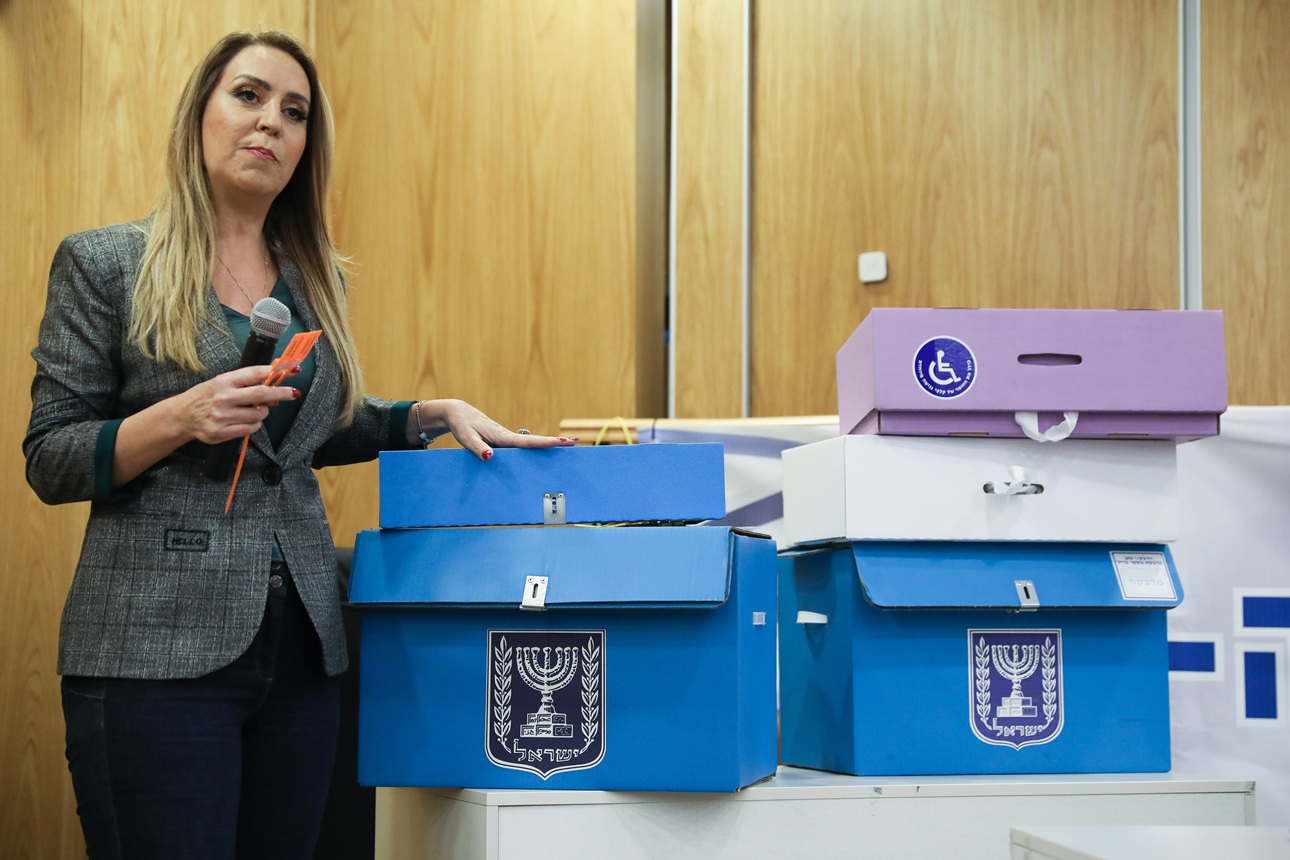
Photo by Olivier Fitoussi/Flash90
What is the Central Elections Committee?
The Central Elections Committee is the body responsible for organizing and managing the Knesset elections. During elections, it is the beating heart of the electoral system organizationally, employing tens of thousands of employees on election day itself. The Committee is headed by a chairperson, currently the deputy president of the Supreme Court, Justice Noam Sohlberg. The chairperson stands at the head of both of the main components of the Committee: (1) the Committee’s professional staff, comprising employees with no political affiliation; and (2) the Committee plenum, which is a political body comprising representatives of the factions in the outgoing Knesset. This component also includes the presidium of the Central Elections Committee, which contains the Committee chair and four deputies, who currently represent the four largest factions in Knesset.[1]
What is the role of the director-general of the Central Elections Committee?
The director-general of the Central Elections Committee heads the Committee’s professional staff, serving under the Committee chair. The newly resigned director-general, Adv. Orly Adas, has occupied this position since 2010, prior to which she was deputy director-general of the Committee.
The director-general is responsible for all administrative and executive aspects of managing the elections, including: outlining policy on administrative and operational issues; the organization and proper execution of the Knesset election process; liaison with the Committee chair, with the directors of the regional election committees, with the Ministry of the Interior, and with security officials; managing the Committee’s budget; initiating and promoting proposals for legislative amendments; formulating and approving the Committee’s work plan, in coordination with the Committee chair, and ensuring its implementation; and managing a supervision and control system for the Committee’s activities and drawing conclusions from assessment of these activities. In addition, the director-general has been given powers relating to the hiring and firing of the Committee’s employees.[2]
What is the procedure for appointing a new director-general?
According to section 41(b) of the Civil Service (Appointments) Law, powers regarding the employees of the Central Elections Committee are vested in the chair of the Committee. According to section 41(b)(2), the Committee chair appoints the director-general, based on the recommendation of a search committee appointed by the chairperson. In other words, this is not a regular tender procedure, nor is it a political appointment or personal appointment by any minister. The chair of the Central Elections Committee appoints a committee whose role is to recommend a candidate or candidates for the director-general position to the chair, and the chair then appoints the director-general. No details are provided regarding the composition of the search committee or its working methods (in contrast to the fairly detailed instructions regarding the composition, functioning, and decision-making of other search committees in the civil service, such as the Civil Service Commissioner Search Committee).[3] There are also no specific threshold and qualifications defined for the director-general (in contrast to directors-general of government ministries, for whom suitability criteria have been set, albeit at quite a low bar).[4] This is based on the assumption that the chairperson—who is, as stated, a Supreme Court justice—will conduct the appointment process in a professional manner and will appoint a suitable and worthy director-general. At the same time, the Knesset Elections Law does include restrictions on employing staff at the Central Elections Committee who have some kind of criminal record (according to the decision of the Committee chair), and there are fairly broad prohibitions regarding the employment of staff members with political affiliations, especially with regard to the director-general: it is forbidden to employ “anyone who has a personal or business affiliation with a political party or with a senior party member, who engages in political or party activity, or who is a member of a party...,” as well as anyone who has previously engaged in such activity or was a member of a party—in the case of the Committee’s director-general, for the past seven years, and in the case of other employees, going back five years.
The appointment process described in the law has never taken place until now, because the amendment to the law that establishes the procedure dates back to 2014, while the outgoing director-general was appointed before then. That appointment, in 2010, was also made through a search committee, but via a process overseen by the presidium of the Central Elections Committee—a largely political body, as mentioned. The 2014 amendment to the law was designed to ensure a professional and independent appointment process, as stated in the explanatory notes to the bill: “The position of the director-general of the Elections Committee is professional in nature; they are not mere political appointments, as is the case with directors-general in government ministries who carry out the minister’s policy, but rather serve as the senior professional managerial authority in the Elections Committee.”
Regarding ending the term of office of the director-general, no time limitations have been set for this position, so there is no fixed date for termination of the term (beyond the retirement age according to the Civil Service Employees Law). This is in contrast to many other senior positions in the civil service on which such limitations have been imposed.[5] It should be noted that in 2014, prior to the amendment which regulated the process for the appointment of the director-general and many other aspects relating to employees of the Central Elections Committee, a proposal was made to limit the term of office of the director-general to four rounds of elections or 12 years, whichever is longer. But ultimately, no rules were set in legislation or elsewhere regarding the length of the director-general’s tenure.
However, in May 2025, the state comptroller published a report (75c) on aspects of human capital management in the Elections Committee. In the report, the state comptroller recommended to the chair of the Central Elections Committee, inter alia, that two aspects of the Commission’s director-general be better regulated: (1) “procedures for the appointment and work” of the search committee for the position of director-general should be laid down, in the spirit of the rules for Civil Service Commission search committees; and, more importantly for our purposes, (2) the comptroller recommended establishing rules regarding the term of office of the director-general. In fact, the state comptroller was of the opinion that the lack of any term limit for the director-general is a kind of anomaly, contradicting the general government policy regarding term limits for senior officials. However, he recognized that any term-limit arrangement must take into account that this is a critical position with unique characteristics, and especially, that it requires maximum independence and accumulated experience. It should be noted that the Central Elections Committee stated in its response to the comptroller that it opposes this recommendation, noting among reasons that this is a unique critical gatekeeper role, that there is great value to the cumulative experience of the office holder, and that, unlike other positions, it is impossible to transfer the director-general to another senior civil service position at the end of their term.
According to section 17(a) of the Knesset Elections Law, the authority regarding the dismissal of employees from the Central Elections Committee rests with the chair of the Committee; that is, the chair is entitled to dismiss the director-general (of course, following appropriate dismissal proceedings as required by law). And of course, the director-general is entitled to resign, as Orly Adas has just done.
What recent events have taken place relating to the Central Elections Committee?
In recent years, there have been a number of incidents that have included harsh criticism and even attacks on the director-general in particular, and the conduct of the Committee in general, to the point that risks compromising the integrity of the Committee:
- Following the publication of the state comptroller’s report recommending a term limit (see above), rumors began to circulate regarding limiting the term of office and Adas’s future. In November 2025, the Committee chair, Justice Sohlberg, officially announced that he had decided to extend her term, so that she would remain in her position during the upcoming election campaign (for the 26th Knesset) and next (for the 27th Knesset). This decision was criticized at the time and again more recently by politicians and other figures (including allegations of involvement in the decision by President Isaac Herzog).
- The Knesset Finance Committee, which approves the Central Elections Committee’s budget via a special procedure, approved a smaller budget this year than the one requested by the Committee. There were allegations from the opposition that this was done in order to harm the functioning of the Committee.
- Criticism and a petition against the appointment of the legal advisor to the Committee: Following the resignation of the Committee’s legal advisor, Adv. Dean Livneh, Adv. Yifat Siminovsky was appointed as the legal advisor to the Central Elections Committee via a tender process. Her appointment drew criticism from political parties, including a public exchange of letters between Adv. Ilan Bombach (representing the prime minister and the Likud) and Committee chair Justice Sohlberg, who strongly defended the appointment and claimed that it had been carried out properly. A petition against the appointment was even filed with the High Court of Justice, which is still pending.
- The resignation of the Central Elections Committee’s internal auditor, Adv. Hila Waldman, was accompanied by criticism of senior officials in the Committee from politicians and on social media.
It is important to note that the professional and proper conduct of the Central Elections Committee is critical to the management of the elections and to public trust in the elections. Criticism of the conduct of the Central Elections Committee, including the procedures for appointment of senior positions at the Committee, and even legal petitions against specific decisions of the Committee, are legitimate and may well contribute to necessary improvements. However, repeated public attacks by political elements and opinion leaders against the Committee and its senior officials are liable to undermine the legitimacy of the Committee, and thus of the entire elections process.
That said, given that elections in Israel have, by and large, so far been conducted properly by the Central Elections Committee to date, it is to be hoped (and we believe) that the 2026 elections will also be conducted in a democratic manner.
What needs to be paid attention to now, ahead of the appointment of the next director-general of the Central Elections Committee?
- A new director-general should be appointed to the Central Elections Committee via a proper and professional process. An alternative option— at the discretion of Justice Sohlberg, and especially relevant if the Knesset elections are brought forward—would be to appoint an acting director-general for a fixed period of time, until after the upcoming Knesset elections (as a rule, the appointment of an acting director-general for an extended period is undesirable, but these are exceptional circumstances given the proximity of the upcoming Knesset elections). If a new permanent director-general is to be appointed before the elections, this should be done as quickly as possible. As noted, according to the law, the chair of the Central Elections Committee, Justice Sohlberg, is responsible for appointing the next director-general, based on the recommendation of a search committee that he himself appoints. It is important that the search committee, the process, and the chosen director-general—and/or the acting director-general—be as professional and apolitical as possible (in accordance with the law, which prohibits the appointment of a director-general who has a political affiliation or who has been politically active in recent years).
- The incoming director-general should be provided with maximum professional support. As suggested by the state comptroller with relation to the entry into office of a new director-general, it is necessary to “strengthen the administrative staff of the Central Elections Committee in such a way as to ensure continuity and stability in the work of the Committee even when a new director-general takes office, as well as to determine an overlapping transition period that will assist in the entry of the new director-general into the position.”[6] As noted, it is also possible to consider appointing a professional acting director-general until a new permanent director-general takes office.
This support is especially important at the present time: Clearly, the entry of a new director-general now, just a few months before the Knesset elections, is particularly challenging. In many respects, the election process has already begun, for example, with regard to the recruitment of personnel, including tenders and contracts issued by the Central Elections Committee; the Committee’s preparations for challenges and dangers related to the management of the election process, for example, with regard to artificial intelligence; and petitions that are increasingly being submitted to the chair of the Central Elections Committee on matters such as the prohibited use of public resources and other violations of election propaganda laws.
- Politicians and other opinion leaders are expected to help strengthen public trust in the election process in general and in the Central Elections Committee and its staff in particular, and to refrain from remarks that undermine the legitimacy. As noted, criticism is legitimate and important, but it must be voiced in the appropriate forums and must be respectful and focused on those aspects that need to be corrected. In this context, it should be remembered that certain elements, including foreign countries, have an interest in undermining the public credibility of the elections in order to contribute to chaos and extremism, and they do so via so-called “influence campaigns” on social networks. It is important not to contribute to these destructive efforts.
- In this context, all parties involved are expected to refrain from exerting any pressure on Justice Sohlberg and on the process of appointing a new director-general of the Central Elections Committee. Such pressure may not only damage the credibility of the Committee and the elections, but also deter potential candidates from submitting candidacy or, later on, deter the new director-general from fulfilling their duties professionally and independently. Here, too, criticism can be justified and important, but unnecessary pressures and attacks should be avoided.
It should be remembered that the Central Elections Committee comprises a professional staff, a political plenum, and a chairperson who is a Supreme Court justice. This mixture itself has the potential to lead to over-politicization and to harm the professionalism of the election management process. Therefore, it is all the more important that the director-general, their appointment process, and their conduct be professional, independent, and free of any political considerations. This is essential for the proper and fair conduct of Israel’s elections and for ensuring public trust in the election process and its results.
The chain of events surrounding the Central Elections Committee and its officials is liable to undermine the integrity of the Committee and to damage the credibility of the elections.[7] However, as noted, in light of the fact that elections in Israel have so far been conducted properly by the Central Elections Committee (with the exception of very specific issues), it is to be hoped (and we believe) that the 2026 elections will also be conducted in a democratic manner.
[1] For more on the structure and functions of the Central Elections Committee, including recommendations for strengthening its professional and independent character relative to its political aspects, see: Dana Blander, The Central Elections Committee: Professional or Political? Policy Study 175 (Jerusalem: Israel Democracy Institute, 2022), https://www.idi.org.il/media/18015/the-central-elections-committee-professional-or-political.pdf.
[2] For details, see the State Comptroller’s Report 75c, Aspects of Managing the Human Capital at the Central Elections Committee (2025), pp. 33–35, https://library.mevaker.gov.il/sites/DigitalLibrary/Documents/2025/2025-05/2025-05-301-Elections.pdf.
[3] Civil Service Commissioner, Instruction 1.1, Policy for Establishing a Search Committee, https://www.gov.il/BlobFolder/policy/guide_line_11/he/GuideLine11-v7.pdf; Civil Service Commissioner, Instruction 1.2, Policy for the Work of the Candidate Search Committee, https://www.gov.il/BlobFolder/policy/guide_line_12/he/guideline12.pdf.
[4] The suitability requirements for directors-general of government ministers are detailed in Government Resolution 86, from May 10, 2009.
[5] For example, as part of Government Resolution 4470 from February 8, 2009.
[6] State Comptroller’s Report 75c, Aspects of Managing the Human Capital at the Central Elections Committee (2025), p. 35, https://library.mevaker.gov.il/sites/DigitalLibrary/Documents/2025/2025-05/2025-05-301-Elections.pdf.
[7] See: Assaf Shapira and Guy Lurie, Safeguarding the Integrity of the 26th Knesset Elections: Mapping the Risks and Strategies for Addressing Them (Jerusalem: Israel Democracy Institute, 2026), https://www.idi.org.il/media/30303/safeguarding-the-integrity-of-the-26th-knesset-elections-mapping-the-risks-and-strategies-for-addressing-them.pdf.