
The “Who Is a Jew?” Bill and its Connection to Shavuot – Explainer
On Shavuot, Jewish tradition celebrates the story of Ruth, emphasizing choice, loyalty, and belonging as the central qualities shaping the boundaries of the Jewish community. A proposed amendment to the Law of Return would go against this spirit – everything you need to know about the bill and the history on the issue.
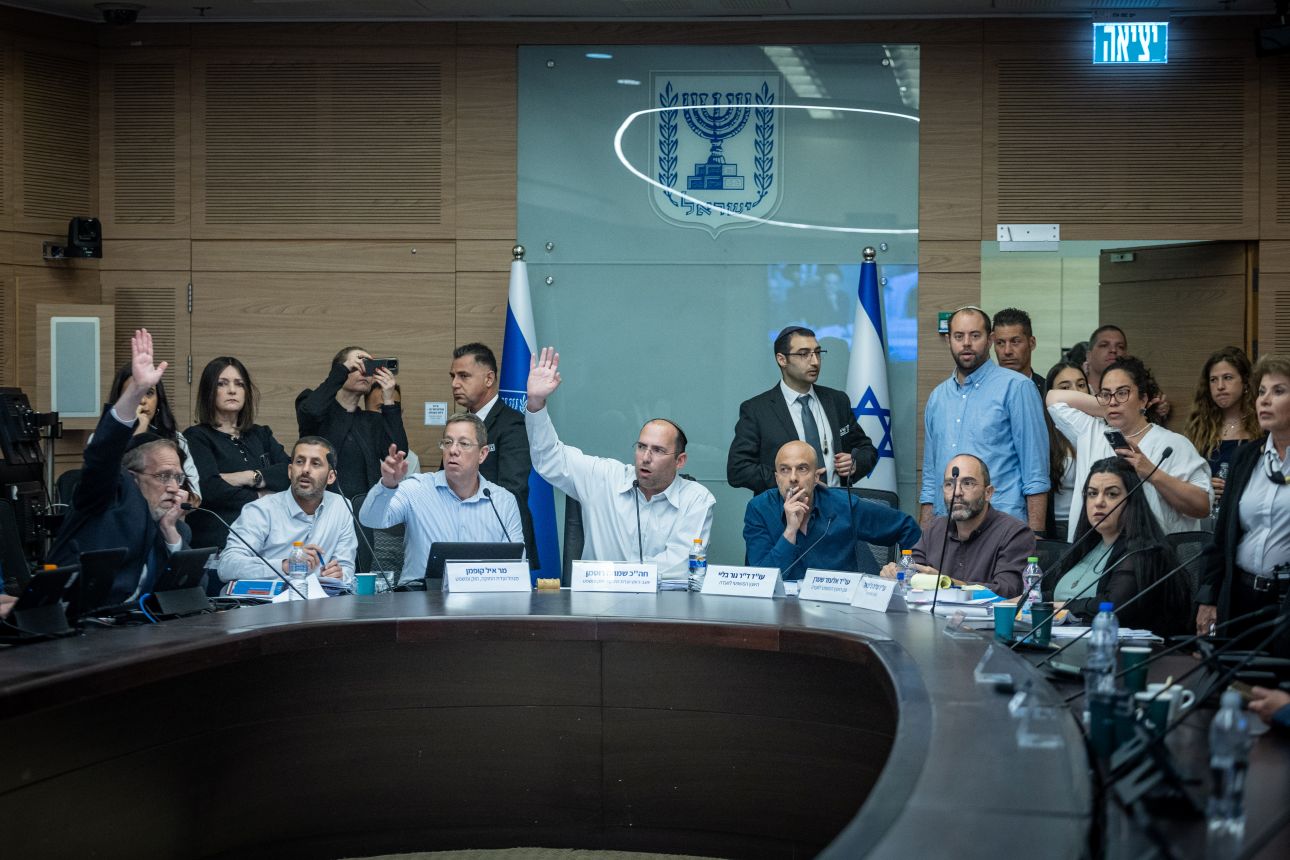
Photo by Yonatan Sindel/Flash90
Amid the current political turmoil and ahead of the Shavuot holiday, the government has once again debated MK Simcha Rothman’s proposed amendment to the Law of Return, dealing with the question of “Who is a Jew?” and, more fundamentally, whether Judaism should be defined only according to halakha (Jewish religious law). The proposed amendment received enthusiastic support from Minister of Justice Yariv Levin, Minister of Environmental Protection Idit Silman, and Minister of National Security Itamar Ben Gvir (“a rare opportunity”), as well as from MK Avi Maoz (“a historic opportunity”). However, it was ultimately delayed on the Prime Minister’s instructions out of concern over the reaction of Diaspora Jewry.
What, in fact, lies at the heart of the dispute over the question “Who is a Jew?” What did David Ben-Gurion actually think about the issue? And would Ruth, the heroine traditionally associated with the festival of Shavuot, be able to convert to Judaism in present-day Israel?
What Is MK Rothman’s Proposed Amendment to the Law of Return?
The bill proposed by MK Simcha Rothman, which as noted was discussed by the government last week, seeks to change only a single word in the Law of Return—but carries dramatic implications. The Law of Return (1950) establishes the right of Jews to immigrate to Israel and receive citizenship there. Ben-Gurion stated, with humility, that it is not the state that grants Jews the right to settle in Israel; rather, every Jew already possesses an inherent citizenship that merely awaits realization.
The original law did not explicitly define the term “Jew.” In 1970, an amendment added the definition that a Jew is “a person born to a Jewish mother or who has converted to Judaism and is not a member of another religion,” without specifying the nature of the conversion process. In practice, two different definitions of “who is a Jew” subsequently developed in Israel. One is the Orthodox-halakhic definition, which primarily governs matters such as eligibility for marriage through the Chief Rabbinate. By contrast, the definition used for population registration and eligibility for citizenship under the Law of Return evolved into a broader civic-cultural definition that also includes individuals who converted through non-Orthodox Jewish movements.
The proposed bill seeks to resolve the tension between these two definitions by applying the halakhic definition of Jewishness to matters of registration and immigration as well. The proposed wording states that a Jew is “a person born to a Jewish mother or who has converted according to halakha and is not a member of another religion.” As a result, Reform and Conservative converts would no longer be eligible to register as Jews or receive Israeli citizenship under the Law of Return.
What Did Ben-Gurion Think About the Question of “Who Is a Jew”?
The explanatory notes accompanying the bill claim that its purpose is to restore matters to their original state and that it reflects a return to the principles and historical legacy of Ben-Gurion and Israel’s founders. But was this truly Ben-Gurion’s view? Well, no, not exactly. Ben-Gurion’s conception of Jewish identity was deeply rooted in the biblical narrative, particularly the story of Ruth, who joined the Jewish people after declaring, “Your people shall be my people, and your God my God,” rather than through the later-developed halakhic conversion process. For Ben-Gurion, the primary test of Jewish belonging was a family’s establishment of life in Israel and its choice to live as Jews.
During the intense political crisis surrounding the “Who Is a Jew?” question in the late 1950s, Ben-Gurion emphasized that in Israel’s Declaration of Independence, “we proclaimed freedom of religion and conscience, and did not determine that the state of the Jews would be a halakhic state ruled by rabbis.”
Why Was No Definition of “Who is a Jew” Included in the Original Law?
The original lawmakers were deeply divided over the question of who qualifies as a Jew. Ultimately, just as they chose to postpone the adoption of a constitution to a future date that has yet to arrive, they similarly deferred resolving the definition of Jewish identity. Ben-Gurion sought to separate the debate from the enactment of the Law of Return itself, which he wanted to expedite in order to encourage the ingathering of exiles. In the Israeli reality, especially on issues of religion and state, it was often more convenient not to decide.
Yet the political crisis soon erupted. In 1958, Interior Minister Israel Bar-Yehuda of the Ahdut HaAvoda party issued internal directives instructing population registry officials to register as Jewish anyone who declared themselves to be so in good faith. Until then, in the absence of a legal definition of “Jew,” no formal policy had existed, and decisions were made by registration clerks and interior ministers on a case-by-case basis.
The crisis led the National Religious Party (Mafdal) to leave the government, forcing Ben-Gurion to retreat from Bar-Yehuda’s directives. However, the manner in which he responded underscores his opposition to absolute religious-halakhic dominance over the question of “Who is a Jew?” Rather than empowering the Chief Rabbinate to decide the matter, he appointed a ministerial committee headed by himself, which referred the question to fifty “Jewish sages” in Israel and the Diaspora, including intellectuals, rabbis, and jurists—religious and secular, Orthodox and non-Orthodox alike. In doing so, he expressed his view that Jewish identity is not solely a halakhic issue, but also a broad national, civic, and cultural question: “The unity of the Jewish people cannot endure except through acceptance of the fact that profound disagreements divide us, and through mutual respect.”
After most of the responses from the Jewish sages reflected an Orthodox position, and after the crisis led to the formation of a new government in which Haim-Moshe Shapira of Mafdal became Interior Minister, Shapira issued a directive instructing officials to register as Jews only those who met the halakhic definition. Nevertheless, contrary to the claim made in the explanatory notes of the current bill, this outcome represented a political concession born of a coalition crisis—not a faithful reflection of Ben-Gurion’s actual position.
Moreover, in 1970 the Knesset amended the Law of Return by adding both the so-called “grandchild clause” (granting the right to immigrate to anyone with at least one Jewish grandparent) and a formal definition of Jewishness. Yet even then, the phrase “according to halakha” was deliberately omitted. The law stated only that a Jew is “a person born to a Jewish mother or who has converted and is not a member of another religion.” The amendment was intended to overturn the Supreme Court’s ruling in the Shalit case, which distinguished between religion and nationality and held that the children of a Jewish father and a non-Jewish mother, though lacking a formal religion, could nevertheless be registered as belonging to the Jewish nationality. The amendment prevented this split identity, but it did not establish that conversion had to be halakhic.
Over the years—and especially since the political upheaval of 1977 that ended a nearly 30-year rule of the left wing Labor Party—many political attempts have been made to add the words “according to halakha” to the law. Yet every prime minister, from both the Right and the Left, refrained from doing so. In practice, if the current proposal is adopted, it would constitute a revolution in relation to all previous decisions on the matter, rather than a return to any prior arrangement.
What Types of Conversion Currently Exist and Are Recognized in Israel?
Within Israel’s religious establishment, in matters such as marriage, divorce, and burial, only officially conducted Orthodox conversions are recognized. According to the Israel Democracy Institute’s Statistical Report on Religion and State, the average number of official conversions over the past decade in Israel has been approximately 3,000 per year, about two-thirds of them through the state conversion system and roughly one-third through the military conversion framework. In addition, the rabbinical courts approve approximately 100 more Orthodox conversions each year that were conducted privately or abroad.
By contrast, for civil purposes such as population registration and eligibility for citizenship under the Law of Return, Israel also recognizes conversions conducted within the country and in Jewish communities abroad that did not receive approval from the religious authorities. In Israel these include conversions through the private Orthodox “Giyur KaHalakha” initiative (an average of 220 annually), the Reform movement (234 annually), and the Conservative movement (92 annually).
Under the Law of Return, as noted, a person who converts abroad is eligible for Israeli citizenship. Over the years, the courts have gradually expanded recognition of non-Orthodox conversions. In 1986, it was ruled that a Reform conversion conducted abroad entitled a person to be registered as Jewish in Israel. Three years later, Supreme Court President Meir Shamgar further held that a conversion certificate issued by a Jewish community abroad was sufficient for registration as Jewish. In 1995, this jurisprudence was extended to include recognition of Jewish status following non-Orthodox conversions conducted within Israel itself.
Against the backdrop of these rulings, and in light of the immigration of roughly one million individuals eligible under the Law of Return from the former Soviet Union, the state conversion authority (1995) and the Ne’eman Commission (1997) were established to address the issue of conversion while attempting to balance the interests of the liberal Jewish movements and Israel’s rabbinical conversion courts. Additionally, during the course of the affair, Interior Minister Eli Yishai of the Shas party ordered the removal of the nationality designation from Israeli identity cards altogether.
The next stage in this process came in 2005 with the recognition of so-called “jump conversions” (where the conversion process takes place in Israel but the formal conversion itself occurs abroad). In 2016, it was further ruled—in relation to a convert who had undergone conversion before a private Haredi rabbinical court—that in practice, any rabbinical court operating within a recognized religious community could have its conversions recognized.
The growing plurality of conversion frameworks has also been reflected in regulations issued by then-Sephardi Chief Rabbi Shlomo Moshe Amar, which prevent the High Rabbinical Court from retroactively invalidating conversions performed by other rabbinical courts (following rulings in 2008 and 2009 that had annulled conversions). It was also reflected in the establishment of private Orthodox conversion courts not recognized by the state—specifically the “Giyur KaHalakha” (conversion according to Jewish Law) initiative operated by the ITIM organization—with the support of leading rabbis from the Religious Zionist community. Finally, in 2021, the Israeli Supreme Court recognized Conservative and Reform conversions conducted in Israel for purposes of the Law of Return as well, granting eligibility for full Israeli citizenship and not merely registration in the population registry.
In several of the more recent cases, the Court delayed ruling for 7 years (Rodriguez), 10 years (Regachova), and even 16 years (Dahan), while petitioners’ cases remained pending in anticipation that the legislature would resolve the matter. Yet the Knesset repeatedly avoided making a decision, just as it had done in the early years of the state. Likewise, the recommendations submitted in 2018 by the Moshe Nissim Commission, established by the government to formulate a solution to the conversion issue, were never adopted.
Do Supreme Court Rulings Reflect Public Opinion in Israel?
Public opinion data indicate that many Israelis recognize non-Orthodox conversions, reflecting broader support for a national-cultural-traditional conception of Jewish identity that is not strictly halakhic. The Israel Democracy Institute’s Annual Report on Religion and State shows that 46% of Jewish Israelis recognize a person who underwent a non-Orthodox conversion as Jewish, compared to 39% who would not recognize such a conversion. Among secular Jews, 73.5% would recognize the person as Jewish, while among traditional, non-religious Jews the figure stands at 48%.
With regard to a person born to a Jewish father and a non-Jewish mother, however, the halakhic position—that such a person is not Jewish—is reflected among roughly two-thirds of the public (65%, compared to 28% who would recognize them as Jewish). Among secular Jews, 47% would recognize such a person as Jewish.
Does the Proposal Change the “Grandchild Clause” in the Law of Return?
This proposal is unrelated to what is commonly known as the “grandchild clause,” which is the subject of a separate legislative proposal that has also been under public debate for many years. The proposed amendment to the grandchild clause seeks to limit the ability to extend eligibility under the Law of Return to children, grandchildren, and the spouses and children of descendants of an eligible Jew—in effect, up to the fourth generation.
A survey conducted by the Israel Democracy Institute found that about half of Israeli Jews believe repealing the grandchild clause is intended to preserve the Jewish majority in the state. At the same time, a similar proportion believe such a repeal could undermine the Zionist principle of encouraging Aliyah (immigration to Israel) and the ingathering of exiles, and would significantly reduce immigration to Israel.
How Could the Proposal Affect Relations Between Israel and Diaspora Jewry?
In practice, concern over this issue has been the main factor preventing passage of such legislation over the years. It was also the reason why no halakhic definition of conversion was included in the 1970 amendment to the Law of Return, and why Diaspora Jewish communities engaged in extensive lobbying and advocacy efforts directed at Israel.
If the addition of the words “according to halakha” were interpreted by the Chief Rabbinate as referring exclusively to a stringent Orthodox standard, it could bring about a profound change: individuals whose eligibility for citizenship under the Law of Return is based on a non-Orthodox conversion—or on an Orthodox conversion not recognized by Israel’s rabbinical courts—could lose their eligibility for Israeli citizenship.
Most American Jews, the largest Jewish community outside Israel, are not Orthodox. According to a Pew Research Center survey, only 9% of American Jews identify as Orthodox, while 37% identify as Reform, 17% as Conservative, and roughly one-third who are unaffiliated. Rates of intermarriage are also high: 61% of Jews who married since 2010 married non-Jews, and among non-Orthodox Jews the rate is 72%. Consequently, restricting recognition under the Law of Return of non-Orthodox conversions would not affect only a small group of converts, but rather broad circles of families and communities throughout the United States and the wider Jewish Diaspora—and, indeed, the very scope and character of the Jewish people itself.
The question of whether, and to what extent, Diaspora Jewry should be involved in decisions made by the State of Israel on issues affecting them remains controversial within Israeli society. Nevertheless, there is broad public recognition that the Law of Return requires dialogue with Diaspora Jewry. A survey by the Israel Democracy Institute found that 46% of Israeli Jews believe representatives of Diaspora Jewish communities should participate in Knesset discussions concerning the Law of Return, compared to 40% who believe they should not.
Who Would Decide What Constitutes a “Conversion According to Halakha”?
“Halakha” is a dynamic concept that has been interpreted in a variety of ways throughout Jewish history. Accordingly, even if the proposed legislation were adopted, it would likely not bring about “an end to the ongoing dispute,” as claimed in the bill’s explanatory notes. The proposal seeks to promote conversion “conducted according to traditional Jewish halakhic rulings, as established in the Mishnah, the Talmud, and Jewish tradition throughout the generations” (as stated in the explanatory notes). This approach ignores the fact that halakhic rulings have never been uniform, and that the enduring dispute stems from the diversity of conceptions of Jewish identity—a diversity that will inevitably continue to exist.
In reality, attitudes toward conversion during the Mishnaic and Talmudic periods, and throughout much of Jewish history, differed significantly from the standards currently practiced in Israel’s Orthodox conversion system. The Talmud, for example, describes the conversion process as extremely minimal. If a person sought to convert even after being warned that joining the Jewish people could be difficult and painful, the rabbinical court would merely inform them of some of the commandments and of reward and punishment, and—subject to circumcision (for men) and mikveh (ritual immersion)—“they accept him immediately… without excessive demands and without meticulous scrutiny.” The convert undertakes to observe the commandments going forward and is not judged based on past conduct, becoming “like a Jew in every respect.”
These minimal criteria are met by Reform and Conservative conversions in Israel, as well as by the conversions performed in most Jewish communities around the world. By contrast, Israel’s state conversion authority imposes requirements far more stringent than those accepted in “traditional Jewish halakhic rulings,” demanding that converts demonstrate actual observance of religious commandments in practice rather than merely committing to future observance. Even so, Israel’s rabbinical courts sometimes cast doubt on the validity of state conversions and military conversions alike.
What Can We Learn Today from the Biblical Story of Ruth?
On Shavuot, Jewish tradition specifically celebrates the story of Ruth, emphasizing choice, loyalty, and belonging as the central qualities shaping the boundaries of the Jewish community. Ruth joins a family and a people and also embraces their religious world. The order of this declaration perhaps points toward a broad interpretation of Jewish identity, one that emphasizes its national-cultural dimension alongside its religious one.
There is concern that the proposed legislation does not seek to restore this tradition, but rather to struggle against it.