

Candidate List Selection Ahead of Israel's 2026 Election
The date of the election for the 26th Knesset has been officially set. One of the major milestones on the road to Election Day is September 8, the deadline for submitting candidate lists. Each party is free to determine how it compiles its list. This review examines the methods the parties use.
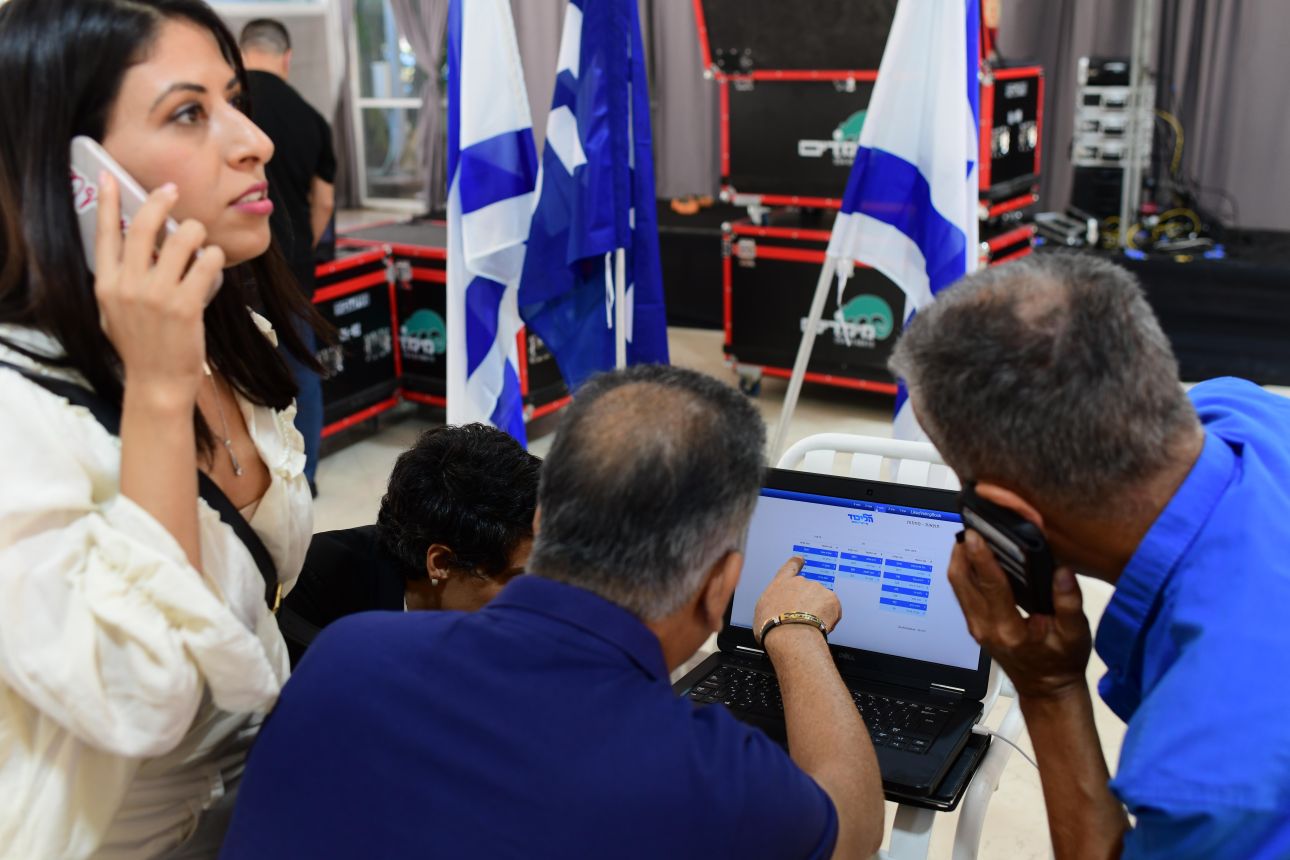
Photo by Tomer Neuberg/Flash90
Selecting Candidate Lists for the Knesset
Israel uses a proportional representation electoral system based on closed-list ballots, that is, voters do not have a way to influence which candidates will enter Knesset on Election Day—unlike most other democracies with a similar system. They select a ballot slip bearing the name of a party list and its identifying letter or letters (and, in some cases, the name of the leader who heads it), but the slip does not include the names of the candidates for the Knesset. Consequently, the process of compiling the lists, whether through internal elections or by other methods, is what determines who will enter Israel's parliament. The methods used to select the lists affect democratic principles such as competitiveness, representativeness, and responsiveness, as well as the behavior of legislators. Different methods create different incentives for members of Knesset (MKs) regarding the main focus of their loyalty: the party leader, a small group of party elites, activists and interest groups, or registered party members.
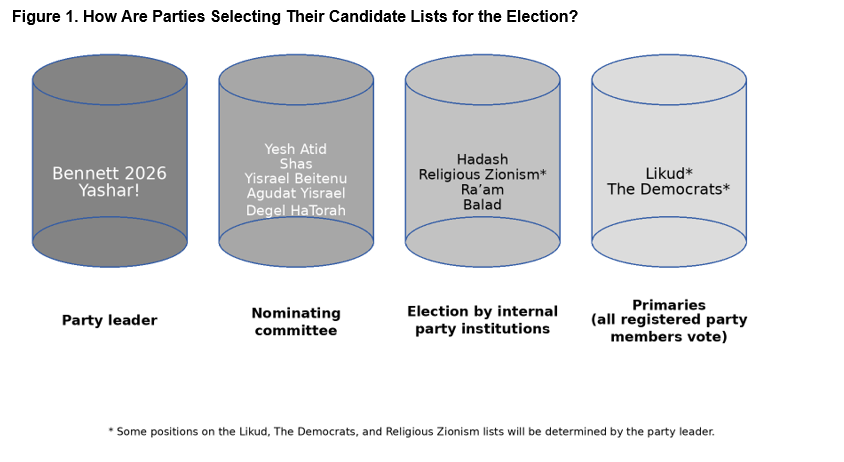
The selectorate—the body that selects the candidates—is considered the most important feature of candidate-selection methods for the Knesset. It determines how inclusive (open) or exclusive (closed) the method is. In some parties, the leader determines the list. For example, the candidates of Bennett's party will be selected by its founder and leader, Naftali Bennett, and those of Yashar!, Gadi Eisenkot's party, will likewise be selected by its leader. Other parties determine their lists through a small body of party elites, such as a small nominating committee (sometimes known as a "slate committee"). This method was once very common, as in the slate committees of Mapai and Herut, and it continues to exist in various forms today. Shas's Council of Torah Sages functions as a type of slate committee, and this is also the method used by the two Ashkenazi Haredi parties—Agudat Yisrael and Degel HaTorah—which together form United Torah Judaism. At least formally, the candidate order in Yisrael Beitenu and Yesh Atid is determined by a similar body.[1]
Other parties determine their lists through internal elections held in party institutions such as a convention, central committee, or council. In 2026, the candidates of Hadash, Balad, Ra'am, and Religious Zionism will be selected in this way.
Of course, the most inclusive method is the primary, in which the right to vote is granted to all party members. Only two parties—Likud and The Democrats—will use this method in the current election.[2]
Rules Governing the Primaries in the Upcoming Election
This section examines the rules governing the primaries used to determine the Likud and The Democrats' lists. The other parties will either hold no internal election to determine their list or will use more limited internal elections. Hadash, for example, selected its Knesset candidates in May. The list was chosen by more than 900 delegates to the Hadash Council. Balad selected its candidates through a similar body of 400 convention delegates, while Religious Zionism selected its list in late July through internal elections in a smaller body of approximately 170 central committee delegates.
Who Is Eligible to Vote?
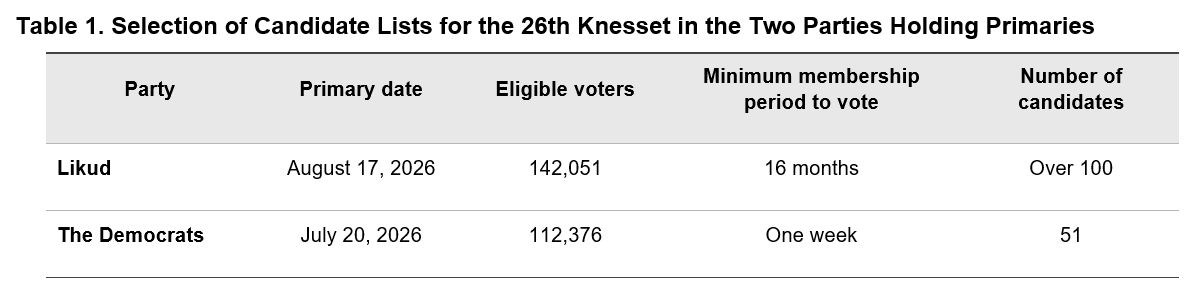
Party primaries are, as noted, an inclusive method that gives all party members the right to participate in selecting the list. However, participation is sometimes restricted to party members who have accumulated a qualifying period, that is, a minimum period of membership. The shorter the qualifying period, the closer the system comes to a model of open primaries, in which formal party registration is not a prerequisite for participating in the internal election. This time, Likud's qualifying period is much longer than that of The Democrats. Only Likud members with at least 16 months of membership will be eligible to vote in the primaries. By contrast, it was possible to join The Democrats and participate in its primaries until one week before they were held.
As Table 1 shows, Likud will have the largest number of eligible party members, at approximately 140,000. More than 112,000 members of The Democrats were eligible to vote. Past experience shows that not everyone who is eligible actually casts a ballot. Turnout in the three most recent Likud primaries averaged approximately 57%, and was slightly lower in Labor. In The Democrats' primary, however, turnout exceeded 86%. In relative terms, this is a record level of participation in contests conducted in a primary format in Israel.
Primaries: Voting Rules and Reserved Slots
Under the basic democratic principle, candidates are ranked on the list in descending order according to the number of votes they receive: the candidate who receives the most votes is placed second (after the party chair, who is elected in a separate process); the candidate who receives the second-highest number is placed third; and so on. Yet all parties that held primaries departed from this principle. These departures serve two purposes. The first is the matter of perceived electability. The second is to address the potential problem of inadequate representation for diverse social groups and sectors. The first objective is pursued by allocating reserved slots for party chairs to choose; the second, through mechanisms that guarantee representation.
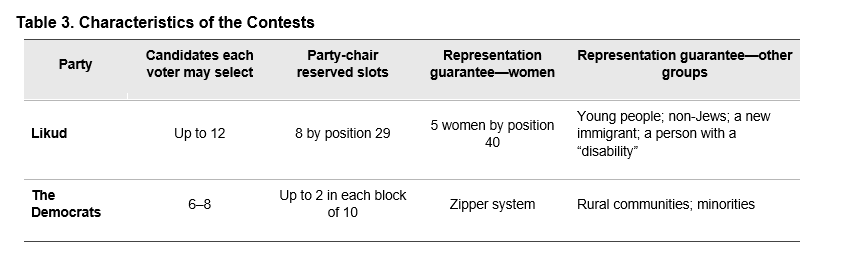
After a saga lasting several weeks, which reflected internal power struggles between the Likud chair and other centers of power within the party, the Likud conference ultimately approved the rules for the August 17 primaries. Part of the candidate list will be determined by the number of votes each candidate receives in the general contest (known as the "national list"). In this contest, each voter may select up to 12 candidates. This time, however, unlike in previous primary contests, the share of the list determined through the national contest has been significantly reduced. The main reason is the large number of reserved slots granted to party chair Benjamin Netanyahu. Under the approved rules, Mr. Netanyahu will be entitled to place no fewer than eight candidates of his choosing in positions 3, 5, 9, 11, 15, 18, 26, and 29 on the list. It should be noted that reserved slots for the party chair did not exist through 2013. This mechanism was first used in the primaries ahead of the 2015 election, when Mr. Netanyahu was allotted two placements on the list. By the 2022 election, the number had jumped to five.
Another reason that relatively few places will be determined in the general contest—the "national list"—is that some positions are allocated to candidates from seven geographic districts.[3]
These candidates will be elected separately by the party members in each district, and the winner from each district will be placed in one of the following positions on the list: 27, 28, 30, 31, 36, 37, and 42.
Finally, Likud uses mechanisms that guarantee minimum representation for several groups: women, a new immigrant, a non-Jew, a young adult candidate, and a person with a disability. The largest representation guarantee is for women. The current primary rules ensure that at least five women will be placed among the top 40 candidates, in positions 10, 20, 25, 34, and 40. The guarantee will be applied only if women candidates do not win these positions, or higher ones, on the strength of the votes they receive. Additional representation guarantees have been allocated to a candidate age 35 or younger (position 39), a non-Jew (position 41), a new immigrant (position 43), and a person with a "disability" (position 45).
The Democrats held only a general ("national") contest, in which each voter selected between six and eight candidates, and it also used representation guarantees. First, the party adopted a principle of gender balance, also known as the "zipper" system. The woman who received the highest number of votes was placed second on the list, after party chair Yair Golan, and the candidates who followed were ranked in alternating order by gender. In addition, three places on the list—6, 8, and 14—were reserved for Meretz candidates, and another five for candidates from rural communities (residents of kibbutzim or moshavim) and from minority groups (Arabs, Druze, and Circassians). As in Likud, The Democrats also granted reserved slots to the party leader. Chair Yair Golan will be permitted to place two candidates in each block of ten positions. However, Golan recently declared he will not use this prerogative.
Conclusion
The different methods for selecting candidate lists reflect different conceptions of party structure and of the appropriate balance among leadership capacity, representativeness, and participation. The decision to entrust the composition of the list to the leader, a nominating committee, party institutions, or all party members affects not only the character of the parties, but also the composition of the Knesset and the incentive structure facing elected officials. That said, it is important to remember that as long as the electoral system continues to rely on closed-list ballots, it will perpetuate a situation in which voters themselves have no ability to influence the ranking of candidates on the list on Election Day. Alongside the debate over the proper way to select lists within the parties prior to national elections, consideration should also be given to the proper way to rank candidates on Election Day. A semi-open ballot system, which would allow voters to express a preference for particular candidates within the list, would strengthen Israel's democratic system. Such a reform would not render internal party candidate-selection processes unnecessary, but it could strengthen the connection between voters and their elected representatives and add another layer of accountability to Israel's political system.
[1] Sometimes the process is formally conducted by a nominating committee, but in practice the party leader exerts considerable influence over the committee's deliberations. This is the case in Yisrael Beitenu, where chair Avigdor Liberman has substantial influence over the decisions of the Permanent Committee responsible for determining the list; probably also in Shas, where chair Aryeh Deri has substantial influence over the decisions of the Council of Torah Sages; and in Otzma Yehudit, where the method is somewhat opaque but it is clear that Itamar Ben-Gvir pulls the strings.
[2] The Reservists party, led by Yoaz Hendel, formally held primaries, but they were quite limited because, under the published bylaws, the first three places on the list were determined by smaller selectorates—the party executive and a nominating committee. In any event, following Hendel's decision to run on a joint list with a new party led by Chili Tropper, those "primaries" lost almost all practical significance.
[3] Until now, Likud primaries had 10 districts. This time, the Jerusalem, Judea and Samaria, and Shfela districts were merged into a single district, while the Tel Aviv and Dan districts were also merged into one.