

Israelis Reveal Their Main Considerations in Deciding Which Party to Vote for in October
Among Jews, a party's position on foreign affairs and security tops the list, while among Arabs, crime in Arab society is ranked most important. 68% of Jewish Israelis and 32% of Arab Israelis say October 7 is a central factor in deciding which party to vote for. Most Israelis are concerned about election interference.
Photo by Olivier Fitoussi/Flash90
Methodology
The survey was conducted by the Viterbi Family Center for Public Opinion and Policy Research at the Israel Democracy Institute between August 31 and September 3, 2026. It was based on a representative sample of the population in Israel aged 18 and above, comprising 605 Jewish interviewees and 150 Arab interviewees.
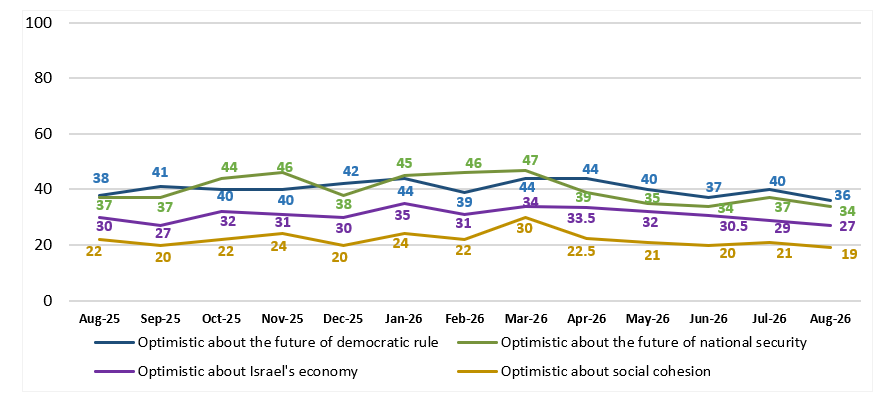
- This month saw a decline in optimism across all four topics. The level of optimism about the future of democratic rule fell from 40% to 36%, and the level of optimism about the future of national security dropped from 37% to 34%. Slight declines of 2 percentage points were also recorded in the levels of optimism regarding the future of the economy and social cohesion. Levels of optimism about the future of national security and of the economy returned to those found in June 2026 and September 2025, respectively, while with regard to the future of democratic rule and social cohesion, this month’s findings were the lowest recorded in 2026.
Optimistic about the future of democratic rule, national security, the economy, and social cohesion (total sample; %)
- As in previous surveys, the share of optimists in the Jewish sample is larger than that in the Arab sample for all four topics. The largest difference between the two groups is in optimism regarding the future of national security (39% versus 8%, respectively), while the smallest difference is in optimism about social cohesion (19.5% versus 16%). Among Jews, optimism is lowest with regard to social cohesion, while among Arabs, optimism is lowest about the future of national security.
Optimistic about the future (%)

- In two separate questions, we asked our respondents to indicate the factor that will have the greatest influence on their decision regarding which party to vote for, as well as the second most important factor (we aggregated the respondent shares for each factor, and hence the total is higher than 100%).
- The party’s position regarding foreign affairs and security and the party’s position regarding the economy and the high cost of living are the two most influential factors among Jews: 39% ranked the party’s position on foreign affairs and security as the first or second most important factor, and 38% said the same about the party’s position on the economy and the high cost of living. The party’s position regarding conscription and its position regarding religion and state were ranked as the main factors by about a quarter of the respondents (27% and 26%, respectively), slightly above the identity of the head of the party (23%), while the party’s position regarding the reform to the judicial system was rated as important by only 18% of respondents.
What will have the greatest influence on your decision regarding which party to vote for in the upcoming elections? (Jews; %)*
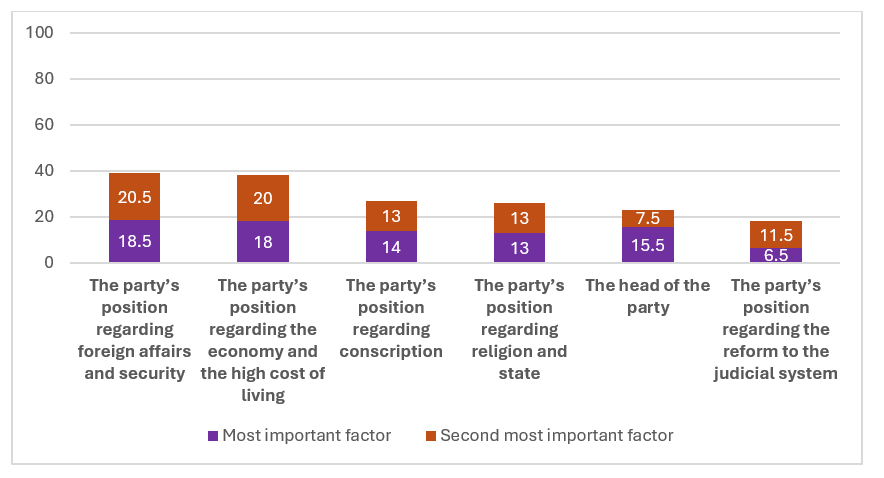
* 14.5% of respondents selected as their primary response one of the options: Other / Don’t know / Don’t intend to vote
- In the Arab sample, we replaced the party’s position regarding conscription with “the party’s position regarding crime in Arab society,” and found that this is the most important issue for the Arab public when deciding which party to vote for: 53.5% listed it as the first or second most important factor in this regard. The party’s position on the economy and the high cost of living was ranked second with 46%, also far above the other factors.
What will have the greatest influence on your decision regarding which party to vote for in the upcoming elections? (Arabs; %)*
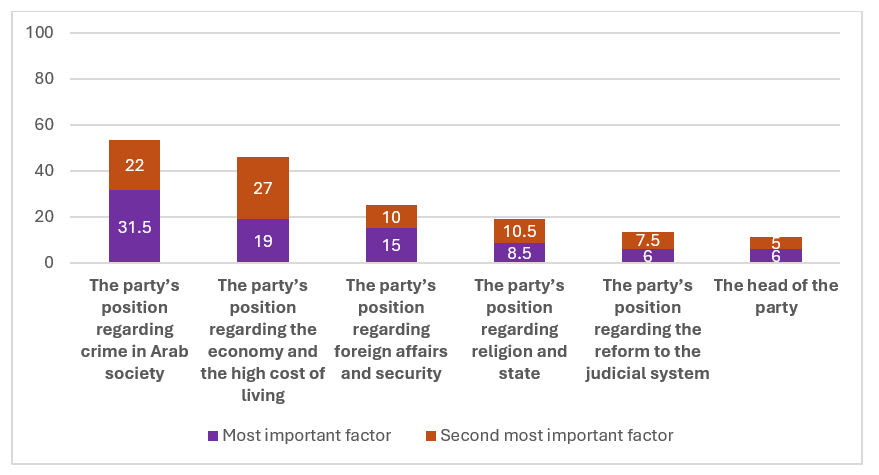
* 14% of respondents selected as their primary response one of the options: Don’t know / Don’t intend to vote
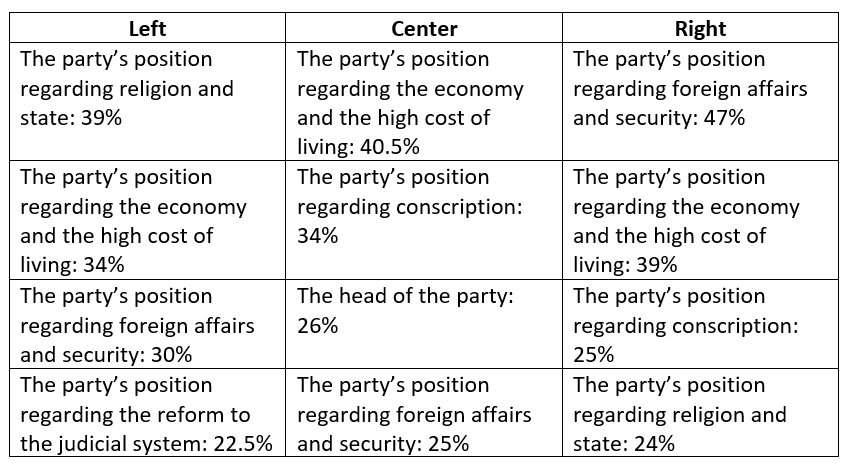
- Breaking down responses in the Jewish sample by political orientation reveals that only on the Right is the party’s position on foreign affairs and security ranked highest in the list of factors (a total of 47% citing it as the first or second most important factor, with a considerable gap to the following factors). In the Center, the party’s position on the economy and the high cost of living tops the list (40.5%), while foreign affairs and security are ranked only fourth (25%), behind the party’s position on conscription and the head of the party (34% and 26%, respectively). On the Left, the leading factor is the party’s position on religion and state (39%), followed closely by the economy and the high cost of living (34%). The party’s position on foreign affairs and security is ranked only in third place (30%), with the party’s position regarding the reform to the judicial system in fourth (22.5%).
Main factors influencing the decision regarding which party to vote for in the upcoming elections (Jews, by political orientation; % indicating factor as the most or second most important factor)
The events of October 7 and voting intentions
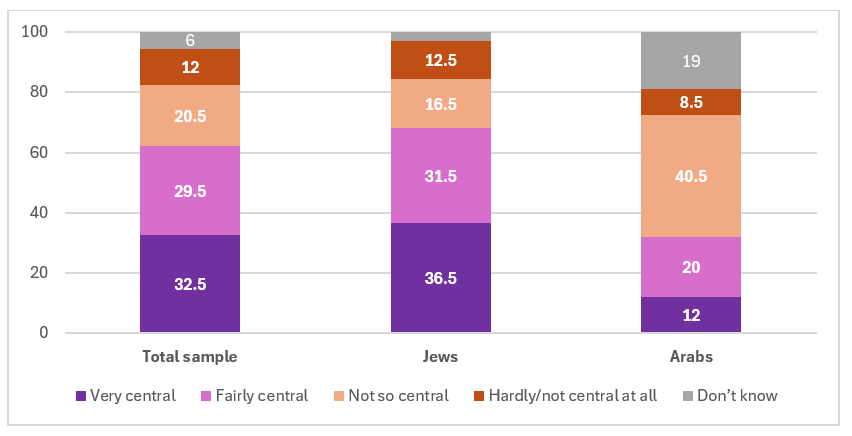
- We asked: “How central a factor are the events of October 7 in your decision regarding which party to vote for in the upcoming elections?” More than two-thirds of Jewish respondents said that these events are a very central or fairly central element in their decision on who to vote for, compared to only around one-third of Arabs.
How central a factor are the events of October 7 in your decision regarding which party to vote for in the upcoming elections? (%)
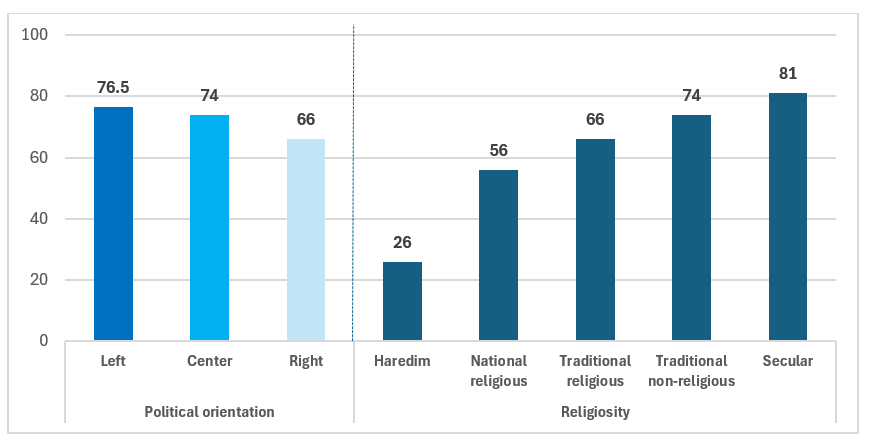
- Breaking down responses in the Jewish sample by political orientation reveals that in all three camps, a significant majority view the events of October 7 as a central element in their decision about which party to vote for, though the Left and the Center accord them more importance than do those on the Right.
- Among secular and traditional non-religious Jews, some three-quarters or more consider the events of October 7 to be a central factor in their decision, as well as around two-thirds of the traditional religious and more than half of the national religious. By contrast, among Haredim, only around a quarter view these events as a central factor when deciding who to vote for, compared to a majority of about two-thirds (64%) who see them as non-central (43% defined them as hardly central or not central at all).
Report that the events of October 7 are a central factor in their decision regarding which party to vote for in the upcoming elections (Jews; %)
Relations between Israel and the United States as a factor in voting intentions
- We asked: “How important to you is the issue of Israel-US relations when deciding which party to vote for in the upcoming elections?” The public is divided on this question: Half of the total sample view relations with the United States as an important issue when deciding which party to vote for, while 45% see it as an unimportant issue.
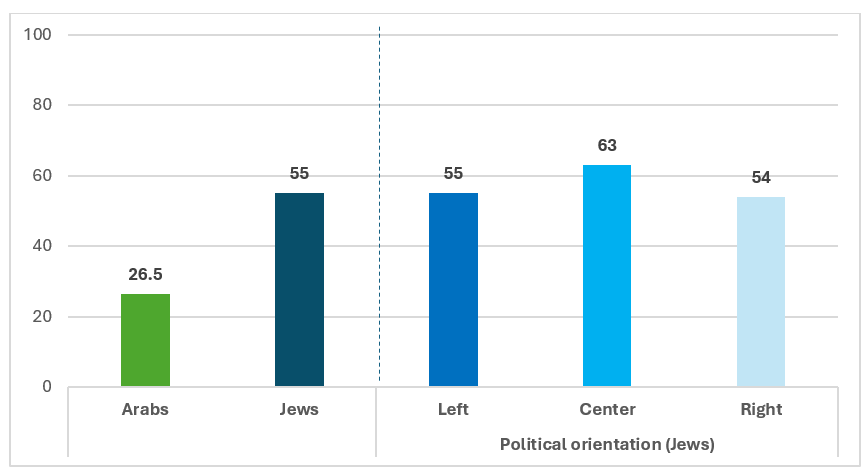
- The percentage of Jews who accord importance to relations between the two countries in their decision is more than double the corresponding share of Arabs (55% versus 26.5%). For the majority of Arabs (68%), this issue is not a central factor when deciding who to vote for.
- Breaking down responses in the Jewish sample by political orientation reveals that in all three camps, the majority attach importance to the issue of Israel-US relations when deciding which party to vote for, although this majority is larger in the Center than on the Right and the Left.
Report that the issue of Israel-US relations is important to them when deciding which party to vote for in the upcoming elections (%)
- Breaking down the responses by voting intention in the upcoming elections (total sample) shows that among those who intend to vote for the Zionist parties currently in the opposition, large shares—between 60% and 73%—see the issue of relations with the United States as a central factor in their voting decision. Among those who intend to vote for parties currently in the coalition, the picture is more complex: Around two-thirds of those who intend to vote for the Likud see relations between the countries as an important factor, compared to only around one-half of those who intend to vote for Otzma Yehudit, Religious Zionism, and Amcha Yisrael (the new right-wing party headed by Ofer Winter). Among voters for the Haredi parties, far less importance is attached to Israel-US relations. The lowest level of importance for relations between the two countries was recorded among those who intend to vote for Arab parties.
Report that the issue of Israel-US relations is important to them when deciding which party to vote for in the upcoming elections (total sample, by voting intention for the 2026 elections; %)*
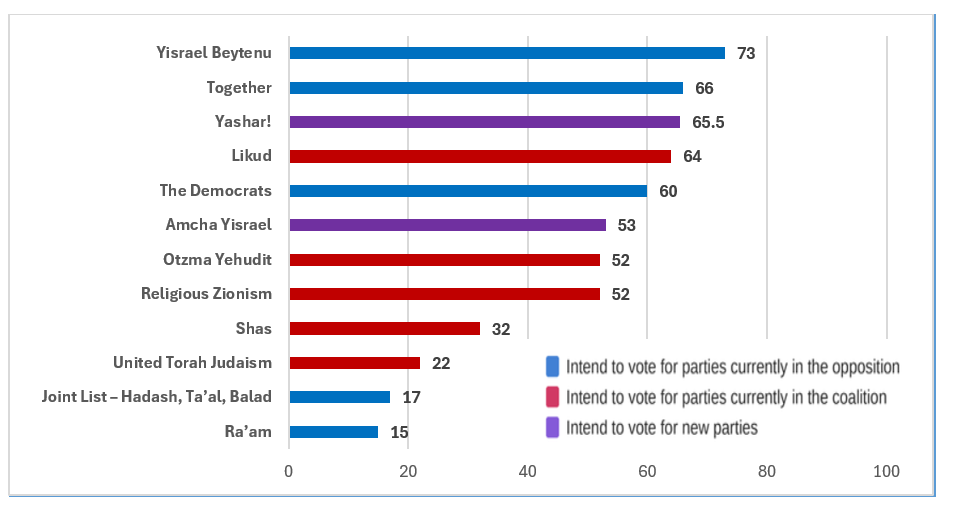
* Data for Blue and White, Unity, and Zionist Home-The Reservists are not presented in the figure, due to the fact that the number of respondents who indicated an intention to vote for these parties was too small to support analysis, and to the fact that some have withdrawn from the race.
Improper interference in the elections
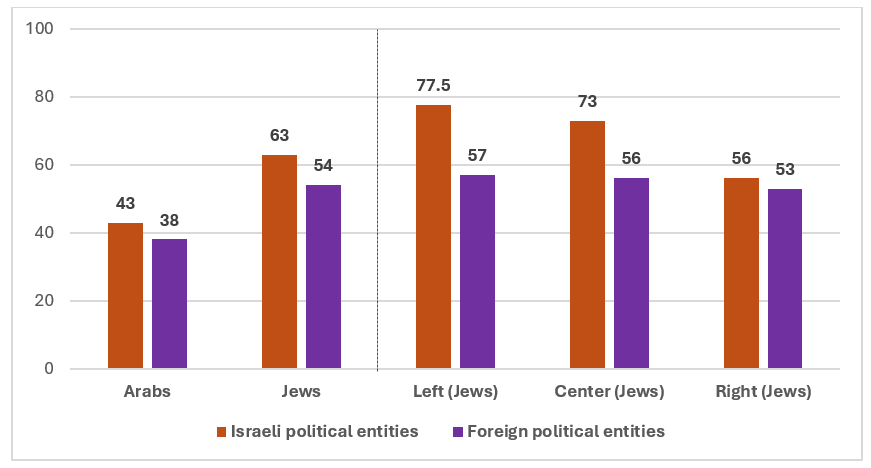
- We investigated whether the public is concerned about improper interference by political entities from Israel or abroad (such as foreign countries) in an attempt to influence the results of the elections. In the total sample, large shares of respondents are worried about improper interference by both Israeli and foreign elements: 59% think there is a high likelihood of interference by Israeli political entities, and 51% think the same with regard to foreign political entities.
- Jews are more worried about both internal and external interference than are Arabs: Only a minority of Arabs are worried about the prospect of internal (43%) and external (38%) interference, compared to a majority of Jews (63% internal, 54% external). In both samples, there is greater concern about internal interference than about external interference.
- Among Arabs, the level of concern is lower than that found in May 2025, when 51% believed there was a high likelihood of interference by Israeli actors (compared to 43% today) and 47% thought the same about interference by foreign entities (compared to 38% today). In the Jewish sample, the opposite trend is in evidence: Jews are more concerned today than in the previous measurement (interference by Israeli entities: 2025, 58%; 2026, 63%; interference by foreign entities: 2025, 50%; 2026, 54%).
- Breaking down responses in the Jewish sample by political orientation reveals that in all three camps, the majority are concerned about improper interference of both kinds, and a similar share in all three think that there is a high likelihood of foreign interference (between 53% and 57%). On the Left and Center, the level of worry about interference by Israeli entities is very high, at around three-quarters, and significantly higher than the fear of foreign interference, while on the Right, the share of those who are worried about internal interference is similar to the share of those who are worried about foreign interference.
Think there is a fairly high or very high likelihood that internal Israeli entities or external entities will attempt to improperly influence the election results (%)
Concerns Regarding the Integrity of the Upcoming Elections
Improper interference in the elections
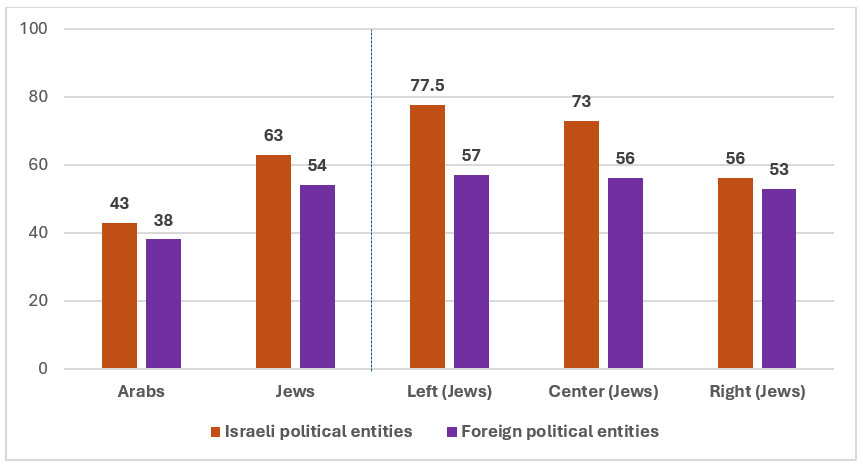
- We investigated whether the public is concerned about improper interference by political entities from Israel or abroad (such as foreign countries) in an attempt to influence the results of the elections. In the total sample, large shares of respondents are worried about improper interference by both Israeli and foreign elements: 59% think there is a high likelihood of interference by Israeli political entities, and 51% think the same with regard to foreign political entities.
- Jews are more worried about both internal and external interference than are Arabs: Only a minority of Arabs are worried about the prospect of internal (43%) and external (38%) interference, compared to a majority of Jews (63% internal, 54% external). In both samples, there is greater concern about internal interference than about external interference.
- Among Arabs, the level of concern is lower than that found in May 2025, when 51% believed there was a high likelihood of interference by Israeli actors (compared to 43% today) and 47% thought the same about interference by foreign entities (compared to 38% today). In the Jewish sample, the opposite trend is in evidence: Jews are more concerned today than in the previous measurement (interference by Israeli entities: 2025, 58%; 2026, 63%; interference by foreign entities: 2025, 50%; 2026, 54%).
- Breaking down responses in the Jewish sample by political orientation reveals that in all three camps, the majority are concerned about improper interference of both kinds, and a similar share in all three think that there is a high likelihood of foreign interference (between 53% and 57%). On the Left and Center, the level of worry about interference by Israeli entities is very high, at around three-quarters, and significantly higher than the fear of foreign interference, while on the Right, the share of those who are worried about internal interference is similar to the share of those who are worried about foreign interference.
Think there is a fairly high or very high likelihood that internal Israeli entities or external entities will attempt to improperly influence the election results (%)
Refusal to accept the results of the elections
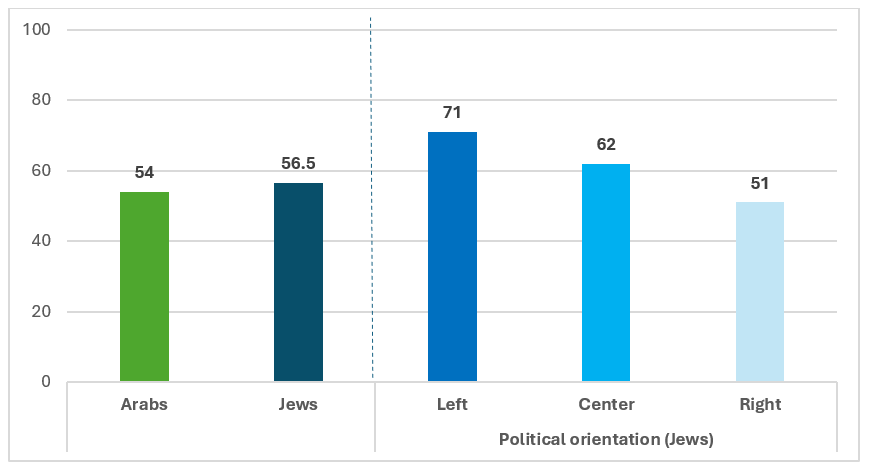
- We asked: “What is the likelihood that some elements on the ‘losing side’ will refuse to accept the published results of the elections and will respond with force in an attempt to change the results?” More than half of the Israeli public (56%) think that there is a high likelihood of this outcome. The shares of respondents holding this opinion are similar among Jews and Arabs.
- Breaking down responses in the Jewish sample by political orientation reveals that in the Center, and to an even greater extent on the Left, a clear majority think that such a scenario is possible, while the corresponding share on the Right is lower, although it is still slightly over half.
Think there is a very high or fairly high likelihood that some elements on the “losing side” will refuse to accept the published results of the elections and will respond with force in an attempt to change the results (%)
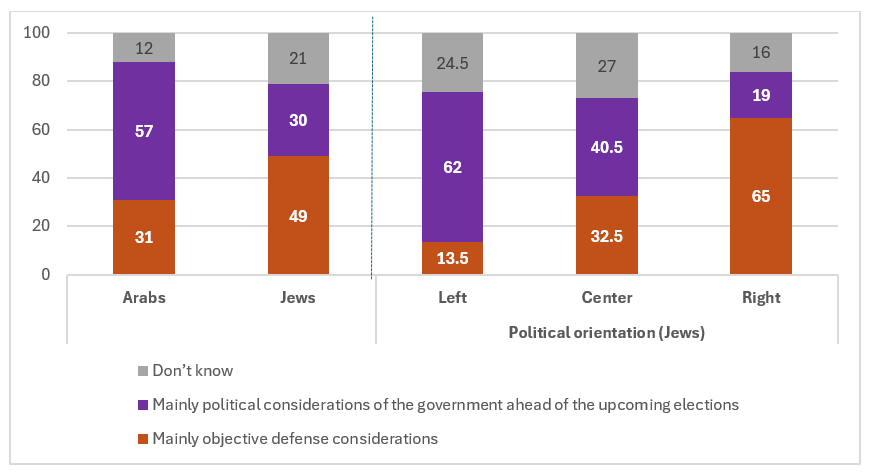
- Several weeks ago, the Israeli Air Force attacked Syrian territory near the Turkish border. We asked, “In your opinion, what were the main considerations behind Israel’s attack on Syria close to the border with Turkey?” In the total sample, 46% of respondents think that the attack stemmed mainly from objective defense considerations, while 34% think that the government’s political considerations were the main factor.
- The majority of Arab respondents (57%) think that the attack stemmed mainly from political considerations, while less than a third believe that it was based on objective defense considerations. Among Jews, the picture is reversed: Around one-half think that the attack stemmed from objective defense considerations, and less than a third think that it was driven by the government’s political considerations. The share of Jews who selected the “don’t know” response is larger than the corresponding share of Arabs, a phenomenon that we have not encountered to date.
- Breaking down responses in the Jewish sample by political orientation reveals that the majority of those on the Left think that the main motivation behind the attack was political. In the Center, too, the largest share (though not the majority) hold the same opinion. On the Right, the situation is the opposite—around two-thirds think that objective defense considerations were the main factor.
What were the main considerations behind Israel’s attack on Syria close to the border with Turkey? (%)
The national mood
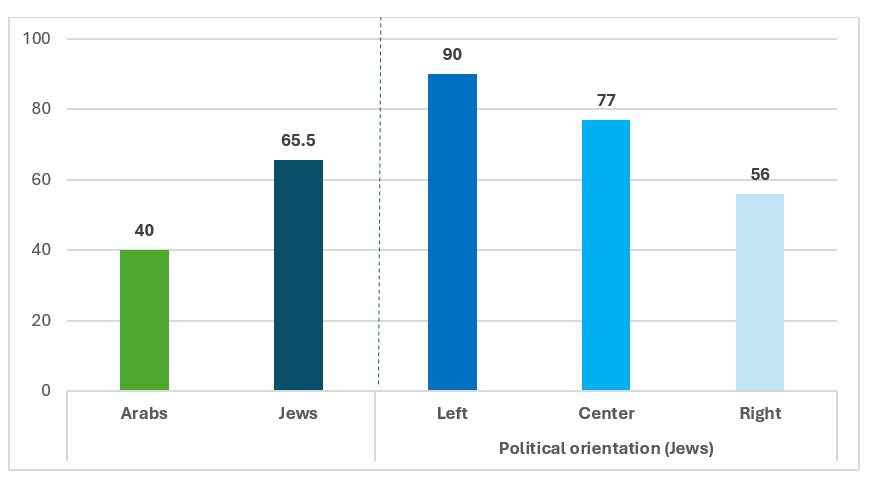
- The majority of the Israeli public (61%) categorize the national mood ahead of the new Jewish year (5787) as poor. As in the past, the share of Jews who provide this assessment is considerably larger than the corresponding share of Arabs (65.5% versus 40%). However, this year’s findings constitute an improvement relative to last year, when 73% of Jews and 58% of Arabs defined the national mood as poor.
- Breaking down responses in the Jewish sample by political orientation reveals that a majority in all three camps define the national mood as poor, though this majority is very large on the Left and in the Center and smaller on the Right.
Define the “national mood” ahead of the new Jewish year (5787) as fairly poor or very poor (%)
Personal mood
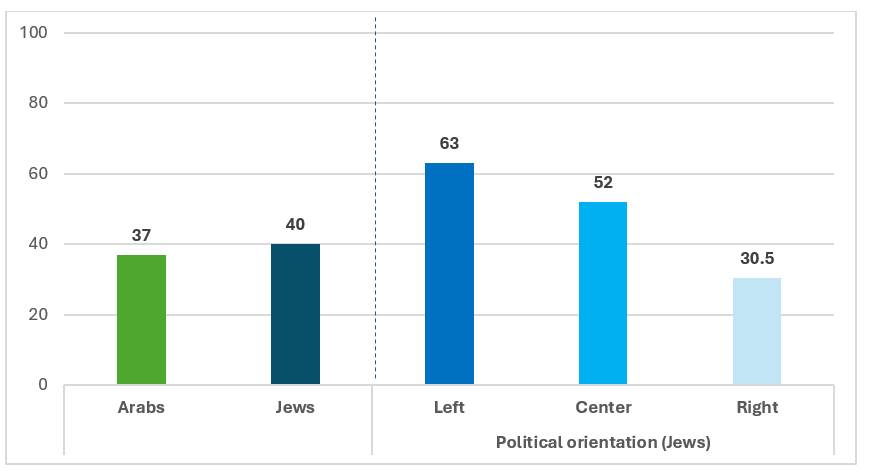
- Once again this year, Israelis’ assessment of their personal mood ahead of the new Jewish year (5787) is better than their assessment of the national mood: Only 40% defined their personal mood as fairly poor or very poor.
- Among both Arabs and Jews, a similar share (59%) defined their personal mood as fairly good or very good. In both samples, and especially among Arabs, this marks an improvement from last year, when 52% of Jews and only 39% of Arabs defined their mood as fairly or very good. Still, in the current survey, 40% of Jews and 37% of Arabs reported that their personal mood is fairly poor or very poor.
- In the Jewish sample, the share of respondents on the Right who defined their personal mood as fairly poor or very poor is about half the size of the equivalent share on the Left, which is the most pessimistic camp (Right, 30.5%; Left, 63%). The Center is somewhere in between, but closer to the Left: 52% defined their personal mood as fairly poor or very poor.
Define their personal mood ahead of the new Jewish year (5787) as fairly poor or very poor (%)
Family meals on festivals
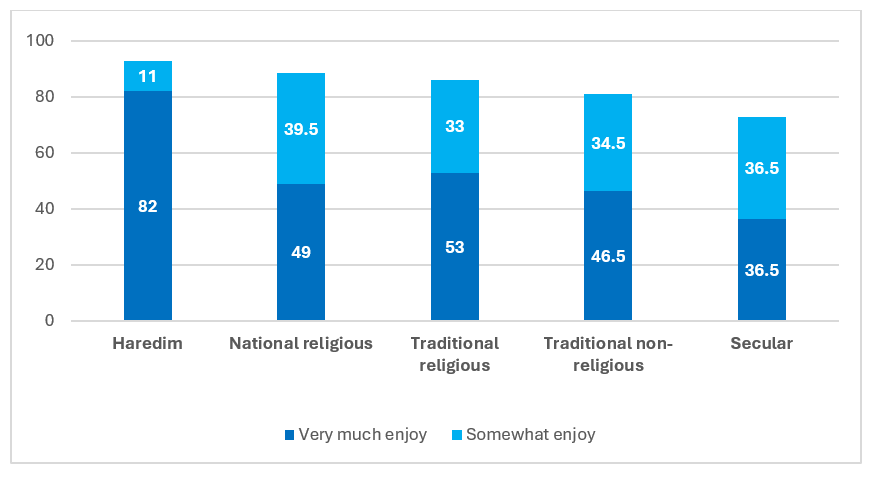
- As in previous surveys, the majority of the Jewish public (81%) say that they enjoy family holiday meals, but not everyone likes them to the same degree: the more religious groups enjoy family meals on festivals more than do the less religious groups.
Very much and somewhat enjoy family meals on festivals (Jews, by religiosity; %)
The August 2026 Israeli Voice Index was prepared by the Viterbi Family Center for Public Opinion and Policy Research at the Israel Democracy Institute. The survey was conducted via the internet and by telephone (to include groups that are under-represented on the internet) between August 31 and September 3, 2026, with 605 men and women interviewed in Hebrew and 150 in Arabic, constituting a nationally representative sample of the adult population in Israel aged 18 and over. The maximum sampling error was ±3.57 % at a confidence level of 95%. Field work was carried out by Shiluv I2R. The full data file can be found at: https://dataisrael.idi.org.il.