

What Happens to Invalid Votes?
What are invalid votes? Do they affect election results? Is there a difference between a blank ballot and other invalid votes? How many invalid votes have been recorded in each election? And how does Israel compare with other parliamentary democracies?
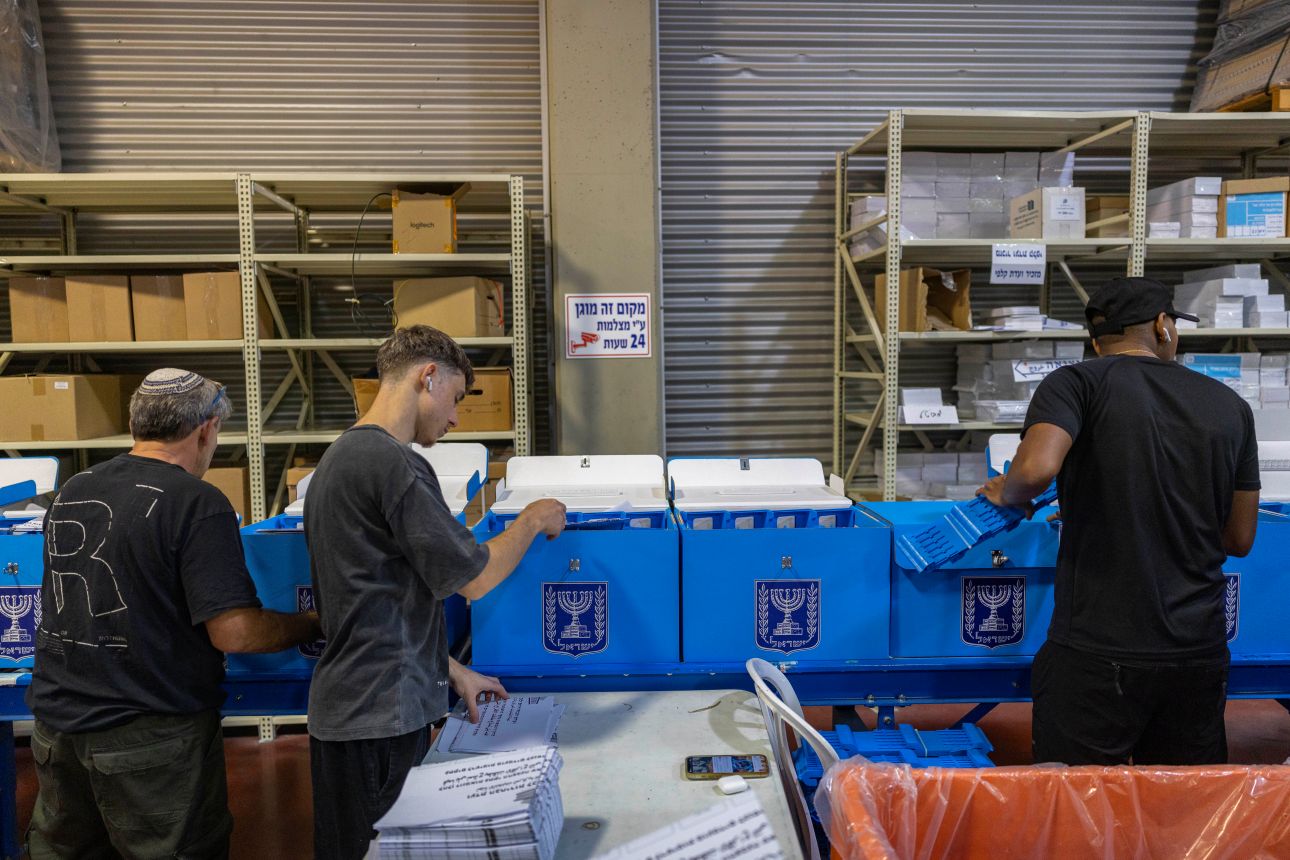
Photo by Yonatan Sindel/Flash90
Under section 78 of the Knesset Elections Law and the regulations issued under it, votes may be invalidated for the following reasons, among others: the envelope used for voting was not supplied by the Central Elections Committee or reached the Committee late (after the end of the first day following election day, although this is a rare ground for invalidation); the ballot slip does not meet the requirements of the law and the Committee’s decisions regarding size, color, and other specifications; the ballot slip or envelope bears any mark that could identify the voter (other marks or scribbles on the slip may invalidate it, although the Committee has previously ruled that such slips may be accepted if they appear to have been deliberately defaced to disrupt voting and cannot be used to identify the voter); the envelope contains ballot slips for more than one list; the envelope contains four or more slips for the same list; or the voter used an unmarked blank slip, or a blank slip that does not meet the legal requirements for indicating a vote on such a slip (see below).
Certain groups of voters, including soldiers, hospital patients, and Israeli diplomats posted abroad, may vote outside their assigned polling station using a double-envelope procedure. The ballot slip is placed inside an anonymous inner envelope, which is then placed inside an outer envelope bearing the voter’s identifying details. These details allow the Central Elections Committee to check that the voter has not voted more than once before the ballots are counted.
In addition to votes that are actually invalidated, some outer envelopes used in the double-envelope voting procedure are never opened and are not even included in the count of invalid votes. For example, if there is a suspicion that someone who voted using a double envelope also voted with a regular envelope at a regular polling station, meaning that they are suspected of voting twice, the double envelope is referred for further examination and may remain unopened.
So-called “wasted votes” is a term for votes that are valid in every respect, but are cast for lists that fail to cross the electoral threshold—that is, the minimum share of valid votes necessary for a party to be represented in Knesset. Unlike invalid votes, wasted votes do affect the allocation of seats, because they are included in the total used to calculate the electoral threshold, which stands at 3.25% of valid votes.
In the 2022 election, for example, a total of 4,764,742 valid votes were cast. A relatively high proportion of these, 8.8%, or more than 417,000 votes, were wasted votes cast for lists that failed to cross the electoral threshold, most notably Meretz, Balad, and The Jewish Home. Votes cast for these and other lists were included in the valid vote count. They therefore slightly increased the number of votes needed to cross the threshold, which, as noted, is calculated as a percentage of valid votes. In theory, if all the votes cast for The Jewish Home and Balad had been deemed invalid and excluded from the threshold calculation, the threshold would have fallen sufficiently for Meretz to cross it and enter the Knesset.
Invalid votes have no effect at all on election results. When the Central Elections Committee calculates the number of votes needed to cross the electoral threshold, it disregards invalid votes entirely and calculates 3.25% of only the valid votes. The only public measure that invalid votes affect is voter turnout, as reported by the Central Elections Committee.
It is important to emphasize that a blank ballot is an invalid vote in every respect. There is no basis for the notion that it serves as a form of protest vote or abstention.
Alongside the ballot slips for the various lists, every polling station also has blank white slips. These serve as a backup if the slips for a particular list run out, whether because of a supply problem, deliberate sabotage, or a large number of voters at that station choosing the same list.
Under section 76(c) of the Knesset Elections Law, a voter may use a blank slip only if they write on it, in blue ink, the list’s identifying letters (אמת, מחל, etc.), or those letters together with the list’s name (The Democrats, Yashar!, Likud, etc.).
In other words, although a blank ballot is sometimes viewed as a form of abstention, this is neither its intended purpose nor its effect. Unmarked blank ballots are counted together with all other invalid ballots, so there is no way of knowing how many voters chose this option. In fact, casting an unmarked blank ballot can, to some extent, have the opposite effect: it counts towards voter turnout. Assuming that low turnout indicates a lack of trust in the political system, not voting, which lowers turnout, is a stronger expression of protest than casting a blank ballot, which increases it.
Some follow an approach similar to Israel’s, while others give blank ballots, or other ballots expressing abstention, greater significance.
In France, for example, blank ballots are counted separately but do not affect election results. Nearly 33 million people voted in the first round of the 2024 parliamentary election for the National Assembly. Of these, approximately 268,000 cast invalid ballots and almost 600,000 cast blank ballots.
In some countries, blank ballots have a tangible effect on the results. In Spain, they are added to the valid vote count when calculating the electoral threshold. In various South American countries, a large number of blank ballots can even trigger a repeat election.
- Protest voting: Political alienation and dissatisfaction with candidates and parties can prompt protest voting. Different systems can encourage different forms of protest. For example, in countries where blank ballots are counted separately, protest votes are likely to take this form. In countries with compulsory voting, where those who fail to vote face fines and other penalties (such as Belgium, Australia, Luxembourg, and many South American countries), many citizens wishing to express their dissatisfaction are likely to go to the polls and cast a blank or invalid ballot.
- Complex electoral systems: With more complex electoral systems, there are more ways for voters to make mistakes that invalidate their ballots. For example, in countries where voters mark their chosen candidates on the ballot paper, a mark in the wrong place or the selection of candidates from different parties may invalidate the ballot. It is important to note that even complex systems can be designed to reduce the proportion of invalid votes. For example, the Israel Democracy Institute has proposed adopting a “semi-open ballot” Voters would still choose a party list, but could also mark their preferred candidates within it, potentially moving those candidates higher up the list and improving their chances of entering the Knesset. The proposal recommended that incorrectly marking candidates should not invalidate the vote for the list. At most, only the candidate preferences themselves would be invalidated.
- Complex voting procedures: These include postal voting, early voting, proxy voting, and other arrangements. Postal voting, for example, often requires various signatures, such as those of the voter or a postal clerk, which may not meet the requirements. There is also a greater risk of envelopes arriving late. In Israel, such risks arise in connection with double envelopes, but the voting procedure is otherwise relatively straightforward.
- Inadequate education and public information: A poor understanding of the electoral system, limited political knowledge, or low literacy rates increase the likelihood that voters will make mistakes that invalidate their votes.
In the 2022 election, 29,851 invalid votes were recorded, representing approximately 0.63% of all votes cast.
Invalid votes in Knesset elections (%)
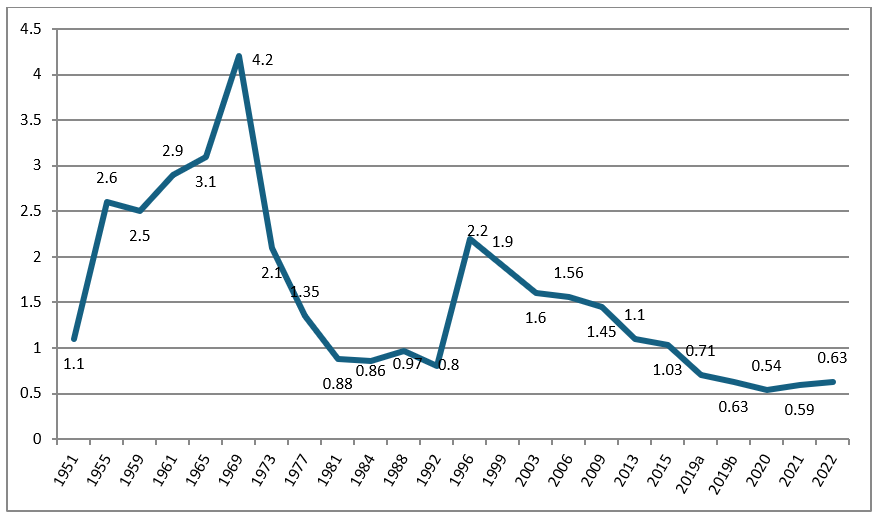
Over time, the proportion of invalid votes in Israel has declined. This can be attributed to factors such as immigrants’ integration into society and improvements in education and literacy. In recent years, it may also reflect a decline in the appeal of blank ballots, which, as noted, are not counted separately and therefore do not effectively serve as protest votes.
The rise in the proportion of invalid votes in 1996 can undoubtedly be attributed to the introduction of direct elections for prime minister using two ballot slips. This made the electoral system more complicated, and the arrangement was new and unfamiliar. The large number of invalid votes in the 1990s and early 2000s may also have reflected protest voting among the Arab public. During this period, there were growing calls to boycott elections or cast blank ballots in protest against events such as Operation Grapes of Wrath in Lebanon, shortly before the 1996 election, and the events of October 2000.
Comparisons with other established democracies show that Israel has a relatively low proportion of invalid votes. This is unsurprising given its simple electoral system, with a single nationwide constituency and a closed-list system in which voters do not mark individual candidates; its relatively straightforward voting procedure, apart from double envelopes; the absence of compulsory voting; and its literacy rate, which, although slightly below the OECD average, remains very high at approximately 98%.
According to international databases, the mean proportion of invalid votes in OECD countries is above 2%, and the median above 1%, compared with 0.63% in Israel’s most recent election. Many countries, like Israel, have invalid vote rates below 1%, including Canada, the United Kingdom, Finland, Estonia, the Netherlands, Ireland, Germany, Slovenia, Austria, and Norway. In others, however, the proportion is very high. In Chile’s most recent parliamentary election, for example, invalid votes accounted for almost 13% of the total, with blank ballots accounting for a further approximately 7%. The likely explanation is a combination of compulsory voting, a complex ballot paper on which any incorrect marking of a candidate invalidates the entire vote, and widespread protest voting. Other countries with compulsory voting also have relatively high proportions of invalid or blank ballots. In Belgium, for example, the combined proportion was 5.63% in the most recent election.