

What Can the New Knesset Do in the Meantime?
The 26th Knesset has been elected and will be sworn in on November 10, but a new government has yet to be formed, and it remains unclear whether one will be formed at all or whether Israel will head to another election. What can the Knesset do in the meantime? Can a new Knesset speaker be elected, and how? Which parliamentary committees can be established, and can the Knesset pass legislation and exercise oversight of the government during this period? And what changes if new elections are called?
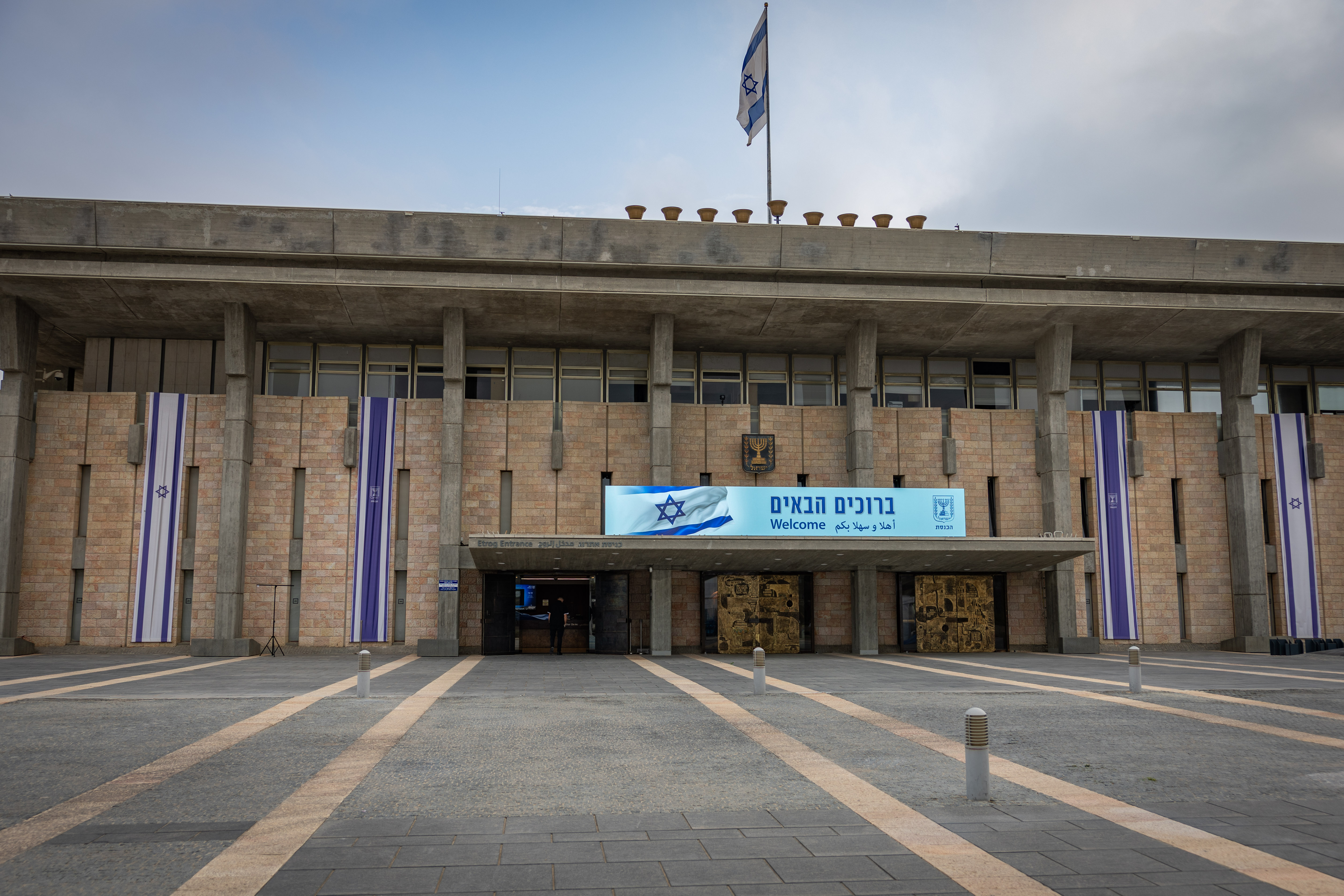
Photo by Yonatan Sindel/Flash90
Yes. The Knesset is an independent branch of government, and its powers are not contingent on the formation of a new government. From the moment it convenes, it can operate independently, even without the government's consent. The fact that the outgoing government remains in office in a caretaker capacity, and is therefore subject to various restrictions, does not limit the Knesset's scope of action. Moreover, the newly elected Knesset has just received a mandate from the public, giving it clear public legitimacy to act.
The new Knesset operates in accordance with the parliamentary procedures set out in Basic Law: The Knesset, the Knesset Law, the Knesset Rules of Procedure, and various guidelines, including those issued by the Knesset's legal advisers.
It is important to emphasize at the outset that the measures discussed below—including electing a new Knesset speaker, establishing certain parliamentary committees, advancing and passing legislation, and exercising parliamentary oversight of the government through various mechanisms—are all consistent with established Knesset procedures and have precedents.
The Speaker of the Knesset presides over the parliament, manages its affairs, and represents it externally. The Speaker is responsible for presiding over plenary sittings, maintaining order, and ensuring compliance with the Knesset Rules of Procedure. Together with the deputy speakers, collectively known as the Knesset Presidium, the Speaker also plays a particularly important role in setting the agenda and managing the Knesset's work.
The Knesset Rules of Procedure require a new Speaker to be elected no later than the sitting at which the Knesset convenes to establish a new government, but there is no obligation to wait until then. Until a new Speaker is elected, the outgoing Speaker continues to serve under the principle of continuity, provided that they were elected to the new Knesset, as will be the case this time. Otherwise, the position would be filled by the longest-serving MK who is not a minister, deputy minister, or prime minister.
A key precedent regarding the Speaker and the principle of continuity was established in the Edelstein case in March 2020 (HCJ 2144/20). The Supreme Court ruled that an incumbent Speaker who remains in office under the principle of continuity may not obstruct the will of a majority of Knesset members seeking to elect a new Speaker. Accordingly, if 61 MKs demand that an election be held, they must be allowed to proceed with it as soon as possible. The reasoning is straightforward: the outgoing Speaker holds the position only on a temporary basis, until a new Speaker is elected. Particularly when 61 MKs demand an election, the Speaker's discretion over its timing is extremely limited. Any delay would frustrate the will of the parliamentary majority, and the decision is one in which the Speaker has a direct personal interest.
As for the timetable, the Court ruled in the Edelstein case that when 61 MKs request an election, it must be held as soon as possible. In some previous Knessets, the Speaker was elected at the very first sitting, even without such a demand. This occurred in 14 of the 25 Knessets elected to date, including the 20th and 21st Knessets (2015 and April 2019, respectively).
The election itself is conducted by an open vote, and a candidate does not need the support of 61 MKs to be elected. When there is more than one candidate, the candidate who receives the most votes is elected. Certain eligibility requirements may, in some cases, prevent an MK from serving as Speaker, primarily those relating to criminal proceedings, indictments, and convictions.
The Arrangements Committee is responsible for organizing the Knesset's work at the beginning of its term. The Knesset Law requires that it be elected as early as possible after the elections. This can take place on the day the Knesset first convenes, as has happened in some previous Knessets.
The Knesset plenum approves the composition of the Arrangements Committee, which reflects the relative size of the parliamentary factions. Every faction with at least four MKs is guaranteed representation. The committee is chaired by an MK from the faction of the person whom the president has tasked with forming a government. If that person fails to form a government and the president assigns the task to someone else, the committee chair is replaced accordingly, although the committee's composition remains unchanged.
Perhaps the Arrangements Committee's most important responsibility is to submit a proposal to the Knesset regarding the composition of its standing committees. This also brings the Arrangements Committee's work to an end, as the House Committee then takes over its functions. Until that point, however, the Arrangements Committee has several other important responsibilities.
Among other things, it may initiate the establishment of temporary and special committees, recommend candidates to chair them (subject to a vote by the respective committee), and decide to refer bills to these committees. It also performs the functions of the House Committee on procedural matters, such as recommending the election of deputy Knesset speakers and granting exemptions from the waiting period for private members' bills. Without such an exemption, 45 days must generally elapse between the tabling of a bill and its consideration.
The Arrangements Committee also approves special procedures for plenary debates, including limits on speaking time or on the reservations to a particular bill that will be put to a vote, in order to prevent or shorten filibusters. However, it may not initiate legislation or prepare bills for readings in the plenum.
As a rule, the standing committees are established together, only after the coalition and opposition have taken shape and the balance of power between them has become clear. An exception occurred following the September 2019 election, when only the House Committee was established, for the purpose of considering parliamentary immunity matters.
Until the standing committees are established, the Arrangements Committee may establish two temporary committees—a Finance Committee and a Foreign Affairs and Defense Committee—to enable parliamentary oversight and address matters within their respective jurisdictions, even before the full committee structure is in place. For example, at the beginning of the 21st Knesset's term in May 2019, temporary Finance and Foreign Affairs and Defense Committees were established, chaired by Moshe Gafni and Avi Dichter, respectively.
In addition, the Arrangements Committee—and subsequently the House Committee—may submit a proposal to the Knesset plenum for the establishment of a special committee to address a particular matter, as provided for in Basic Law: The Knesset. The proposal must specify the committee's areas of activity, powers, and composition.
Special committees may be established to consider a particular bill (see below), or for other purposes, such as conducting oversight hearings on government activity. These can include summoning public officials and hearing testimony from experts representing civil society organizations and the broader public.
In March 2020, for example, at the beginning of the 23rd Knesset's term and before the formation of a government, the plenum approved the establishment of several special committees at the recommendation of the Arrangements Committee. These included a special committee dealing with the coronavirus pandemic, chaired by Ofer Shelah; a special committee on preparations for the upcoming school year and special education, chaired by Nitzan Horowitz; and a special committee on labor and welfare.
Yes, absolutely. There are precedents for both private members' bills and government bills being passed by the Knesset before a new government has been formed.
The process of advancing and passing legislation during this period is the same as at any other time, but certain conditions must be met. These include establishing the appropriate Knesset committees—primarily special committees—to consider bills and prepare them for readings in the plenum. Private members' bills also require the election of deputy Knesset speakers (usually on a temporary basis), because the approval of the Knesset Presidium is necessary before such bills can be formally tabled.
For example, immediately following the elections to the 25th Knesset, several private members' bills were passed. These included Amendment No. 51 to the Knesset Law, concerning the splitting of parliamentary factions; Amendment No. 11 to Basic Law: The Government, concerning eligibility requirements for ministers and the possibility of appointing an additional minister within a ministry; and Amendment No. 37 to the Police Ordinance, commonly known as the "Ben-Gvir Law," which expanded the minister's powers over the police.
Following the 2015 election, by contrast, a government bill was passed, since the outgoing governing party was also the party set to lead the incoming government. The legislation amended Basic Law: The Government to suspend the limit on the number of ministers and deputy ministers and allow the appointment of ministers without portfolio.
Following the 2020 election, an amendment to Basic Law: The State Economy was passed to address the budgetary challenges posed by the coronavirus crisis.
These examples illustrate how legislation passed before the formation of a government has been used either to resolve political issues necessary for establishing a new government or to address urgent circumstances, such as the coronavirus pandemic. This does not, of course, mean that legislation on other matters would be unlawful or illegitimate.
It is important to emphasize that legislative processes intended to be completed before a government is formed are, by their nature, conducted more rapidly. To ensure a proper legislative process, particular attention must therefore be paid to several requirements: explaining the need for urgency; establishing a sufficient factual basis for the proposed legislation; providing MKs with a genuine opportunity for meaningful participation; hearing the views of legal advisers and relevant professional experts; ensuring transparency and public participation; and maintaining a process in which the content of the proposed legislation remains open to substantive input.
Beyond ensuring the integrity of the legislative process, consideration must also be given to the nature of the legislation and its consequences, including concerns about legislation targeting specific individuals, retroactive legislation, and the undermining of legitimate reliance interests.
Quite a bit. For example, MKs can submit parliamentary questions to ministers serving in the outgoing government. Regular and urgent parliamentary questions are answered in the plenum, while direct questions receive written responses. Ministers in the outgoing government are obligated to respond to these questions.
Neither a new government nor standing committees are required for an initial plenary debate on a motion for the agenda. The outgoing government may respond to such a motion if it wishes. If the motion is referred to a committee for further consideration, the Arrangements Committee assumes the role of the House Committee and determines which committee will consider it. The absence of an appropriate committee may delay further proceedings, but it does not prevent the initial debate from taking place in the plenum.
It is important to emphasize that when a caretaker government remains in office following an election, there is an even stronger justification for increased parliamentary oversight—not least because the government continues to exercise its authority more by virtue of institutional continuity than by virtue of public confidence.
If the Knesset is dissolved and new elections are called, it continues to serve until the next Knesset convenes. However, the scope and nature of its activities become significantly more limited.
First, once attempts to form a government have been exhausted and grounds for holding another election have arisen, particular caution is required when advancing controversial legislation. At around the same time, or shortly thereafter, the Knesset enters a formal election recess. The dates of the recess are determined by the Knesset Speaker, following consultation with the deputy speakers and subject to the approval of the House Committee—or the Arrangements Committee, which serves in its place for this purpose.
During an election recess, parliamentary activity is substantially curtailed. Under the Knesset Law and the Knesset Rules of Procedure, the government or at least 25 MKs may request that the plenum be convened. However, debates on legislation may take place only at the government's request.
Committee activity during a recess is governed by the Knesset Rules of Procedure and established parliamentary practice. During an election recess, it is customary to introduce an additional mechanism known as the "Agreements Committee," consisting of representatives of the coalition and opposition—or of the respective political camps, if no formal coalition and opposition have been established—with one representative from each camp. Subject to certain exceptions, the Agreements Committee's approval is required for parliamentary committee meetings to take place.
In general, this period calls for particular restraint in advancing legislation, with parliamentary activity focused primarily on urgent matters and proposals that enjoy broad support. In practice, since the 2000s, there has been a clear trend toward such restraint, reflected in a decline in the volume of legislation passed during election recesses. The laws that are enacted during these periods are generally passed with broad agreement.
One notable example is the Assets of Holocaust Victims Law (Restitution to Heirs and Dedication to Aid and Commemoration) (Amendment No. 5), 2022, which was passed with broad support during the 24th Knesset's election recess.
As for parliamentary oversight of the government, certain oversight mechanisms remain available even during an election recess. A group of 25 MKs may demand that the plenum convene for a special sitting to debate motions for the agenda, and direct parliamentary questions may still receive written responses. However, the regular weekly proceedings involving motions for the agenda and ministers' responses to parliamentary questions in the plenum do not continue as usual.
Finally, the Knesset may also elect certain public officials whose appointments are due. In June 2019, the Knesset elected Matanyahu Englman as State Comptroller, even though a new government had not yet been formed and legislation dissolving the Knesset had already been passed.
The 26th Knesset will be responsible for electing a new State Comptroller following the cancellation of the election process conducted in June 2026. In fact, the outgoing Knesset should have carried out this task during its election recess—as also stated in an opinion issued by the Knesset Legal Adviser. Since it failed to do so, the responsibility now falls to the newly elected Knesset.
