Women Serving in the 26th Knesset
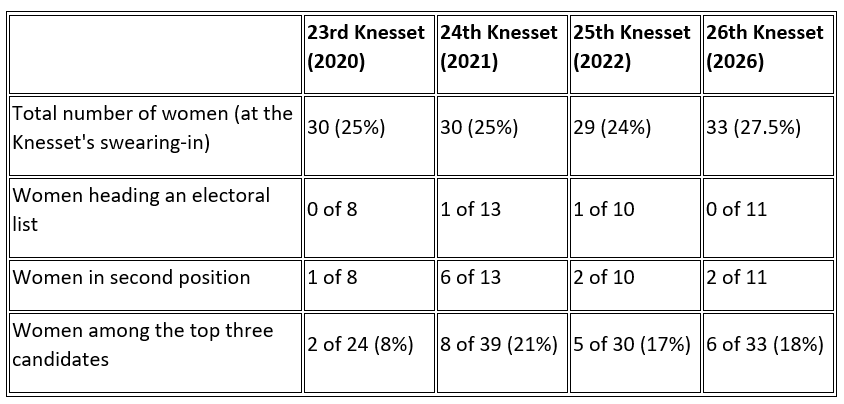
The 26th Knesset will include 33 women, representing 27.5% of its members. This is a record high for the number of women serving at the time of a Knesset's swearing-in, but only a modest improvement over the previous three elections, which saw 29–30 women (24–25%) elected.
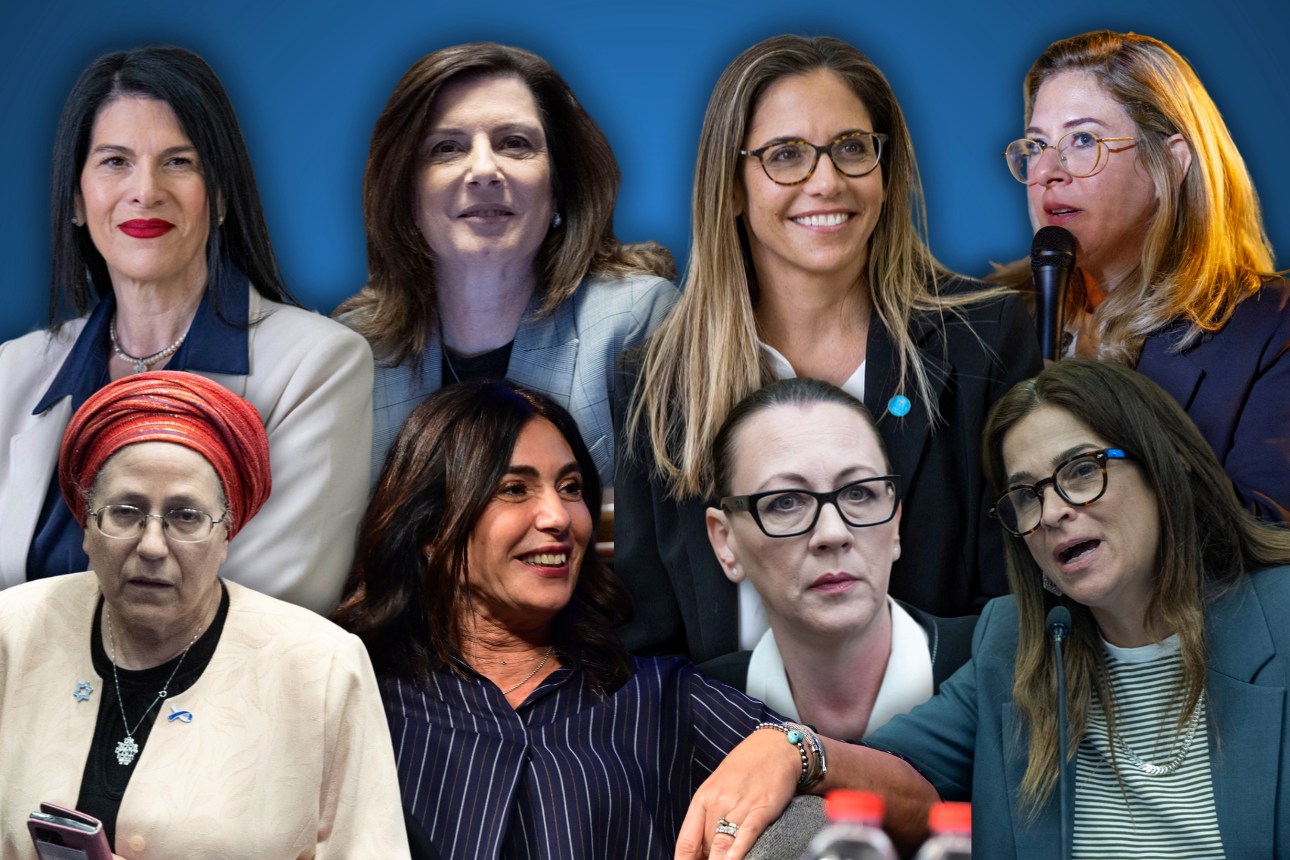
Photos by Flash90
- Women account for 39% of MKs in the change bloc (including both the Jewish and Arab lists), compared with 13% in the Netanyahu bloc. This gap has widened steadily since 2020.
- More than half of the women elected to the Knesset (55%) are first-time MKs, compared with 33% of the men. Only five female MKs (15% of the women elected) have previously served as government ministers.
- Like their male counterparts, female MKs come primarily from backgrounds in civil society and education. The number of women with backgrounds in the civil service is similar to that of men. In the security sector, however, men have a clear advantage.
- No woman headed an electoral list that won seats in the Knesset (unlike in the 2021 and 2022 elections), and only two of the 11 lists placed a woman in second position. In this respect, unlike the overall proportion of women in the Knesset, women's representation has declined compared with previous Knessets.
There are substantial differences between the two blocs in gender representation that were already evident before the process of compiling candidate lists. On the Yashar, Together, and Democrats lists, women accounted for approximately half of the candidates in winnable positions. For the Democrats, this was achieved through a formal mechanism guaranteeing women's representation (although gender parity on the list would have been maintained even without this mechanism). In Yashar and Together, it resulted from decisions made by party leaders. Women's representation was lower on the other lists.
In addition to the Democrats, two other parties employed formal mechanisms to guarantee women's representation. Likud established minimum representation requirements (for example, at least one woman among the top ten candidates), while Balad, a component of the Joint List, reserved the third position on its list for a woman. As in previous elections, neither Shas nor United Torah Judaism included any women on their candidate lists.
Only a few parties addressed women's issues in their election platforms, all of them belonging to the change bloc. Three lists or parties—Together, the Democrats, and Hadash—explicitly committed in their platforms to advancing gender equality.¹
Two additional developments are particularly noteworthy:
- In Hadash, a candidate was removed from the list following a campaign by women's organizations in response to testimonies alleging sexual harassment, although he had not been convicted. The case demonstrated the ability of women's organizations to influence the composition of electoral lists and the norms governing political conduct in response to sexual violence, even though the candidate's removal did not increase the number of women on the list.
- For the first time, women ran as candidates in a Haredi (ultra-Orthodox) party. Although the Haredi Public Party fell well short of the electoral threshold, this marked a historic step in a community where women have until now been entirely excluded from parliamentary representation. It remains too early to determine what impact this development may have on the representation of Haredi women in the future. It is worth noting that the party's leading female candidate came under attack during the election campaign, including attacks with gender-specific characteristics. Beyond the potential implications for Haredi women's representation, this provides another illustration of the personal price women may pay for breaking new ground in the political arena, including women who are already active in politics.
Women's representation matters not only as a principle of equality in its own right, but also because it has a tangible impact on public policy. Female MKs advance more legislation on issues relating to women, families, gender equality, and combating violence against women. This impact is also evident in the executive branch: female ministers appoint more women to serve as directors general of government ministries. Between 2003 and 2025, women accounted for 31% of the directors general appointed by female ministers, compared with just 12% of those appointed by male ministers. Women's representation in the Knesset and government therefore influences not only the composition of the Knesset plenum, but also women's advancement to senior positions in the civil service.²
The 26th Knesset will include 33 women, representing 27.5% of its members.
Before the elections, as of September 1, 2026, there were 31 female MKs. At that time, Israel ranked 97th out of 183 countries in the Inter-Parliamentary Union (IPU) ranking for women's parliamentary representation. The increase to 33 female MKs could improve Israel's ranking to approximately 90th place.
Despite this slight improvement, women continue to be largely absent from the top positions on electoral lists. In the elections for the 26th Knesset, no woman headed a list that won seats, and women's representation among the top three candidates on electoral lists was significantly lower than their overall share of Knesset seats.
For the most part, the differences compared with previous Knessets are not substantial. Nevertheless, over the past 20 years, women have headed several electoral lists that won Knesset seats, including Labor, Meretz, Hatnua, Yamina, and Kadima.
The proportion of women in the change bloc (including the Jewish and Arab lists) is three times as high as in the parties of the Netanyahu bloc: 39% compared with 13%. In other words, approximately 80% of female MKs do not belong to parties in the Netanyahu bloc.
Women as a Share of Each Parliamentary Party: Outgoing Coalition and Opposition Parties
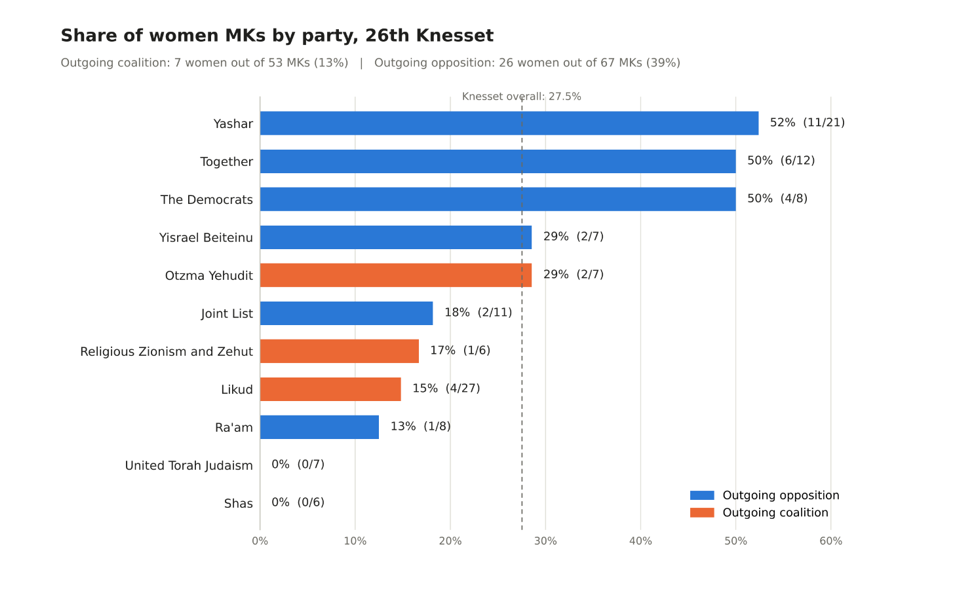
According to the data, Yashar is the only parliamentary faction in which women will constitute a majority, while women will account for 50% of the MKs in both Together and the Democrats. Likud, the largest faction in the Knesset, will have four women among its 27 MKs. As noted, Shas and United Torah Judaism have no female MKs.
Women in the 26th Knesset are younger and have less parliamentary experience than their male counterparts. Of the female MKs, 55% are entering the Knesset for the first time, compared with 33% of the men. Their average age is 51.1, compared with 54.3 among male MKs.
One reason for this is the large number of women elected from parties in the change bloc: of the 26 women elected from these parties, 17 are entering the Knesset for the first time. In the Netanyahu bloc, by contrast, only one of the seven female MKs is a newcomer.
Differences in parliamentary tenure and experience are also reflected in prior ministerial experience. Only five female MKs (15% of all women elected) have previously served as government ministers, compared with 33 men (38% of all male MKs).
Another noteworthy finding is that men significantly outnumber women among both the youngest and oldest MKs. Among MKs under the age of 40, there is only one woman compared with ten men, while among those aged 70 and over, there are seven men and no women.
Professional Backgrounds of Members of the 26th Knesset, by Bloc and Gender
Each MK was classified under one professional field only.
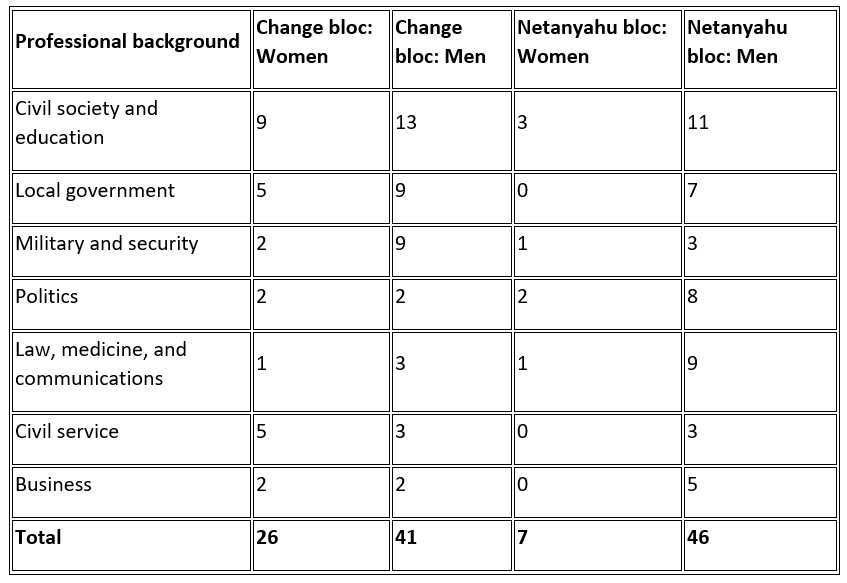
In the change bloc, the most common professional background among women is civil society and education (nine of the 26 women, more than one-third), followed by local government and the civil service. The civil service is the only field in which women outnumber men.
The gender gap is particularly pronounced among those with careers in security-related fields: two women compared with nine men in the change bloc, and one woman compared with three men in the Netanyahu bloc.
In the Netanyahu bloc, the seven female MKs come from backgrounds in civil society and education, politics, security, and the liberal professions. None of the women in this bloc have backgrounds in local government, the civil service, or business, compared with 15 men whose professional backgrounds fall within these three fields.
A comparison with the previous three Knessets shows that the gap in women's representation between the political blocs has continued to widen. In the Netanyahu bloc, the proportion of women declined from 21% in the 23rd Knesset to 13% in the 26th Knesset, while in the change bloc, it increased from 29% to 39%.
In the current Knesset, the proportion of first-time female MKs (55%) is also the highest of the four Knessets, while the proportion of women with previous ministerial experience (15%) is significantly lower than that of men with previous ministerial experience (38%).
Women's Representation in the Two Political Blocs, 23rd–26th Knessets
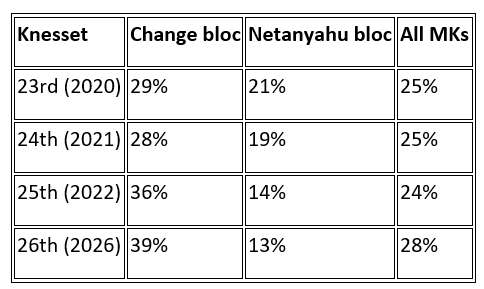
Representation figures reflect the party composition on the day of each Knesset's swearing-in.⁴
Parliamentary faction chairs. As of the publication of this analysis, the two factions that have already appointed chairs—Yashar and Together—are both headed by men, despite women accounting for at least half of the MKs in each faction.
Women's representation on coalition negotiating teams. According to media reports, the negotiating teams representing Together, Yashar, the Democrats, and Yisrael Beiteinu initially included just one woman among 13 representatives. Following an appeal by women's organizations, three additional women were added.⁵
Speaker of the Knesset and chairs of temporary committees. According to media reports, the change bloc reached an agreement on appointments to four important parliamentary positions: Speaker of the Knesset, chair of the Arrangements Committee, and chairs of two temporary committees—the Foreign Affairs and Defense Committee and the Finance Committee.
Only one of these four positions will be held by a woman: Liran Avisar Ben Horin (Together) will chair the temporary Finance Committee. Nevertheless, this represents a historic breakthrough, as no woman has ever chaired the Knesset Finance Committee.
Gendered aspects of efforts to delegitimize voting in Arab society. Efforts to delegitimize voting among Arab citizens included a distinct gender dimension, with attacks directed at female voters, who were wrongly portrayed as lacking the judgment necessary to make their own electoral choices.⁶
Footnotes
- For details of the party platforms, see Dr. Assaf Shapira and Adv. Anat Thon Ashkenazy, "2026 Elections: Women's Representation in the Next Knesset" (Israel Democracy Institute, September 2026).
- Dr. Assaf Shapira, Daphna Aviram-Nitzan, Ilay Gabay, and Adv. Nisreen Abo Asalh, "Gender Analysis of Directors General of Government Ministries, 2003–2025" (Israel Democracy Institute, July 2025).
- The classification was conducted for this study based on the list of elected MKs as of October 29, 2026. Each MK was assigned to only one professional field. "Military and security" refers to a professional career in the security sector, rather than military service.
- The composition of the blocs in each of the four Knessets was as follows:
23rd Knesset (2020):
- Netanyahu bloc: Likud, Blue and White (headed by Gantz), Shas, United Torah Judaism, Derech Eretz, Labor (Amir Peretz and Itzik Shmuli), Gesher, and the Jewish Home (73).
- Change bloc: Yesh Atid–Telem, the Joint List, Yisrael Beiteinu, Yamina, Meretz, and Merav Michaeli of Labor (47).
24th Knesset (2021):
- Netanyahu bloc: Likud, Shas, United Torah Judaism, Religious Zionism, the Joint List, and Amichai Chikli (59).
- Change bloc: Yesh Atid, Blue and White, Labor, Yisrael Beiteinu, Yamina, New Hope, Meretz, and Ra'am (61).
25th Knesset (2022):
- Netanyahu bloc: Likud, Shas, United Torah Judaism, Religious Zionism, Otzma Yehudit, and Noam (64).
- Change bloc: Yesh Atid, National Unity, Yisrael Beiteinu, Labor, Ra'am, and Hadash–Ta'al (56).
26th Knesset (2026):
- Netanyahu bloc: Likud, Otzma Yehudit, United Torah Judaism, Shas, Religious Zionism, and Zehut (53).
- Change bloc: Yashar!, Together, the Democrats, the Joint List, Yisrael Beiteinu, and Ra'am (67).
- Letter from women's organizations dated November 2, 2026, published on the Israel Women's Network website.
- In response to efforts to delegitimize voting, see researcher Mirvat Abu Hadoba-Frieh, "My Mother Wears a Veil, and She Still Has the Right to Vote," Israel Democracy Institute, November 1, 2026.
