

Polymarket and Synthetic Simulations: Election Forecasts That Are Not Polls
Polymarket, Synthetic Simulations, and the Need to Expand Transparency Requirements Beyond Election Polls
Photo by: SOPA Images/Reuters
Two new types of tools have emerged in recent years that generate quantitative information about the state of an election race without conducting a conventional public opinion poll. The first is prediction markets, most prominently Polymarket, where participants buy and sell contracts on future outcomes, and the contract price is presented as the probability of those outcomes occurring. The second is synthetic polling or simulation, in which artificial intelligence models simulate populations of voters, sometimes based on profiles of real people and sometimes synthetic personas, to generate forecasts of voting preferences and election results.[1]
Methodologically, these are two different mechanisms. Polymarket brings together the judgments and interests of traders willing to risk money on the outcome. Synthetic polling asks a model to predict how people with particular characteristics would respond. Yet the similarities between them are significant in terms of the election information environment. Both may be presented to the public with the same numerical, scientific appearance as a poll: a 63% chance of victory; 31 seats; one party rising and another falling. The concern is therefore twofold: first, methodological errors and inaccuracy; and second, the emergence of substitutes for election polls that benefit from the professional authority attributed to polling without being subject to disclosure and transparency requirements or restrictions on publication.
Under Israel’s existing election laws, section 16E of the Elections (Propaganda Methods) Law provides a specific framework governing the publication of election polls. Their publication is prohibited in the final days before the election, beginning at the end of the Friday before the polls open. Publication is also subject to transparency and disclosure requirements, discussed below. An election poll is defined by a functional approach that focuses on the content of the information produced and its connection to the electoral process, rather than by the methodology used to produce it: an “election poll” is “a poll conducted during the election period that examines voters’ voting patterns in the election, or issues directly related to the contenders in the election.”[2] Although this is a broad definition, determining whether it encompasses the publication of data from prediction markets or synthetic simulations, and which transparency and disclosure rules are appropriate for them, requires an interpretation informed by an understanding of how these tools operate.
We should emphasize at the outset that these technologies are relatively new. There is as yet no empirical basis for establishing how, or to what extent, the publication of data from prediction markets or synthetic simulations affects voters’ attitudes or behavior. This differs from the longstanding literature on the effects of publishing election polls, which points to potential effects on turnout, perceptions of candidates’ chances, and voters’ choices, although there is no consensus on the magnitude or direction of those effects.[3] Nevertheless, if the legislature has identified a particular risk in the introduction of new quantitative information about the state of the race in the final moments before an election, then new technologies capable of producing information with the “look and feel” of polls warrant consideration for inclusion within the existing regulatory framework.
Our proposal calls on the Central Elections Committee to treat the publication of data from Polymarket and synthetic simulations as the publication of polls, even if they do not constitute polls in the scientific sense, and to apply two sets of requirements similar to those governing election polls: a ban on publishing results from the end of the Friday before the election, and the existing polling requirements for transparency and methodological disclosure. In this legal analysis, we explain these technologies, describe emerging efforts around the world to address them, and present our proposals for methodological transparency requirements that take account of their distinctive features.
Polymarket is one of the world’s largest prediction market platforms. A market of this kind may pose a binary question, such as whether a particular candidate will win an election. A YES contract trading at 63 cents implies, approximately, a market-implied probability of 63% that the event will occur. If it does, the contract pays out one dollar; if it does not, the contract is worth zero. The price is not the output of a Polymarket statistical model, nor does it represent a candidate’s level of support as measured by a poll. It is the aggregate result of market participants’ buying and selling decisions.[4]
This also explains the difference between Polymarket and a poll. An election poll seeks to measure preferences: whom people intend to vote for. A prediction market seeks to price expectations: what participants think will happen. A trader may be an ardent supporter of candidate A yet buy a contract on candidate B winning because the trader expects B to win. Nor is the market a representative sample of the electorate, and traders do not each have “one vote.” A wealthy participant willing to risk money can have far more influence on the price than thousands of observers who do not trade in the market.
The traditional argument in favor of prediction markets is that the price mechanism can aggregate “dispersed information.” Someone who believes the market is wrong can profit from its error and therefore has an incentive to correct it. The US Commodity Futures Trading Commission (CFTC), the federal regulator overseeing derivatives markets and event contracts, likewise describes prediction markets as tools for aggregating information, with prices reflecting market participants’ collective expectations. This also explains why prediction markets are increasingly used not only for betting, but also as a kind of live indicator of expectations about elections, interest rate decisions, geopolitical events, and legal outcomes.[5]
The 2024 US election marked a significant moment in the relationship between Polymarket and elections. More than $3.5 billion was traded in Polymarket’s presidential election market. In the final weeks of the race, the platform gave Donald Trump a clear lead, while opinion polls showed a much closer contest. Trump did win, and the result bolstered prediction market advocates’ claim that these markets had identified the direction of the race more successfully than the polls.[6] Yet this comparison is problematic from the outset, since a poll and a prediction market do not measure the same variable. A broader examination also shows that prediction markets do not consistently outperform models based on polling.
An article published in Undark in May 2026, drawing in part on a comparative study of prediction markets and models based on polling in the 2024 election, found that Polymarket had correctly identified the winner but had not clearly outperformed statistical models in predicting voting outcomes. Its performance in congressional races was particularly weak, including in markets with low trading volumes. (Polls conducted with samples too small to meet accepted professional standards likewise struggle to predict voting outcomes.) In August 2026, Polymarket and Kalshi received a striking reminder of this limitation: on the eve of Wisconsin’s Democratic gubernatorial primary, they gave Francesca Hong an approximately 95%–96% chance of winning, yet she lost to David Crowley. Separately, a large-scale study of Polymarket, based on hundreds of millions of transactions, found that profits were highly concentrated: the top 1% of profitable users captured 76.5% of all profits. This finding does not in itself demonstrate that prices are inaccurate, but it does weaken the simple image of the “wisdom of crowds,” in which each participant contributes similarly to the collective knowledge.[7]
A study by the Anti-Corruption Data Collective (ACDC), a nonprofit research organization bringing together investigative journalists, academics, data scientists, and policy professionals, reported by Reuters on September 9, 2026,[8] examined more than 11,000 markets relating to congressional elections on two prediction platforms, Kalshi and Polymarket. According to the analysis, in 94% of the markets examined, a single bet of less than $1,000 could move the price by an amount equivalent to ten percentage points of probability. In hundreds of instances on Polymarket, the new price persisted for at least a day, and sometimes longer. Both platforms countered that a distorted price creates an arbitrage opportunity: if other traders believe that a contract’s price has moved away from a reasonable estimate of the event’s probability, they can buy the side that has become too cheap or sell the side that has become too expensive, and profit when the price corrects itself. The platforms therefore argue that the very possibility of profiting from a distortion gives the market an incentive to correct it.[9]
In an election, a price change lasting only a few hours or a day can be enough for a screenshot to become a news headline, a candidate’s post, or a campaign message intended to exert political influence: “The markets now give us a 70% chance of winning.” In such circumstances, a trader with a vested interest might even be willing to incur a loss as the price of sending a political signal, rather than as the result of a failed financial investment. This possibility arises from the feedback loop between the media and prediction markets: traders respond to polls, news, and campaign events; the price changes; media outlets report the change as new information; candidates and activists use it; and a price shaped in part by political discourse thus returns to that discourse as independent evidence of the state of the race.[10]
This concern is heightened by evidence of highly concentrated trading in US election markets. According to ACDC’s analysis, the top 1% of wallets in congressional markets accounted for approximately 68% of trading volume, and just ten wallets accounted for approximately 17%. This matters because the market price is not determined by “one person, one vote”: when a large share of activity is concentrated in a small number of wallets, a small group can have a disproportionately large role in setting the price subsequently presented to the public as a probability.
Presenting prediction market activity as a reliable source of election information may therefore blur the distinction between a poll and a speculative wager: a transaction in which a participant risks money on an assessment of a future event, without the transaction itself measuring the electorate’s views. In June 2026, the Brennan Center for Justice warned that treating the probabilities offered by prediction market platforms Kalshi and Polymarket as a reliable source of election information, rather than as speculative wagers based on traders’ opinions and assessments, could confuse voters, shape perceptions of the state of the race, and even provide material for false claims of election fraud when the actual outcome does not match the forecast.[11]
Language models make it possible to create populations of agents, synthetic respondents, digital twins, and AI-based entities; assign them demographic and political characteristics and, sometimes, additional information about a particular person or that person’s information environment; and ask the model to respond on their behalf.
One of the foundational studies in this field was Argyle and colleagues’ Out of One, Many, which introduced the term “silicon sampling.”[12] The researchers supplied GPT-3 with sociodemographic profiles of human respondents and showed that, under certain conditions, the model could reproduce aggregate patterns of attitudes across population groups. A body of research subsequently began to develop examining language models as a potential source of synthetic public opinion data. Other studies, however, show that reproducing voter personas is not equivalent to conducting a validated survey. In their article “Synthetic Replacements for Human Survey Data? The Perils of Large Language Models,” published in Political Analysis, Bisbee and colleagues compared synthetic responses with US voting behavior and public opinion data from the American National Election Studies (ANES), a longstanding, representative academic survey series regarded as a central source for electoral research.[13] They found that, although the synthetic averages could appear close to those of human respondents, response variance was lower, statistical relationships between variables differed from those observed in human data, and small changes to the instructions given to the system or updates to the model affected the results. The researchers therefore concluded that there is currently no basis for treating such data as a reliable substitute for human survey data for statistical inference.[14]
Despite disagreement over the accuracy and reliability of synthetic simulations, they have been used in electoral contexts. Aaru, for example, created thousands of voter agents using census data and numerous personal characteristics, supplied them with an “information diet” designed to simulate that of the voter groups they represented, and asked them how they would vote. The company provided services to US political campaigns, political action committees (PACs), and other organizations, claiming that it could poll thousands of “respondents” within minutes and at a far lower cost than surveying humans.[15] A forecast it published on the eve of the 2024 US presidential election for the swing states through Semafor, a US news website covering politics, technology, and business. The model gave Harris an overall advantage and predicted that she would win the Electoral College. After the election, the forecast, of course, proved wrong.[16]
Another academic project, ElectionSim, sought to simulate voters on a large scale and forecast the behavior of groups and individual voters. The project team created a database of approximately one million synthetic voters sampled from social media information and developed a benchmark based on polls, the Poll-based Presidential Election Benchmark (PPE), to assess how closely the system reproduced distributions of voter preferences in US presidential election scenarios. The paper reports strong and consistent performance against the researchers’ own benchmark. However, it was published as a preprint, before peer review, and does not present an external test in which ElectionSim predicted the outcome of the 2024 election in advance. At this stage, the evidence primarily demonstrates an ability to reproduce or approximate polling data within the specified simulation scenarios.[17]
Whereas prediction markets primarily generate probabilities of outcomes, synthetic simulations produce the familiar outputs of polling: levels of support, demographic breakdowns, seat allocations, voter shifts between parties, and even verbal responses from “voters.” The difficulty is that they rely on extensive “inference”[18] and depend, among other things, on the data used to train the model, the way the synthetic entities are defined, their weights and temperature settings, sampling, and the number of runs. Polling professionals have therefore begun to respond. The American Association for Public Opinion Research (AAPOR) recently published a new code of ethics stipulating that responses generated or inferred by artificial intelligence, including “silicon responses,” digital twins, and similar outputs, do not count as “research participants.” The code also states that the terms “poll,” “polling,” and “survey” imply that humans are the primary source of the data and should therefore not be used to describe information generated by artificial intelligence. At the same time, the association’s Transparency Initiative requires that, whenever AI-generated responses are used, researchers describe how they were produced, what role AI played, and what human oversight was provided.[19]
Prediction markets are already subject to regulation in various countries. That regulation generally focuses on the legal nature of the product offered by the platform, whether a wager, an event contract, or a financial product, and on who may offer it and under what conditions. In the United States, jurisdiction is contested: the CFTC, the federal derivatives regulator, regards event contracts traded on regulated exchanges as products falling within the federal framework of the Commodity Exchange Act, while various states seek to apply their gambling laws to some of this activity. In 2026, the CFTC withdrew a proposal to regulate certain event contracts in light of judicial scrutiny, and subsequently initiated a new, broader rulemaking process concerning prediction markets.[20]
Outside the United States, general regulation likewise focuses primarily on gambling licenses, financial products, and consumer protection. In France, Polymarket was blocked in July 2026 on the grounds that it was operating unlicensed gambling. In Spain, Polymarket and Kalshi were blocked in May 2026 for lacking gambling licenses. Singapore prohibits participation in unauthorized remote gambling. In Australia, the Australian Securities and Investments Commission (ASIC) warned that no prediction market is currently licensed to operate in the country as a financial market, and that users of foreign platforms do not enjoy domestic investor protections.[21]
In Israel, we have not identified a specific framework regulating prediction markets as a distinct legal category. Such activity may nevertheless raise questions under general gambling law. Section 224 of the Penal Law defines “betting” broadly as an arrangement offering the chance to win money, money’s worth, or another benefit, where winning depends on a prediction. Sections 225 and 227 prohibit, among other things, organizing or conducting betting, as well as certain activities relating to offering and advertising it.[22] In addition, the Authorities for Prevention of Internet Use for the Commission of Offenses Law, 2017, allows, subject to the conditions it establishes, orders restricting access to a website used to commit gambling offenses. In some circumstances, it also allows the website to be excluded from search results or removed if it is hosted in Israel or controlled by an Israeli entity.[23] In January 2026, an application was filed for certification of a class action against Blockratize, the company operating Polymarket, on the grounds that it is a gambling and lottery platform prohibited under the Penal Law. No decision on the application has yet been issued.[24] In addition, in February 2026, a civilian and a reservist were indicted in connection with the use of classified military information for activity on Polymarket. In announcing the arrests, the police described the suspicions as involving the conduct of betting on Polymarket concerning the occurrence of military operations. The indictment, however, charged the suspects with serious security offenses, bribery, and obstruction of justice, rather than gambling offenses.[25] We have therefore not identified an Israeli ruling classifying Polymarket itself as prohibited gambling under Israeli law, and there is consequently no basis here for concluding that the platform’s activity in Israel is itself unlawful.
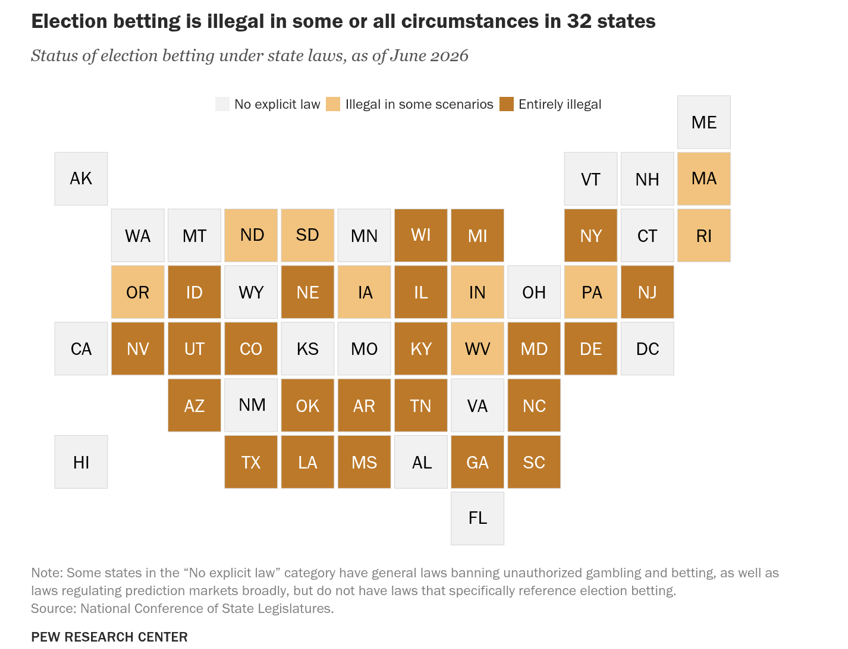
Turning from general regulation to the regulation of prediction markets under election law reveals a different set of rules. Their purpose extends beyond protecting gamblers or regulating a financial product to preventing improper incentives and protecting election integrity. According to Pew Research Center’s June 2026 review of state laws, 23 US states have blanket prohibitions on election betting, and another nine prohibit it in certain circumstances. Some states impose specific restrictions on candidates, officeholders, or public employees. In several states, a conviction for election betting may also affect eligibility to hold certain offices, as illustrated in the following chart.[26]
In 2026, legislation began to address this intersection. Minnesota enacted a broad prohibition on prediction market activity, subject to exceptions, alongside a provision specifically prohibiting candidates from betting on a race in which they are running. Tennessee created an offense that applies when a person holds a prediction market contract from which they may benefit and takes action with the intent of influencing whether the event occurs. This provision is not necessarily limited to elections, but it is particularly relevant to the electoral context because it directly addresses the connection between a financial position and the ability to influence the real-world events on which the bet is placed.[27]
What these rules have in common is that, even when they explicitly address elections, they focus primarily on whether betting is permissible, who may bet, and what actions are prohibited while holding a market position. We have not identified a dedicated transparency and disclosure framework governing the publication of prediction market data as electoral information. Such a framework might, for example, require a media outlet or campaign publishing “Candidate X: 67% on Polymarket” also to disclose trading volume, market depth, the number of traders, the concentration of holdings, the size of recent trades, or the price’s sensitivity to a single transaction. In the run-up to the US midterm elections, Reuters and the Associated Press reported on researchers’ and election authorities’ concerns that the publication of such data could itself become a tool of influence, and on the need to explain to the public that prediction market results are neither polls nor voting results.[28]
A further difficulty concerns the ability to impose obligations directly on a global platform. Under the Propaganda Law, the chair of Israel’s Central Elections Committee has no straightforward mechanism for bringing a foreign platform such as Polymarket under Israeli supervision and requiring it to provide the Israeli public with data on market depth and concentration, or with methodological warnings. Israeli law does recognize indirect territorial measures against foreign websites, such as restricting access to a website used to commit certain offenses. These tools, however, are not designed to impose an election law transparency regime on a foreign platform.[29] This difficulty reinforces the need to regulate the point at which the information enters Israel’s election environment: not necessarily Polymarket itself, but those who choose to publish its market prices in Israel as information about the state of the race.[30]
At this stage, we have not identified a dedicated statutory framework in the United States, the European Union, or the United Kingdom that regulates “synthetic election polls” as a separate category. Transparency regimes exist for political advertising and content created or altered digitally. However, they generally address synthetic content presented as a record of a person, place, or event, rather than a statistical figure or an election forecast produced using a simulated population of voters. In the absence of legal regulation, AAPOR’s new ethical rules provide an important point of reference: responses generated by artificial intelligence must be explicitly identified and must not be presented as originating from human respondents.[31]
The new disclosure requirement for election propaganda constituting a “deepfake,” set out in section 2A2 of the Propaganda Law, applies to visual or audio content featuring a figure, place, event, document, or object that may appear to have been originally recorded, although it was created or altered digitally. The chair of the Central Elections Committee has issued detailed rules on how such content must be labeled. This framework shows that the legislature has already recognized the need for specific transparency requirements when artificial intelligence changes the electoral information environment. However, its wording is generally ill-suited to a synthetic simulation that produces a number, such as a seat allocation or a level of support. The problem in that case is the presentation of a model’s inference as a measurement of public opinion, rather than the falsification of a visual or audio record. Section 2A2 thus serves primarily as a regulatory analogy illustrating the gap in the law, rather than as a direct legal basis for requiring every synthetic poll to be labeled.[32]
As noted, the Propaganda Law regulates the publication of election polls. Research shows that polls may influence public opinion, sometimes in manipulative ways, for example through the design of the questions or the sample, or through how and when results are presented.[33] As the Beinisch Committee (2017) explained, polls need to be regulated “because of the concern about manipulation of public opinion through polls, which ostensibly provide the public with a snapshot of reality and have the power to influence the public. The public’s underlying assumption is that a poll is an objective and reliable tool, unlike other election propaganda, and an important and central means of reflecting public opinion during an election period.”[34] For this reason, many democracies, including Israel, regulate their publication. Israel began doing so in 2002, with an amendment introducing, as noted, disclosure requirements to the public and the Central Elections Committee. In 2007, the law was amended again to prohibit the publication of the results of a new poll in the final days before the election, beginning at the end of the Friday before the polls open.[35] Regulation in Israel was intended to prevent deception and manipulation through polls, rather than to prevent their use, which serves an important purpose in the electoral process.[36] As the 2002 bill that first regulated this issue put it, “Disclosure requirements are imposed so that the public can assess the credibility of polls and evaluate them in an informed manner.”[37]
Section 16E of the Propaganda Law defines an “election poll” as “a poll conducted during the election period that examines voters’ voting patterns in the election, or issues directly related to the contenders in the election.” The framework requires publishers to disclose, among other things, who commissioned and conducted the poll, when it was conducted, the population from which the sample was drawn, how many people participated, and the margin of error. A poll that is not based on recognized statistical methods must carry an explicit warning that no conclusions about voting patterns or public opinion can be drawn from it. A pollster using recognized statistical methods must also submit detailed information to the Central Elections Committee on the sampling method, sample size, population categories, participation rates, and dates of the interviews. Subsection (d) is particularly relevant here: it shows that the legislature anticipated the existence of products described as polls that are not based on recognized statistical methods, and chose to subject them to warning and disclosure requirements rather than disregard them.[38] As MK Michael Eitan, chair of the Knesset Constitution, Law and Justice Committee, explained in the plenum when introducing this provision for its second and third readings: “The second issue concerns what a poll actually is and how we can protect the public from the publication of ‘polls’ that are not really polls, but various telephone straw polls conducted without oversight or statistical examination [...] Alongside polls, we are also allowing the continued publication of various straw polls that are not conducted using statistical methods. It will be possible to publish a straw poll conducted in a marketplace or an internet straw poll, and so on, provided that, during the election period, the publication of such results also includes a statement that they cannot indicate voting patterns, because these straw polls or ‘polls’ were not conducted professionally or in a manner that statisticians could endorse as capable of predicting and indicating the public’s voting patterns.”[39]
The interpretation proposed here also has roots in decisions of the chair of the Central Elections Committee. Election Case 23/01, One Israel Faction v. Maariv Internet, concerned the publication of the results of online and telephone straw polls on election day. The committee’s chair, Justice Mishael Cheshin, regarded the publication of poll results with the potential to influence voter behavior as a matter falling within election propaganda law. He also considered it under section 13 of the Propaganda Law, which prohibits one party list from conducting propaganda in a manner that constitutes “unfair interference” with another list’s propaganda. The decision preceded the current polling framework. Indeed, in that decision and subsequently, the committee’s chair called for the law to be amended, as it eventually was with the introduction of the present framework. It should therefore not be read as a direct ruling on Polymarket or synthetic simulations. It does, however, reinforce the rationale that, when a new measurement technology intersects with elections, consideration should be given to the function and electoral effect of publishing its findings, as well as to its methodological label.[40]
Section 13 of the Propaganda Law may therefore provide a supplementary avenue, but it cannot replace section 16E, whose wording addresses “polls,” whether conducted professionally or otherwise. Section 13 concerns unfair interference with another party list’s propaganda, and subsequent decisions have cautioned against an overly broad interpretation of prohibitions on political expression. It would therefore be wrong to conclude that every publication of prediction market or synthetic simulation data constitutes “unfair interference” in itself. Nevertheless, in extreme cases involving deliberate manipulation or a particularly misleading presentation, especially shortly before voting, section 13 may provide an additional legal basis for intervention.[41]
Under section 16E, the publication of the results of a new election poll that was not published earlier is prohibited during the period beginning at the end of the Friday before the polls open and ending when they close. It is precisely during this period that there is an incentive to use substitutes for polls and claim that their publication is permitted. Our proposal does not seek to classify every political forecast as a poll. A commentator’s analysis, a seat projection model explicitly based on previously published polls, or a qualitative assessment of probability need not necessarily fall within the disclosure framework. The proposed test is functional: when a new quantitative output is published that is intended to be, or could reasonably be, perceived by voters, under an objective test, as an empirical measurement or prediction of voting patterns, seat allocations, the winner’s identity, or a contender’s chances of success, it should be treated as an “election poll” for the purposes of the publication ban and transparency requirements, or at least as an equivalent product, with the necessary adaptations.[42] We therefore propose issuing guidelines clarifying that the publication of new data from prediction markets and synthetic simulations is subject to the same ban during the polling blackout period, and, during the rest of the election period, to transparency requirements tailored to the mechanism that produced the data. The prohibition and transparency requirements would primarily address those publishing the data to the Israeli public, whether a media outlet, campaign, candidate, or other actor. This approach does not assume that all the obligations and prohibitions under the Propaganda Law can be imposed directly on the global platform from which the information originated.
- For the publication of prediction market results, transparency requirements should include at least the following information:
- The name of the platform and the specific market.
- The wording of the question and the resolution criteria: the rules specifying in advance exactly what must occur for the contract to resolve as YES or NO, which sources will be used to determine the outcome, and what will happen in borderline or disputed cases.
- The date and time at which the data were recorded.
- Total trading volume and trading volume within a relevant time window. “Trading volume” is the total value of transactions carried out in the market over a given period. It helps indicate whether the price emerged from broad trading activity or from a small number of transactions.
- An available measure of liquidity or market depth: an indication of the volume of buy and sell orders around the current price, and the amount of money required to move the price substantially. “Market depth” describes the buy and sell orders available at different prices around the current price, and thus how much money is needed to move it. A deep market is relatively difficult to move, whereas in a shallow market even a small transaction may change the displayed probability.
- The number of participants or wallets, insofar as this can be determined.
- The concentration of holdings, particularly the share held by the largest traders.
- The size of recent unusual trades and their effect on the price.
- A clear warning that the price is not based on a representative sample of voters and does not measure a candidate’s level of support. When any of this material information is unknown to the publisher, that fact must be stated explicitly.
- For synthetic simulations, transparency requirements should include at least the following information:
- The identity of those who commissioned and conducted the simulation.
- The model and version used.
- The source of the data used to construct the synthetic population.
- How the personas, agents, or twins were created.
- The number of variables used to define each persona.
- The wording of the prompts used to create the personas.
- The number of runs.
- Key sampling parameters: the settings that determine how the model chooses among possible responses and how much randomness or variation is permitted between runs, such as temperature or equivalent parameters.
- The aggregation and weighting method: how the agents’ responses are combined into an overall result, and the weights assigned to different types of agents to align the synthetic population with the distribution of the population it is intended to represent.
- The method of calibration against real-world data, or the results of validation against a human sample, if conducted.
- The extent of human oversight.
- A prominent statement that the respondents are not human and that the result is based on inference by an artificial intelligence system. These requirements are broadly consistent with AAPOR’s new transparency standard.
For each of these mechanisms that bypass polling, where it cannot be demonstrated that the method meets recognized and validated standards for measuring public opinion, we propose requiring compliance with section 16E(d): a clear statement must appear alongside the result. For Polymarket, it should read: “This figure reflects a trading price in a prediction market. It is not based on a representative sample of voters and does not indicate a candidate’s level of support.” For a synthetic simulation: “This figure was generated through an artificial intelligence simulation, rather than from the responses of human voters, and should not in itself be regarded as a measurement of public opinion.”
Israeli law regulates the publication of election polls both in the professional sense and in the form of “quasi-polls” that voters may perceive as forecasts of voting behavior. The framework proposed here is intended to apply those provisions to the publication, ahead of elections, of prediction market and synthetic simulation results that voters may perceive as such forecasts. The intention is solely to establish that these results are subject to the ban on publishing election polls in the final days before the election, beginning at the end of the Friday before the polls open, and to transparency and disclosure requirements similar to those applying to other quasi-polls. It is not intended to interfere with how these results are produced. More broadly, this issue once again illustrates the need to update the Propaganda Law to reflect contemporary campaigning methods. This outdated legislation struggles to address today’s digital challenges to the proper balance between freedom of expression in elections and fairness and equal opportunity among those contesting them.[43] This difficulty poses a significant threat to the realization of these principles and to the protection of election integrity.[44] After the election, the Knesset should therefore undertake a substantial reform of the Propaganda Law to enable it to address these challenges more effectively.
[1] For an explanation of how prediction markets work, see Commodity Futures Trading Commission, “Prediction Markets,” Advance Notice of Proposed Rulemaking, 91 Fed. Reg. 12516 (March 16, 2026), which describes these markets as mechanisms for aggregating information, https://www.cftc.gov/LawRegulation/FederalRegister/proposedrules/2026-05105.html; for “silicon sampling” and the simulation of human samples, see Lisa P. Argyle et al., “Out of One, Many: Using Language Models to Simulate Human Samples,” Political Analysis 31 (2023): 337–351, https://www.cambridge.org/core/journals/political-analysis/article/abs/out-of-one-many-using-language-models-to-simulate-human-samples/035D7C8A55B237942FB6DBAD7CAA4E49.
[2] The definition of “election poll” in section 16E(a) of the Elections (Propaganda Methods) Law, 1959 (hereinafter: the “Propaganda Law”).
[3] Jason Roy, Shane P. Singh, and Patrick Fournier, The Power of Polls? (Cambridge University Press, 2021), pp. 1–8, 35–59, https://www.cambridge.org/core/books/power-of-polls/D3CC77369A6659153BD13E1FE3054EBB.
[4] Polymarket, “How Markets Work,” https://docs.polymarket.com/concepts/prices-orderbook.
[5] Commodity Futures Trading Commission, “Prediction Markets,” Advance Notice of Proposed Rulemaking, 91 Fed. Reg. 12516 (March 16, 2026), https://www.cftc.gov/LawRegulation/FederalRegister/proposedrules/2026-05105.html.
[6] Polymarket, “Presidential Election Winner 2024” (final trading volume: $3.686 billion), https://polymarket.com/event/presidential-election-winner-2024; Reuters, “Thousands of election gamblers anticipate betting jackpot after Trump win” (November 6, 2024), https://www.reuters.com/world/us/thousands-election-gamblers-anticipate-betting-jackpot-after-trump-win-2024-11-06/.
[7] Camila Grigera Naón, “Prediction markets’ reputation comes back to earth after surprise result in Wisconsin,” Fortune (August 13, 2026), https://fortune.com/2026/08/13/prediction-markets-reputation-surprise-result-wisconsin/.
[8] Reuters, “Prediction markets shift US election odds on small bets, researchers say” (September 9, 2026), https://www.reuters.com/legal/government/prediction-markets-shift-us-election-odds-small-bets-researchers-say-2026-09-09/.
[9] Anti-Corruption Data Collective, “About Us,” https://acdatacollective.org/about/; Reuters, “Prediction markets shift US election odds on small bets, researchers say” (September 9, 2026), https://www.reuters.com/legal/government/prediction-markets-shift-us-election-odds-small-bets-researchers-say-2026-09-09/.
[10] This is primarily our own analysis, but it is supported by documentation of how prediction market results are reported in the media. See Associated Press, “2026’s elections could test how heavy trading on prediction markets affects races and results” (September 8, 2026), https://apnews.com/article/prediction-markets-elections-gambling-trump-states-8ee4d0ba5dc92adb04f0284665c18e0f; Rachel Moran, “In Election Betting, Voters Face the Highest Stakes,” Brennan Center for Justice (June 30, 2026), https://www.brennancenter.org/our-work/research-reports/election-betting-voters-face-highest-stakes; Jeremy B. Merrill, Leslie Shapiro, and Mariana Alfaro, “Why prediction markets’ election picks are useful, even when they seem wrong,” Washington Post (June 23, 2026), https://www.washingtonpost.com/politics/2026/06/23/why-prediction-markets-election-picks-are-useful-even-when-they-seem-wrong/.
[11] Rachel Moran, “In Election Betting, Voters Face the Highest Stakes,” Brennan Center for Justice (June 30, 2026), https://www.brennancenter.org/our-work/research-reports/election-betting-voters-face-highest-stakes; Nizan Geslevich Packin and Sharon Rabinovitz, “Prediction markets as a public health threat,” Science 392(6795) (April 2026): 257.
[12] Lisa P. Argyle et al., “Out of One, Many: Using Language Models to Simulate Human Samples,” Political Analysis 31 (2023), https://doi.org/10.1017/pan.2023.2.
[13] American National Election Studies (ANES), “About Us,” https://electionstudies.org/about-us/. ANES has produced nationally representative academic survey data on voting, public opinion, and political participation since 1948.
[14] James Bisbee et al., “Synthetic Replacements for Human Survey Data? The Perils of Large Language Models,” Political Analysis 32(4) (2024): 401–416, https://doi.org/10.1017/pan.2024.5.
[15] Reed Albergotti, “AI startup Aaru uses chatbots instead of humans for political polls,” Semafor (September 20, 2024), https://www.semafor.com/article/09/20/2024/ai-startup-aaru-uses-chatbots-instead-of-humans-for-political-polls.
[16] Gina Chua, “An AI polling startup makes its predictions for the 2024 US election,” Semafor (November 4, 2024), https://www.semafor.com/article/11/04/2024/an-ai-polling-startup-polls-bots-predicts-harris-will-win; Diego Mendoza, “AI polling company defends wrong predictions on the US election,” Semafor (November 6, 2024), https://www.semafor.com/article/11/06/2024/ai-startup-aaru-defends-using-artificial-intelligence-for-polling.
[17] Xinnong Zhang et al., “ElectionSim: Massive Population Election Simulation Powered by Large Language Model Driven Agents,” arXiv:2410.20746 (2024), https://arxiv.org/abs/2410.20746.
[18] Rachel Aridor-Hershkovitz and Tehilla Shwartz Altshuler, Privacy and Elections: Toward the 2026 Elections, Policy Proposal 64 (Israel Democracy Institute, March 2026), pp. 21–31.
[19] James Bisbee et al., “Synthetic Replacements for Human Survey Data? The Perils of Large Language Models,” Political Analysis 32(4) (2024): 401–416, https://www.cambridge.org/core/journals/political-analysis/article/synthetic-replacements-for-human-survey-data-the-perils-of-large-language-models/B92267DC26195C7F36E63EA04A47D2FE; see also Xinnong Zhang et al., “ElectionSim: Massive Population Election Simulation Powered by Large Language Model Driven Agents,” arXiv:2410.20746 (2024), for an election-simulation architecture using LLM-driven agents, https://arxiv.org/abs/2410.20746.
[20] See, for example, Reuters, “Judge blocks Minnesota’s first-in-nation prediction markets ban” (July 27, 2026), https://www.reuters.com/world/judge-blocks-minnesota-implementing-novel-prediction-markets-ban-2026-07-27/; Commodity Futures Trading Commission, “Prediction Markets,” Advance Notice of Proposed Rulemaking, 91 Fed. Reg. 12516 (March 16, 2026), https://www.cftc.gov/LawRegulation/FederalRegister/proposedrules/2026-05105.html.
[21] Reuters, “France blocks access to Polymarket website” (July 17, 2026), https://www.reuters.com/technology/french-internet-service-providers-told-block-access-polymarket-2026-07-17/; Reuters, “Spain blocks prediction markets Polymarket, Kalshi over lack of gambling licences” (May 26, 2026), https://www.reuters.com/business/spain-blocks-prediction-markets-polymarket-kalshi-over-lack-gambling-licences-2026-05-26/; Singapore Gambling Regulatory Authority, “Unlawful Remote Gambling Activities,” https://www.gra.gov.sg/harm-minimisation/unlawful-remote-gambling-activities; Australian Securities and Investments Commission (ASIC), Moneysmart, “Prediction markets” (updated August 3, 2026), https://moneysmart.gov.au/investment-warnings/prediction-markets.
[22] Penal Law, 1977, sections 224, 225, and 227.
[23] Authorities for Prevention of Internet Use for the Commission of Offenses Law, 2017. The law permits access restriction orders in relation to an exhaustive list of offenses, including gambling, and, where applicable, orders to prevent a website from appearing in search engine results or to remove it if it is hosted in Israel or controlled by an Israeli entity.
[24] Class Action 38089-01-26, Itai Langer v. Blockratize (January 15, 2026).
[25] Israel Police, “Several Suspects Arrested for Gambling on the Polymarket Website” (February 12, 2026); Guy Assif, “The Dark Side of the War Gambling Industry,” Ynet (February 27, 2026).
[26] Shifra Dayak, “More than half of states restrict betting on elections,” Pew Research Center (June 23, 2026), https://www.pewresearch.org/short-reads/2026/06/23/more-than-half-of-states-restrict-betting-on-elections/.
[27] National Conference of State Legislatures, “Prediction Markets 2026 State Legislation” (updated September 9, 2026), https://www.ncsl.org/financial-services/prediction-markets-2026-state-legislation.
[28] Associated Press, “2026’s elections could test how heavy trading on prediction markets affects races and results” (September 8, 2026), https://apnews.com/article/prediction-markets-elections-gambling-trump-states-8ee4d0ba5dc92adb04f0284665c18e0f; Reuters, “Prediction markets shift US election odds on small bets, researchers say” (September 9, 2026), https://www.reuters.com/legal/government/prediction-markets-shift-us-election-odds-small-bets-researchers-say-2026-09-09/.
[29] See the powers under the Authorities for Prevention of Internet Use for the Commission of Offenses Law, 2017, and the orders issued pursuant to it (https://www.gov.il/he/pages/cyber_access_restriction_warrants), compared with the sometimes ineffective enforcement of election law orders issued by the chair of the Central Elections Committee against foreign platforms, discussed in Tehilla Shwartz Altshuler and Guy Lurie, Digital Campaign Advertising and the Threat to Elections (2020), pp. 69, 80. Compare Yonadav Samet and Ido Schlesinger, “An Elephant Through the Eye of a Needle: Reexamining Online Election Propaganda Law,” Mishpatim 52 (2023): 617, at 656.
[30] Authorities for Prevention of Internet Use for the Commission of Offenses Law, 2017. This law does not establish an electoral transparency regime for foreign platforms; it is cited here solely as an example of an indirect territorial instrument recognized by Israeli law in relation to websites used to commit specified offenses.
[31] American Association for Public Opinion Research (AAPOR), Code of Professional Ethics and Practices (revised June 2026), and AAPOR Transparency Initiative disclosure standards for AI-generated responses, https://aapor.org/standards-and-ethics/.
[32] Elections (Propaganda Methods) Law, 1959, section 2A2 (2026 temporary provision); Elections (Propaganda Methods) (Compliance with the Disclosure Requirement for Deepfake Election Propaganda) Rules, 2026. Section 2A2 defines a “deepfake” as visual or audio content that may appear to be an original recording, although it was created or altered by digital means. See Guy Lurie, Tehilla Shwartz Altshuler, Assaf Shapira, and Noa Goshen, “Legal Opinion on the 26th Knesset Elections Bill,” Israel Democracy Institute website (June 21, 2026), https://www.idi.org.il/knesset-committees/64776.
[33] Guy Lurie and Tehilla Shwartz Altshuler, Reforming Israel’s Campaign Advertising Laws (2015), p. 38; Yitzhak Galnoor and Dana Blander, The Political System of Israel, vol. 1 (2013), p. 543 [In Hebrew].
[34] Public Committee to Review the Elections (Propaganda Methods) Law, 1959, Report (2017), p. 39 (the “Beinisch Committee Report”).
[35] Lurie and Shwartz Altshuler, note 34 above, p. 39.
[36] Lurie and Shwartz Altshuler, note 34 above, p. 39.
[37] Explanatory notes to the Elections (Propaganda Methods) (Amendment No. 22) (Election Poll) Bill, 2002, Hatza’ot Hok (Bills), No. 3131 (2002), p. 634.
[38] Elections (Propaganda Methods) Law, 1959, section 16E, particularly subsections (d), (e), and (h); Central Elections Committee, “Knesset Election Polls,” https://www.gov.il/he/Departments/DynamicCollectors/knesset_election_polls_26?skip=0.
[39] Divrei HaKnesset (Knesset Proceedings), November 4, 2002, pp. 96–98.
[40] Election Case 23/01, One Israel Faction v. Maariv Internet Ltd. and the Likud Faction (2001). The decision concerned the publication of online and telephone straw polls on election day and examined, among other issues, the applicability of section 13 of the Propaganda Law.
[41] On the need for caution when interpreting prohibitions on election propaganda and unfair interference under section 13 of the Propaganda Law, particularly the restriction of election propaganda under the near-certainty test (which favors protecting freedom of expression), see Election Case 15/25, Yesh Atid v. Likud (August 25, 2022); Salim Joubran and Guy Raveh, “Election Propaganda Law: Past, Present, and Future,” in Yoram Danziger Book, ed. Limor Zer-Gutman and Ido Baum (2019), p. 531, at 554.
[42] Elections (Propaganda Methods) Law, 1959, section 16E(h).
[43] See Lurie and Shwartz Altshuler, note 34 above; the Beinisch Committee Report, note 35 above; Shwartz Altshuler and Lurie, note 30 above; Justice Yitzhak Amit, Decisions and Guidelines from the 25th Knesset Elections (2022), pp. 23–24.
[44] Assaf Shapira and Guy Lurie, Safeguarding the Integrity of the 26th Knesset Elections (2026), p. 44.