
Roundtable: The Status of the Knesset and Its Relations With the Executive Branch
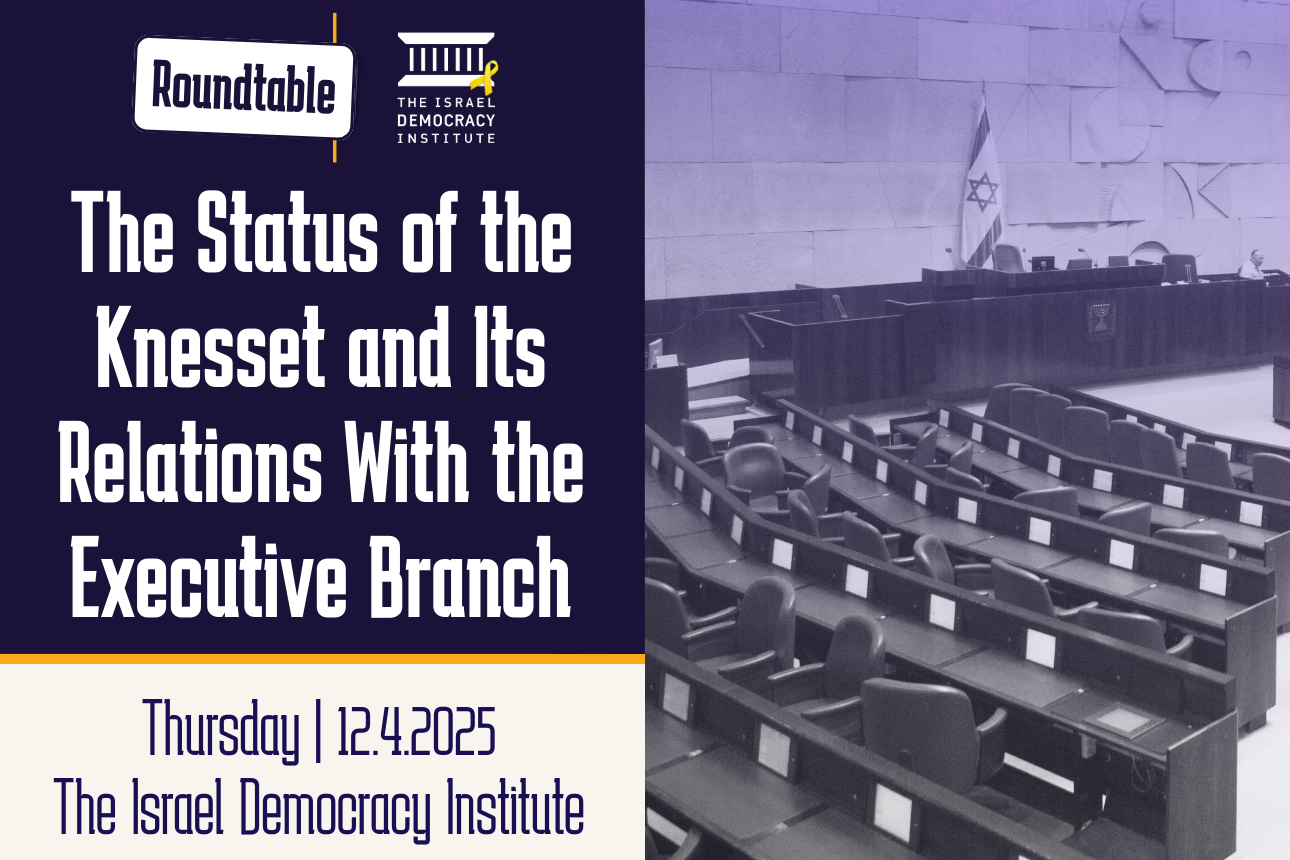
Photo by Miriam Alster/FLASH90
Summary: The Status of the Knesset and Its Relations With the Executive Branch
IDI hosted a special roundtable which looked at a core question relating to the balance of power and Israel's system of checks and balances: what is the relationship between the Knesset, Israel's legislature, and the executive branch. The checks and balances between Israel's executive and legislative branches are historically weak. The voters elect the Knesset, which in turn appoints the government. This means that once in office, the cabinet – the executive branch – inherently enjoys a majority in the Knesset, Israel's legislative branch.
Though not an uncommon arrangement in parliamentary systems, the Knesset also has the authority and responsibility to serve as a check on the work of the government. That authority, however, is often not exercised to the extent that one would expect. The roundtable discussed and debated these matters, bringing in key officials involved in both branches, including, among others, Minister Ze'ev Elkin, Legal Advisor to Knesset Sagit Afik, Former Secretary General of the Knesset Yardena Meller-Horowitz, and all the chairs of the opposition factions in the Knesset faction chairs for a special panel discussion their role in the parliament.
Select Quotes from the Roundtable
Minister Ze’ev Elkin: "We are legislating ourselves to death with private legislation on a crazy scale. Enormous amounts of the Knesset’s time resources are going toward this...I think that giving the Knesset, as a parliament, more teeth in oversight, in exchange for reducing the volume of private legislation, is a kind of deal from which the government also stands to benefit".
IDI President (and former MK) Yohanan Plesner said, "Everything has changed in the era of polarization. In this era, the Knesset becomes a kind of production house for digital content. You go into a discussion for a few minutes and come out. The meaning of being a real MK — the basic concept is that the committee is my workplace. If you know that you are a member of one committee with all the tools, and you finish three years in that same committee, you are truly a professional. And from that professionalism and presence, real influence is created".
MK Oded Forer, Chair of the Yisrael Beytenu faction: "The number of committees in the Knesset has become a joke; it is a degradation of what the Knesset is. It does not allow for summoning officials to Knesset committees — you can’t be in four committees. The government’s ability to impose discipline must be reduced. And when there is such a limitation, the discourse between the ministers and the coalition will be different..."
Former Minister, MK and Mayor Meir Sheetrit: "We need personal regional elections. The Supreme Court will decide how many districts there will be and determine the division into districts, so that no tricks will be played. Members of Knesset who are elected in a personal regional manner — no one will dare to behave the way they behave today, because they’ll be thrown out".
Knesset Legal Advisor Sagit Afik: "Even when the government and its professional, legal representatives oppose a certain bill… there is an obligation for the government’s representatives - certainly for the Office of the Deputy Attorney General for Legislation, the Ministry of Justice, and the legal advisors to the government ministries - to appear before the Knesset committees. Otherwise, we can sit here and have many discussions about oversight, but if the representatives [involved in the legislation] do not come to the Knesset, it will be impossible to fulfill the principles of transparency, publicity, and the ability of Members of Knesset to receive information, consider it, and make various decisions in relation to it".
MK Efrat Rayten Marom, Chair of the Democrats (Labor) faction:
"What they have done now has simply brought out into the open all the failures and the weakness of the Knesset. The families of the hostages call it the House of the People — what House of the People? Hostage families are thrown out, depending, of course, on which side you come from. There is no true representation of the people, of all the citizens of the State of Israel. This Knesset has become anti-democratic, aggressive; the rules have been trampled and have become a dead letter".
MK Walid Taha, Chair of the Ra’am faction, at a conference on the status of the Knesset: "Any government would pray to have an opposition like the one today…Today in Israel there is no patience to hear criticism. I, as an Arab Member of Knesset, live this day by day. They silence me in the committees, they silence me at the podium when I say things that are unpleasant to the ears of others..."
Dr. Assaf Shapira, Head of the Political Reform Program at the Israel Democracy Institute: "In Israel, as in other parliamentary democracies, there is a blending between the Knesset and the government, which limits the independence of the Knesset. The Knesset has also been weakened in recent years compared to the government and compared to the court. The Knesset of Israel has also suffered from the outset from flaws that weaken it even further. This does not mean that it does not fulfill incredibly important roles, but the starting point is that it is too weak and we need to think about mechanisms to strengthen it".
Amir Fuchs, Senior Researcher at the Institute: "In recent years, the government has been in a struggle with the officials: the legal advisors, the State Attorney’s Office, and the oversight is essentially being misused in order to interfere with them…Thus a paradox is created, in which the Knesset is supposedly overseeing the government, but not the ministers — rather the professionals — so that it is not only the government’s legislative agency but also an agency for oversight of the professionals on behalf of the government".
Quotes were lightly edited for length and clarity
09:30–10:00 Reception
10:00–10:15 Opening Remarks
Dr. Assaf Shapira, head of the Political Reform Program, Israel Democracy Institute
Adv. Sagit Afik, legal advisor to the Knesset: Principles of the Knesset’s Work
10:15–11:45 First Session: Separation of Powers and the Independence of the Knesset
Chair: Dr. Chen Friedberg, Israel Democracy Institute; Department of Middle Eastern Studies, Ariel University
Introductory remarks: Minister Ze’ev Elkin, minister at the Ministry of Finance responsible for rehabilitation of the North and South
Participants:
Nir Orbach, head of the Jewish National Identity Authority, Prime Minister’s Office; former chair of the Knesset House Committee
Yardena Meller-Horowitz, former secretary general of the Knesset
Raz Nizri, former deputy attorney general
Hodaya Kain, director of the Knesset Research and Information Center
Prof. Ofer Kenig, research fellow, Israel Democracy Institute; senior lecturer, Ashkelon Academic College
Meir Shetreet, former government minister, Knesset member, and mayor
Closing remarks: Yohanan Plesner, president of the Israel Democracy Institute
11:45–12:00 Break
12:00–13:30 Second Session: The Status of the Opposition in Israeli Democracy
Chair: Noa Shpigel, parliamentary correspondent, Ha’aretz
Participants:
MK Meirav Ben Ari, chair of the Yesh Atid Knesset faction, coordinator of the Opposition
MK Waleed Taha, chair of the Ra’am Knesset faction
MK Ahmad Tibi, chair of the Hadash-Ta’al Knesset faction
MK Oded Forer, chair of the Yisrael Beytenu Knesset faction
MK Efrat Rayten Marom, chair of the Democrats Knesset faction
MK Pnina Tamano-Shata, chair of the Blue and White Knesset faction
Closing remarks: Dr. Assaf Shapira, head of the Political Reform Program, Israel Democracy Institute