

The Wizard of Oz Wears a Shtreimel: The Crisis of the Haredi Leadership
The panic and disarray in response to the threat of conscription reveal a hidden truth: like the Wizard of Oz, the Haredi leadership—in the true sense of the word leadership—does not exist.
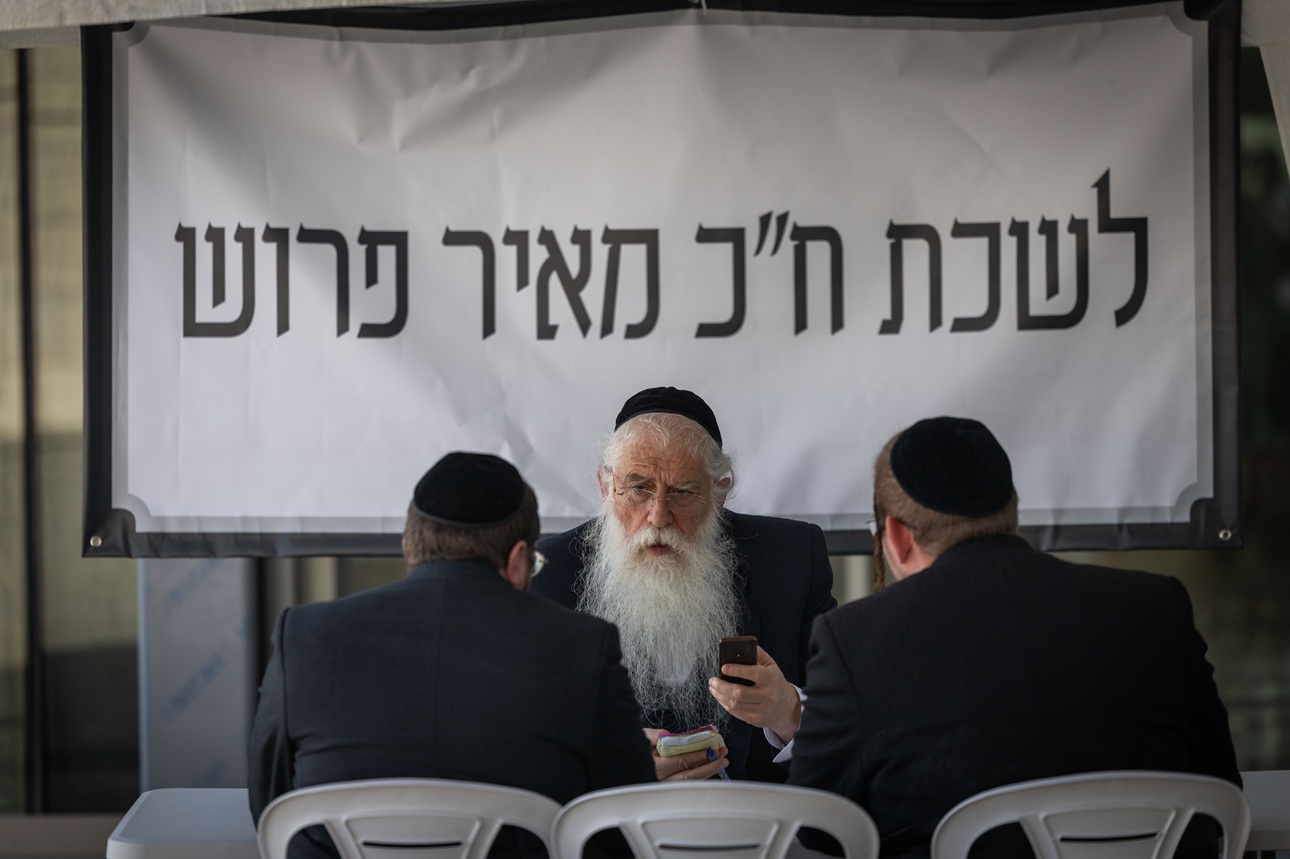
MK Meir Porush | The writing on the banner: "Chambers of MK Meir Porush" | Photo by Chaim Goldberg/Flash90
“Just like in the Holocaust, they’re suspected of being capable of killing us in gas chambers. You think that’s far-fetched? That they couldn’t do that to us? They’re suspected of that too! [...] Yes, our brothers — including the brother from Ra’anana. They are clearly suspected of such things! They don’t count us. They’re wicked, anti-Semites — worse than the Germans, may their name be erased!”
These harsh words, referencing non-Haredi Jewish leadership, were not spoken by some fringe Jerusalemite fanatic, nor by a hothead from the margins of ultra-Orthodox (Haredi) society. They were said by one of the leading Lithuanian Rosh Yeshivas, Rabbi Yigal Rosen, who also serves as a senior rabbinic figure in the Lithuanian faction's “Degel HaTorah” party.
On the Hasidic side, Knesset member Meir Porush half-warned, half-threatened, of a complete disruption of life in the country, and even civil war. Porush is not alone. Within Haredi society, voices are growing louder that call to rise up and launch civil disobedience. In recent weeks, threats have even emerged from the homes of leading Lithuanian rabbis to bring down the banking system through mass withdrawals and to collapse major corporations through consumer boycotts.
Rabbi Rosen’s severe remarks, MK Porush’s warnings, and the unprecedented threats issued by rabbinic households all point to one thing: widespread panic and a total loss of composure. The Haredi leadership is in a state of acute distress and has no idea how to cope with the dramatic shift that has occurred in the legal landscape, in public opinion, and in the Knesset regarding the exemption granted to Haredi men from military service.
The deep distress in the face of the Haredi conscription crisis actually exposes a more fundamental layer of the real challenge facing Haredi society. The shock and confusion, the panic and the disarray in response to the threat of conscription, reveal a hidden truth: like the Wizard of Oz, the Haredi leadership—in the true sense of the word leadership—does not exist.
Until the challenge of the draft, Haredi society functioned by inertia. Its trajectory was shaped by arrangements made at the founding of the state, such as the establishment of separate education systems and, of course, the military draft exemption. Over the years, occasional localized adjustments were made (mainly expanding the privileges granted to Haredim), but in general, movement occurred within the boundaries of the original Haredi-state framework. Under such conditions, there was no real need for effective leadership. The system simply existed and sustained itself, as long as no external forces intervened.
In recent years, however, a growing recognition has emerged among the general public that it is simply impossible to continue like this. It is no longer tenable to grant a community that comprises about a quarter (!) of all Israelis under age 20 an exemption from core curriculum studies, a pass on meaningful participation in the labor market, and a blanket exemption from military service.
The Haredi leadership correctly senses the existential threat looming over it. The arrangement that enabled Haredi society to recover after the Holocaust, take root, and flourish to a degree and in a form previously unseen must change, and is on the verge of changing. If not in the current Knesset, then in the next one. For better or worse, every element in the system of arrangements between the state and the Haredi community will soon be reexamined and placed before the public for debate.
Anyone can be a leader when things run smoothly under the status quo. But effective leadership is measured, among other things, by how it confronts crises. Leadership is measured by its ability to adapt to changing circumstances, to preserve the foundational pillars on which it is built, and to rebuild the system after the illusion of the wizard has crumbled.
Perhaps the best example of a Jewish leader whose resourcefulness and extraordinary historical insight preserved the very existence of Judaism is Rabban Yochanan ben Zakkai. The Babylonian Talmud recounts that on the eve of the destruction of the temple, Rabban Yochanan ben Zakkai approached the Roman military commander and future emperor Vespasian, and made several requests. These laid the foundation for the continuation of Judaism after the destruction of the Temple. One request involved preserving political leadership (the leadership lineage of Rabban Gamliel), and another involved preserving religious leadership (“Yavne and its sages”).
Sadly, it appears that instead of rising to the occasion and choosing to follow in the footsteps of Rabban Yochanan ben Zakkai, whom it regards as its historic spiritual leader, the Haredi leadership is choosing to entrench itself in the old arrangement with all its might, lashing out at any suggestion of change. Even as that arrangement crumbles before its very eyes, it clings to it with its last remaining strength, just like the historical zealots of the time of the destruction of the second temple, the very enemies of the pragmatic Rabban Yochanan ben Zakkai.