
Stay or Go? A Mapping of the Views and Considerations of Israelis in Relation to Moving Abroad
The following is a summary of the key findings of IDI research on Israelis who express a desire to move abroad, including a sociodemographic profile, considerations and purpose of wanting to leave, and additional analysis. The research is based on a survey of a representative sample of Israeli adults, including 720 Jews and 187 Arabs. The data were collected April 6-17, 2025 by CI Marketing and Research.

Photo by Gili Yaari/Flash90
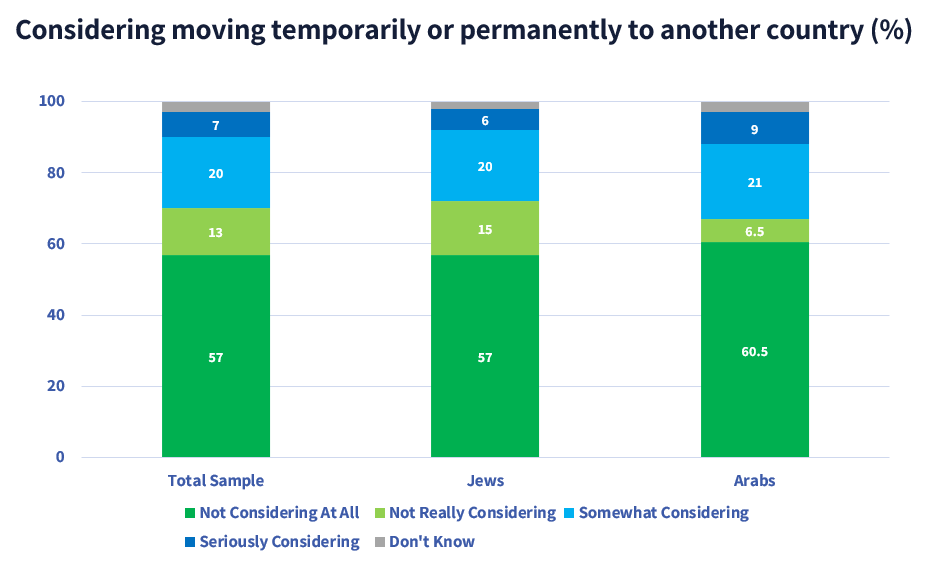
- Around a quarter of Jews and around a third of Arabs are considering leaving Israel and moving to live in another country, either temporarily or permanently.
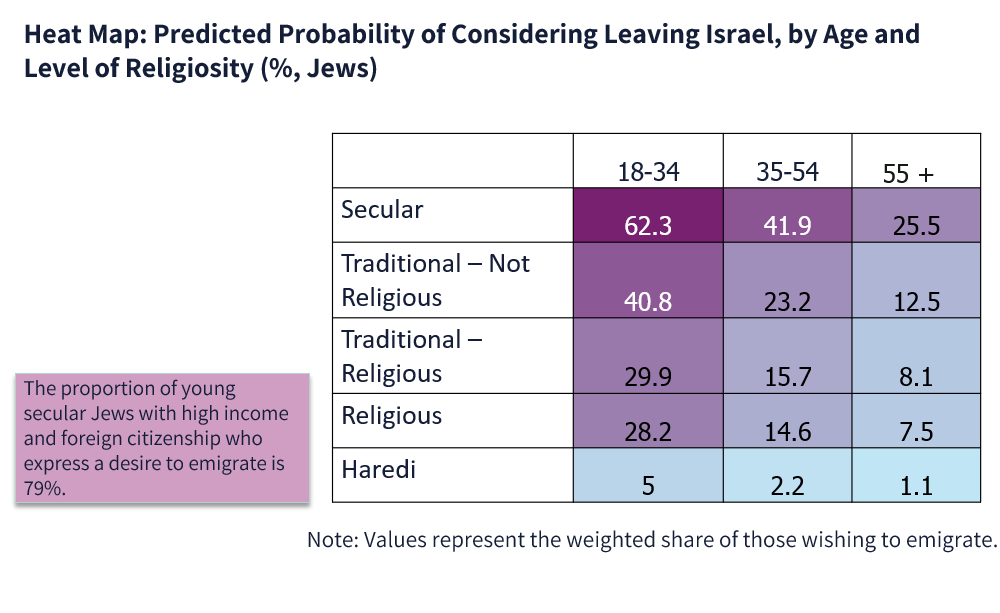
- Among Jews, religiosity is the most influential factor regarding the intention to leave: a particularly large share of secular Jews (39%) are considering leaving (traditional non-religious, 24%; traditional religious, 19%; national religious, 14%; Haredim, 3%).
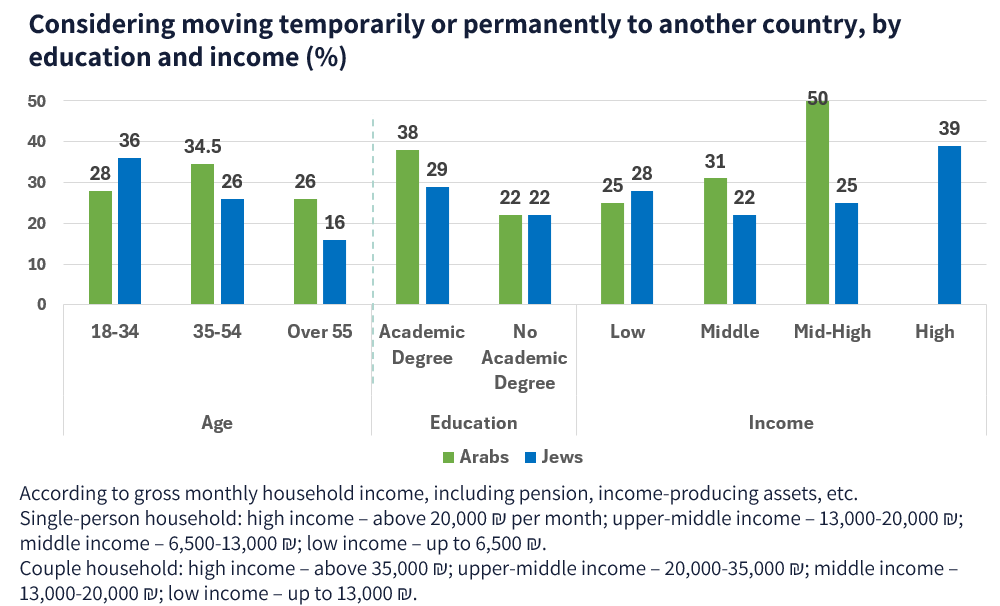
- The second most important factor among Jews is age: 36% of young people aged 18–34 are considering leaving (35-54, 26%; 55+, 16%).
- Among Arabs, the middle age group (35–54) has the largest share of respondents who are considering leaving, at 34.5% (18–34, 28%; 55+, 26%).
- Among both Jews and Arabs, those with high incomes and high-mobility occupations are more likely to consider leaving.
- Among Israeli-born Jews with foreign citizenship, 38% are considering leaving, compared to 25% of those without foreign citizenship.
- Advanced statistical analysis reveals that the probability that a young secular Jew will consider leaving is over 60%, and if they have a high income and foreign citizenship, this probability rises to around 80%.
- Political orientation (Jews): Over 40% of those on the Left and 35% in the Center are considering leaving, compared to 19% on the Right (secular Jews on the right – 34%).
- 42% of Jews who categorize Israel’s situation as “bad” are considering leaving, compared to 8% who consider its situation to be “good.” Among Arabs, the corresponding shares are 33% and 15%, respectively.
- Impact of social environment: Those who have relatives or close friends who have left Israel in recent years are two to three times more likely to consider leaving than those who do not have friends or relatives who have left.
- The large majority of Jews and Arabs say that living in Israel is important to them (90% and 79% respectively). The same is true among the Jewish subgroups that are more likely to consider leaving: 83% of secular Jews say that living in Israel is important to them, as do 86% of young people, 82% of those on the Left, and 83% of those in the Center.
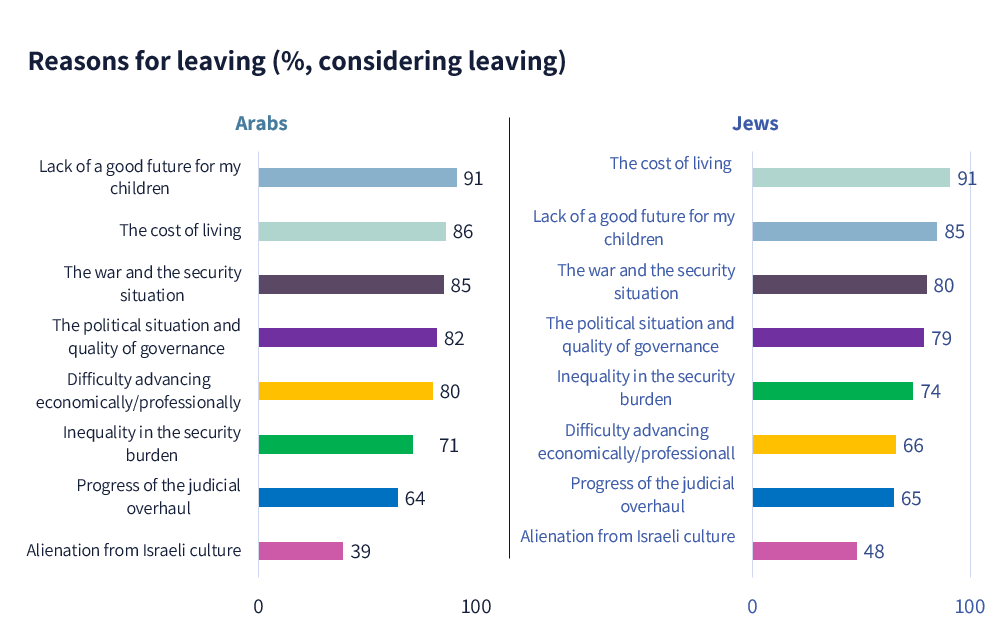
- The factors with the strongest influence on those considering leaving are the high cost of living in Israel and the lack of a good future for their children.
- Segmentation by political orientation (Jews) among those who are not considering leaving reveals that the factors that are most likely to cause them to change their minds are as follows: On the Left and in the Center—the political situation and the quality of government, the judicial overhaul, and the lack of a good future for children; on the Right—the high cost of living and the lack of a good future for children.
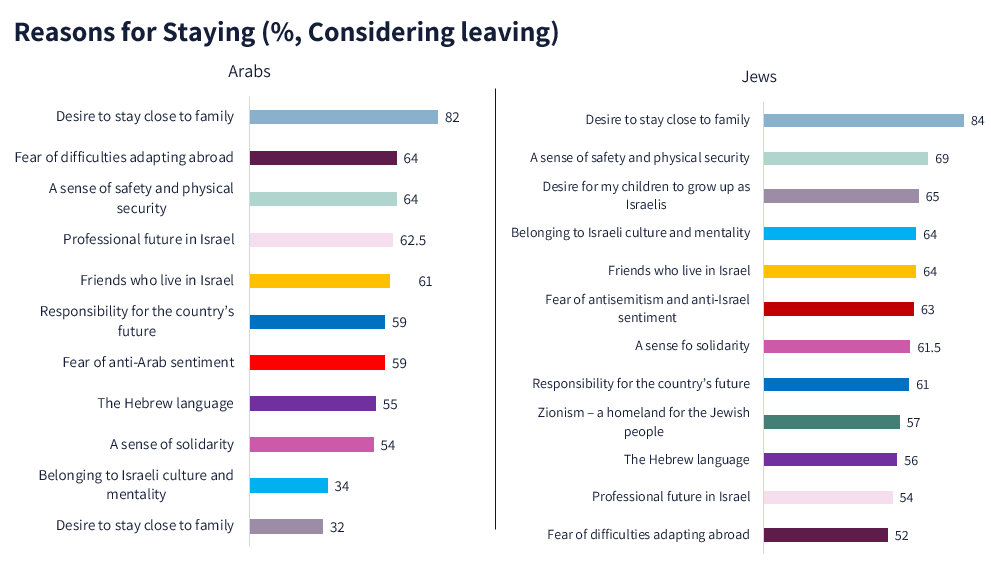
- The most significant factor in favor of staying in Israel, among all populations and subgroups, is the desire to remain close to family.
- Jews who are considering leaving cite security and cultural factors—such as physical safety, a desire to raise their children as Israelis, belonging to Israeli culture and mentality, and fear of antisemitism—as significant factors in favor of staying.
- Arabs who are considering leaving cite more practical considerations, such as their professional future and concerns about integration abroad, as factors motivating them to remain.
- A significant majority of those considering leaving among both Jews (69%) and Arabs (62.5%) do not have a specific purpose in moving abroad; rather, the main thing is simply to leave Israel. 14% of Jews and 20% of Arabs are considering relocating for work purposes.
- Europe is preferred over North America: 43% of those considering leaving prefer EU countries, compared to 27% who prefer the United States or Canada.
- The most important considerations for Israelis when choosing which country to move to are the quality of public services there, the economic situation, and the level of antisemitism/Islamophobia.
- The less important considerations are geographical distance from Israel and the weather.
- Around one-half of Jews and one-third of Arabs considering leaving do not know how long they would remain abroad. Only around 10% plan to leave permanently.
- The majority of the public (Jews, 58%; Arabs, 64%) think that the increase in the number of people leaving is a danger to the future of the country, and consider the departure of members of educated and well-established groups—a “brain drain”—to be an even greater danger (Jews, 64%; Arabs, 73%).
- The public is very tolerant of those leaving Israel. The reasons for leaving that are considered the most legitimate are academic studies and family reunification (82% in both cases). The least legitimate reasons are lack of trust in the political system (57%) and fears related to the security situation (65%). We found only minor differences between Jews and Arabs on this issue.
- The shares of respondents who legitimize leaving for the various reasons cited are particularly large among secular Jews and those on the Left.
- Should the state invest in Israelis living abroad, and if so, how? 29% of Jews think that the government should invest resources in encouraging Israelis to return, and 25% think it should invest in maintaining Israeli identity abroad. Among Arabs, the largest share (29%) think that the state should not interfere in any way in the lives of Israelis abroad.
- 51% of the public oppose allowing Israeli citizens to vote in elections from their place of residence abroad, while 39% are in favor.
- Around 60% of these immigrants are considering moving to another country, different from their country of origin, while only 21% are considering returning to their country of origin.
- Age and religiosity are factors that strongly influence leaving intentions: 77% of young adults (18–34) are considering leaving, compared to less than half of those aged 55 and over; and only one-fifth of those with an affinity to Judaism are considering leaving, compared to 57% of secular Jews and 86% of those seculars who are not Jewish.
- A large majority (78%) of immigrants whose expectations from Israel have not been met are considering moving to another country, compared to only 37% of those whose expectations have been fulfilled to a large extent.
- Factors encouraging leaving: Immigrants cite the war, the security situation, and the cost of living in Israel as the most significant factors in favor of leaving Israel.
- Factors encouraging staying : A sense of being protected and physical safety, a sense of mutual responsibility, and a desire to stay close to family are the most significant factors in favor of remaining in Israel.
- 5% of these immigrants think that the increase in the number of people leaving is a danger to the future of the country, and 86.5% see a danger in a “brain drain.”
- The immigrants afford great legitimacy to those leaving the country – at least 80% express support for each of the possible reasons for leaving. The reasons for leaving that are considered the most legitimate are academic studies, reunification with family (97% in both), and
professional advancement and improved pay (95%).