

A Plurality of Israelis Are Against a Pardon for Prime Minister Netanyahu
50% of Israelis do not think President Herzog should grant Prime Minister Netanyahu a pardon; 41% think he should. 45% of Israelis think Israel’s security forces and law enforcement agencies are too lenient in their treatment of settler groups involved in acts of violence against Palestinians; 22% think they are too harsh; 21% think their treatment is appropriate. 61% of Jews think the decision to sell F-35 war planes to Saudi Arabia harms Israel’s security.
Photo by Reuven Kastro/POOL
The survey was conducted by the Viterbi Family Center for Public Opinion and Policy Research at the Israel Democracy Institute between November 30 and December 3, 2025. It was based on a representative sample of the population in Israel aged 18 and above, comprising 604 Jewish interviewees and 153 Arab interviewees.
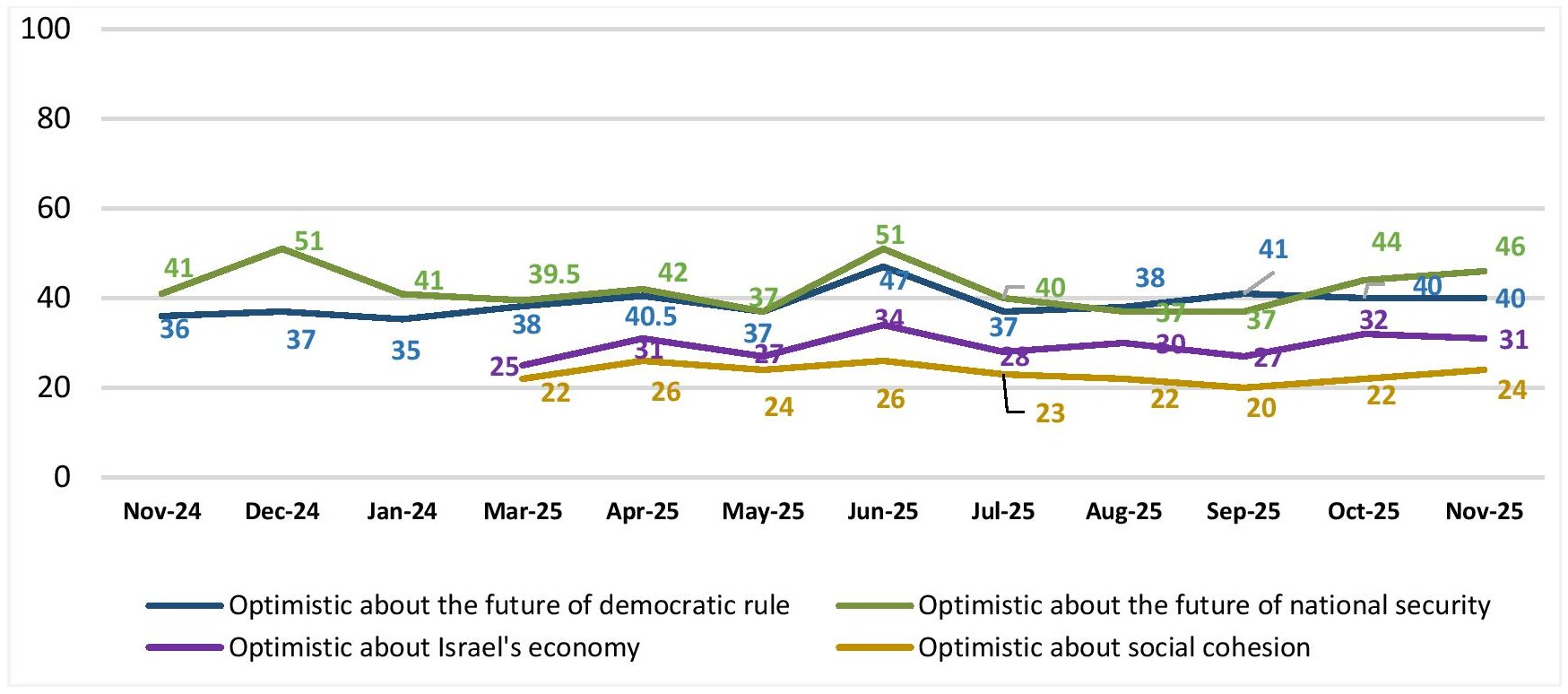
- This month was marked by relative stability across the four monthly indicators of national mood, though there was a slight increase (of 2 percentage points) in the share of those optimistic about the future of Israel’s national security, further to the sizable increase measured last month. A similar rise was also found in the level of optimism about the future of social cohesion, which remains the lowest of the four categories. The proportion of optimists about the future of democratic rule has remained identical, and there has been almost no change in optimism about the future of Israel’s economy.
Optimistic about the future of democratic rule, national security, the economy, and social cohesion (total sample; %)
- Regarding the future of democracy, security, and the economy, optimism among Jews is stronger than among Arabs (future of democratic rule—Jews, 42%, Arabs, 32%; future of national security—Jews 51.5%, Arabs 20%; future of the economy—Jews 34%, Arabs, 15.5%). Regarding social cohesion, the share of optimists in the Arab sample is slightly larger than that in the Jewish sample (28% versus 23%).
- Breaking down the findings by political orientation (Jews) reveals that on the Right, there is a majority of optimists about the future of national security and democratic rule, compared with a minority on the Left and in the Center. Regarding two categories—the future of the economy and of social cohesion—optimists constitute a minority in all political camps, though this minority is larger on the Right than in the Center and on the Left.
Optimistic about the future (Jews, by political orientation; %)
| Future of national security | Future of democratic rule | Future of the economy | Future of social cohesion | |
| Left | 24 | 10 | 8 | 10 |
| Center | 37 | 26 | 23 | 14 |
| Right | 62 | 54 | 43 | 28 |
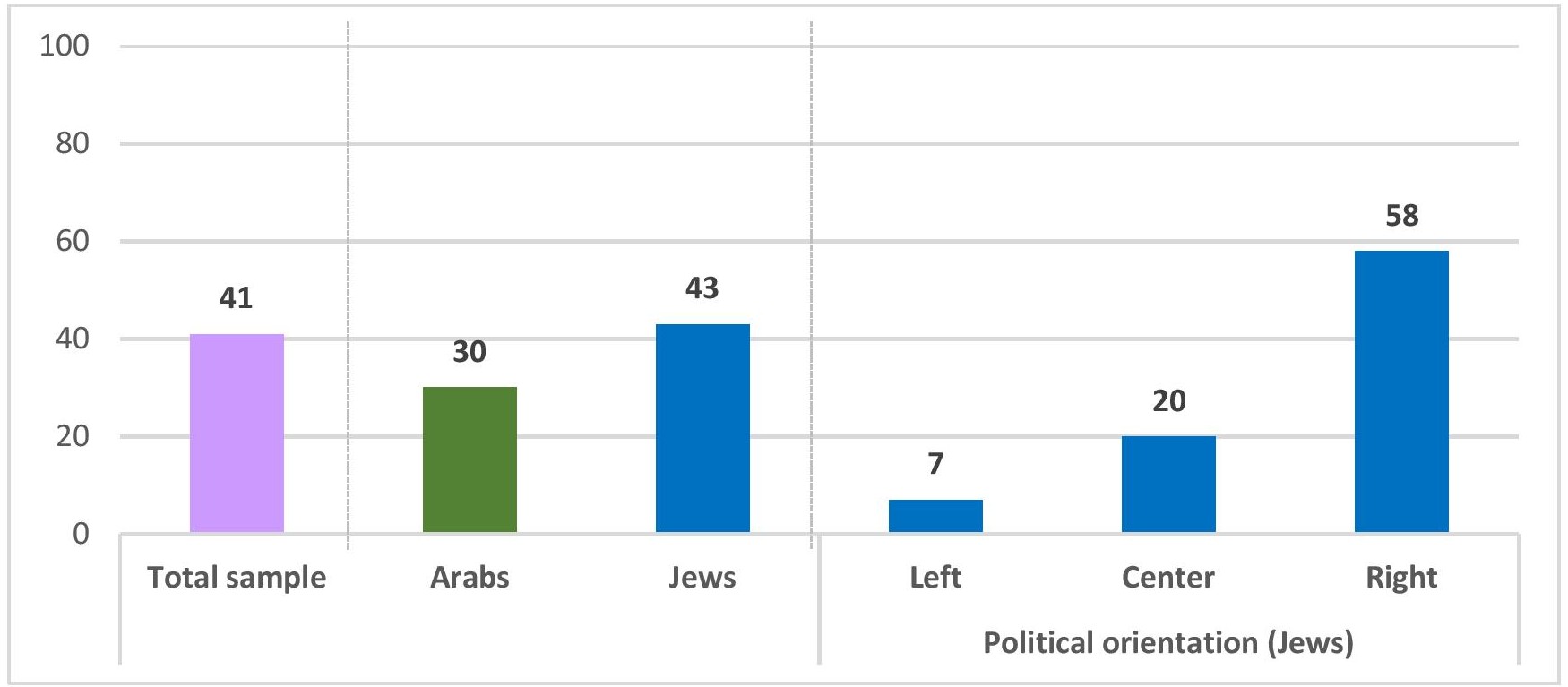
- In the total sample, one-half oppose granting the prime minister a pardon that would halt the criminal proceedings against him, so that he can continue in his position without interruption, while 41% think he should be given a pardon.
- Among Jews, 49% oppose a pardon, while 43% are in favor. Among Arabs, 55.5% are against, and 30% support a pardon.
- The differences between political camps (Jews) are considerable, with opposition to a pardon standing at 92% on the Left, 73% in the Center, and 32% on the Right.
Think that President Herzog should issue a pardon to Prime Minister Netanyahu that will halt the criminal proceedings against him, so that he can continue as prime minister without any distraction (%)
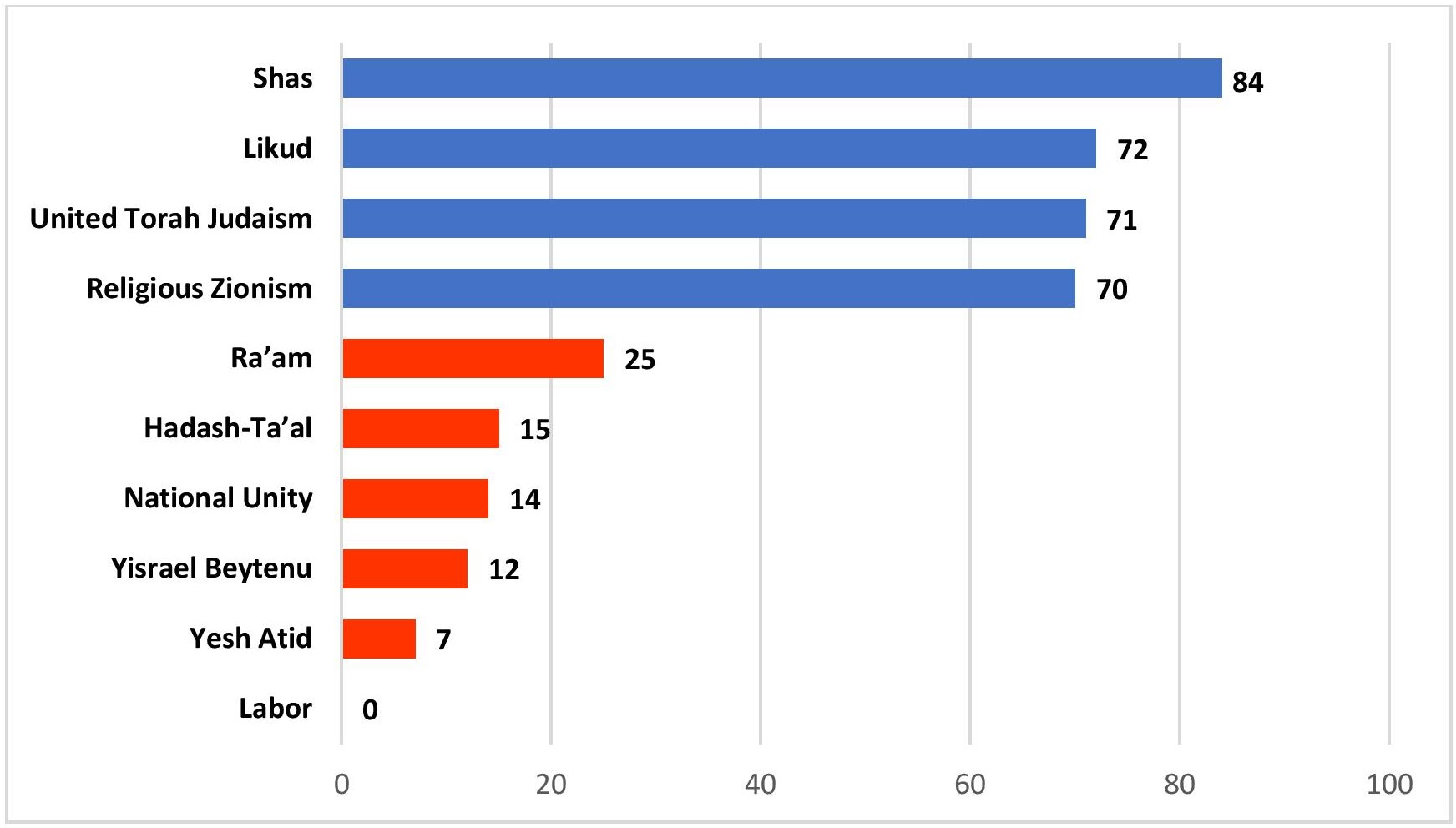
- A breakdown of responses by vote in the 2022 elections reveals, as expected, a majority who support a pardon among voters for all coalition parties, and only a minority in favor among voters for opposition parties.
Think that President Herzog should issue a pardon to Prime Minister Netanyahu that will halt the criminal proceedings against him, so that he can continue as prime minister without any distraction (total sample, by vote in the 2022 elections; %)
Repeating a question from previous surveys, we asked: "How would you rate Israel’s current leadership regarding corruption on a scale from 1 to 5, where 1 = very corrupt and 5 = not at all corrupt?"
- More than half (55.5%) think that Israel’s leadership is very or fairly corrupt, a high proportion, though almost identical to that found when we last asked this question in 2022, and slightly lower than in 2019 and 2020. It is higher than our findings prior to 2019, as well as our findings in 2021.
Think that Israel’s leadership is very or fairly corrupt (total sample; %)
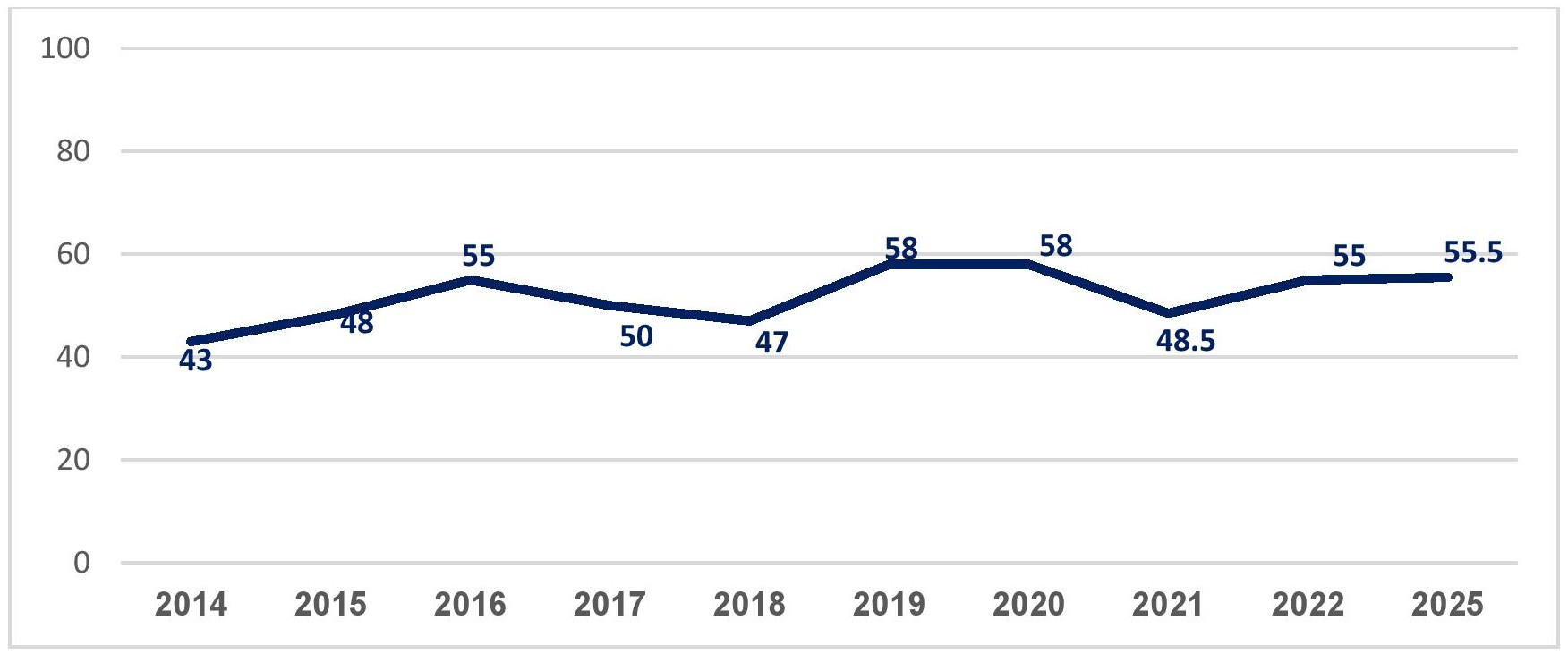
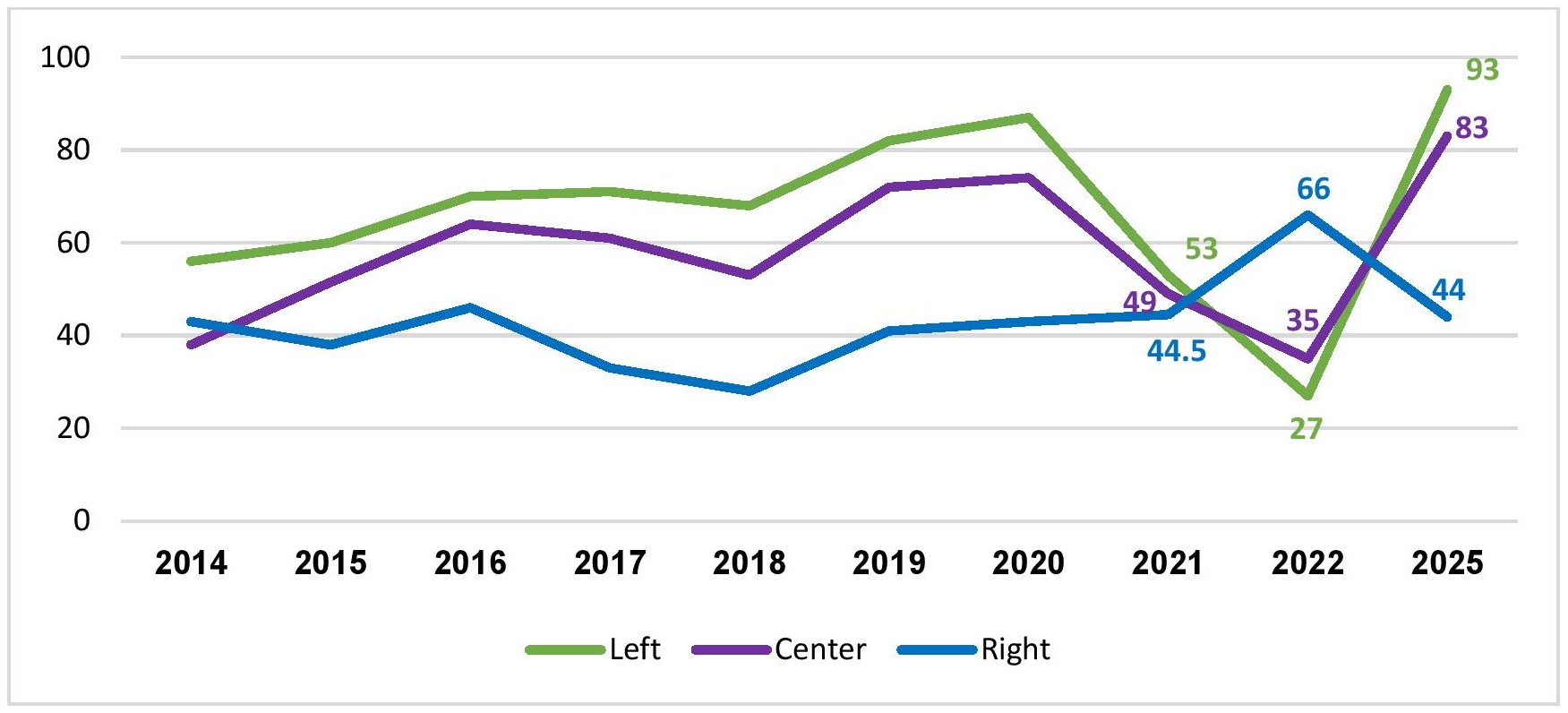
- Among Jews, 59% think that the country’s leadership is corrupt, a significant increase relative to previous surveys (2022, 54%; 2021, 47%). There has been a significant decline in this view in the Arab sample—only 40.5% currently think that Israel’s leadership is corrupt, compared to 60% in 2022 and 55% in 2021. Further measurements will be required in order to determine whether this finding represents a new trend or is simply an aberration.
- Breaking down responses in the Jewish sample by political orientation reveals very large differences between, on the one hand, the Left and the Center, where a large majority of respondents think that the leadership is corrupt, and on the other hand, the Right, where less than half of respondents consider Israel’s leaders to be corrupt. This is a dramatic change from our findings in 2022, in which the picture was reversed: a large proportion of those on the Right thought the leadership was corrupt, compared to small shares on the Left and in the Center. This reversal stems from the change in government, from the Bennett-Lapid government in 2022 to the current Netanyahu government. Nevertheless, the shares found in the current survey on the Left and in the Center who think that Israel’s leadership is corrupt are the largest ever recorded.
Think that Israel’s leadership is very or fairly corrupt (Jews, by political orientation; %)
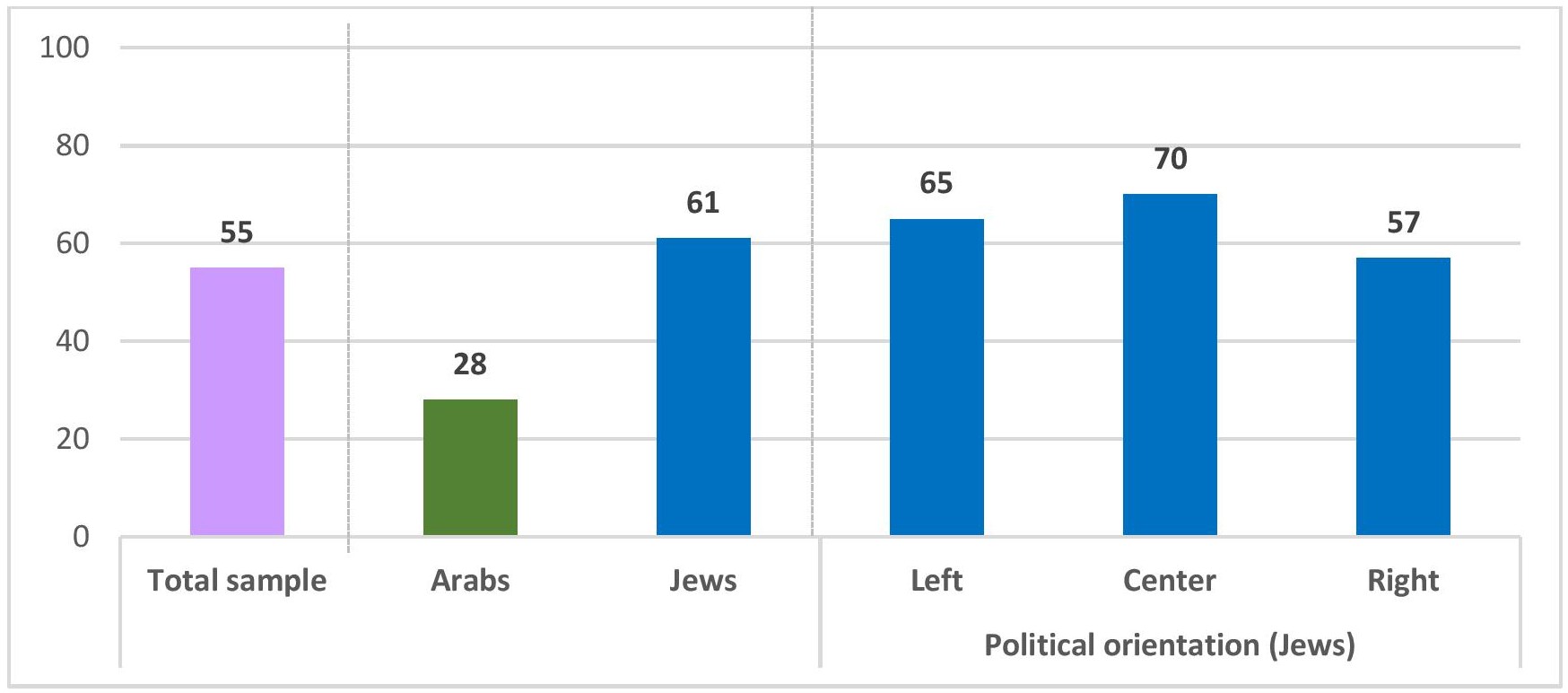
We asked: “In your opinion, does the decision to sell F-35 warplanes to Saudi Arabia, announced at the end of the meeting between President Trump and Saudi Crown Prince Mohammed bin Salman, harm or not harm Israel’s security?”
- Among Jews, 61% think that this step does harm Israel’s security, 24.5% think it does not, and 14.5% say that they don’t know. Among Arabs, this picture is reversed: 28% think the sale damages national security, while 58% hold the opposite view and 14% say they don’t know.
- In the Jewish sample, there are some differences between political camps, with the smallest share found on the Right; however, in all three, a majority of respondents think that the decision to sell F-35s to Saudi Arabia harms the security of the State of Israel.
Think/certain that the decision to sell F-35 warplanes to Saudi Arabia harms Israel’s security (%)
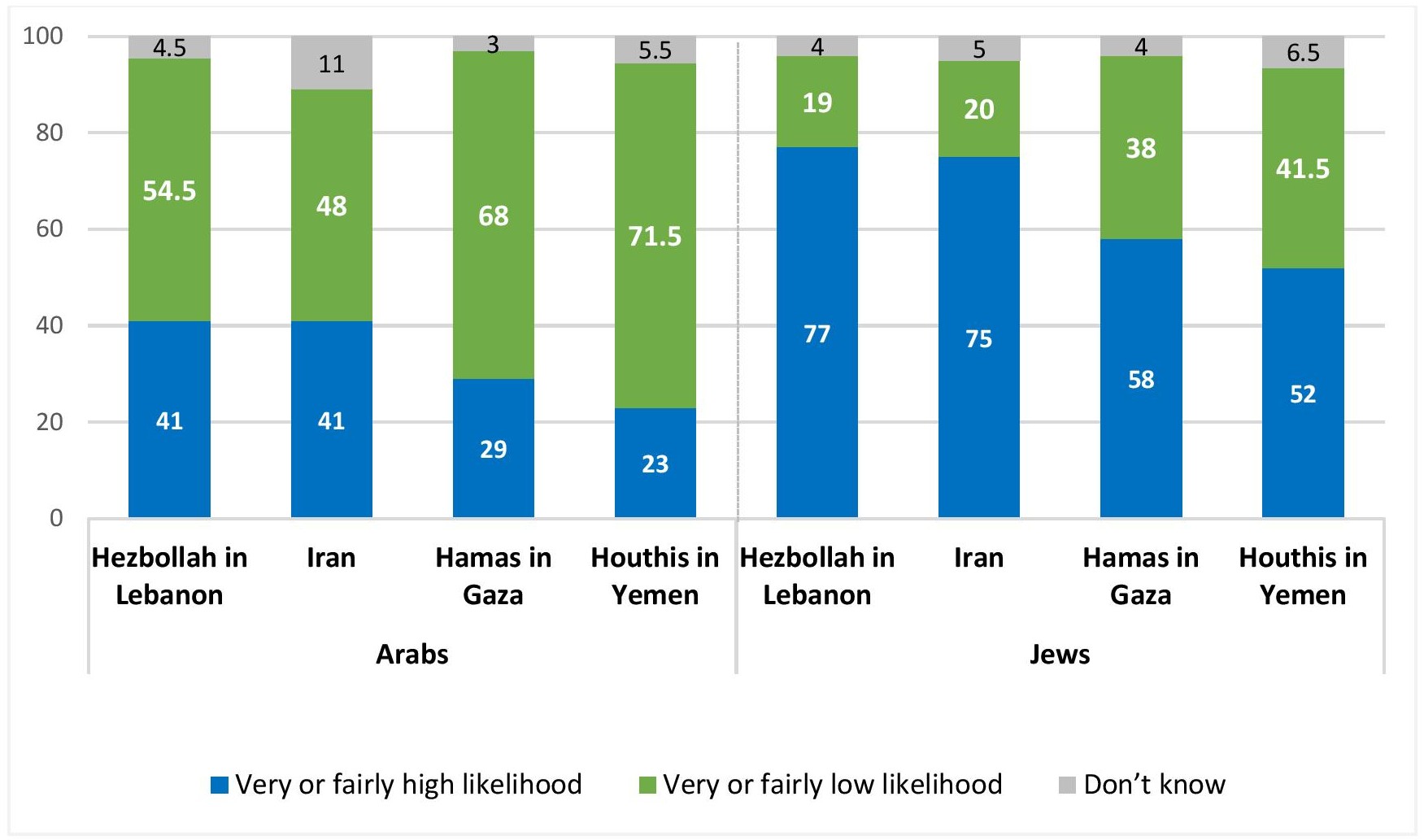
- The Israeli public expects war: 71% of the total sample think that in the coming year there will be a renewed military conflict with Hezbollah, 69% expect another confrontation with Iran, 53% think that the war against Hamas will be restarted, and 47% think that we will find ourselves once again in conflict with the Houthis in Yemen.
- Some three-quarters of Jews think that we are headed for another conflict with Iran and Hezbollah, and more than half think that a new confrontation with Hamas and the Houthis will break out in the coming year. In the Arab sample, though the proportion of respondents anticipating conflict are smaller, the strongest likelihood of conflict is considered to be with Iran and Hezbollah.
In your opinion, what is the likelihood that during the coming year, a large-scale military conflict will be renewed between Israel and the following? (%)
- Segmentation by political orientation (Jews) reveals a rare consensus, with similar shares of respondents in all three camps anticipating a renewed outbreak of large-scale military conflicts on the various fronts.
- And what about the West Bank/Judea and Samaria? A majority of Israelis believe that a Palestinian popular uprising (an intifada) is likely to erupt in the foreseeable future. Once again, the percentage of Jews who hold this view is significantly higher than the corresponding percentage of Arabs. In the Jewish sample, the differences between the political camps are very small—in all three, around two-thirds think that a popular uprising is likely in the foreseeable future.
In your opinion, what is the likelihood that in the foreseeable future, a Palestinian popular uprising (intifada) will erupt in the West Bank/Judea and Samaria?
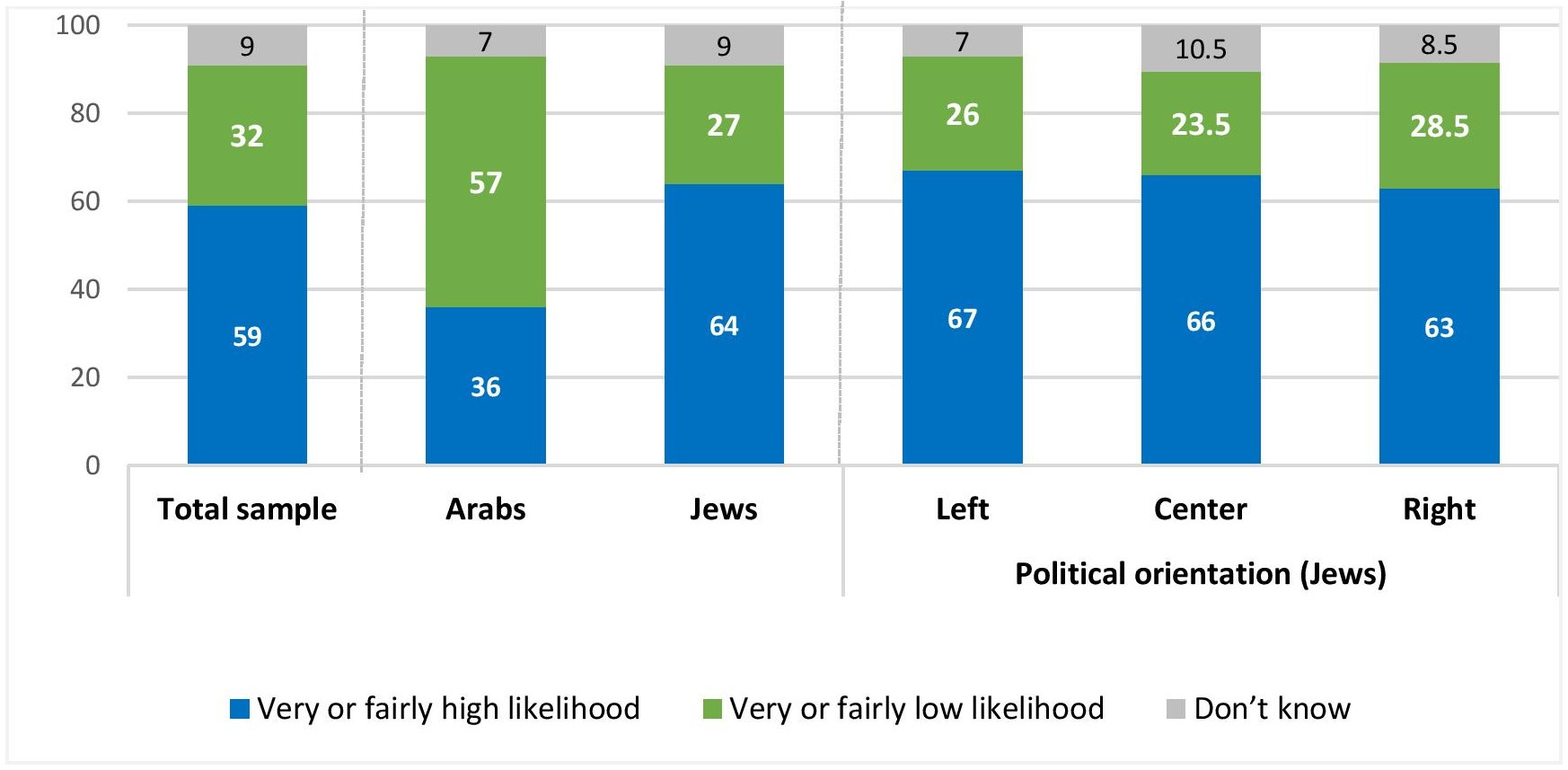
The data point to a paradox that is particularly striking among Jews: On the one hand, large shares of the public anticipate large-scale military conflicts on various fronts, and on the other hand, there is a trend of rising optimism about national security (in the current survey, 51.5% of Jews expressed optimism in this regard). We cross-tabulated responses to the question on optimism about the future of national security with those regarding the likelihood of military conflict on the various fronts.
- Regarding future confrontations with Hezbollah in Lebanon and with Iran, the differences between optimists and pessimists on the issue of national security are very small (5.5 and 3 percentage points, respectively). Among those optimistic about national security, around three-quarters expect a large-scale military conflict on these fronts. In other words, the anticipation of conflicts with these foes does not affect optimism about national security.
- Regarding future confrontations with Hamas and the Houthis, and the possibility of a large-scale popular uprising in the West Bank/Judea and Samaria, there were significant differences between the optimists and the pessimists on the issue of national security: the pessimists see a significantly higher likelihood of future conflicts than do the optimists (differences of 13, 14, and 15 percentage points, respectively). Still, for each of these fronts, close to half or more of the optimists think that the chances of confrontation are high.
| Jews (%) | Optimism/pessimism about the future of national security | ||
| Optimistic | Pessimistic | ||
| Hezbollah in Lebanon | Very high or fairly high likelihood | 75 | 80.5 |
| Very low or fairly low likelihood | 22 | 15.5 | |
| Don’t know | 3 | 4 | |
| Iran | Very high or fairly high likelihood | 74 | 77 |
| Very low or fairly low likelihood | 22 | 17 | |
| Don’t know | 4 | 6 | |
| Hamas in Gaza | Very high or fairly high likelihood | 52 | 65 |
| Very low or fairly low likelihood | 45 | 31 | |
| Don’t know | 3 | 4 | |
| Houthis in Yemen | Very high or fairly high likelihood | 46 | 60 |
| Very low or fairly low likelihood | 48 | 33 | |
| Don’t know | 6 | 7 | |
| Intifada in the West Bank/Judea and Samaria | Very high or fairly high likelihood | 58 | 73 |
| Very low or fairly low likelihood | 32 | 20 | |
| Don’t know | 10 | 7 | |
| Total | 100 | 100 | |
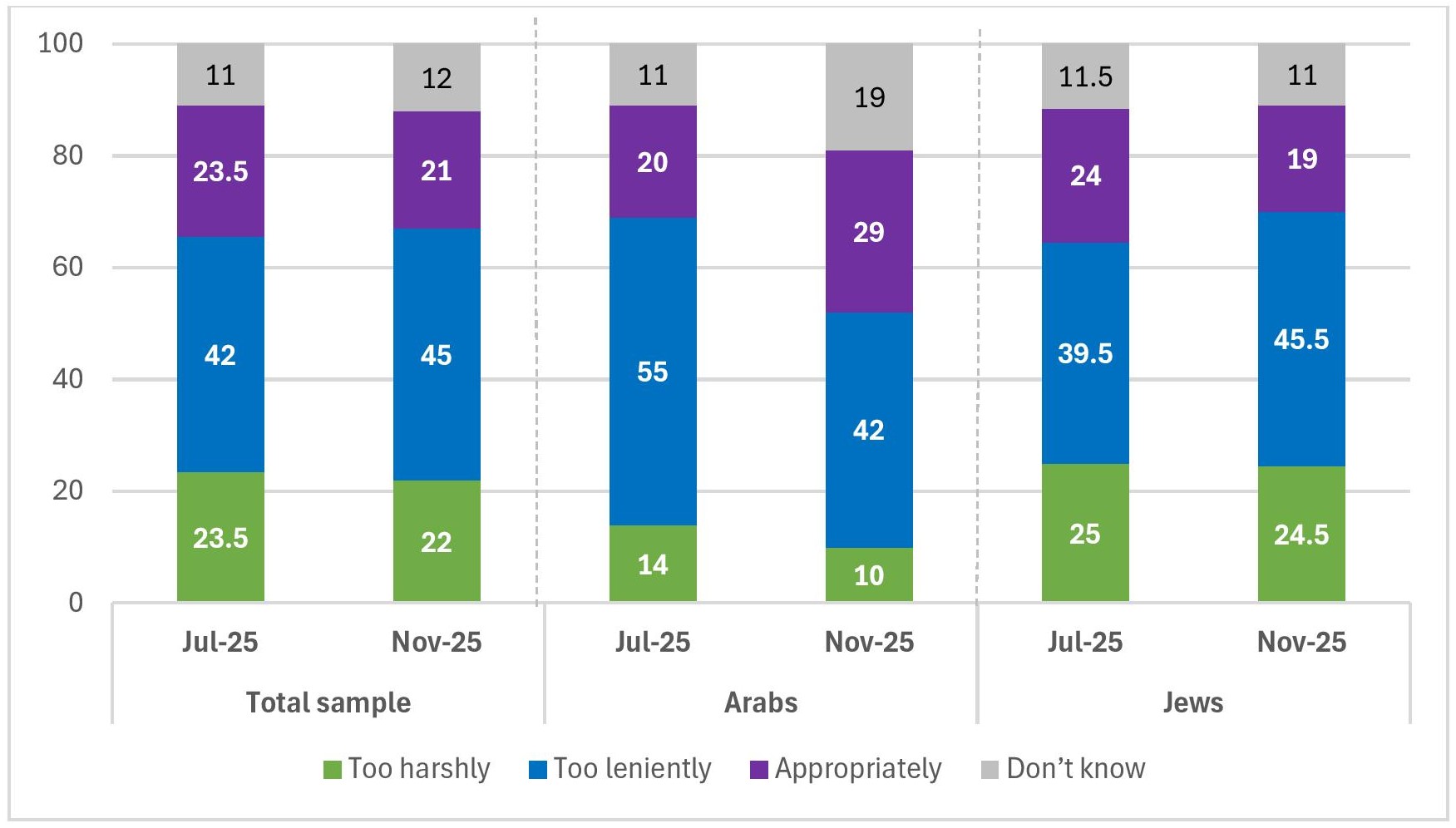
- 45% of the total sample think that Israel’s security forces and law enforcement agencies are too lenient in their treatment of settler groups involved in acts of violence against Palestinians, twice as many as those who think that this treatment is too harsh. This finding represents a slight increase compared to the previous measurement from July.
- Among Jews, the share who think that treatment is too lenient rose by 6 percentage points, while the proportion who think it is appropriate fell by 5 percentage points.
- Among Arabs, there was a significant decline of 13 percentage points in the share who think that settler violence is handled too leniently, but also a decline of 4 percentage points in the proportion who think that treatment is too harsh. There were corresponding increases in the shares of those who think that the treatment is appropriate and those who selected the “don’t know” response (9 percentage points and 8 percentage points, respectively).
Do the security forces and enforcement agencies treat groups of settlers who are involved in acts of violence against Palestinians too harshly, too leniently, or appropriately? (%)
- Segmentation of the Jewish sample by political orientation shows a large majority on the Left and in the Center (78% and 63% respectively) who think that the security forces and enforcement agencies are acting too leniently. The same view is held by the largest share of responses on the Right, though not the majority (35%), while a similar proportion think that the treatment handed out is too harsh (32.5%).
- Breaking down responses in the Jewish sample by religiosity reveals that around two-thirds of secular Jews think that settler violence is treated too leniently, a view shared by the largest share of respondents in both traditional groups, though not by a majority. Among Haredim and the national religious, the largest proportion (again, not the majority) think that the treatment of settlers involved in acts of violence is too harsh.
| Jews (%) | Too leniently | Appropriately | Too harshly | Don’t know | Total |
| Political orientation | |||||
| Left | 78 | 12.5 | 4 | 5.5 | 100 |
| Center | 63 | 17 | 10 | 10 | 100 |
| Right | 35 | 21.5 | 32.5 | 11 | 100 |
| Religiosity | |||||
| Haredim | 12.5 | 23.5 | 43 | 21 | 100 |
| National religious | 20.5 | 27 | 46 | 6.5 | 100 |
| Traditional religious | 36 | 19 | 32.5 | 12.5 | 100 |
| Traditional non-religious | 43 | 22 | 27 | 8 | 100 |
| Secular | 66.5 | 14 | 9 | 10.5 | 100 |
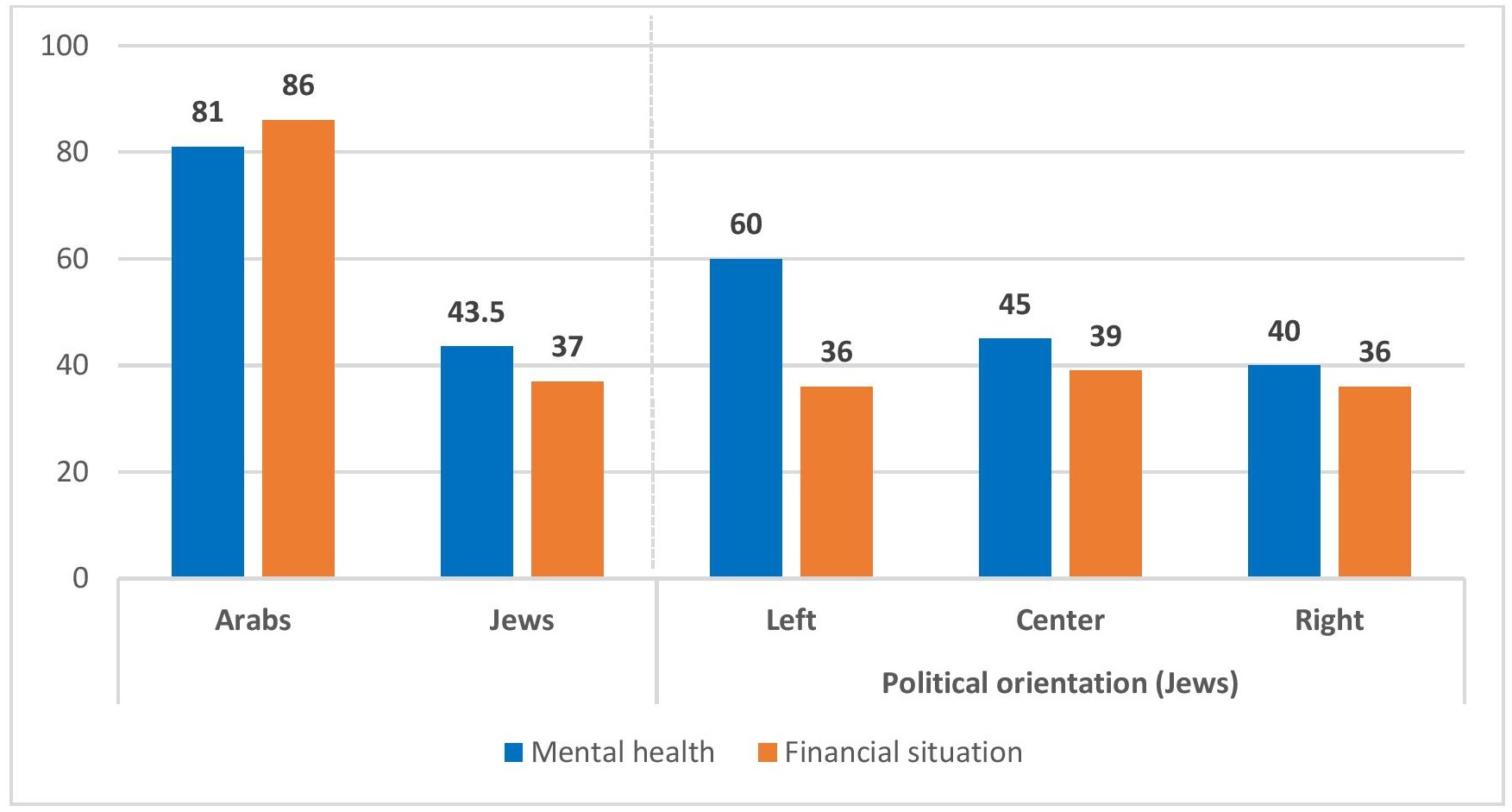
- Half of the respondents in the total sample report that the events of the last two years have had a negative impact on their mental health, and 45% say that these events have negatively affected their financial situation.
- The differences between Jews and Arabs are huge: More than 80% of Arabs report harm to both their mental health and economic situation, roughly double the rates reported among Jews.
- A breakdown by political orientation (Jews) reveals that harm to mental health is more prevalent on the Left than in the Center and on the Right, while in terms of financial harm, no significant differences were found.
The events of the last two years had a negative impact to a very large or fairly large extent on my mental health and/or my financial situation (%)
- Segmentation by gender reveals that more women than men, both Jewish and Arab, report that the events of the past two years have negatively affected their mental health (Jews—women, 51%; men, 36%; Arabs—women, 89%; men, 74%).
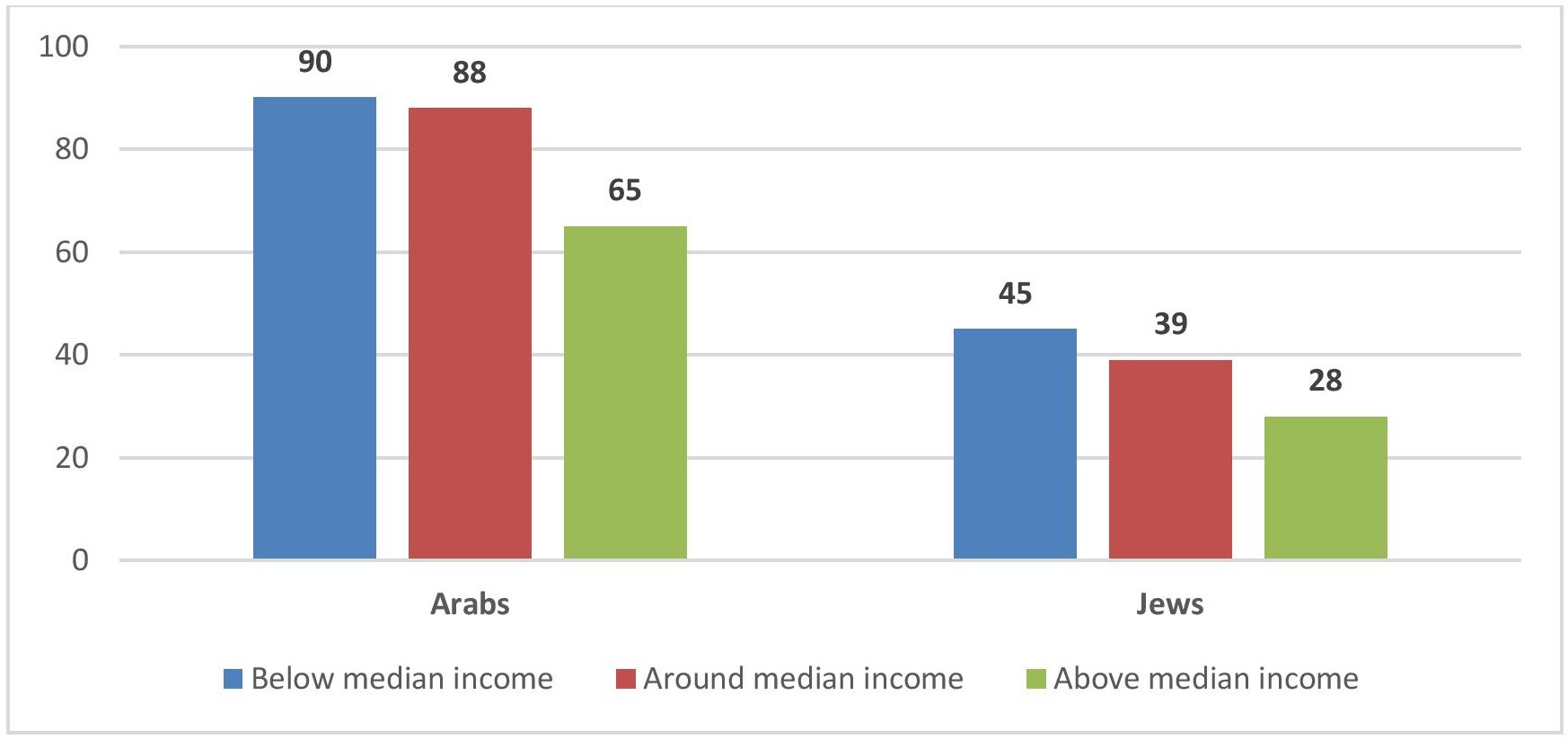
- We found a clear link between income level and negative impact on financial situation: among both Jews and Arabs, those with a high income level reported less of a negative impact on their finances.
The events of the last two years had a negative impact to a very large or fairly large extent on my financial situation, by income level (%)
The November 2025 Israeli Voice Index was prepared by the Viterbi Family Center for Public Opinion and Policy Research at the Israel Democracy Institute. The survey was conducted via the internet and by telephone (to include groups that are under-represented on the internet) between November 30 and December 3, 2025, with 604 men and women interviewed in Hebrew and 153 in Arabic, constituting a nationally representative sample of the adult population in Israel aged 18 and over. The maximum sampling error was ±3.56% at a confidence level of 95%. Field work was carried out by Shiluv I2R. The full data file can be found at: https://dataisrael.idi.org.il.