

State Commissions of Inquiry and the Differences from the Government's Politically Appointed Commission
The proposal to advance a politically appointed commission of inquiry into the events of October 7 is a significant departure from the accepted model of an independent state commission of inquiry. This explainer compares the two models and lays out the key details of each one.
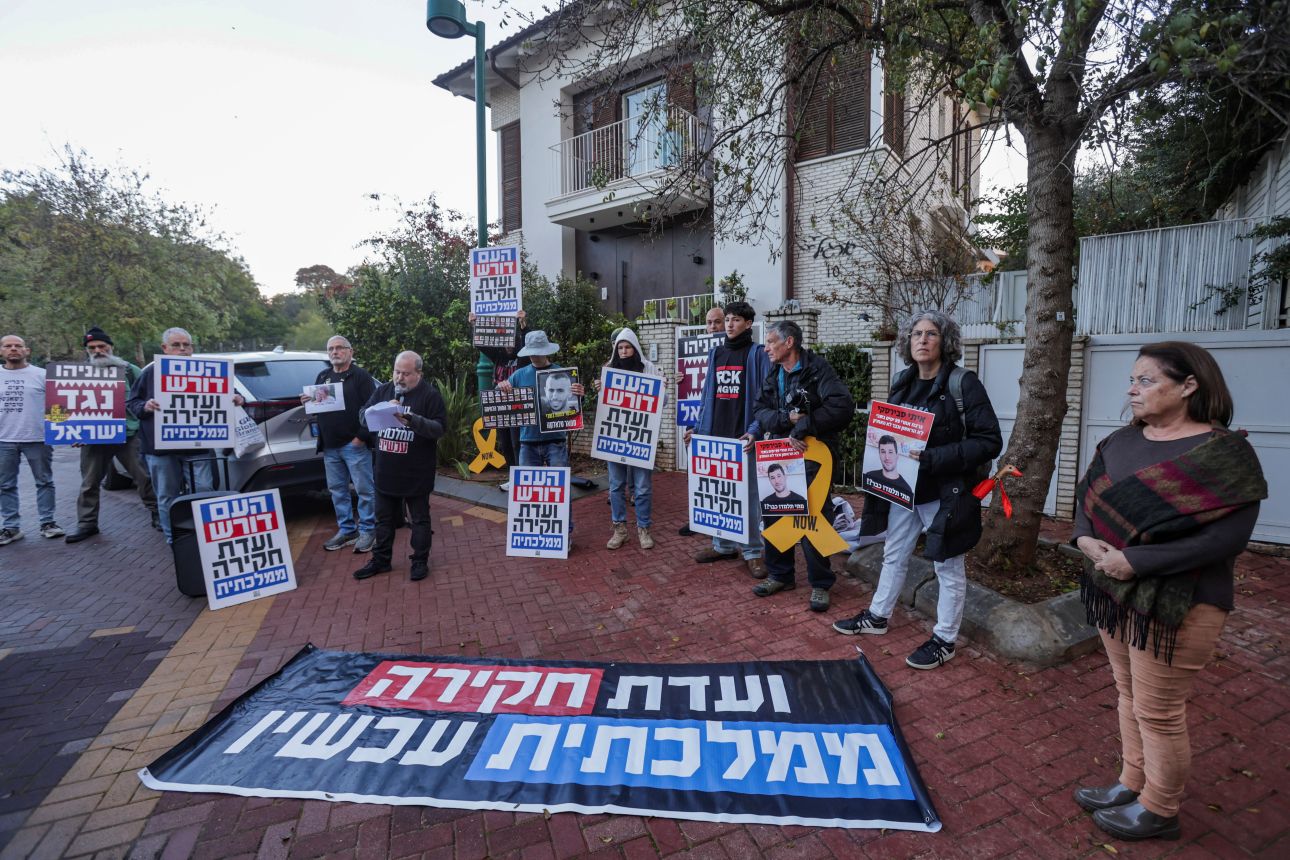
Photo by Tal Gal/Flash90
Introduction
The events of October 7 and the war that broke out thereafter are a traumatic breaking point in the history of the State of Israel. There is broad agreement regarding the need to investigate the circumstances and failures that led to the events of October 7, as well as other important issues such as the decision-making process during the war in Gaza, the relations of the political leadership with the military leadership, the negotiations concerning the release of Israeli hostages, and the evacuation of Israeli citizens living close to Israeli borders. The investigation is important in order to clarify the facts, to understand what occurred, and to prevent the recurrence of such failures in the future.
However, more than two years after October 7, no commission of inquiry has been established to investigate the events. The reason given for this by the government was that as long as the war is ongoing, it is not possible to conduct an investigation, despite the fact that other bodies such as the military and security bodies and the State Comptroller carried out investigations concurrently with the continuation of the war.
Following petitions submitted to the Supreme Court, and also following the decrease in the intensity of the war, the government adopted a decision on November 16, 2025 “to advance the establishment of an independent commission with full investigative powers that will enjoy the broadest possible public consensus.” The decision further stated that a special ministerial committee would discuss the issues to be included in the commission's investigative mandate. The Prime Minister appointed himself head of the ministerial committee that will determine the subjects of the investigation.
On November 19, 2025 the Supreme Court issued a conditional order instructing the government to explain why it is not establishing a commission of inquiry in accordance with the Commissions of Inquiry Law (i.e., a “State Commission of Inquiry”, that will investigate the events of October 7 in an independent, professional and impartial manner).
On December 15, 2025 a private member’s bill was submitted by a Likud Member of Knesset seeking to establish a political investigative mechanism to investigate the events of October 7, termed a “National-State Commission of Inquiry.” This bill undermines the existing mechanism of a state commission of inquiry.
Proponents of this newly proposed commission argue that it includes representation of all sides of the political spectrum and bereaved families, embodying a commission with broad representation and national consensus. However, as argued in section 2 of this explainer, rather than building consensus, the proposed commission would intensify polarization that will inevitably lead to deadlock, ultimately leaving the most important aspects of the investigation in the hands of the government and the coalition.
Below is an explainer clarifying what a state commission of inquiry is, compares it to the proposal of the so-called national state commission, and outlines the ways in which this newly proposed commission departs from the accepted model in Israel.
Section 1: State Commission of Inquiry
What is a state commission of inquiry?
A state commission of inquiry investigates and clarifies facts, draws conclusions, and is empowered to make recommendations on any matter of vital public importance requiring clarification at a particular time. State commissions of inquiry, as independent quasi-judicial bodies, enjoy great public prestige. Handing over the process of establishing the facts and formulating recommendations to a body that is external to the political system restores the public’s faith in that system in the event of a crisis of public trust.
The political system’s willingness to submit elected and appointed officials to critical scrutiny by an external body is a sign of democratic resilience. In addition, the broad powers given to a state commission of inquiry, and its professional composition, ensure an in-depth, comprehensive, and objective investigation.
State commissions of inquiry established in the past have helped shape Israel’s political culture and the public responsibility of its elected and appointed officials. The commissions that examined the relationship between the military and civilian leaderships (the Agranat Commission, which was established in the wake of the Yom Kippur War; the Kahan Commission, which investigated the Sabra and Shatila massacre; and the Landau Commission, which investigated the Shin Bet’s interrogation methods) contributed to a certain extent to the regulation of this relationship, and clarified the respective areas of responsibility. For example, following the publication of the Agranat Commission’s conclusions, the Knesset enacted an amendment to the Basic Law: The Military, which clarified that the IDF is subject to the authority of the government as a whole (and not only to the authority of the minister of defense).
Who establishes a state commission of inquiry?
It is the government that decides on the establishment of a state commission of inquiry, in accordance with the Commissions of Inquiry Law, 5729-1968. To date, 20 state commissions of inquiry have been appointed, on various issues. Two of these were established in the wake of wars: the Agranat Commission (1973), which was established by a government decision less than a month after the end of the Yom Kippur War; and the Kahan Commission (1982), which was appointed to investigate the Sabra and Shatila massacre during the First Lebanon War, and was established around two weeks after the massacre. (Though the Winograd Commission, set up after the Second Lebanon War, exercised the powers of a state commission of inquiry, it was in fact a government commission of inquiry (as explained in Section 2 below) that was granted these powers on a special basis).
The Knesset’s State Control Committee is also entitled, in special circumstances, to decide to establish a state commission of inquiry into a matter referred to in a State Comptroller’s report (section 14(b) of the State Comptroller Law, 5718-1958). To date, the Knesset’s State Control Committee has established four state commissions of inquiry, three of them during the term of the 17th Knesset (these commissions examined the bank shares crisis, assistance to Holocaust survivors, the water crisis, and assistance to evacuees from Gush Katif).
Who appoints the members of a state commission of inquiry, and what is its composition?
After the government decides to establish a state commission of inquiry, the members of the commission are appointed by the president of the Supreme Court. The government defines, by government decision, the subject of the investigation and the scope of the mandate given to the commission, and then transfers responsibility for determining its composition to the Supreme Court. A state commission of inquiry must be headed by a serving or retired judge. In this way, the independence of the commission is preserved, and it enjoys the prestige of the judicial branch. The commission usually comprises three members, and in special cases, a larger odd number. To date, the majority of state commissions of inquiry have been headed by a Supreme Court justice.
What subjects can a state commission of inquiry investigate?
The government may establish a state commission of inquiry into “a matter which is of vital public importance at the time and requires clarification” (section 1 of the Commissions of Inquiry Law, 5729-1968). In other words, it is the government that decides that a certain matter is of vital public importance and that the facts related to it must be clarified.
The government defines the issue that the commission is supposed to investigate, usually with a fairly limited scope. For example, the Kahan Commission was appointed to examine “all the facts and factors related to the atrocities committed by a unit of the Lebanese Forces against the civilian population in the Sabra and Shatila camps” (from the Commission’s letter of appointment), and was not given a mandate to investigate the broader issue of the First Lebanon War, the decision-making process during the war, the relations within the country’s political leadership (the prime minister and the defense minister), or the relations of the political leadership with the military leadership. The commission of inquiry established immediately after the assassination of Prime Minister Yitzhak Rabin in November 1995 also focused on the security arrangements of the Shin Bet, and its recommendations were restricted solely to this issue. The commission did not examine aspects that were the subject of fiery public debate, such as the incitement that preceded the murder.
At the same time, certain commissions have interpreted their mandates in a less exacting manner. For example, the Agranat Commission was charged with examining the assessments and decisions made by civilian officials on the basis of the information available during the days preceding the Yom Kippur war. However, the commission discussed more broadly the interaction between the political leadership and the IDF, and published recommendations regarding the working methods of the State Security Cabinet and the War Cabinet. Similarly, the Or Commission, appointed to investigate the events of October 2000, also broadened its focus to address the issue of long-standing discrimination against Arab citizens of Israel.
Table 1. State commissions of inquiry, by area of investigation
|
Area of investigation |
Commission of inquiry (year of establishment) |
|
Commissions to investigate wars and military events (including relations between military and civilian leaderships) |
Agranat Commission: Commission of inquiry into the information held by officials preceding the Yom Kippur War, the preparations and decisions of military and civilian actors, and the IDF’s readiness for war (1973) |
|
Kahan Commission: Commission of inquiry into all the facts and factors relating to the atrocities committed by a unit of the Lebanese Forces against the civilian population in the Sabra and Shatila camps (1982) |
|
|
SCommissions to investigate events linked to the Arab-Jewish conflict |
Zussman Commission: Commission of inquiry into the circumstances of the fire in the Al-Aqsa Mosque (1969) |
|
Shamgar Commission: Commission of inquiry into the massacre in the Cave of the Patriarchs on February 25, 1994 (1994) |
|
|
Or Commission: Commission of inquiry into the clashes between the security forces and Israeli citizens in October 2000 (2000) |
|
|
Kenet Commission: Commission of inquiry into condition in prisons (1979) |
|
|
Commissions to formulate public policy |
Netanyahu Commission: Commission of inquiry into the functioning and efficiency of the health system (1988) |
|
Dorner Commission: Commission of inquiry into assistance to Holocaust survivors (2008) |
|
|
Bein Commission: Commission of inquiry into the management of the crisis in Israel’s water supply system (2008) |
|
|
Commissions to investigate bureaucratic failures, corruption, and actions by agencies for which the government is responsible |
Vitkon Commission: Commission of inquiry into the management of the oilfields in Sinai (1971) |
|
Bejski Commission: Commission of inquiry into the regulation of bank shares (1985) |
|
|
Landau Commission: Commission of inquiry into the methods of investigation used by the Shin Bet regarding hostile terrorist acts (1987) |
|
|
Shamgar Commission: Commission of inquiry into the circumstances surrounding the murder of Prime Minister Yitzhak Rabin on November 4, 1995 (1995) |
|
|
Matza Commission: Commission of inquiry into the treatment by the appointed authorities of the evacuees from Gush Katif and Northern Samaria (2008) |
|
|
Grunis Commission: Commission of inquiry into the acquisition of submarines and naval craft (2022) |
|
|
Commissions to investigate historical incidents |
Bechor Commission: Commission of inquiry into the accusations that Avraham Stavsky and Zvi Rosenblatt, or one of them, took part in the murder of Haim Arlosoroff (1983) |
|
Kedmi Commission: Commission of inquiry into the disappearance of Jewish Yemenite children (1995) |
|
|
Commissions to investigate events and disasters that caused public outrage |
Etzioni Commission: Commission of inquiry into the rumors of payments to influence the outcome of games in the national soccer league (1971) |
|
Zeiler Commission: Commission of inquiry into the safety of public buildings and places (2001) (following the Versailles wedding hall disaster) |
|
|
Naor/Berliner Commission: Commission of inquiry into the Mount Meron disaster (2021) |
Can a government be forced to establish a state commission of inquiry?
According to the law, the government is entitled but not obligated to establish a state commission of inquiry. However, experience shows that public pressure can motivate the government to establish a state commission of inquiry in order to restore public trust and allay concerns. The Knesset plenum can also try to pressure the government to establish a state commission of inquiry, as can other official representatives. For example, President Yitzhak Navon called for the establishment of a state commission of inquiry to investigate the Sabra and Shatila massacre, and threatened to resign if it this was not done. Governments tend to be reluctant to establish a state commission of inquiry, and in many cases, government commissions of inquiry are launched before a state commission of inquiry is established, but if public pressure continues or the work of the government commission is called into question, then a state commission of inquiry is eventually established.
With regard to the possibility of applying judicial review to a government’s refusal to establish a state commission of inquiry, the Supreme Court has so far refrained from obliging the government to appoint such a commission. In the Yadid case, in which petitioners asked the Court to compel the government to establish a state commission of inquiry into the events surrounding the appointment of Adv. Roni Bar-On to the position of attorney general (1997), the Court ruled that the power to establish a commission of inquiry is a broad discretionary power held by the government, and therefore it will intervene in a government decision on this matter only “in exceptional and rare cases, the likes of which have not been brought before the Court, and it is doubtful that they ever will be brought [...] Even when it comes to a matter of great public importance, and even one that requires clarification, it is still in the government’s discretion not to establish a commission of inquiry.”
In the later Ometz case, concerning the establishment of the Winograd Commission (which was created as a government commission of inquiry), the Court made clear that the proceedings for examining matters that come under the government’s responsibility—like certain other matters of a political or state nature, which do not largely concern human rights—fall within the scope of those issues that are perceived as being within the sole jurisdiction of the executive branch. It is important to note that this decision was made by a majority of four justices to three. The minority justices were of the opinion that the authority of the government to decide on the establishment of a commission of inquiry, and specifically on the establishment of a state commission of inquiry, is not absolute, and that this power should be exercised on the basis of relevant considerations and within the realm of reasonableness. Failure to exercise this power, in some cases, may become fundamentally unreasonable.
Nevertheless, the Court later reiterated its clarification, in a decision by Justices Amit, Hendel and Sohlberg in the Movement for Quality Government case, in which the petitioners requested the establishment of a commission of inquiry into the submarine scandal, that the Court does not interfere with the government’s power to appoint or not to appoint a commission of inquiry, except in rare and exceptional cases.
It is possible that the disaster of October 7 constitutes such a rare and exceptional case, and thus it is possible that the Supreme Court will intervene in the government’s decision on whether to establish a commission of inquiry, and also in the question of which type of commission to establish.
What powers does a state commission of inquiry have?
The uniqueness of the state commission of inquiry lies in the broad powers granted to it by law. State commissions are authorized to compel witnesses to testify and to produce documents and other exhibits (sections 9, 11, and 20 of the Commissions of Inquiry Law, 5729-1968). They are equipped with all the powers of a court, including the imposition of fines for knowingly giving an evasive answer during testimony and for perjury. In addition, an individual who refuses to appear to testify before a commission without reasonable justification has committed a criminal offense, punishable by up to two years in prison.
State commissions of inquiry are obligated to notify any person who may be harmed by their investigation or its results (section 15(d) of the Law). In such cases, the chairperson of the commission must inform the individual in question of how they are liable to be harmed, and it will make available to that person the evidentiary material held by the commission that is related to the possible harm that may be caused to them by the investigation or its results. For example, the Or Commission of Inquiry into the events of October 2000 issued warning letters to 14 individuals who it believed might be harmed by its conclusions, even though some of these individuals were not mentioned in the recommendations presented in its final report. The state commission of inquiry into the Meron disaster issued warning letters to 18 individuals, including Prime Minister Benjamin Netanyahu, former Public Security Minister Amir Ohana, and former Police Commissioner Kobi Shabtai. A person who receives such a warning letter is entitled to appear before the commission accompanied by legal representation and the commission may even allow them to submit evidence to it. However, issuing a warning letter does not attest to the commission’s final conclusions and recommendations.
Does a state commission of inquiry seek only to establish the facts, or does it also issue recommendations?
The law states that “at the conclusion of its deliberations, a commission of inquiry shall prepare a report of the results of its investigation and its recommendations, should it deem it necessary to add recommendations, and shall submit the report to the government” (section 19(a) of the Commissions of Inquiry Law, 5729-1968). This means that commissions must publish a report that includes the results of their investigations; they are not obligated to make recommendations in addition to clarifying the facts, but they are entitled to do so.
The recommendations of commissions of inquiry are usually issued on two levels: personal and institutional. With regard to personal recommendations, commissions of inquiry have considered themselves empowered to point out failures in the conduct of public servants or elected officials, to criticize this conduct, and to draw conclusions about it. They have also adopted the approach that they are empowered to make recommendations regarding specific individuals, such as recommending that a particular person should not continue to serve in their official position.
Is the government obligated to accept the conclusions and recommendations of a state commission of inquiry?
The law does not obligate the government to accept the factual clarification provided by a state commission of inquiry, its conclusions, or its recommendations that go beyond factual clarification to include institutional and normative aspects. There is usually no dispute about the results of the factual clarification presented in a commission report; rather, the debate centers on the status of the commission’s conclusions and recommendations.
However, it is important to clarify that the Supreme Court has previously ruled—in the Ganor case relating to the recommendations of the Bejsky Commission, which looked at the regulation of bank shares—that special weight should be given to the recommendations of a commission of inquiry, because of the public’s expectations that its recommendations will be implemented. The Court ruled that when a governmental body makes a decision in the wake of recommendations issued by a commission of inquiry, it is not obligated to obey these recommendations, yet it is not authorized to ignore them. Rather, it must examine the recommendations on their merits, and accord them due consideration in light of the objective, professional, and non-partisan nature of the commission of inquiry. These recommendations carry particular weight when the question at hand is the existence or absence of public interest in a criminal indictment being filed, with regard to the significant event examined by the commission. To date, Israeli governments have not ignored the recommendations of the commissions of inquiry that were established
Section 2:
Other types of commissions of inquiry and the proposal for investigating October 7
The government is also permitted to establish a government commission of inquiry, though it did not propose to do so in the case of October 7. According to Section 8A of the Government Law, 2001, a government commission of inquiry is intended to examine a particular subject or event that falls within the responsibility of a minister, or of several ministers in the government. The appointing minister or the government determines the composition, the role, the mandate, and the powers of the government commission of inquiry. The commission submits to the appointing minister a report on the results of its examination and its recommendations, and the minister brings the report before the government. The main differences between a government commission of inquiry and a state commission of inquiry (additional details below in Table 2):
Subject of investigation: A government commission of inquiry is suitable for investigating a relatively narrow subject that falls within the responsibility of a minister, as opposed to a state commission of inquiry which is intended to clarify matters of vital public importance.
Composition: The minister who appoints the government commission of inquiry determines the composition of the commission. In contrast, the composition of a state commission of inquiry is determined independently by the President of the Supreme Court.
Powers: A state commission of inquiry has powers similar to those of a court in a civil proceeding, whereas a government commission of inquiry is not granted such powers, unless it is headed by a judge and the Minister of Justice assigns it powers according to the Commissions of Inquiry Law.
What commission of inquiry is the government proposing to establish regarding the events of October 7?
The government is attempting to advance, by means of a private member’s bill of a Likud Member of Knesset, a political commission (the so-called "national state commission of inquiry") to investigate the events of October 7 (P/ 6380/25). Unlike a state commission of inquiry, which is independent, autonomous, and headed by a judge, the proposed commission is a political commission; that is, as outlined below, its members are appointed by Members of Knesset and political actors and the investigative mandate is determined by a special ministerial commission appointed for this purpose. In other words, this is a commission “on behalf of” the coalition and the government.
Despite the similarity in name, this proposed commission cannot, by its very nature, carry the same professionalism and independence of a state commission of inquiry. This sentiment was also conveyed by the Israeli Attorney General, who claims that this proposed commission lacks the basic characteristics of a state commission of inquiry – independence, professionalism and impartiality.
What will be the role of bereaved families in the proposed commission?
The bill also proposes a mechanism of supervision on behalf of bereaved families identified with the coalition and bereaved families identified with the opposition. Such politicization and polarization is concerning in the context of those who lost loved ones during the war and is likely to result in a struggle over representation in the commission. The voice of the bereaved families should certainly be heard by a commission of inquiry, but it is unprecedent to polarize the families according to political camps, and to decide which “bereavement” would be “represented.” It might also affect the professionalism of the investigation.
Who appoints the members of the proposed commission according to the bill?
In contrast to a state commission of inquiry, in which the appointment of the members of the commission is entrusted to the President of the Supreme Court, the bill transfers the appointment of the commission’s members to political actors:
First attempt: A proposed composition submitted by the Speaker of the Knesset after consultation with Members of Knesset and approval by a majority of 80 Members of Knesset.
If there is no agreement or no majority – a paritetic appointment: three members on behalf of the coalition and three on behalf of the opposition.
If this mechanism also fails – the Speaker of the Knesset appoints the remaining members himself.
Given the well-known political polarization in Israel, in practice, this mechanism all but guarantees the de facto control of the coalition (i.e., the Speaker of the Knesset) over the composition of the commission.
Who determines the topics and scope of the investigation?
This is one of the most significant differences between a state commission of inquiry and the newly proposed Commission. In a state commission of inquiry, the government defines only the general matter, and the commission itself determines the lines of investigation, the specific topics, and the testimonies that will be examined. According to the new bill, the government is authorized to determine the investigative topics themselves, and even to clarify, expand, or narrow them. In doing so, the government—which is, of course, a central subject of the examination—is granted exceptional power to influence the boundaries and contents of the investigation. Even in the absence of legal status, the government has already established a dedicated ministerial commission headed by the Prime Minister to determine the subjects of the investigation. That is – the person who was Prime Minister at the time of the October 7 massacre, 15 of the 16 years that preceded the attack, and throughout the full 2+ years of war will have the power to determine what will be investigated.
Who chairs the commission?
According to the bill, the chair of the commission is chosen from among the members of the commission themselves, who are not required to be judges or have legal expertise, as would be the case in a state commission of inquiry. Moreover, the proposal establishes a mechanism for appointing two joint chairs in cases of political disagreement, with the powers of the chair being exercised only with the agreement of both.
This structure raises a fundamental difficulty: the division of leadership powers may paralyze the work of the commission, prevent the making of essential decisions, and in practice lead to the existence of two parallel commissions of inquiry — and two competing versions of “the truth.”
What investigative powers does the proposed commission have?
The bill grants the commission some of the powers of a state commission of inquiry under the Commissions of Inquiry Law, but with significant changes:
• Quasi-judicial powers (such as summoning witnesses and compelling the delivery of documents) are not vested in a judge serving as chair, but in any two members of the commission — even if they are not jurists.
• Section 16 of the Commissions of Inquiry Law, which enables the Attorney General to take part in the investigative proceedings, is explicitly excluded. The meaning is the complete exclusion of the Office of the Attorney General from the work of the commission.
These changes raise serious concerns regarding due process, the professionalism of the investigation, and the separation of powers.
Can judicial review be exercised over the government’s decision not to establish a state commission of inquiry and over the proposed legislation?
As noted above, as a rule, the Supreme Court tends toward judicial restraint with respect to a government decision on whether to establish a state commission of inquiry. Case law has recognized that this is a broad power vested in the government, and that the Court will intervene only in exceptional and particularly rare cases. However, the Court has also held that this power is not immune from judicial review. In extreme cases, where the government’s decision is afflicted by extreme unreasonableness, an inherent conflict of interest, or severe harm to fundamental principles of the rule of law and the public’s right to know — grounds for judicial intervention may arise.
Table 2: Comparison between a state commission of inquiry, a government commission of inquiry, and the political commission proposed by the government (in a private member’s bill)
|
Topic |
State Commission of Inquiry |
Governmental Review Commission |
Political Commission of Inquiry (National-State Commission of Inquiry into the October 7, 2023 massacre bill) |
|
Legal Basis |
Commissions of Inquiry Law, 1968 |
Section 8A, Government Law, 2001 |
Private Member’s Bill P/6380/25 |
|
Establishment |
By the government or by the State Control Committee |
By a minister or several ministers |
By the Knesset (Speaker of the Knesset, Chair of the Knesset Committee, Leader of the Opposition, decision of 80 MKs) |
|
Purpose of Establishment |
To investigate “a matter of vital public importance that requires clarification” |
“To examine a particular subject or event within the responsibility of a minister.” |
“A full, thorough, and independent investigation of the Simchat Torah massacre (October 7), the outbreak of the war, and the circumstances that led to them” |
|
Who Determines the Subject of Investigation? |
The government defines the general matter that will be the subject of the investigation. Upon request of the commission, it may clarify, expand, or narrow the subject. |
Minister(s), the government |
Although established by the Knesset, the government (with the help of a special ministerial commission headed by the Prime Minister) will define the subjects of investigation (broader than the current law). The government may change the investigative subject. |
|
Chair of the Commission |
A Supreme Court or District Court judge, serving or retired |
Determined by the minister who establishes the commission |
Chosen from among the commission members; in case of disagreement, two co-chairs will be appointed — one from the coalition and one from the opposition |
|
Composition |
Chair and members appointed by the President of the Supreme Court |
Determined by the minister who establishes the commission |
Option A: 7 members agreed upon following consultation with the Speaker of the Knesset. |
|
Option B: If no agreement—three members on behalf of the coalition appointed by the Chair of the Knesset Committee, and three on behalf of the opposition appointed by the Leader of the Opposition. |
|||
|
Option C: If the opposition does not cooperate—the Speaker of the Knesset appoints the remaining members. |
|||
|
Additionally: Appointment of four supervisors from bereaved families. If there is no agreement—two from the coalition and two from the opposition. |
|||
|
Number of Commission Members |
Three, but the government may decide on a larger odd number |
Not specified |
Six (oddly – an even number) or seven |
|
Powers |
May summon and compel any person to appear and produce documents; require testimony under oath; compel appearance; take testimony abroad; issue search warrants; order the collection of documents. The chair has powers similar to a judge in civil proceedings. |
The law does not define powers; however, the Minister of Justice may grant partial powers similar to those of a state commission of inquiry, at the request of the minister who established it and with government approval, provided it is chaired by a retired judge. |
Powers under the Commissions of Inquiry Law will be granted. The powers will be vested “in any two members of the commission.” |
|
Duties and Rights of Witnesses |
Same as any person investigated under criminal procedure. A witness who may be harmed by the investigation or its results is notified by the commission and may defend himself. |
Not specified by law |
According to the Commissions of Inquiry Law |
|
Sanctions |
The chair may impose fines on those who fail to appear or present documents, refuse to testify under oath, or fail to answer questions. A person who unjustifiably fails to appear may face indictment and up to two years’ imprisonment. |
Not specified by law |
According to the Commissions of Inquiry Law. The powers will be given to the two chairs. |
|
Publicity |
Hearings are public; however, the commission may hold all or part of a hearing behind closed doors in certain circumstances |
No requirement in law |
Hearings are public and will be broadcast, except when a majority of commission members decides they should be held behind closed doors in certain circumstances |
|
Report |
Must submit a report to the government |
Must submit a report to the appointing authority (minister). The minister submits the report to the government. |
Although established by the Knesset, the report will be submitted to the government |