

Large Majority of Jewish Israelis Think Israel is Safer than Abroad; Arab Israelis More Divided on Where is Safest
Around three-quarters of Jews and one third of Arabs think it is safer to live in Israel than countries abroad. There has been a decline by about 10 percentage points in the share of Israelis who support a state commission of inquiry into the events of October 7. A small majority of Israelis (54%) think Prime Minister Netanyahu was aware of the link between his close advisors and Qatar.

Bondi Beach Australia Photo by: AAPIMAGE via Reuters Connect
Methodology
The survey was conducted by the Viterbi Family Center for Public Opinion and Policy Research at the Israel Democracy Institute between December 28, 2025 and January 1, 2026. It was based on a representative sample of the population in Israel aged 18 and above, comprising 602 Jewish interviewees and 150 Arab interviewees.
The National Mood
- In the total sample, there was a decline (-8%) this month in the share who are optimistic about the future of Israel's national security. This may be due to media reports of a possible second round of fighting with Iran and the strengthening of Hezbollah in Lebanon.
- The polarization discourse that is currently found in all areas of life—from the political arena to the traditional media, across social media, and on the street—presumably contributes to the decline (-4%) in the share of respondents who are optimistic about social cohesion.
- There was almost no change this month in the proportion of those optimistic about the future of democracy in Israel and about the country’s economic future.
Optimistic about the future of democratic rule, national security, the economy, and social cohesion (total sample; %)
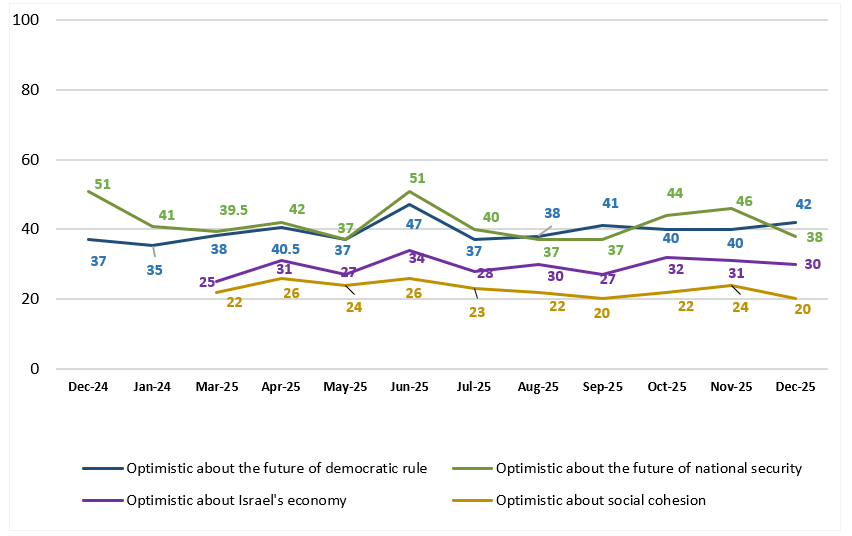
- The share of optimists among Jews is larger than that among Arabs on all topics, especially regarding the future of national security: future of democracy, 45% versus 30%; national security, 43% versus 13%; the economy, 33.5% versus 13%; social cohesion, 22% versus 13%.
- Breaking down the findings by political orientation (Jews) reveals that on the Left, there is a small minority of optimists (less than one-fifth for all issues), and the same is true in the Center, though the rates of optimism here are slightly higher than on the Left. On the Right, we found a majority of optimists regarding the future of national security and democratic rule, and a minority of optimists—albeit much larger than in the other two camps—regarding the future of the economy and social cohesion.
Optimistic about the future (Jews, by political orientation; %)

Where is it Safer to Live?
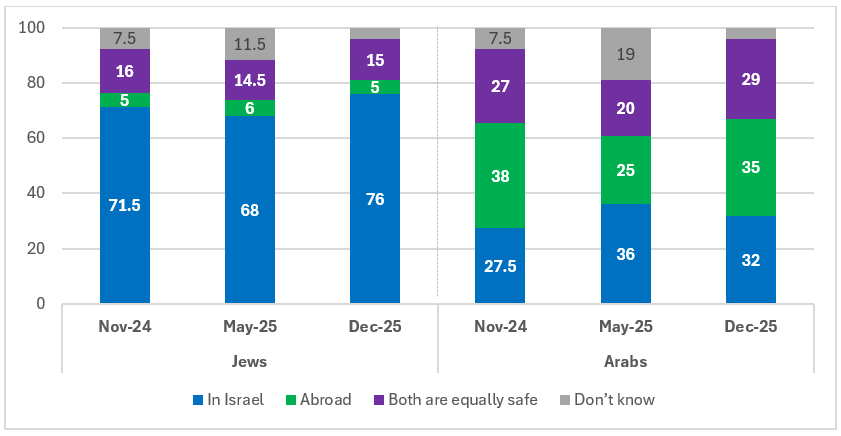
- Further to the decline in optimism about security and the rise in terrorist incidents against Jewish targets abroad, we repeated a question from the past: Where is it safer for Jews to live? Around three-quarters of Jews think it is safer for Jews to live in Israel, a slight increase relative to previous measurements during the war.
- Among Arabs, the picture is very different: Only around a third think that it is safer for Arabs to live in Israel, slightly lower than the share who think it is safer to live outside of Israel, and slightly higher than the share who think both places are equally safe. The proportion of Arabs who think it is safer for Arabs to live in Israel is slightly smaller than in May 2025 and slightly larger than in November 2024.
- In other words, while most Jews feel relatively secure in Israel, Arabs do not, most likely due to the violent crime in Arab localities that has not been met with an adequate response from the state .
In your opinion, where is it safer for Jews/Arabs to live today? (%)
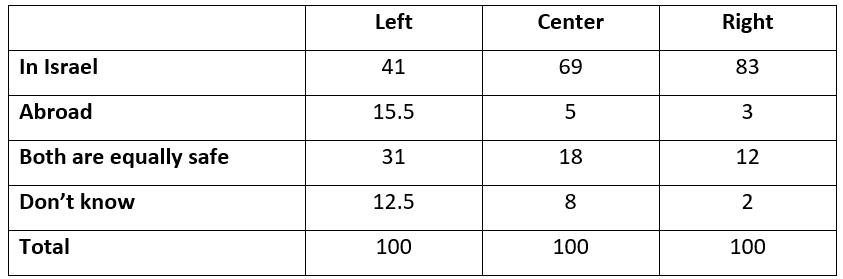
- We found significant differences when analyzing by political orientation (Jews): On the Left, only a minority (41%) think it is safer for Jews to live in Israel, compared to a majority in the Center (69%) and on the Right (83%).
In your opinion, where is it safer for Jews to live today? (Jews; %)
Should the Israeli Government Support Jewish Communities Abroad?
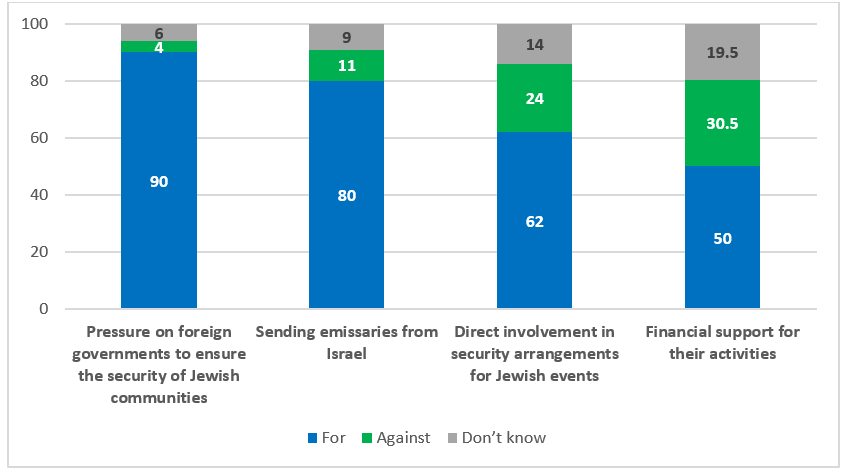
- A clear majority of Jews (90%) think that the Israeli government should support Jewish communities abroad by pressuring foreign governments to ensure the security of Jewish communities. In addition, 80% support sending emissaries from Israel, around 60% support direct Israeli involvement in security arrangements for Jewish events, and half are in favor of financial support for Jewish communities abroad (on this question, a particularly large share of respondents selected the “don’t know” response).
- Among Arabs, only a minority think that the Israeli government should support Jewish communities abroad via each of the options suggested. The difference between Arab and Jewish opinions on this issue is large, with the exception of financial support for activities, where the gap is smaller.
What is your opinion regarding support from the government of Israel for Jewish communities abroad, by the following means? (Jews; %)
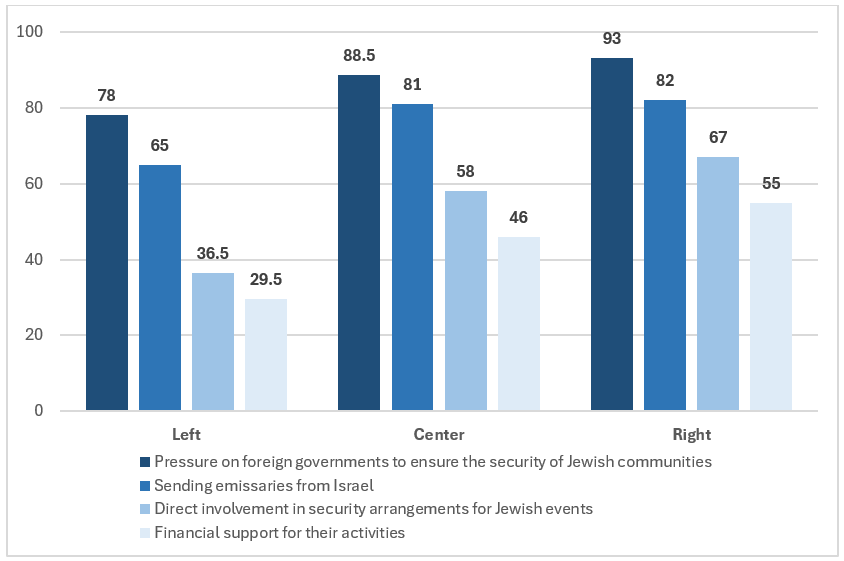
- Across all three political camps (Jews), the ranking of these options is the same, although there are substantial gaps between them: for all options cited, the percentage of respondents who are in favor of support for Jewish communities abroad is considerably lower on the Left than in the Center, and much lower than on the Right.
In favor of the government of Israel supporting Jewish communities abroad by the following means (Jews, by political orientation; %)
The Most Appropriate Mechanism for An Inquiry Into the Events of October 7
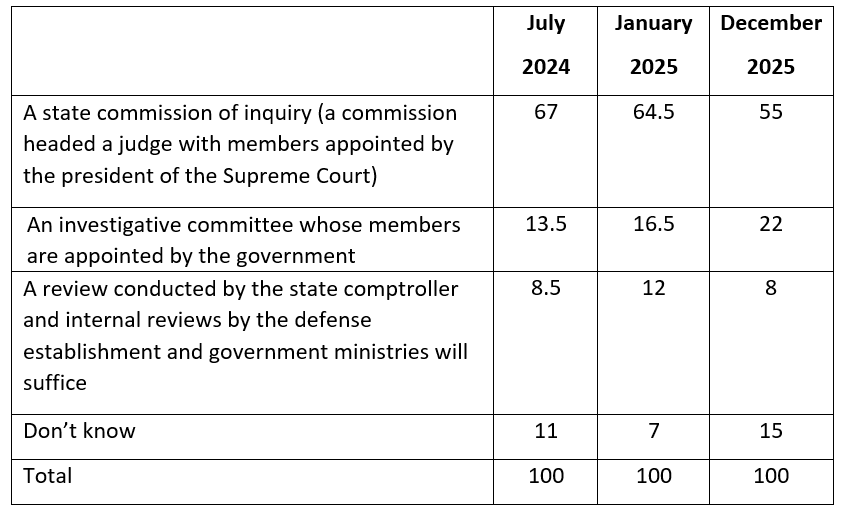
- 55% of the general public (Jews, 54%; Arabs, 61%) think that the most appropriate mechanism is a state commission of inquiry headed by a judge, with members appointed by the president of the Supreme Court. While this still constitutes a majority, there has been a decline of around 10 percentage points compared to previous measurements (July 2024 and January 2025).
- 22% think that an investigative committee whose members are appointed by the government is the appropriate mechanism, a rise of 5.5 percentage points relative to the previous measurement (January 2025), and 8.5 points compared to the measurement before that (July 2024). As in the past, only 8% of Israelis currently think that a review by the state comptroller and internal reviews by the defense establishment and government ministries will suffice.
What do you think is the most appropriate mechanism for an inquiry into the events of October 7? (total sample; %)
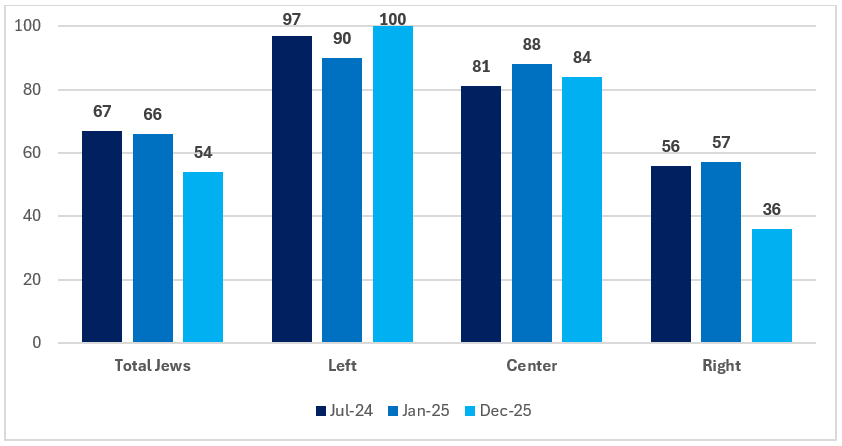
- The decline in the share of respondents who support a state commission of inquiry is particularly evident among those who identify with the Right (in the Jewish sample). In this group, a decrease of around 20 percentage points was measured compared to the previous measurements. On the other hand, on the Left and in the Center, support for a state commission of inquiry remained similar to its previous levels.
Agree that a state commission of inquiry is the most appropriate mechanism for investigating the events of October 7 (Jews; %)
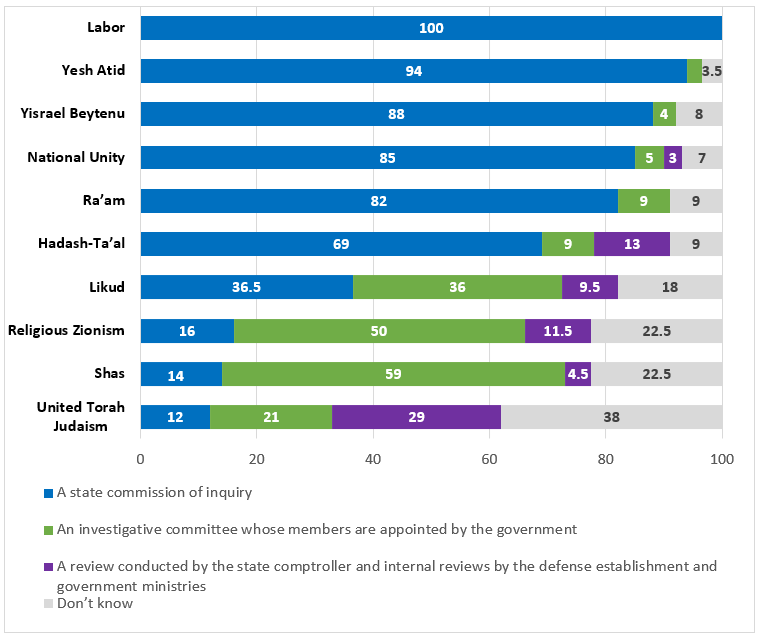
- Respondents who voted for Likud in the 2022 elections are more or less evenly split between support for a state commission of inquiry and support for an investigative committee appointed by the government (36.5% and 36%, respectively). By contrast, among Religious Zionism and Shas voters, the proportion who support a government-appointed commission of inquiry is significantly higher than those who support a state commission of inquiry. Of voters for United Torah Judaism, the largest share (38%) responded that they do not know what the most appropriate mechanism is. Among voters for all opposition parties, a large majority are in favor of a state commission of inquiry.
What do you think is the most appropriate mechanism for an inquiry into the events of October 7? (total sample, by vote in the 2022 elections; %)
Netanyahu and “Qatargate”
- A small majority (54%) of the total sample think that Prime Minister Netanyahu, despite his denials, was aware of the links between his close advisors and Qatar, while 26.5% believe that he was not aware—similar shares to those measured in March.
- On the Right (Jewish sample), a minority of just over a third believe that Netanyahu was aware of his advisors’ connections with Qatar, and a similar proportion believe he did not know about them. In the Center, and to an even greater degree on the Left, a very large majority think that the prime minister was aware of these links.
In your opinion, was Prime Minister Netanyahu aware or not aware of the links between his close advisors and Qatar? (%)
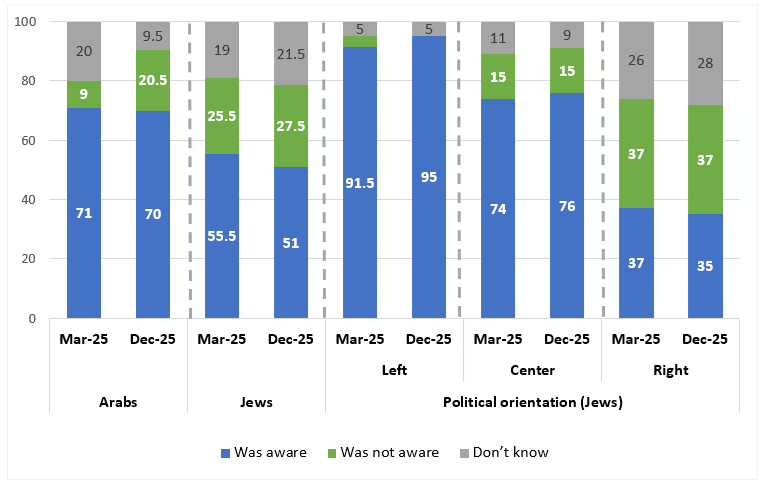
- Only around a quarter of those who voted for Religious Zionism and Likud in the 2022 elections, as well as around one-fifth of Shas and United Torah Judaism voters, think that Netanyahu was aware of his advisors’ ties to Qatar. Large shares of voters for coalition parties, and again especially among United Torah Judaism voters, responded that they did not know whether Netanyahu was aware of this.
- Among voters for all opposition parties, a large majority believe that the prime minister was aware of his advisors’ links to Qatar.
Establishing a Government with Support From Ra’am? [1]
- In the event that the next elections do not produce a clear winner between the two major political blocs, around two-thirds of Jewish voters for parties currently in the opposition would support the formation of a government that relies on some form of cooperation with the Arab Ra’am party, whether by including it in the government (50%) or by securing its external support (14.5%). Around a quarter say they would not support such a step.
- Among coalition voters (Jews), a very large majority oppose the formation of a government headed by their political camp if it is dependent on Ra’am, even in the event of a tie between the blocs. The strongest opposition is found among Religious Zionism and Shas voters
[1] This question was presented to Jewish respondents only.
In the event of a tie between the blocs after the next elections, would you support or not support the establishment of a government headed by the political camp that is closest to your position which relies on cooperation with Ra’am, headed by Mansour Abbas? (Jews; %)
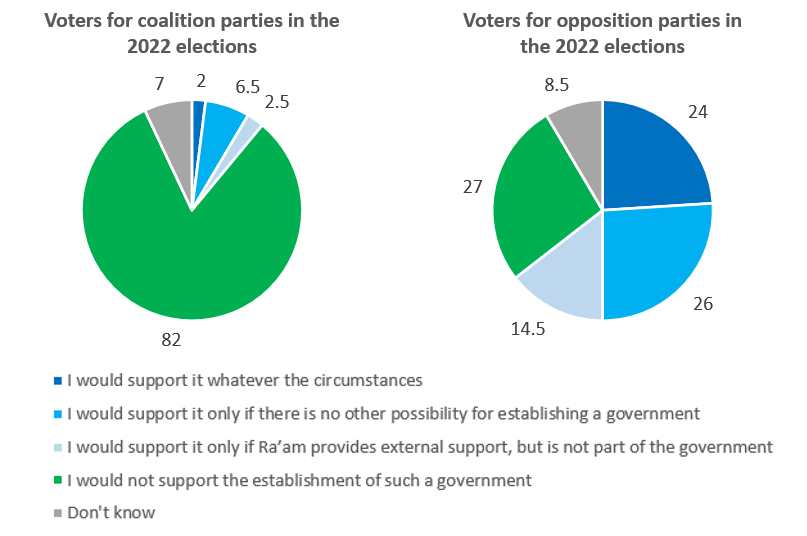
- Among Jews who voted for Labor and Yesh Atid in the 2022 elections, a large majority would support the formation of a government that relies on some form of cooperation with Ra’am (81.5% and 70% respectively). Among National Unity voters, 60% would support such a step and a third oppose it, while among Yisrael Beytenu voters, 49% would be in favor and 47% against.
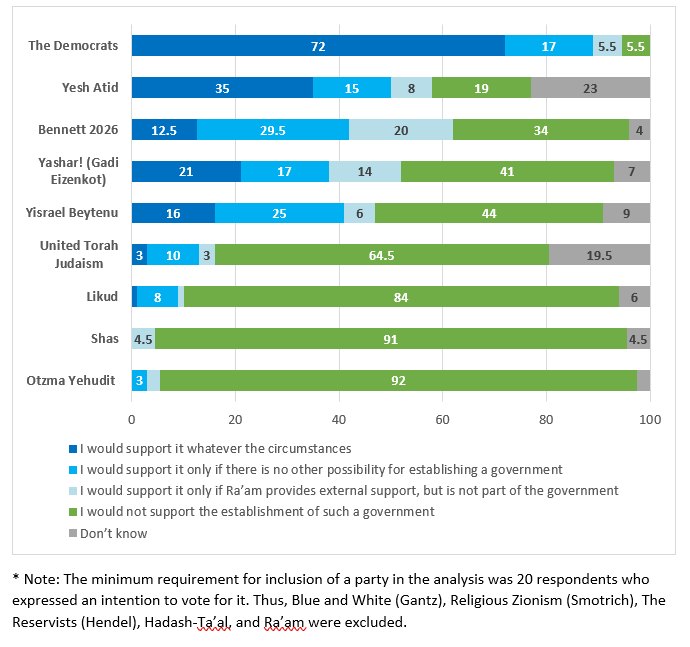
- We analyzed respondents’ support for the formation of a government that would rely on cooperation with Ra’am by their voting intentions in the next elections. We included in the analysis only parties with a large enough number of voters for statistical analysis.* Among those who intend to vote for the following parties, a majority would support cooperation with Ra’am, whether by including it in the government or relying on its external support: The Democrats, 94.5%; Bennett, 62%; Yesh Atid, 58%; and Yashar!, 52%. Those who intend to vote for Yisrael Beyteinu are divided: 47% would be in favor and 44% against. Among voters for the other parties, all of whom currently make up the coalition, a large majority oppose any kind of cooperation with Ra’am.
In the event of a tie between the blocs after the next elections, would you support or not support the establishment of a government headed by the political camp that is closest to your position which relies on cooperation with Ra’am, headed by Mansour Abbas? (Jews, by voting intentions in the next elections; %)
The Next Elections From a Gender Perspective
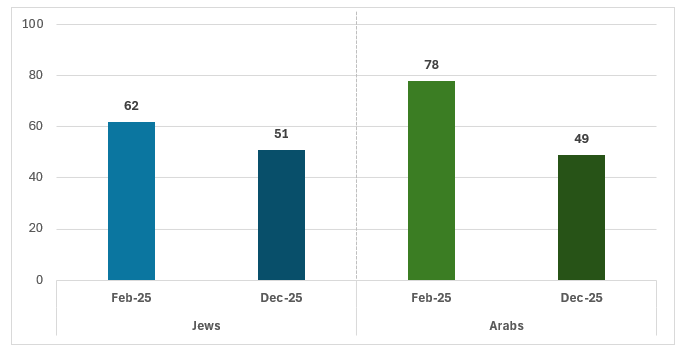
- Approximately half (51%) of the total sample say that when deciding who to vote for, they would prefer parties in which there is equal representation for women. By contrast, 65% responded this way in February 2025 in a survey on gender segregation issues.
- The difference between Jews and Arabs on this issue is small (Jews, 51%; Arabs, 49%). Both publics show a decline compared to the previous survey, when 62% of Jews and 78% of Arabs answered in the affirmative. This might perhaps be explained by a real decline in the importance attributed to the gender issue, but it is also possible that the different wider contexts of the two surveys (the current one dealing with the general state of affairs in Israel, and the previous one with gender segregation) directed the respondents in different ways. Therefore, further examination is necessary.
When deciding who to vote for, prefer parties in which there is equal representation of women (%)
- Breaking down the Jewish sample by religiosity reveals that a minority in the Haredi and national religious publics would prefer gender-equal parties (28% and 35%, respectively), as would half of the traditional religious respondents (51%), and the majority (though not large) of the traditional non-religious (58%) and secular (59%) groups.
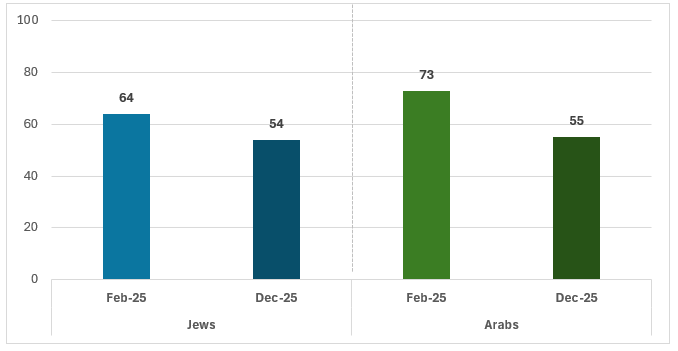
- We asked whether women would be better off if there were more women in the Knesset, in the government, and in senior positions in government ministries. In the current survey, a small majority of the total sample (54%) agree with this claim, once again representing a decline relative to the February 2025 survey, when 65.5% answered in the affirmative.
- An almost identical share of Jews and Arabs agree with the statement (54% and 55%, respectively). This is again a decline, and a reduction of the disparity between the two publics, compared to February 2025, when 64% of Jews and 73% of Arabs responded positively.
Agree that women would be better off if there were more women in the Knesset, in the government, and in senior positions in government ministries
- Breaking down the Jewish sample by religiosity reveals a similar distribution to the previous question. Only a minority of Haredi and national religious respondents think that women would be better off if there were greater representation of women in the Knesset and in government (33% and 40.5%, respectively), as do half of the traditional religious respondents (51%), and a majority in the traditional non-religious and secular groups (57% and 62%, respectively).
- We also examined the public’s positions regarding the proposal that parties that do not include women in their candidate lists should not be allowed to stand in Knesset elections. The majority of respondents in the total sample disagree (55.5%), while only 39% agree. On this question, the resemblance to the February 2025 poll is apparent: at the time, 53% were against and 42% in favor.
- 55% of Jews, and 58% of Arabs, are opposed to this idea.
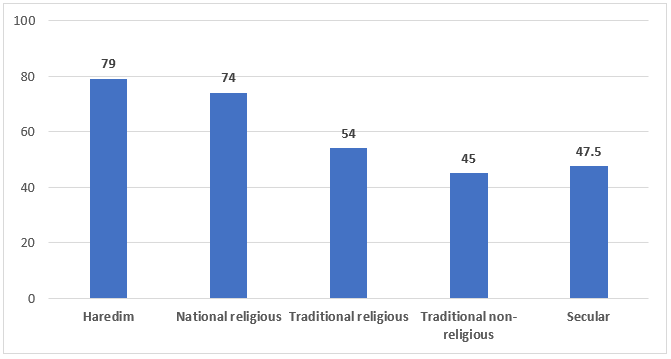
- Breaking down the Jewish sample by religiosity reveals that a large majority of Haredi and national religious respondents are opposed to preventing the participation in Knesset elections of parties that do not feature women (79% and 74%, respectively), as do the majority of traditional religious respondents (54%). Among the traditional non-religious, less than half are opposed (45%), and the same is true of the secular group (47.5%).
Opposed to the idea that parties that do not have women in their candidate lists should not be allowed to stand in Knesset elections (Jews; %)
Expectations for 2026
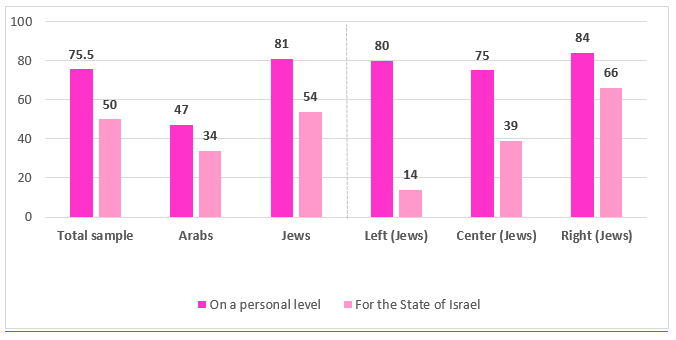
- With the beginning of the new year, we wanted to know what the public’s expectations are, for themselves personally and for the country as a whole. As in the past, we found that in all the analyses, smaller shares of respondents think that 2026 will be good on the national level than hold the same view on the personal level. In other words, the Israel public expect a more promising future for themselves than for the state.
- In all segmentations, the forecast for 2026, on both the national and personal levels, is more optimistic than on the eve of 2025. In other words, the future looks better.
- The largest discrepancy between national and personal expectations was found on the Left (only 14% expect 2026 to be good for the country, compared to 80% who expect this to be the case for themselves). The smallest gap is on the Right, where 66% believe that 2026 will be good for the country, and 84% believe it will be good for them personally. Since in the survey in which the same question was asked about 2025, the Right was also the most optimistic on both the national and personal levels, the relative increase in the rate of optimism for 2026 in this camp on both levels is the smallest (the “ceiling effect”).
- The share of Jews who estimate that 2026 will be a good year, on both the national and personal levels (a majority), is much higher larger than the corresponding share of Arabs (only a minority). Moreover, the gap in assessments between the two sectors has widened: For example, when it comes to the personal level, the disparity between the expectations of Jews and Arabs for a good year in 2025 was 18 percentage points, while this year this gap has doubled to 34 percentage points. At the national level, the gap between Jews and Arabs was 17 percentage points in 2025, and has risen to 20 percentage points this year. The increase in these differences is the result of a much larger rise relative to 2025 among Jews who think that 2026 will be a good year, compared to a smaller increase among Arabs.
Think that 2026 will be a good or quite good year (%)
The December 2025 Israeli Voice Index was prepared by the Viterbi Family Center for Public Opinion and Policy Research at the Israel Democracy Institute. The survey was conducted via the internet and by telephone (to include groups that are under-represented on the internet) between December 28, 2025 and January 1, 2026, with 602 men and women interviewed in Hebrew and 150 in Arabic, constituting a nationally representative sample of the adult population in Israel aged 18 and over. The maximum sampling error was ±3.57% at a confidence level of 95%. Field work was carried out by Shiluv I2R. The full data file can be found at: https://dataisrael.idi.org.il.