

Israelis Divided on Participation in a Potential US Attack on Iran
50% of the total sample support participating in a military response only if Israel is directly attacked by Iran, while 44% support direct military involvement in a potential U.S. attack on Iran. The largest share (49%) think that Israel’s security will be harmed by reduced military aid from the US, down to zero, while 39.5% think it will not be harmed. Rise in optimism for the future of all four topics: democratic rule, national security, economy, and social cohesion.
Photo by Matanya Tausig/Flash90
Methodology
The survey was conducted by the Viterbi Family Center for Public Opinion and Policy Research at the Israel Democracy Institute between January 25–29, 2026. It was based on a representative sample of the population in Israel aged 18 and above, comprising 604 Jewish interviewees and 151 Arab interviewees.
The National Mood
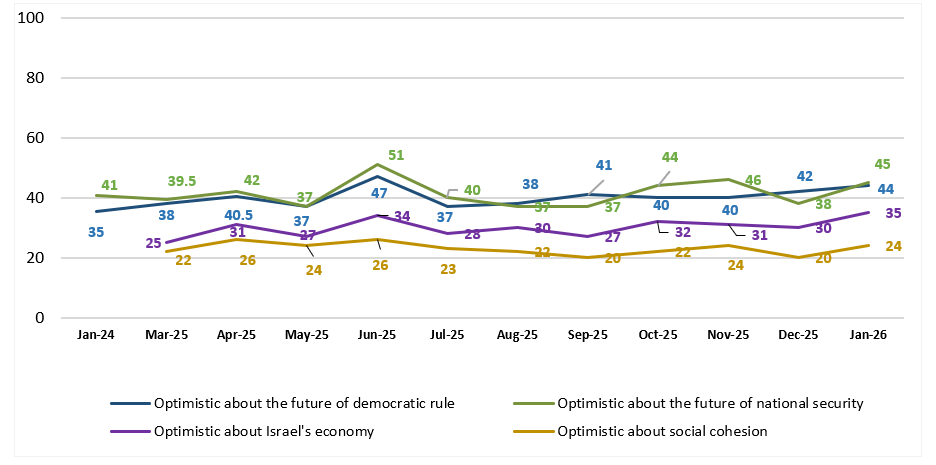
- This month saw a rise in optimism about the future for all four topics—democratic rule, national security, the economy, and social cohesion. The largest increase (7 percentage points) was in optimism about the future of national security, and the smallest (2 points), about the future of democratic rule. A review of findings over the past year shows (unsurprisingly) that optimism about the future of national security rose and fell more than optimism in the other three categories. As for the future of Israel’s economy, the share of optimists this month is the largest since we began measuring this topic.
Optimistic about the future of democratic rule, national security, the economy, and social cohesion (total sample; %)
- As in previous months, the share of optimists among Jews is larger than that among Arabs on all topics, with the most surprising finding being the very large discrepancy in perspectives about the future of national security— the majority of Jews are optimistic (52%), compared with only a very small minority of Arabs (11%).
Optimistic about the future (Jews and Arabs; %)

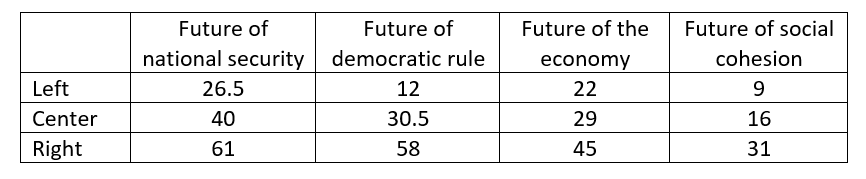
- A breakdown of findings by political orientation (Jews) reveals once again that the Left is the least optimistic camp, and the Right is the most optimistic. In fact, on the Left, there is no majority of optimists in any of the four areas, while on the Right, we found a clear majority of optimists regarding the future of national security and the future of democratic rule.
Optimistic about the future (Jews, by political orientation; %)
- Since this is an election year, in which accuracy is particularly important, this time we refined our analysis and made a differentiation in the two main political camps between those who position themselves toward the extremes and those who position themselves closer to the Center. We found that on both the Left and the Center-Left, as well as in the Center, there are still only a minority of optimists, and even on the Center-Right the share of optimists is less than half (only with regard to national security does this share approach half). However, among those who define themselves as fully on the Right (44% of the Jewish sample), the majority are optimistic, except with regard to social cohesion, though even here, the share of optimists was at least double that found in the other four political categories. In other words, in terms of optimism about the future, the dividing line is between those who define themselves as fully on the Right and the rest of the public, rather than between the Right as a whole and the Left, and perhaps the Center.
Optimistic about the future (Jews, by refined political orientation; %)
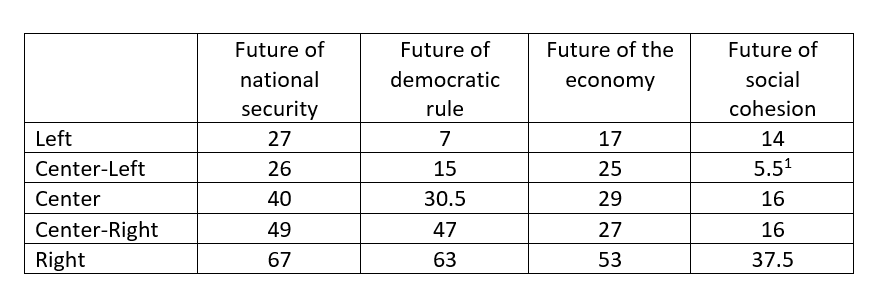
[1] Due to the small size of this group, the figure obtained this month is not representative. The average share of optimists among this group over the past six months (July–December 2025) was 11%.
Israeli Participation in a Possible Attack on Iran
- The Israeli public is almost evenly divided on the question of Israel’s possible involvement in an American attack on Iran. The largest share (50%) favor participation only in the event that Israel is attacked by Iran, while a smaller proportion support direct military involvement coordinated with the United States from the outset (44%).
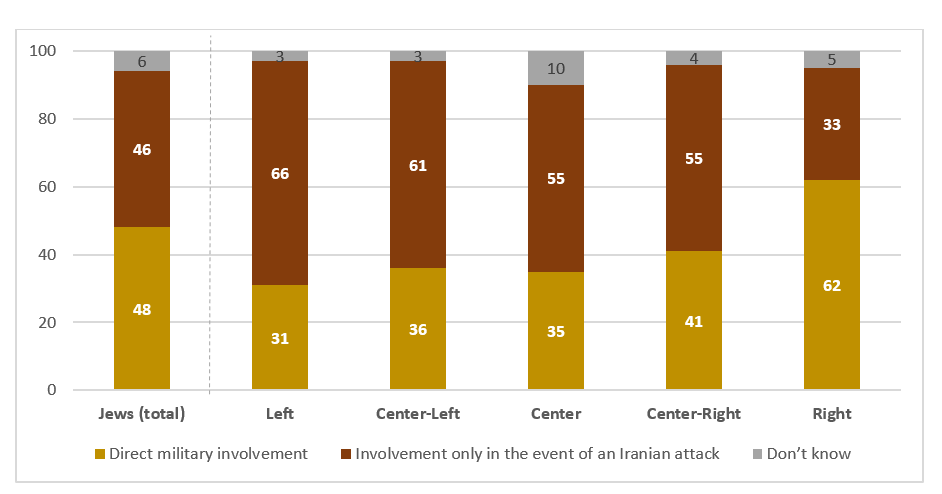
- In the Jewish sample, the share of those who support direct involvement is slightly larger than the share who prefer Israeli participation only in the event of an Iranian attack (48% versus 46%, respectively). By contrast, among Arabs, the majority are in favor of involvement only if Iran attacks Israel (67%).
- On the Left and in the Center (Jewish sample), the majority are in favor of Israeli involvement in an American attack on Iran only if Iran attacks Israel first (63%, 55% respectively). On the Right, on the other hand, the majority are in favor of direct participation in an American attack from the outset (55%).
- However, even in this case, when we divide the Jewish sample into five categories of political orientation, we find that only among those fully on the Right is there a majority who support direct Israeli participation in an attack on Iran, while in all other categories, including the Center-Right, the majority support participation only in the event of an Iranian attack on Israel.
In the event of an American attack against Iran, what do you think should be the extent of Israel’s involvement? (Jews; %)
Trump’s Board of Peace
- We asked our respondents whether they think it is correct or incorrect for Prime Minister Netanyahu to join Trump’s Board of Peace, to which the Americans have also appointed representatives of Turkey and Qatar, despite Israeli opposition. In the total sample, just over half (51%) think it is correct for Netanyahu to join the Board, while 30% think it is incorrect. An unusually large share of 19% selected the “don’t know” response, mainly due to the particularly high rate of Arab respondents who say they “don’t know” (31%).
- Among Jews, a majority (55.5%) are in favor of Netanyahu joining the Board of Peace, while in the Arab sample, just under a third of respondents (31%) support this step, and just over a third (38%) are against it.
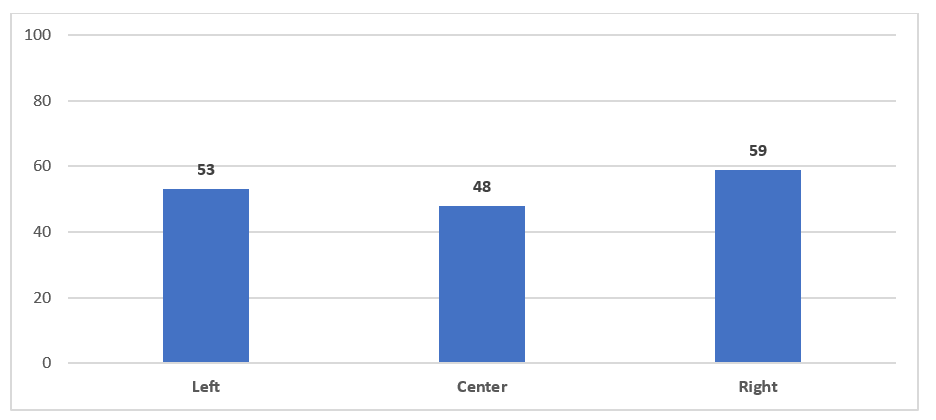
- Breaking down the Jewish sample by political orientation, whether using three or five categories, reveals only small differences in preferences on this subject between the various camps.
Think that it is correct for Prime Minister Netanyahu to join Trump’s Board of Peace, to which the Americans have also appointed representatives of Turkey and Qatar, despite Israeli opposition (Jews; %)
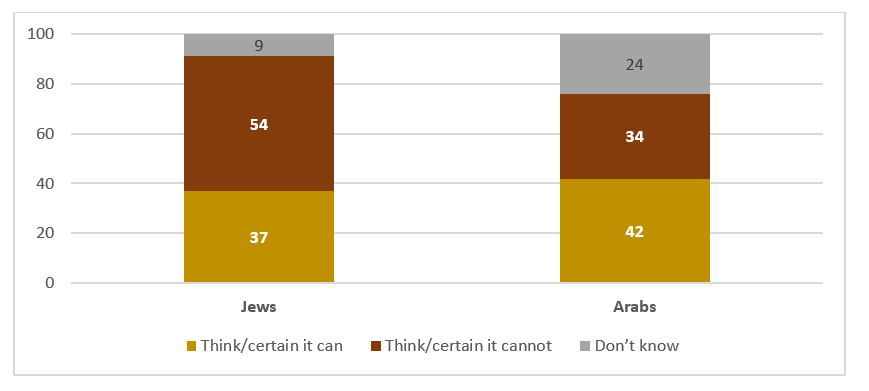
- We then asked our respondents whether the establishment of President Trump’s Board of Peace can or cannot help solving the problems in Gaza while maintaining Israel’s security. The picture among Jews and Arabs is different: A majority of Jews (54%) believe that the Board cannot help in this regard, while among Arabs, the largest share (42%) think that it can. Again, among Arab respondents, a very large proportion (24%) selected the “don’t know” response.
- On this issue as well, no significant differences were found between the main political camps in the Jewish sample. In all three, the majority think that the Board cannot help solve the problems in Gaza while maintaining Israel’s security (Left, 57%; Center, 51%; Right, 54%).
To what extent can the establishment of President Trump’s Board of Peace help solve the problems in Gaza while maintaining Israel’s security? (%)
Reducing Military Aid from the United States
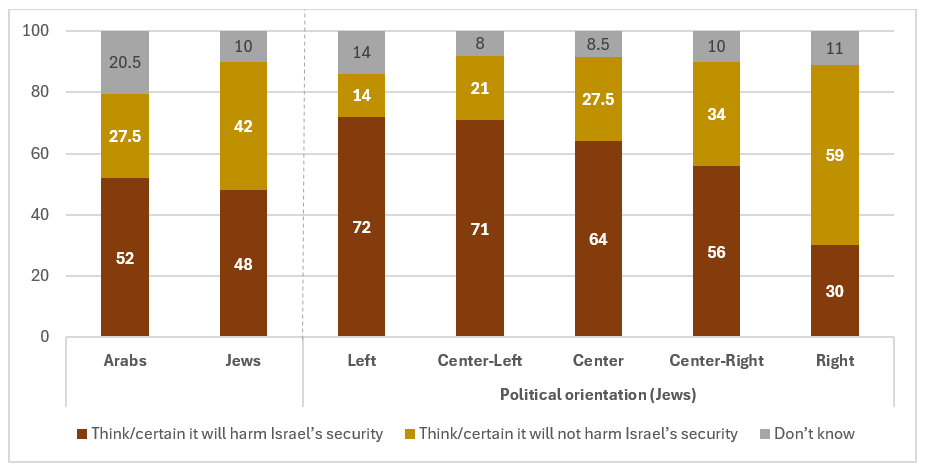
- Recently, Netanyahu announced that Israel will take steps to gradually reduce the scale of military aid from the United States down to zero, in light of Israel’s greater economic and international strength. We asked our respondents whether they think this will harm or not harm Israel’s security. We found that in the total sample, the largest share (49%) think that Israel’s security will be harmed by this change, while 39.5% think it will not be harmed.
- Among both Jews and Arabs, a greater proportion think that this step will harm Israel’s security than hold the opposite view (Jews: 48% vs. 42%, respectively; Arabs: 52% vs. 27.5%, respectively).
- Among Jews who identify with the Left, the Center-Left, and the Center, a clear majority think that reducing and ending American military aid will harm national security. Among those on the Center-Right, too, more than half hold the same view. Once again, only among those fully on the Right are opinions reversed, with less than a third who think this step will harm Israel’s security.
Will a gradual reduction in US military aid, down to zero, harm or not harm Israel’s security? (%)
The Government’s Intention to Withdraw from the UN Framework Convention on Climate Change
- Idit Silman, the minister for environmental protection, is taking steps to withdraw Israel from the UN Framework Convention on Climate Change, from which the United States withdrew when President Trump took office. She argues that this is because of incitement against Israel on the part of international environmental organizations. As background, we wanted to find out to what extent the Israeli public believe the climate researchers who warn that if the world’s countries do not make significant policy changes, such as restricting the use of polluting fuels, there may be severe consequences for the climate in the future. We found that a majority of respondents (total sample, 65%; Jews, 67%; Arabs, 58%) believe the claims made by climate researchers.
- From here we moved on to examine whether, in the opinion of the public, Israel should withdraw from the Convention or remain in it. Among Jews, the largest share (43%) are in favor of withdrawal from the Convention (35% support remaining in it). Among Arabs, too, the largest share (51%) are in favor of withdrawing from the Convention. It should be noted that in both groups, large proportions of respondents said that they “don’t know” (Jews 21%, Arabs 25%), reflecting the Israeli public’s general lack of interest in climate issues.
- Cross-tabulating the responses to the two questions shows that among those who do not believe the warnings of scientists, a large majority support withdrawing from the UN Convention (73%). Among those who do believe the scientists’ warnings, the largest share (43%) support remaining in the Convention, a third support withdrawing, and around a quarter don’t know. In other words, believing the climate scientists’ claims influences attitudes toward withdrawal from the UN Convention on Climate Change.
Should Israel withdraw from the UN Framework Convention on Climate Change or remain? (total sample, by extent of belief in warnings from climate researchers; %)

Is Israel Still a Liberal Democracy?
- Recently, the former president of the Supreme Court Aharon Barak said that Israel is no longer a liberal democracy. We asked our respondents to what extent they agree or disagree with his claim. We found that in the total sample, one-half (49.5%) agree with Barak, while a slightly smaller share disagree (45%).
- Among Jews, the picture is reversed: the slightly larger share (49%) disagree with Barak, while 47% agree with him. A majority of Arabs (60%) agree with Barak that Israel is no longer a liberal democracy, and only a quarter (25%) disagree.
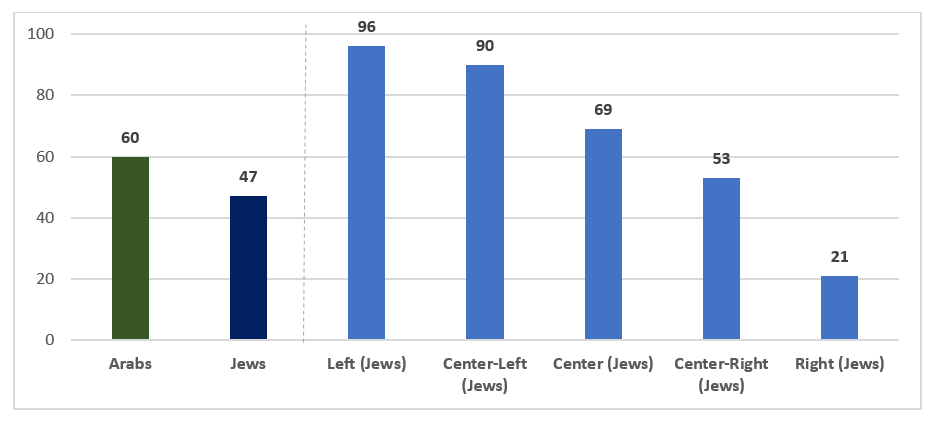
- Analyzing the Jewish sample by three political camps reveals that those on the Left and in the Center agree with Barak to a very large degree (92.5% and 69%, respectively), while on the Right, only a minority agree (31%). However, when dividing the Jewish sample into five political camps, we find that even on the Center-Right, the majority agree with Barak, and only among those fully on the Right do the majority (74%) disagree with him. Here, too, the line of separation runs between those fully on the Right and the rest of the Jewish public.
Agree with Aharon Barak that Israel is no longer a liberal democracy (%)
The Tragedy at an Infant Daycare Facility in Jerusalem
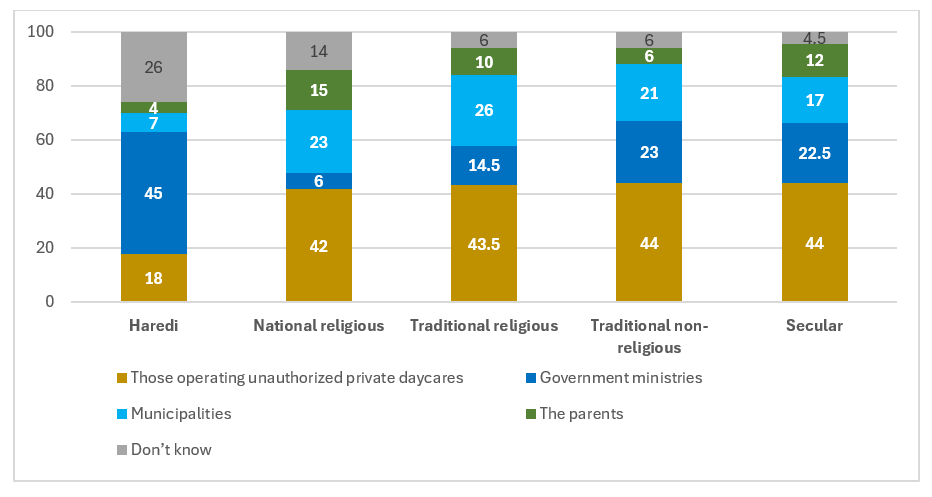
- We asked our respondents who they think is primarily responsible for the tragedy that claimed the lives of two infants at a private and unsupervised daycare facility in Jerusalem. In the total sample, the largest share (39%) placed the responsibility on the operators of unsupervised private daycares, followed by government ministries (22%) and municipalities (20%). Ranked last are the parents, whom only 12% of the public considers to be primarily responsible for the tragedy.
- While over 40% of secular, traditional, and national religious Jews attributed the main responsibility to the operators of the daycares, followed by government ministries or municipalities, among Haredim the picture is completely different: the largest share (45%) think that government ministries are mainly responsible. Only a minority of Haredim (18%) blame the operators of daycares. Also striking is the large proportion of Haredim who selected the “don’t know” response, and the small proportion who blame the parents.
Following the tragedy at an infant daycare facility in Jerusalem (which has been in operation for 30 years), in which two babies died and others were injured, who do you think bears the main responsibility for preventing such incidents? (Jews; %)
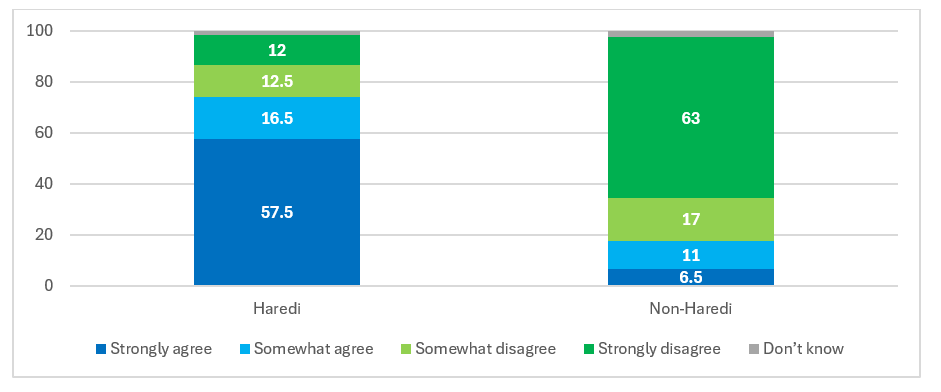
- In this context, we also examined the degree of public agreement with the claim made by several Haredi Knesset members and officials that the attorney general is to blame for the deaths of the infants, due to her decision to suspend daycare subsidies for families of kollel students, thus forcing them to place their infants in unauthorized private frameworks that are cheaper. A large majority (70%) of the total sample disagree with this accusation.
- Among secular, traditional, and national religious Jews, a large majority disagree with the claim that the attorney general is to blame for the tragedy. By contrast, a large majority of Haredim (74%) blame her for the disaster.
Agree/disagree that the attorney general is to blame for the death of the infants at a daycare facility in Jerusalem (Jews; %)
The January 2026 Israeli Voice Index was prepared by the Viterbi Family Center for Public Opinion and Policy Research at the Israel Democracy Institute. The survey was conducted via the internet and by telephone (to include groups that are under-represented on the internet) between January 25–29, 2026, with 604 men and women interviewed in Hebrew and 151 in Arabic, constituting a nationally representative sample of the adult population in Israel aged 18 and over. The maximum sampling error was ±3.57% at a confidence level of 95%. Field work was carried out by Shiluv I2R. The full data file can be found at: https://dataisrael.idi.org.il.