

12 Necessary Changes for the Government's Conscription Bill (Amendment 26)
IDI experts argue for a universal obligation to serve, as opposed to the model of the latest "conscription" bill, which would be harmful to Israel's security and social solidarity. However, if the present legislation does move forward, the points presented here would mitigate the harm in the proposed bill.
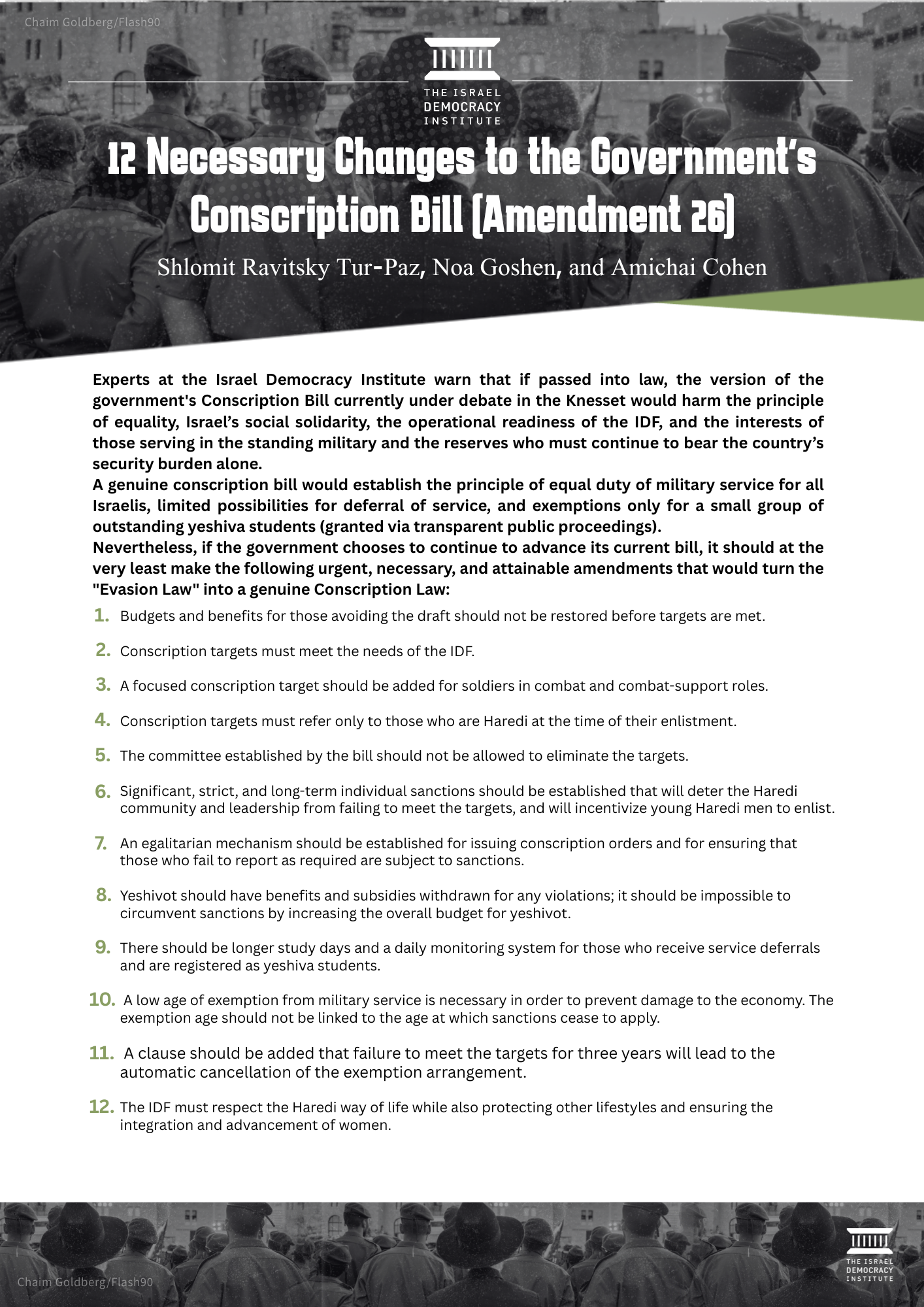
Here are the points in detail:
- Budgets and benefits should not be restored before targets are met.
Over the past year and a half, governmental authorities have begun to deny various benefits and subsidies from tens of thousands of Haredim to whom mandatory conscription currently applies, in some cases going so far as preventing them from leaving the country and arresting them. These actions were credited with doubling Haredi enlistment rates in 2024 (though the overall number is still small).
The current bill would immediately restore benefits to those who are obligated to enlist—half of the yeshiva budget for yeshivot, full discounts for daycare centers and national insurance payments, scholarships for studies and training—before even a single soldier is drafted. In addition, the bill grants amnesty to draft dodgers and cancels enforcement proceedings. These steps create zero incentives to meet the conscription targets. In addition, the media have reported harsh statements made by the rabbinical leadership of the Haredi community, according to which there is no intention to meet these targets. Therefore, the restoration of benefits and the suspension of enforcement procedures should be delayed until the targets are met.
- Conscription targets must meet the needs of the IDF.
The IDF needs soldiers now. Not in a year or two – but right now. For more than a year, the military has been publicly voicing its immediate need for at least 12,000 combat soldiers and combat-support soldiers, and has warned of damage to its operational readiness. In the meantime, an even greater burden is being placed on hundreds of thousands of reservists, who are unable to fully return to their lives after over two years of intensive fighting, while the draft for regular soldiers is being extended. Assuming (optimistically) that around half of all recruits are suitable to serve as combat and combat-support soldiers, then some 24,000 Haredim need to be drafted in the short term. The low targets set in the bill constitute a tiny percentage of the current “pool” of nearly 100,000 Haredi young men to whom mandatory conscription currently applies, around half of whom are under the age of 22.
The bill does not list among its goals addressing the country’s security needs or providing relief for those currently serving, and sets targets that do not correspond with these needs: The target is around 5,400 for the first year (8,160 for the first year and a half), and then 6,840, 7,920, and 8,500 for each of the following three years. In the fifth year, the target is based on the numerical criterion of 50% of 18-year-old Haredi men (8,541 in the 2030 recruitment year according to the Central Bureau of Statistics), and is to be met from across the multi-age enlistment pool.
All of these are low targets that do not meet the needs of the IDF. The targets should be set, at the very least, to meet the immediate needs of the military for the first year, with a similar number defined for the coming years. In addition, the law’s defined goals should include meeting Israel’s security needs and providing relief for those currently serving.
- A focused target should be added for soldiers in combat and combat-support roles.
The conscription targets defined in the bill do not limit the age of conscripts and do not require them to serve in combat roles or combat-support roles. According to the bill, conscripts aged 25–26, without a combat profile, with two children and a promise of military service at a location close to home, also count toward the target. The IDF’s proposal is that at least 50% of Haredi recruits be aged 18–21, with 75% aged 23 or below. In addition, the target also includes 10% who will serve in defense-related roles in civilian establishments. These will certainly not help ease the burden of service, nor will these individuals enter the reserve service system. An age quota or a quota for combat soldiers should be set, and service in civilian settings should be defined only as an addition and not as part of the core conscription targets.
- Conscription targets must refer only to those who are Haredi at the time of their enlistment.
The bill includes in its targets those who left the Haredi education system in the 10th grade (at least two years of study in a Haredi institution between the ages of 14 and 18 are required). According to Central Bureau of Statistics data, 7 out of 10 conscripts to the IDF who graduated from Haredi education no longer define themselves as Haredi at the time of enlistment (69%). According to IDF data, 55% of conscripts who are counted as Haredim opt in advance to serve in general IDF units that do not have special Haredi adaptations, which indicates that they are probably no longer members of the Haredi community. There are also some conscripts who choose to serve in units with Haredi adaptations even though they no longer define themselves as Haredi. Thus, the definition of “Haredi” in the bill should be changed to include only those who have completed secondary studies in a Haredi institution and who maintain a Haredi lifestyle at the time of their enlistment.
- The committee established by the bill should not be allowed to eliminate the targets.
The bill includes provisions for a committee that can reduce or even eliminate the conscription targets if it believes that the IDF has not met the requirement to create and expand special Haredi service tracks. In other words, even a minor error or local failure could lead to the complete cancellation of the annual targets. The bill defines both the composition of the committee—four IDF representatives (some of them retired), one of whom is a graduate of a Haredi institution and maintains a Haredi lifestyle, and a judge from the of the Great Rabbinical Court (a non-military position held exclusively by Haredi rabbis)—and its authority, but does not limit the scope of its discretion. In this regard, it would allow the committee’s decisions to override primary legislation of the Knesset. This power should be withdrawn from the committee, and other measures should be used to ensure that the IDF fulfills its promises; and in any case, criteria should be set that will restrict the manner in which the committee can exercise its discretion.
- Significant, strict, and long-term individual sanctions should be established that will deter the Haredi community and leadership from failing to meet the targets, and will incentivize young Haredi men to enlist.
The sanctions and withdrawals of benefits defined in the bill are weak and short-term, and will not result in a change in behavior. The only immediate sanctions contained in the bill actually help keep young Haredi students in yeshivot rather than encouraging them to enlist, while the more severe sanctions begin late, are limited, and end at the age of 26. The immediate sanctions in the bill are restrictions on leaving the country and on obtaining a new driver’s license (both of which apply only up to the age of 23, and are subject to an exceptions committee), as well as restrictions on admission to positions in the civil service, on academic scholarships, and on tax benefits. All of these initiatives encourage young Haredim to enroll as yeshiva students rather than enlisting in the IDF, especially since some of the restrictions already apply to yeshiva students (in many yeshivot, especially Lithuanian ones, unmarried young men are not allowed to obtain a driver’s license, and there are also restrictions on working). The sanctions that may be imposed on child daycare centers and on housing in the event of failure to meet the conscription targets cease to apply at the age of 26. In other words, Haredi young men, who on average buy an apartment at the age of 24 and have their first child at the age of 24.5, will only have to wait a year or two to receive the extensive discounts to which they are entitled, even if their community does not meet the targets. This is not sufficient motivation to incentivize any changes in lifestyle.
All the sanctions and denials of benefits should apply immediately, including withdrawal of budgets to yeshivot, the right to participation in housing tenders, discounts for daycare centers, housing benefits, national insurance discounts, scholarships for training and study programs, tax benefits, labor benefits, and affirmative action in the civil service. In addition, the sanctions should apply for the long term, through to the end of the obligation for reserve duty (currently 39–40), with the exception of the restrictions on work in the civil service, which should last until the age of 29.
- An egalitarian mechanism should be established for issuing conscription orders and for ensuring that those who receive service deferrals are subject to sanctions.
The bill does not provide instructions on how the government is to meet the targets, and no mechanisms are defined to guide the defense minister’s decision-making on how many conscription orders to issue and according to what criteria. This is likely to lead to severe discrimination among young Haredim. In addition, the sanctions apply only to those who were called up for regular service (sent a conscription order with an actual date of enlistment) and did not comply with the order, but not to those who received an initial order to report and register at an IDF conscription office (orders that are sent to everyone, and may be followed by a deferral of service). The defense minister is not obligated in the bill to issue such orders. If the orders are not issued, then no sanctions apply to anyone. The minister of defense should be obligated to issue conscription orders in an equal manner, and the sanctions should also be applied equally to those who fail to obey reporting and registration orders, rather than just full conscription orders. In addition, the very existence of a mechanism for sanctions against individuals (who have not been obligated to enlist), while the targets apply to the government, raises legal difficulties.
- Yeshivot should be fined for any violations, and it should be made impossible to circumvent sanctions by increasing the overall budget for yeshivot.
The bill establishes a certain sanction to be applied to the budget for yeshivot, with half of the budget to be withdrawn immediately, and the other half made dependent on meeting the targets. This sanction is even weaker than it appears on paper, because only for a violation of more than a quarter of the target (25% in the first year, then 20% for two years, and then 10%) is the yeshiva budget withdrawn in full, while for lesser violations, the fine is smaller and more financially attractive relative to the budget given to yeshivot.
Moreover, the bill imposes no restrictions on the government and the Knesset with regard to increasing the overall budget for the yeshivot, and thereby compensating the yeshivot for the losses incurred. This means there is no motivation to meet the targets. The bill should disallow increasing the budget for yeshivot as a way of circumventing the sanctions, and the budget should be withdrawn in the event of any failure at all to meet the targets, so as to create motivation to meet them.
- There should be longer study days and a daily monitoring system for those who receive service deferrals and are registered as yeshiva students.
The bill slightly increases the oversight of yeshiva students, so that inspectors will visit yeshivot once a quarter. This is not enough. There needs to be substantial daily monitoring (using means such as cameras, clocking in, biometric means, and so on) that will be consistent with the significance of the exemption granted to students. This is particularly highlighted by the data on the extensive scale of participation in the workforce among yeshiva students (even for work that is reported, and not including clandestine working), when they are supposed to be fully engaged in their studies.
For example, in 2022, even though only married Haredim over the age of 22 were allowed to work under the terms of their exemption from service, and only after completing their yeshiva studies, 17% of 20-year-olds worked in an average month, to an average extent of 40% of standard working hours; 26% of 23-year-olds worked in an average month, completing an average of 62% of standard working hours; and 33% of 25-year-olds worked in an average month, averaging 72% of standard working hours (Gabriel Gordon, Workforce Participation of Haredi Yeshiva Students Under the Exemption Age, Israel Democracy Institute, July 2024; based on CBS data, assuming the minimum wage).
In addition, the 45-hour study week required of single yeshiva students is too short, and does not even reflect the length of the study day in many yeshivot. This is especially true when compared to the long hours of service required of many soldiers at nights and on weekends.
- A low age of exemption from military service is necessary in order to prevent damage to the economy. The exemption age should not be linked to the age at which sanctions cease to apply.
The bill sets the age of exemption from military service at 26 – the age at which a Haredi man can leave the yeshiva and join the workforce without fear of being drafted. Since the majority of Haredim who enlist do so by the age of 23, and since the likelihood of enlistment after this age is low, the age of exemption should be set at 23, in order to prevent a double blow of non-participation in both the military and the labor market. As it is, the economy suffers from a very low rate of participation in the workforce among Haredi men—just 53%, compared to 86.5% among non-Haredi Jewish men—and Haredi men earn on average only 49% of the average earnings of non-Haredi Jewish men (Annual Statistical Report on Ultra-Orthodox Society in Israel, Israel Democracy Institute, 2025).
The sooner they enter the labor market, the greater the likelihood of their participating in studies or training courses that will improve their quality of employment in the future and promote the growth of the economy as a whole. A survey of young Haredim who enlisted to the IDF shows that lowering the age of exemption will not affect the decision of whether or not to enlist. In any case, the exemption age should not be linked to the age at which sanctions cease to apply, which should be set at an age higher than 26, and based on maximum effectiveness (sanctions related to employment should apply up to the age of 29, while those related to housing and daycare center subsidies should apply until the age for completion of reserve duty, age 39-40 as of today).
- A clause should be added that failure to meet the targets for three years will lead to the automatic cancellation of the exemption arrangement.
In its current version, the law will not be revoked even after several years of failure to meet the targets. The defense minister is to establish a committee and propose “tools and incentives,” but is not obligated to make any significant changes, and the failed law will remain in place. Even the 2022 bill, in which the targets and sanctions set were even weaker, included a clause that rendered the law void if the targets were not met for three years. A similar clause should be added to this bill as well.
- The IDF must respect the Haredi way of life while also protecting other lifestyles and ensuring the integration and advancement of women.
In addition to its reference to respecting Haredi lifestyles, and adapting the IDF’s sourcing, screening, preparation, and service procedures for this group, the bill should also stipulate the importance of respecting the lifestyles of other IDF personnel, and the need to strike a balance between the needs of different soldiers. In addition, the bill should impose an obligation on the IDF to provide reports on the advancement of women and diversification of positions open to women, and to monitor the impact of service by Haredim on the other population groups.