

Israel Is in a State of Emergency; in Knesset, It's Business as Usual
The decision for Knesset to advance highly controversial legislation during the war with Iran, and under a special home front situation, risks undermining proper legislative processes, impeding public debate on the issues, and hindering the ability of elected officials to address urgent war-related matters.
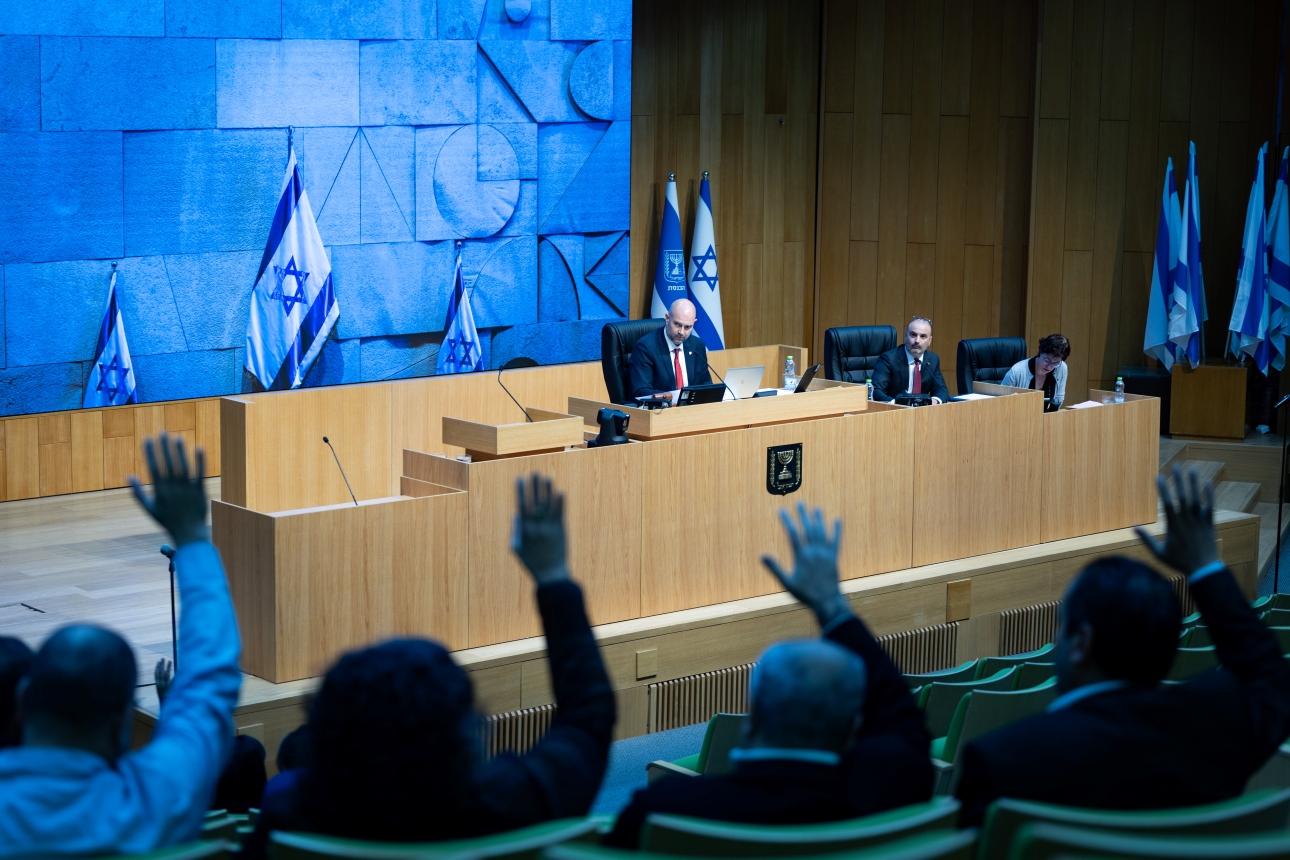
Photo by Yonatan Sindel/Flash90
Since the morning of February 28, with the launch of Operation Roaring Lion, the State of Israel has been under a special home front situation (an emergency status that, among other things, grants special emergency powers to the IDF and certain members of government). As part of this, the work of the Knesset in the plenary and especially in its committees was significantly reduced and limited to matters related to the war and to the state budget. Access to the Knesset building was restricted, and committee meetings were held with external participants, such as government officials and representatives of civil society, joining via Zoom. Controversial issues not related to the war were not advanced at all.
The special home front emergency status has been extended until March 26. Despite this, the Speaker of the Knesset decided last week that discussions could now be held in Knesset without any limitation on their subject matter. The committee schedule for this week has included deliberations on some of the most contentious bills currently on the table, including splitting the role of the Attorney General, establishing a political commission of inquiry into October 7, introducing the death penalty for terrorists, and advancing the Communications Law.
This decision has negative implications for the Israeli public and Israeli democracy.
First, it is clear that the capacity for attention to these issues is extremely limited at present. The public, the media, and politicians are, quite naturally, occupied with the war, sirens, reaching bomb shelters, and damage to the civilian home front. Advancing legislation of such significance during wartime is problematic considering the limited capacity for media coverage, public awareness, and open debate.
Second, the agenda that has been set diverts members of Knesset from their central role at this time: parliamentary oversight and representation of the public. Knesset's work ought to be centered on such urgent matters as the military campaign, and, even more so, addressing the needs of the home front, allocating emergency funds, and making key decisions around civilian defense measures, reserve service, and the education system.
These concerns are amplified when one considers that these discussions will take place while the aforementioned restrictions imposed on the Knesset are still in effect. As a result, professional experts and at least some representatives of civil society will only be able to participate remotely, in a manner that undermines effective participation and, more broadly, the quality of deliberations. Furthermore, with most Israeli schools closed and multiple missile launches taking place every day, these participants are already constrained by needing to care for children or to run to bomb shelters during air-raid sirens. The matters under debate are consequential legislative proposals with broad implications, and the focused input of professional experts, academic specialists, and representatives of the wider public is of paramount importance.
Furthermore, advancing such highly controversial matters at this time is likely to further deepen political polarization and undermine the solidarity that is so essential during wartime. Debate can and should continue, but it is reasonable to expect that in the current period, Israelis would aim to focus on relevant, substantive, and urgent issues such as reopening the education system and mitigating the physical and economic damage of the war, rather than on the structure of the communications market or the method of appointing the chief public prosecutor.
Looking at Knesset wartime protocols since October 7 reveals a growing erosion of the norm that highly controversial legislation should not be advanced at the height of a military campaign. Following October 7, for a period of several months, Knesset dealt almost exclusively with overseeing the work of the government and representing the needs of the public. Similarly, during the 12-day Iran war in June 2025, the Knesset committees focused primarily on issues related to the war, such as support for local authorities or enabling remote court hearings. At the same time, during those twelve days, there were discussions held on routine and even controversial matters, such as a Finance Committee debate on transferring funds to religious councils and a House Committee discussion on a request to terminate Ayman Odeh’s membership in the Knesset. The Knesset schedule for the coming week indicates a significant escalation of this shift of norms.
Advancing controversial measures with far-reaching implications for Israeli democracy during wartime and under a special home front situation risks seriously undermining proper legislative processes and the Knesset’s ability to represent the public’s needs on urgent war-related matters. It will also deepen divisions within the public at a particularly sensitive time. It would be wise for Knesset leadership to reconsider this step.
This article has been published in the Jerusalem Post.