

Jewish Israelis Overwhelmingly Support Continued Fighting Against Hezbollah in Lebanon
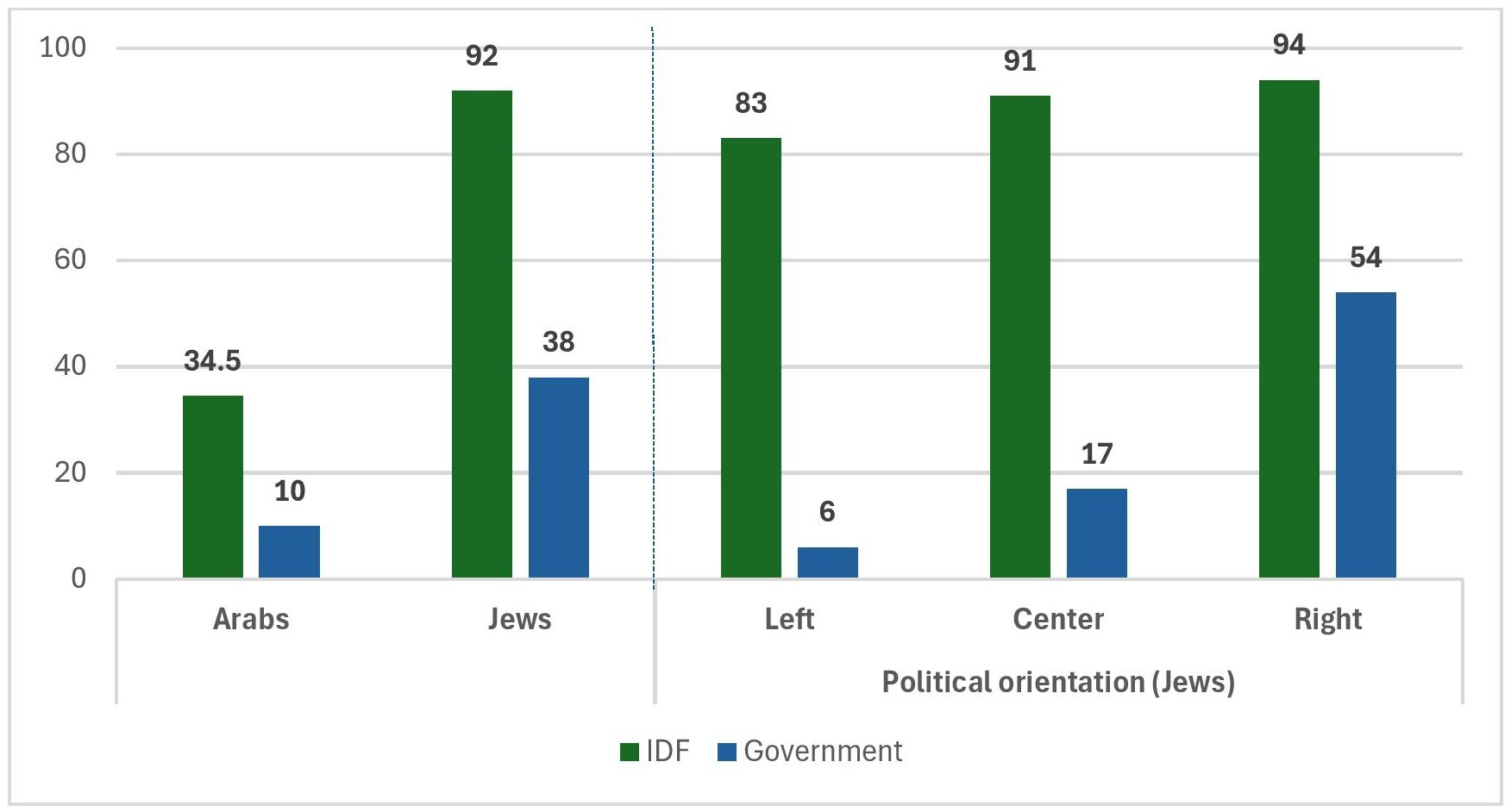
49% of Jewish Israelis say Israel's strategic and security situation is better than before the war with Iran, while among Arabs, 49% say it is worse. 92% of Jews gave the IDF a high rating on their management of the war; only 38% gave the government high ratings. Among Arabs, 34.5% gave the IDF high ratings; only 10% gave the government high ratings.
Photo by David Cohen/Flash90
Methodology
This flash survey on the ceasefire between the United States and Iran was conducted via internet by the Viterbi Family Center for Public Opinion and Policy Research at the Israel Democracy Institute between April 9–12, 2026, with 502 respondents interviewed in Hebrew and 100 in Arabic, constituting on a representative sample of the population in Israel aged 18 and above. The maximum sampling error was ±3.99% at a confidence level of 95%. Field work was carried out by iPanel. The full data file can be found at: https://dataisrael.idi.org.il.
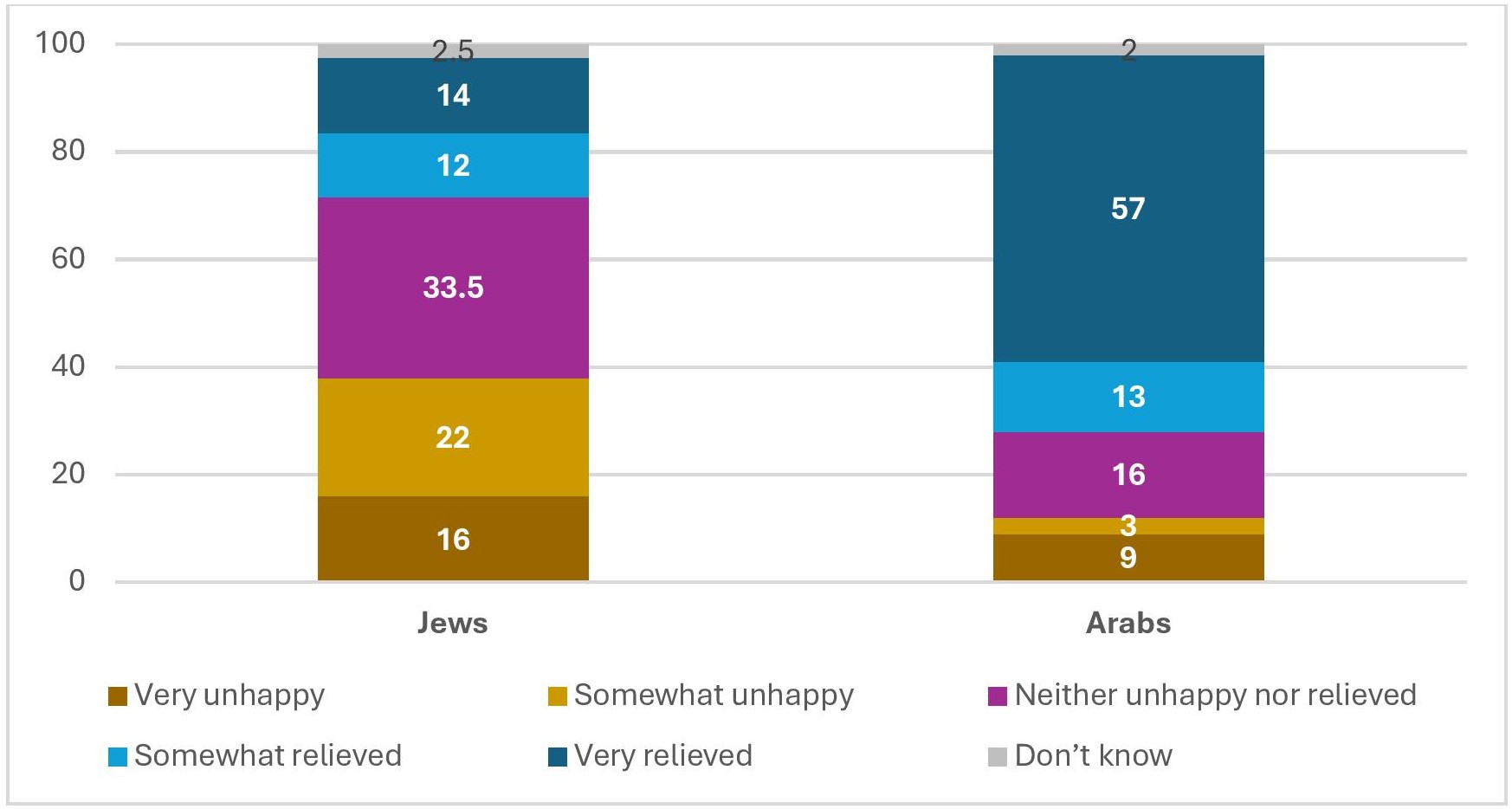
- Only around one-quarter of Jewish respondents felt some degree of relief at the announcement of the ceasefire between the United States and Iran. Around one-third reported that they felt neither relieved nor unhappy, and around 40% were unhappy to some extent.
- Among Arab respondents, a very large majority (70%) felt relieved when the ceasefire was announced. Only a minority (12%) were unhappy to some degree.
How did you feel when you heard about the ceasefire between the United States and Iran? (%)
- In the Jewish sample, the share of those on the Left who felt unhappy to some degree on hearing about the ceasefire was smaller than the corresponding shares in the Center and on the Right, while the share who felt relieved was larger than in the other two camps. A larger proportion of respondents on the Right and in the Center said they were neither unhappy nor relieved than did so on the Left.
How did you feel when you heard about the ceasefire between the United States and Iran? (Jews; %)
| Left | Center | Right | |
| Very or somewhat unhappy | 31 | 35 | 40 |
| Neither unhappy nor relieved | 24 | 34.5 | 35.5 |
| Very or somewhat relieved | 38 | 28 | 22 |
- Segmentation of the Jewish sample by area of residence reveals that the greatest degree of dissatisfaction with the ceasefire was reported in the north (48%), and the least, in the West Bank/Judea and Samaria (29%). This was also the area with the highest proportion of respondents who were neither relieved nor unhappy (46%). The lowest proportion of those who felt this way was found in the north (21%). The areas with the highest proportion of residents who felt relieved were Jerusalem and the south (31% each), while Haifa had the lowest (21%), but the differences between the different regions in terms of the share of respondents who felt relieved were relatively small. (In the Arab sample, we were unable to perform a regional segmentation due to the small number of respondents.)
- The percentage of Jewish women who were unhappy to hear of the ceasefire was slightly higher than that of men (40% versus 36%). No significant difference was found between Arab women and men on this issue.
- Breaking down responses in the Jewish sample by age produced only one interesting finding: Older respondents were less unhappy than younger respondents following the announcement of the ceasefire (respectively, 34% of those aged 55 and over were unhappy, compared to 40.5% in the 35–54 age group, and 39% in the 18–34 age group).
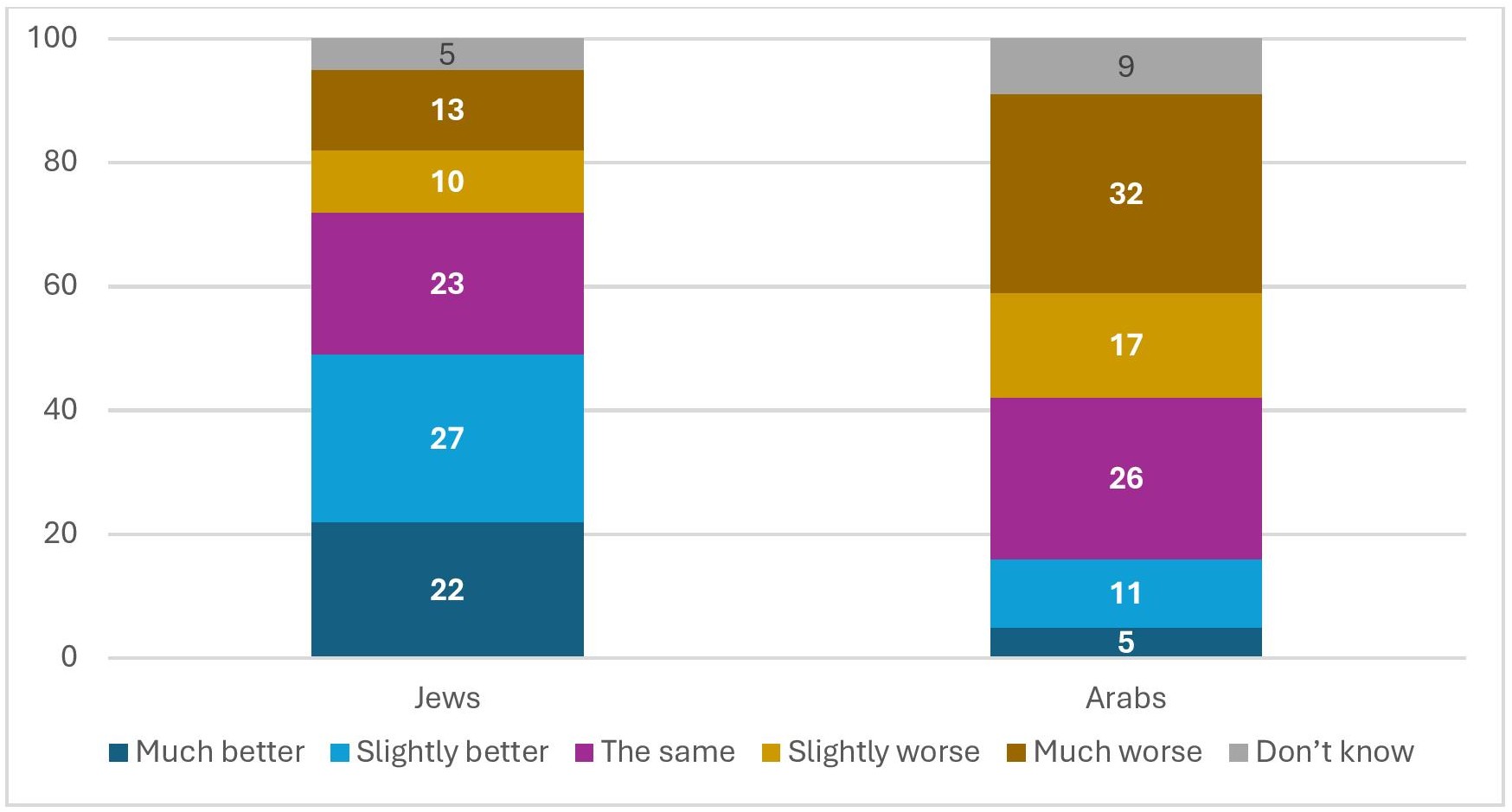
- Approximately half of the Jewish respondents think that Israel’s strategic and security situation is slightly better or much better now than it was before Operation Roaring Lion. Just under a quarter think that the situation has not changed, and a similar share think it has worsened.
- Among Arab respondents, around one-half think that Israel’s strategic and security situation is slightly worse or much worse now than it was before Operation Roaring Lion, around one-quarter think that it has remained unchanged, and only a small minority (16%) believe that the situation is slightly or much better.
Is Israel’s strategic and security situation better or worse now than it was before Operation Roaring Lion? (%)
- In the Jewish sample, around half of those on the Left (51%) think that Israel’s strategic and security situation is slightly or much worse following the Operation, and only 18% that it is better. In the Center, 34% think Israel’s situation has improved, while 29% think that it has worsened. On the Right, there is a clear majority (62%) who think that Israel’s situation has improved as a result of the operation, and only 15% think that it has deteriorated.
- Among Jews, more than 90% gave the IDF a positive performance rating, but only 38% rated the government’s performance positively.
- Among Arabs, the shares providing a positive assessment were significantly smaller in both cases for both bodies: Just over one-third rated the IDF’s performance positively, while only one-tenth did so for the government’s performance.
- Segmentation of the Jewish sample by political orientation reveals a highly positive assessment of the IDF in all three camps, although its rating was higher in the Center and on the Right than on the Left.
- The government’s rating is significantly lower than that of the IDF in all three camps. The differences between the camps in their assessment of the government’s performance are large: In the Center, and even more so on the Left, a very small proportion of respondents have a positive view of the government’s handling of the war, while the corresponding share on the Right is just over one-half.
Proportion of respondents who awarded high scores (4–5) to each of the following for their management of Operation Roaring Lion (on a scale from 1 = very poor to 5 = excellent,%)
- In the total sample, considerable differences were found in assessments of the government’s handling of the Operation among voters for the various coalition parties in the 2022 elections, although for all these parties, the majority of respondents gave the government a score of good or excellent. Among Likud voters, “only” 59% gave the government a high score for its management of the Operation, compared to 69% of Shas voters, 71% of Religious Zionism voters, and 83% of voters for United Torah Judaism. As expected, the majority of voters for opposition parties in the 2022 elections awarded low scores to the functioning of the government.
- The IDF received very high performance ratings among voters for all Jewish parties, ranging from 84% (Yisrael Beytenu) to 97% (National Unity). Among voters for Arab parties, the shares of those who gave the IDF high scores are smaller: only 22% of Ra’am voters, and 26% of Hadash-Ta’al voters.
- In terms of average scores, the largest gap between the assessment of the government’s performance and that of the IDF was found in the oldest age group in the Jewish sample (55 and over). The average score given by this group of respondents to the government was only 2.85 (compared to an average score of 3.03 from the youngest age group, and 2.91 from the intermediate age group), while the IDF received an average score of 4.75 (compared to 4.60 from the youngest age group and 4.69 from the intermediate age group).
- We asked: “What is the likelihood that the agreement that may be reached between the United States and Iran will take Israel’s security into account to an appropriate degree?” A large majority of Jewish respondents are pessimistic in this regard (72%), while only a small minority (20.5%) think there is a high likelihood that the agreement reached following the ceasefire will properly take into account Israel’s security.
- Arabs are less pessimistic than Jews about the probability that an agreement between the United States and Iran will benefit Israel’s security. While just over one-half think the likelihood of this happening is fairly or very low, more than a third (38%) rate it as fairly or very high.
What is the likelihood that the agreement that may be reached between the United States and Iran will take Israel’s security into account to an appropriate degree? (%)
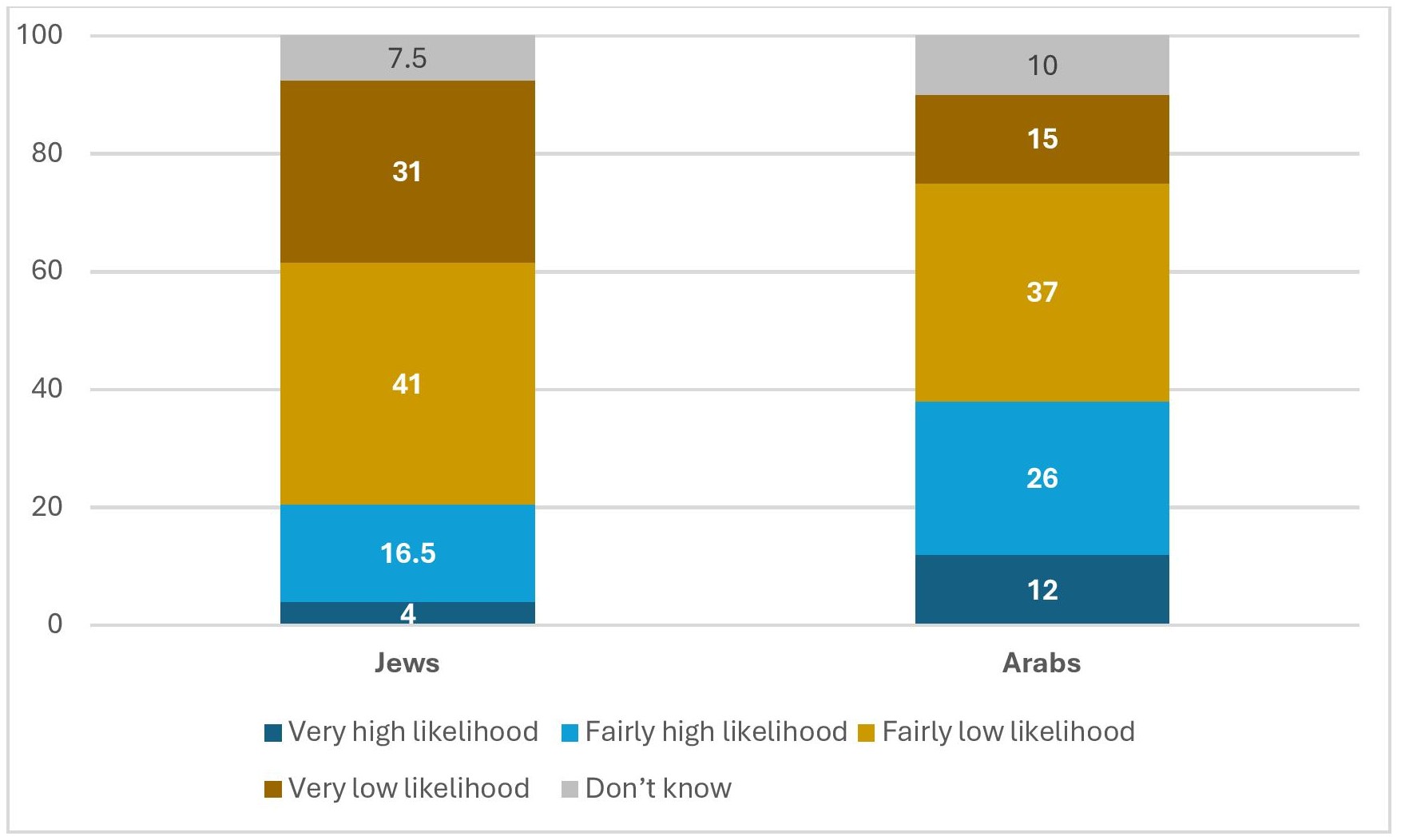
- In the Jewish sample, those on Left are the most pessimistic on this issue, but even in the other two camps, the majority do not believe that an agreement between the United States and Iran will take Israel’s security into account to an appropriate degree (84.5%, 74%, and 68%, respectively).
- A very large majority of Jewish respondents (80%) think that Israel should continue the fighting in Lebanon against Hezbollah, regardless of developments vis-à-vis Iran, even if this results in friction with the US administration.
- Among Arabs, a two-thirds majority (66%) are opposed to the continuation of the fighting in Lebanon.
Should Israel continue the fighting in Lebanon against Hezbollah regardless of developments vis-à-vis Iran, even if this results in friction with the US administration? (%)
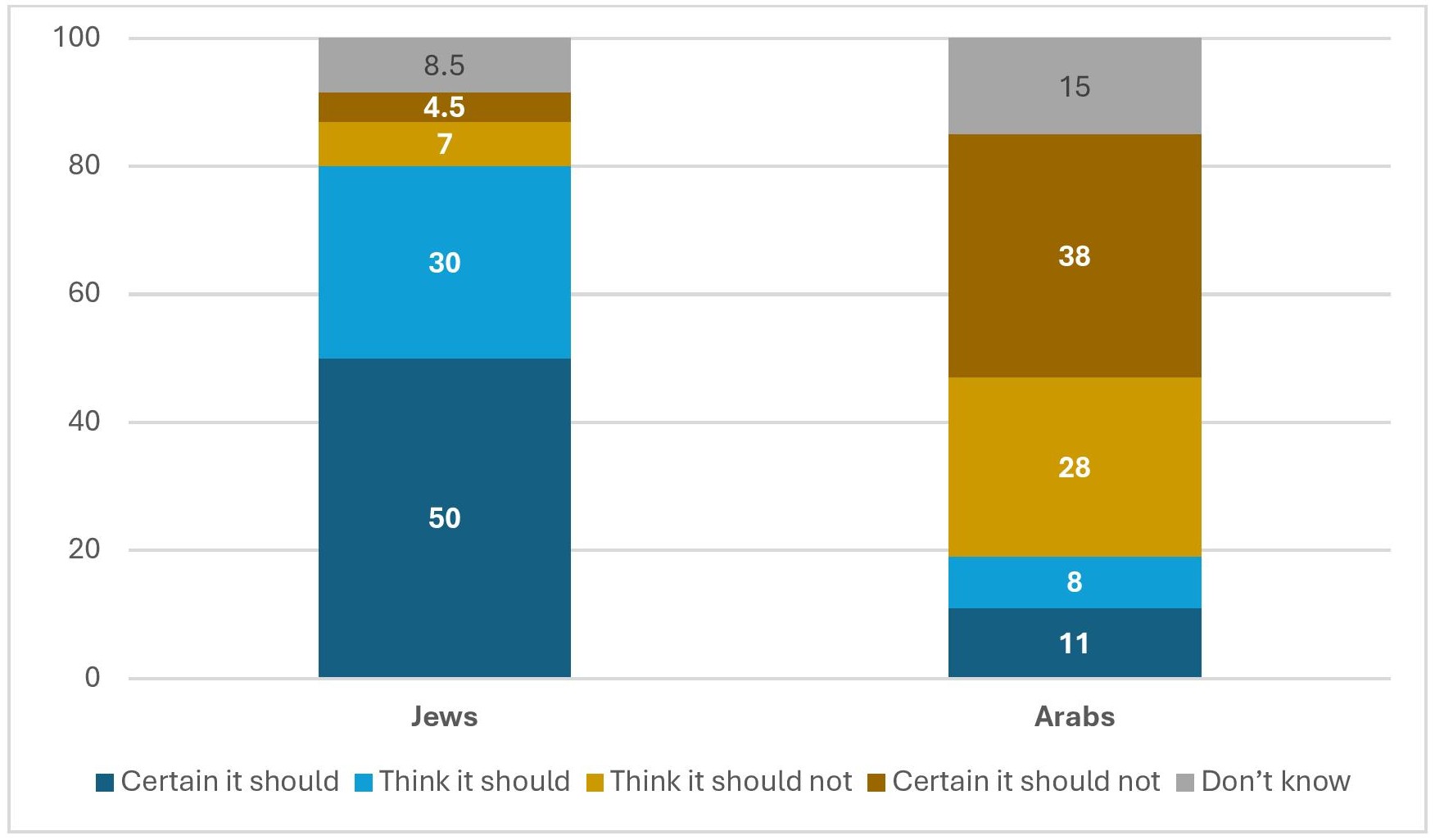
- In the Jewish sample, more than half of those on the Left are in favor of continuing the fighting against Hezbollah in Lebanon even if it means friction with the US administration (56%), while in the Center and even more so on the Right, this is the view of the large majority of respondents (74% and 89%, respectively).
- Breaking down the Jewish sample by area of residence did not reveal large differences, as in all regions a majority of respondents support the continuation of the fighting against Hezbollah. However, the largest share in favor of continued fighting was found in the central region (84%) and the lowest, in the West Bank/Judea and Samaria (64%). In the north and Haifa (79% in both cases), there is strong support for continuing the fighting even at the cost of friction with the United States.