

Lag B’Omer at Mt. Meron: What both sides get wrong
In the midst of fringe calls to violence that misrepresent the Lag B'Omer pilgrimage to Mount Meron, Haredi leadership ought to speak out for public responsibility and safety. Five years after the Meron crush disaster that left forty-five dead, protecting life is not a concession. It is a moral and religious imperative.
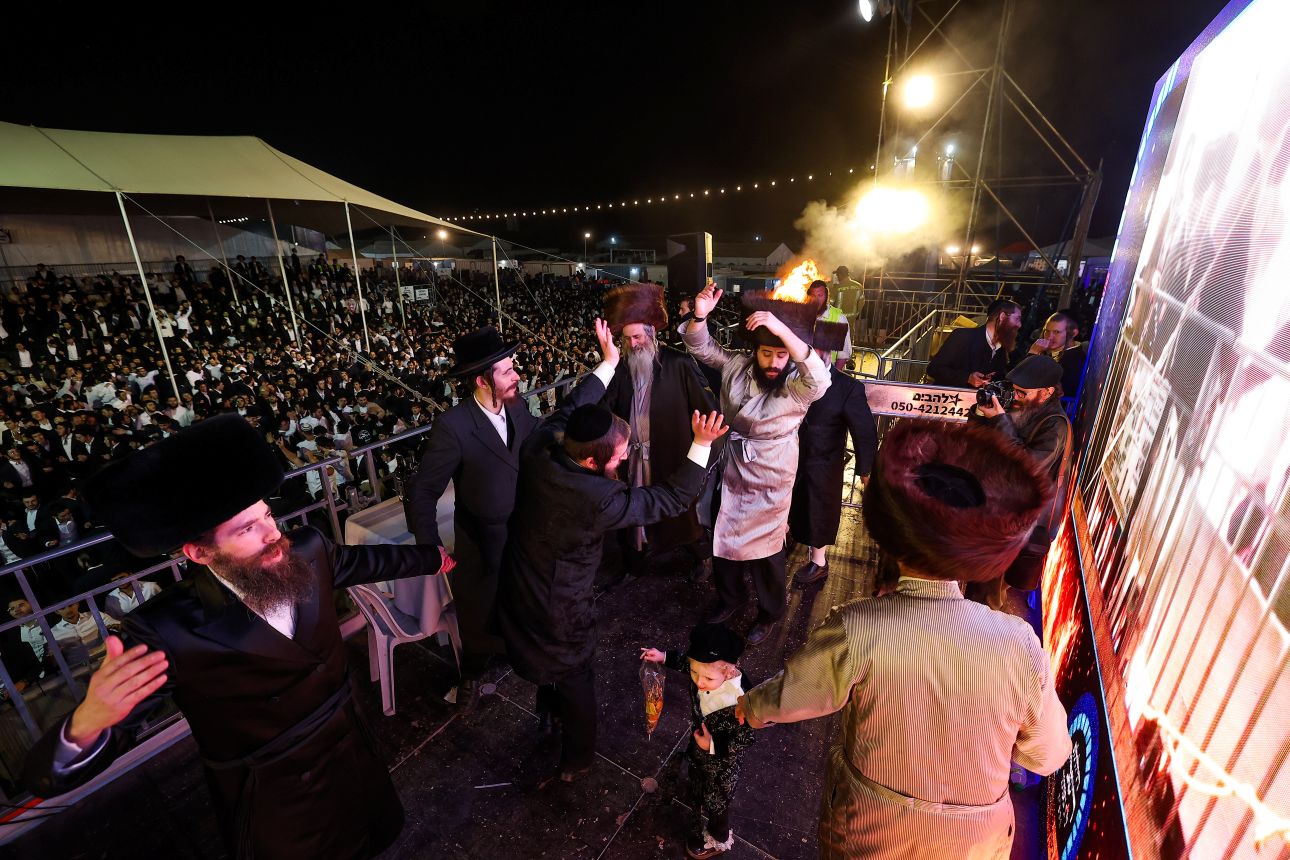
Photo by Shlomi Cohen/Flash90
In the days leading up to Lag Ba'Omer, Israelis saw the writing on the wall…quite literally: "One who comes to kill you, rise early [and kill him first]" was written on a poster plastered throughout Haredi neighborhoods, referring to police. To understand why, we must first understand the deep significance of the hillula on Lag B'Omer
A hillula is a Jewish custom to celebrate the anniversary of the passing of a righteous individual. The traditional Lag B'Omer hillula is a pilgrimage-celebration held at the tomb of Rabbi Shimon Bar Yochai—known by his acronym Rashbi— on the anniversary of his death on the Lag Ba'Omer holiday at the site of his burial on Mount Meron in northern Israel. The celebration has been taking place for hundreds of years, but as Kabbalistic and Hasidic traditions grew stronger and Rashbi's stature rose in the Jewish religious imagination, the hillula became a defining event for various religious communities in Israel, primarily for those from Hasidic and Sephardic-Mizrahi backgrounds. To understand its popularity, one must understand who Rabbi Shimon Bar Yochai was.
In Talmudic and Midrashic sources, Rashbi's image is that of one of the greatest disciples of Rabbi Akiva. But in the Zohar, the foundational text of Jewish mysticism, he is transformed into an altogether different kind of figure — not merely a sage from the mishna, but something closer to a new giver of Torah, the man through whom the inner secrets of the Torah were revealed. For entire communities, he embodies a meeting point with a hidden depth of holiness, with a promise of salvation, with a religious fire that refuses to be contained within the boundaries of ordinary life. Meron, accordingly, is so much more than just a burial site. It is a site of religious eruption: fire, song, tears, prayer, and a felt closeness to the transcendent.
This helps explain what the average Israeli and others outside of this community surely wonder: why do tens of thousands insist on coming to the hillula year after year, even under conditions of pandemic, security threat, or police restrictions? And more to the point, how is it that five years after the catastrophic disaster that unfolded there, in which a crowd crush claimed the lives of forty-five participants, the Meron hillula continues to draw masses with a force that seems almost impossible to contain?
From the state's perspective, Mount Meron is a dangerous mass-gathering site, to be managed through the tools of safety, regulation, and enforcement. But for many of those who ascend Mount Meron on Lag B'Omer, a security checkpoint—or prohibition on gathering—is experienced as a violation of sacred space, not a security decision. This double misunderstanding is not a justification for breaking the law, and certainly not for violence. It is, however, a necessary distinction, because Meron cannot be managed by orders and barriers alone.
About two years ago, the government imposed restrictions on the ascent to the hillula, again on security grounds. Tens of thousands of believers tried to make the ascent regardless. Police enforcement was forceful, and Haredi media circulated jarring images of elderly men beaten and collapsed on the ground. Out of this grew a collective memory of injury and humiliation, which extremist circles are now trying to translate into the language of struggle.
And so we return to the writing on the wall: "One who comes to kill you, rise early [and kill him first]." As mentioned, this headline appeared in a poster circulated and plastered across Haredi neighborhoods last week, referring explicitly to law enforcement. The body of the poster promised "a special distribution of self-defense equipment for all those ascending to Meron, who fear a recurrence of police violence like that of two years ago." The list included helmets, pepper spray, and electric tasers for the general public, and gas pistols, smoke grenades, and body cameras for community representatives. The poster was signed by "those who have drawn lessons from police violence at Meron."
The ideological identity of those behind the poster is not hard to guess: the minority Haredi militant factions for whom confrontations with state authorities and the police are standard fare. To this we say unequivocally: This poster is not Meron, and it does not represent the tens of thousands who make the pilgrimage up the mountain. It is fringe, dangerous, and violent, which is precisely why we must not blur the line between extreme elements that paint the police as the enemy and a broad public seeking to reach a place of prayer, longing, and sanctity.
The poster exploits a deep religious truth, that is, the longing for the transcendent at the Meron hillula, and twists it into a call for war. It replaces the real question, how to hold a hillula without endangering human lives, with a false and dangerous one: how to fight those who are preventing us from reaching holiness. This interpretation is a distortion of the religious significance of Meron. And here, we see just how important the role is of responsible Haredi leadership—leadership that will reinforce the forceful statements of the Sephardic Chief Rabbi of Israel, Rishon LeZion Rabbi David Yosef, who has discouraged ascent the mountain at this time. Haredi leadership must speak out against a romanticism of confrontation, and for public responsibility and safety.
Five years after the Meron crush that left forty-five dead, protecting life is not a concession to the hillula. It is the only moral and religious condition for its continued existence.
This article was published in The Times of Israel.