

30 years ago, this week: When Mr. Netanyahu became PM Netanyahu
Thirty years ago this week, on June 18, 1996, MK Benjamin Netanyahu was sworn in as Israeli Prime Minister for the first time. Since then, he served a cumulative total of nearly 19 years in office. This makes him one of the longest-serving leaders in the democratic nations.
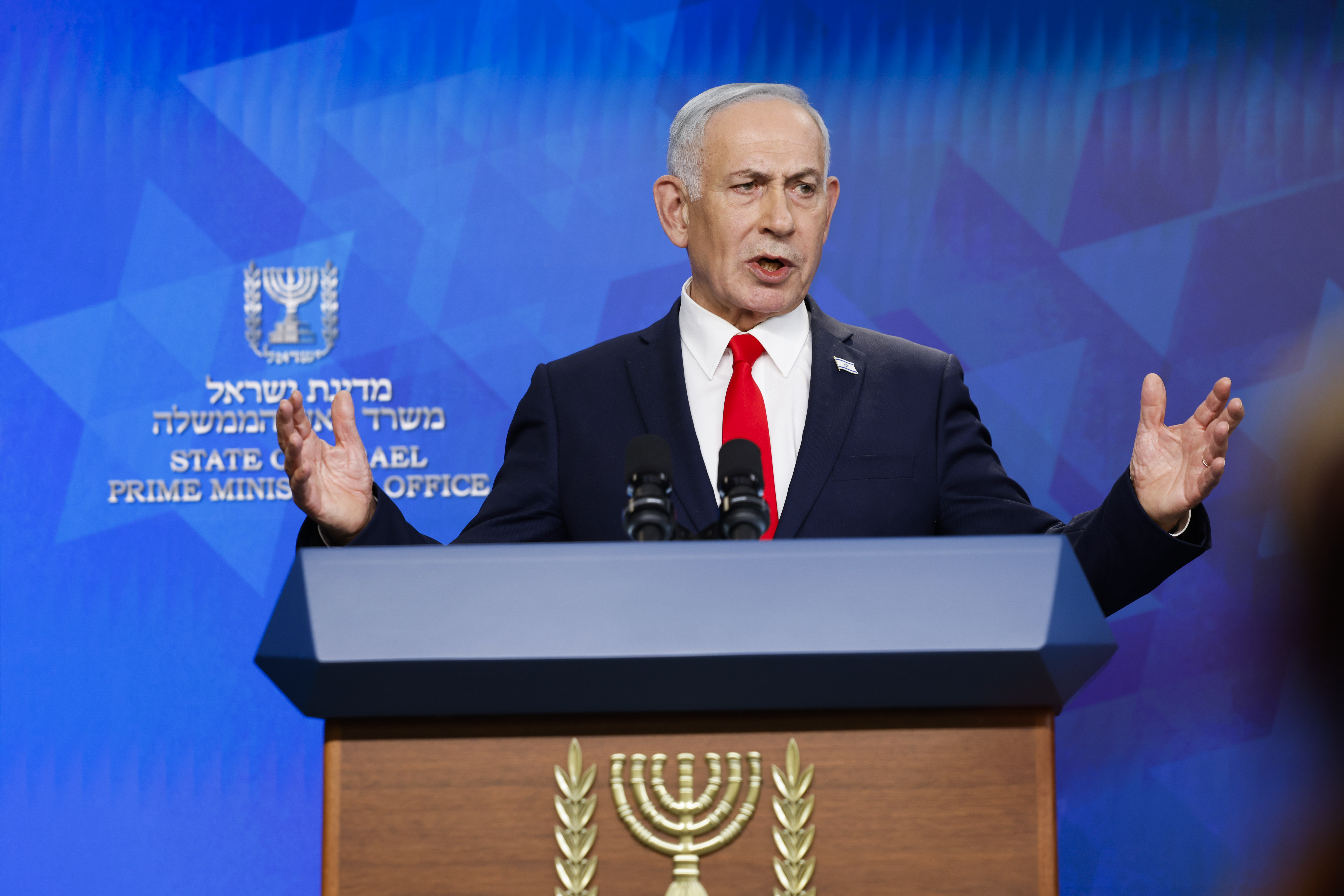
Photo by OLIVIER FITOUSSI/POOL***
I, Benjamin, son of Tzila and Ben-Zion Netanyahu, pledge as Prime Minister to remain loyal to the State of Israel and its laws, to faithfully fulfill my duties as Prime Minister, and to carry out the decisions of the Knesset.
With those words, spoken in front of the Knesset Plenum on 18 June 1996, Benjamin Netanyahu was sworn in and started his first term as Prime Minister of Israel. 30 years later, Netanyahu is still in office, one of the longest-serving leaders in the democratic world.
On 29 May 1996, Netanyahu narrowly defeated Shimon Peres (Labor Party) in a direct election for the prime minister, and three weeks later the first Netanyahu Government was sworn in. That was the first among six governments he headed. Following a relatively short first term (1996-1999) Netanyahu took a political timeout, only to come back three years later and serve as Minister of Foreign Affairs, and then Minister of Finance in Ariel Sharon’s cabinets. Netanyahu returned to the office of prime minister following the 2009 elections and remained in the position until 2021. This period in office is the longest consecutive time ever held by an Israeli prime minister. After about 18 months out of office (during the Bennett-Lapid government), Netanyahu performed a second political ‘comeback’ following the 2022 elections.
Netanyahu’s six governments
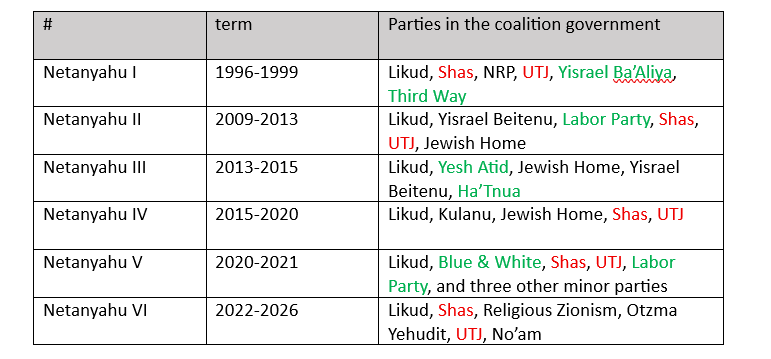
* In red – Haredi parties; In green – center or center-left parties.
Netanyahu’s early governments were rather balanced, as he always sought to include centrist and even left-of-center parties in his coalition governments. Even when he could build a politically homogeneous right-wing coalition (following the 2009 elections, for example), he preferred to invite partners from the opposing political side. The 2015 elections, however, signaled a turning point in his preferences. He formed a right-wing coalition government (only slightly moderated by Moshe Kahlon’s Kulanu party) and fortified his strong political alliance with Haredi and ultra-right parties. While, after the 2020 elections Netanyahu did indeed form a 'parity' government with Benny Ganz’s centrist party, this was done only after multiple rounds of elections in which no candidate could form a government, and the nascent covid pandemic essentially forced his hand. Indeed, at the first opportunity Netanyahu terminated this short-lived government. Following the 2022 elections, he built the most rightwing coalition in Israel’s political history.
As of today, Netanyahu’s accumulative term length is heading towards the 19-year milestone. This spell of time in office is remarkable not just in Israel but also in comparative perspective. Netanyahu ranks 5th in this respect and will overpass Jean-Claude Juncker of Luxembourg by the time of the coming elections, to rise to 4th.
10 leaders with the longest accumulative time in office
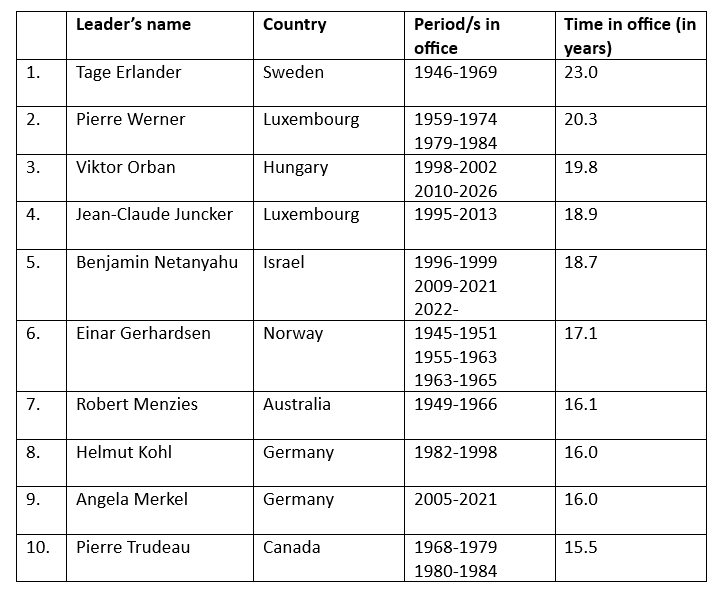
* Leaders of OECD democracies, from 1945 onwards. All the leaders above are prime ministers, who do not face term limits like presidents in presidential systems.
Netanyahu’s enduring time in office, just like the long terms of other leaders mentioned in the table above, raises the question about the need for prime ministerial terms limits. This institutional mechanism, a key feature in presidential systems, is extremely rare in parliamentary democracies. The reason lies in the very nature of the parliamentary system, where prime ministers are not directly elected by the public, and therefore the danger of accumulating excessive and potentially dangerous power based on direct public legitimacy is lower than in presidential systems. Moreover, prime ministers are subject to several internal checks and balances: votes of no confidence, coalition pressures, and even internal challenges within their own party. Term limits also pose a real challenge to the dynamics of the parliamentary system, which derive from the fact that the terms of parliament and government are not necessarily harmonized.
Yet in recent years, calls to impose term limits have been increasing even in parliamentary democracies. The primary reason is a process of “presidentialization”: the strengthening of prime ministers’ position as individuals and their transformation into more powerful figures, both in the executive sphere and in the public and electoral arenas. When long tenures combine with an extreme concentration of power and with trends of democratic backsliding, concerns about the erosion of democratic institutions intensify, along with calls for a “safety valve” in the form of term limits.
It is not surprising, then, that one of the first actions of the new, post-Orban, government in Hungary has been the amendment of the constitution by installing an 8-year limit on the terms of prime ministers. Calls to adopt term limits have taken root in Israel as well. In fact, several party leaders – including Naftali Bennett, Gadi Eisenkot, Yair Golan and Avigdor Lieberman – have already declared their intention to promote such a measure in the next Knesset. A two-term limit for prime ministers is also supported by the majority of Israeli citizens with a recent poll by IDI's Viterbi Family Center for Public Opinion and Policy Research, finding that about 61% support such a measure, while only 25% object.
While it is unknown at this point whether Netanyahu will succeed in forming yet another government after this fall's election, his prolonged time in office over the years has sparked many debates. Now, a growing number of Israelis are ready to follow the lead of presidential democracies and consider a fundamental change to our parliamentary system.
This article was published in The Times of Israel.