
Voting Patterns of Jews in the 2022 Elections by Religious Self-Definition
This review demonstrates a clear correlation between religious self-definition and voting in elections. The further one moves toward the secular end of the continuum between Haredim and secular Jews, the greater the likelihood of voting for a political camp currently identified with the opposition, and vice versa.
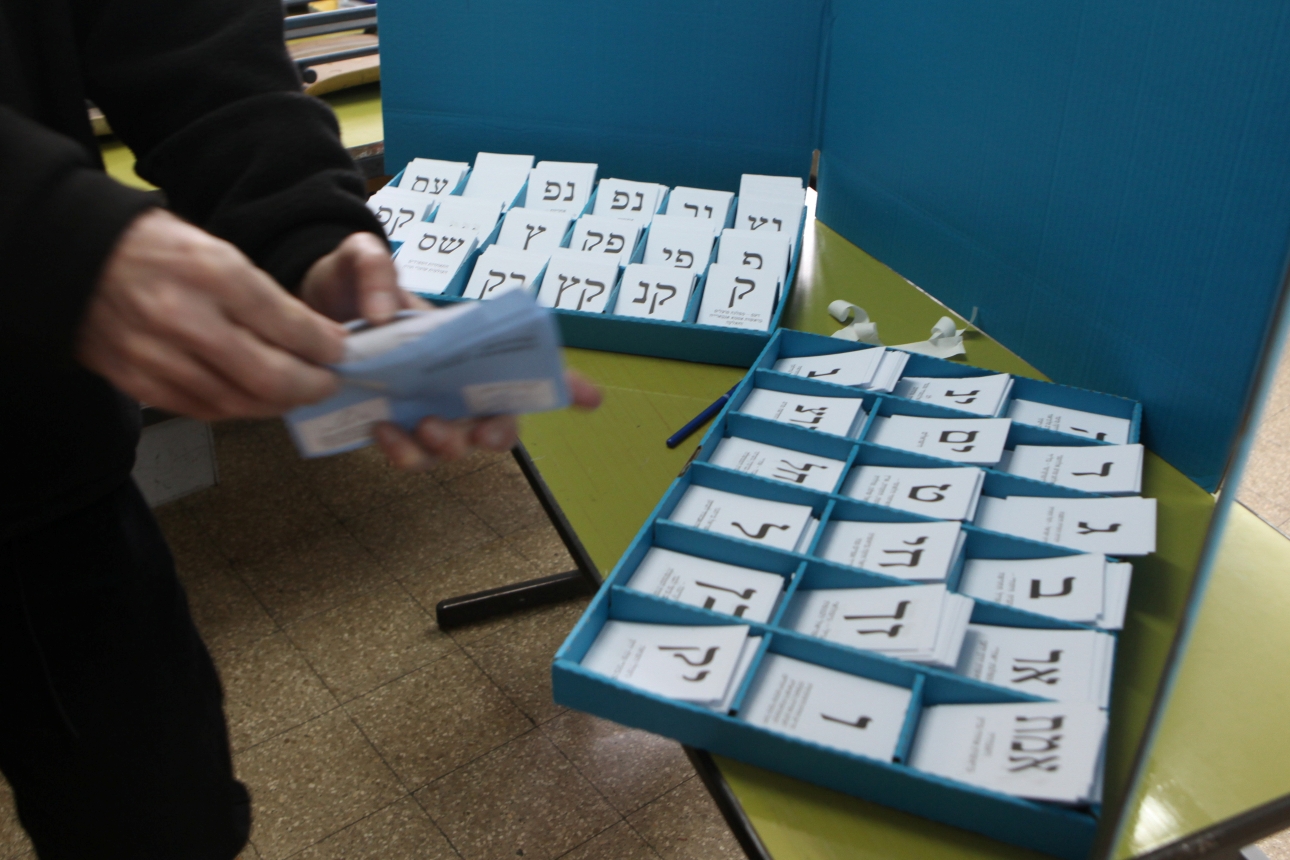
Photo by Flash 90
Introduction and Methodology
This review presents a mapping of the voting patterns of the Jewish public in Israel in the Knesset elections held in November 2022. These patterns were examined by religious self-definition, in accordance with the Central Bureau of Statistics’ customary division of Jewish society into five categories of religious self-definition: Haredi, religious, traditional-religious, traditional non-religious, and secular.
In most Western democracies, individual voting patterns are based on historical and structural cleavages shaped by a variety of factors, including economic class, nationality, ethnic/communal origin, degree of religiosity, and place of residence. Against the backdrop of the strengthening of “tribal” trends in Israeli society, which are based to a large extent on the division of Israeli society into different groups along religious lines, it is especially important in Israel to examine the relationship between voting and the variable of religious self-definition.
The information presented is based on an aggregate analysis of 20 different surveys conducted by the Viterbi Family Center for Public Opinion and Policy Research at the Israel Democracy Institute in the year following the elections; that is, the surveys were conducted between November 2022 and October 2023. These surveys were not seat-projection or election surveys, but rather as part of the full set of questions asked in each survey, respondents answered, among other things, which list they voted for in the most recent elections and how they define themselves religiously. The question on religious self-definition used in these surveys is almost identical to the five categories of the Central Bureau of Statistics mentioned above, with one exception: the category “religious” does not appear; instead, respondents are presented with two different categories: “national-religious” and “Torani/Hardal.”
The 20 surveys noted above include a representative sample of Jewish society in Israel, with a total of 12,322 Jews aged 18 and over participating. Of these, 6.5% answered that they had not voted in the elections or had cast a blank ballot, and another 6.5% of respondents refused to answer the question of which list they had voted for (the distribution of those who refused to answer was almost entirely uniform across the different religious groups, so this figure has no real effect). The review below examines voting patterns among voters in the elections only, and is therefore based on a total sample of 10,694 Jews. I am grateful to Ayala Goldberg for her assistance in collecting and processing the data.
Background
This review deals with the elections for the Twenty-Fifth Knesset, which were held on November 1, 2022. The elections took place during the period of the political crisis in Israel, which had lasted about three and a half years since the failed attempt to form a government after the elections for the Twenty-First Knesset (April 2019). During the crisis, five election cycles were held, with the 2022 elections being the fifth. The elections were held after the dissolution of the 36th Government of Israel, which was a rotation government headed by Naftali Bennett and Yair Lapid and had served since June 2021.
In the 2022 elections, 49 parties competed within the framework of 40 lists.² Of these, 10 lists passed the electoral threshold and entered the Knesset:
- Likud, headed by Benjamin Netanyahu (32 seats).
- Yesh Atid, headed by Yair Lapid (24 seats).
- Religious Zionist-Otzma Yehudit, headed by Bezalel Smotrich (14 seats): this list included three parties: Religious Zionist, headed by Bezalel Smotrich; Otzma Yehudit, headed by Itamar Ben-Gvir; and Noam, headed by Avi Maoz.
- National Unity, headed by Benny Gantz (12 seats): this list included two parties: Blue and White (Israel Resilience), headed by Benny Gantz, and New Hope, headed by Gideon Sa’ar.
- Shas, headed by Aryeh Deri (11 seats).
- United Torah Judaism, headed by Yitzhak Goldknopf (7 seats): this list included two parties: Agudat Yisrael, headed by Yitzhak Goldknopf, and Degel HaTorah, headed by Moshe Gafni.
- Yisrael Beytenu, headed by Avigdor Liberman (6 seats).
- Ra’am, headed by Mansour Abbas (5 seats).
- Hadash-Ta’al, headed by Ayman Odeh (5 seats): this list included two parties: Hadash, headed by Ayman Odeh, and Ta’al, headed by Ahmad Tibi.
- Labor, headed by Merav Michaeli (4 seats).
Alongside these lists, three additional parties competed and won more than 1% of the vote but did not pass the electoral threshold: Meretz, headed by Zehava Galon (3.2% of the votes); Balad, headed by Sami Abu Shehadeh (2.9%); and The Jewish Home, headed by Ayelet Shaked (1.2%).
Part A: Voting by Religious Group (by Self-Definition)
The Haredi Public
The following chart presents the distribution of voting among the Haredi public in the 2022 elections.
Breakdown of voting among the Haredi public in the 2022 elections, by list (%)
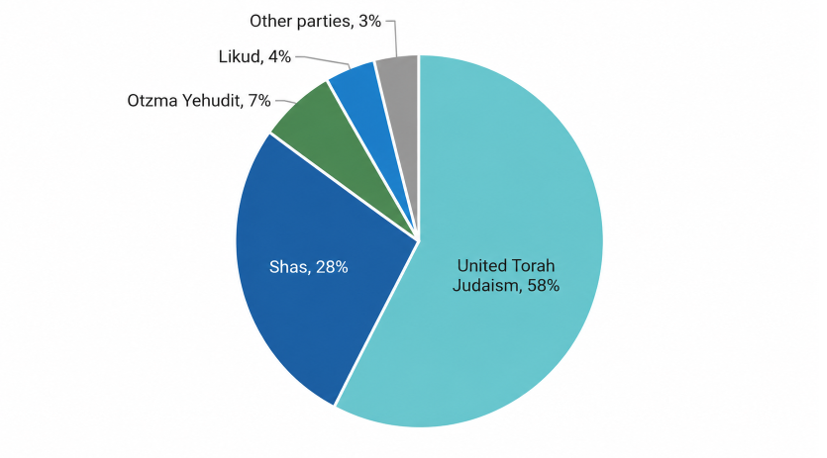
Eighty-six percent of those who define themselves as Haredi voted for the Haredi lists: 58% for United Torah Judaism and 28% for Shas. By contrast, 14% of the Haredi public did not vote for the Haredi lists: 7% voted for the Religious Zionist-Otzma Yehudit list, 4% for Likud, and the remainder (3%) voted for the other lists.
A comparison with the 2021 elections shows a slight decline in the share of Haredim who voted for Haredi lists—from 89% to 86%—and, conversely, an increase in the share of Haredim who voted for the Religious Zionist-Otzma Yehudit list, from 4% to 7%.
The National-Religious Public
As noted, the national-religious public is divided in the surveys into two groups: the larger group consists of those who define themselves as “national-religious,” and a relatively small group consists of those who define themselves as “Torani/Hardal.” First, the data for the two groups are presented together, and afterward the differences between the two groups are analyzed.
Breakdown of voting among the entire non-Haredi religious public (including Torani/Hardal) in the 2022 elections, by list (%)
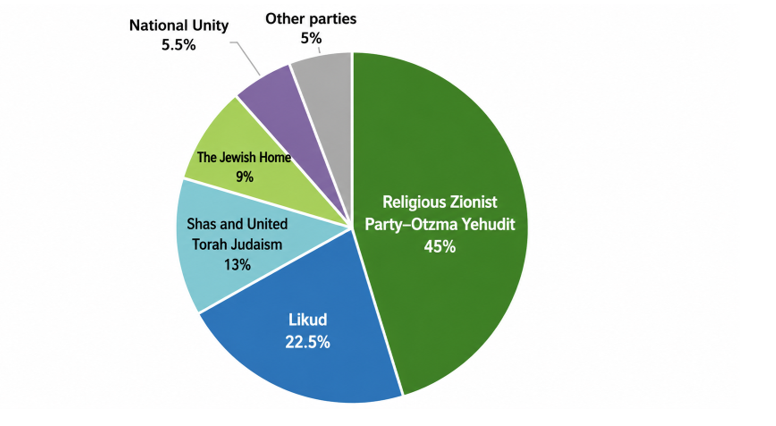
The most prominent list among national-religious voters was Religious Zionist-Otzma Yehudit, for which 45% of national-religious voters voted; the next most prominent list was Likud, with 22.5% of the national-religious vote. In addition, 13% of national-religious voters voted for the Haredi lists, most of them—10.5% of national-religious voters—for Shas, and the remainder for United Torah Judaism. The Jewish Home list (headed by Ayelet Shaked), which did not pass the electoral threshold, won 9% of the national-religious vote. The other lists, which are in effect opposition lists, won 10.5% of the national-religious vote; about half of them—5.5% of the national-religious public—voted for National Unity.
Compared with the 2021 elections, a significant change occurred among national-religious voters against the backdrop of the withdrawal of the Yamina list headed by Naftali Bennett, which in the 2021 elections received the votes of 27% of national-religious voters. The new list of Yamina member Ayelet Shaked, The Jewish Home, won, as noted, 9% of the religious vote in the 2022 elections, so the remaining votes were distributed among other lists. Apparently, most of Yamina’s votes shifted to the Religious Zionist-Otzma Yehudit list, which experienced a substantial increase, from 30% of the national-religious vote in the 2021 elections to 45% in the 2022 elections. The disappearance of Yamina did not lead to an increase in the share of national-religious voters who voted for Likud, which remained at around 23%, while there was a slight increase in the share of national-religious voters who voted for the Haredi lists (from 11% to 13%) and for the opposition lists (from 9% to 10.5%).
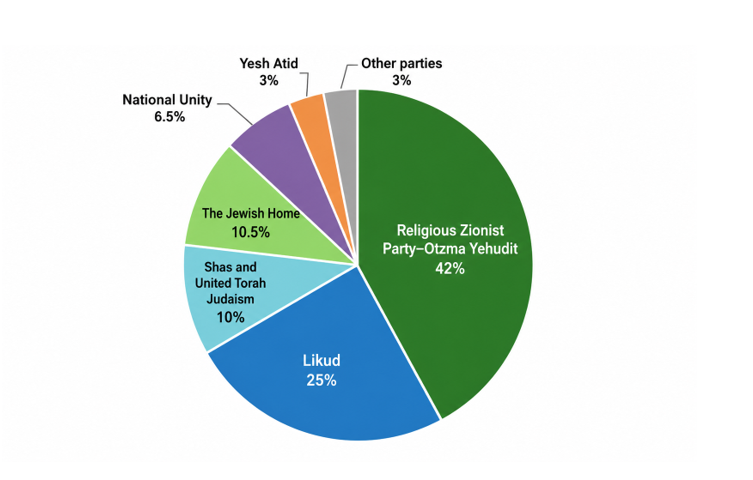
The next two charts present the distribution of voting while distinguishing between the different types of national-religious voters: (1) Torani/Hardal; (2) national-religious but not Hardal.³
Breakdown of voting among the national-religious public that is not Hardal in the 2022 elections, by list (%)
Breakdown of voting among the Torani/Hardal public in the 2022 elections, by list (%)
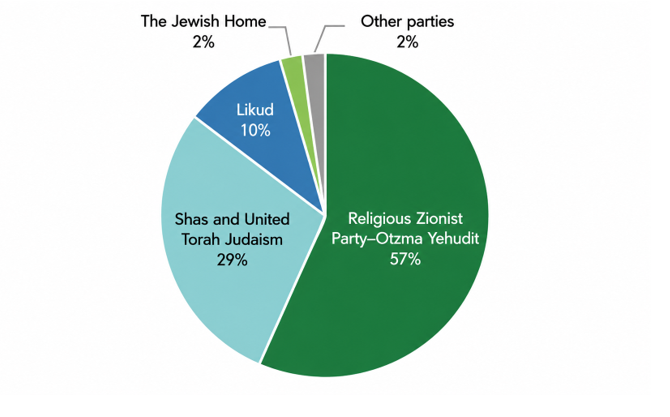
Significant differences can be seen between the voting patterns of the Torani/Hardal group and those of the rest of the national-religious public. The Torani/Hardal public voted at a much higher rate for the Religious Zionist-Otzma Yehudit list (57%) and also for the Haredi lists (29%). Among the non-Hardal national-religious public, by contrast, the Religious Zionist-Otzma Yehudit list was indeed the most dominant list, but the share voting for it was much lower (42%), and the share voting for the Haredi lists was also much lower (10%). Conversely, the share voting for Likud among the non-Hardal national-religious public was much higher than among the Torani/Hardal public (25% compared with 10%), as was the share voting for the opposition lists (12.5% compared with 2% among Torani/Hardal voters) and for The Jewish Home list (10.5% compared with 2% among Torani/Hardal voters).
The Traditional Public
As noted, the traditional public is also divided in the survey into two groups: “traditional-religious” and “traditional non-religious.” First, the data for the two groups is presented together, and afterward the differences between the two traditional groups are examined.
Breakdown of voting among the entire traditional public in the 2022 elections, by list (%)
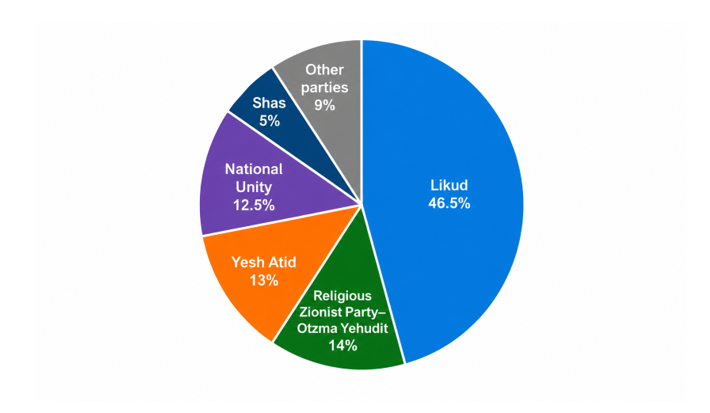
The preferred list of the traditional public—by a considerable margin—is Likud, with 46.5% of traditional voters voting for this list. The three strongest lists among the traditional public after Likud were Religious Zionist-Otzma Yehudit (14%), Yesh Atid (13%), and National Unity (12.5%).
A comparison with the 2021 elections shows a substantial increase in the share of traditional voters who voted for Likud and for Religious Zionist-Otzma Yehudit. The share of traditional voters who voted for Likud rose between the two election cycles from 39% to 46.5%, and the share of traditional voters who voted for the Religious Zionist-Otzma Yehudit list rose from 4% to 14%. The share of traditional voters who voted for Yesh Atid also rose somewhat, from 11% to 13%. These upward trends came mainly at the expense of the Yamina list, which in the 2021 elections won 14% of the traditional vote and, as noted, did not run in the 2022 elections (although 2% of traditional voters voted in the 2022 elections for The Jewish Home list). A decline in the share of traditional voters was also recorded for National Unity: the two parties that made it up—New Hope and Blue and White—together won 18% of the traditional vote in the 2021 elections, while in these elections they declined to 12.5%.
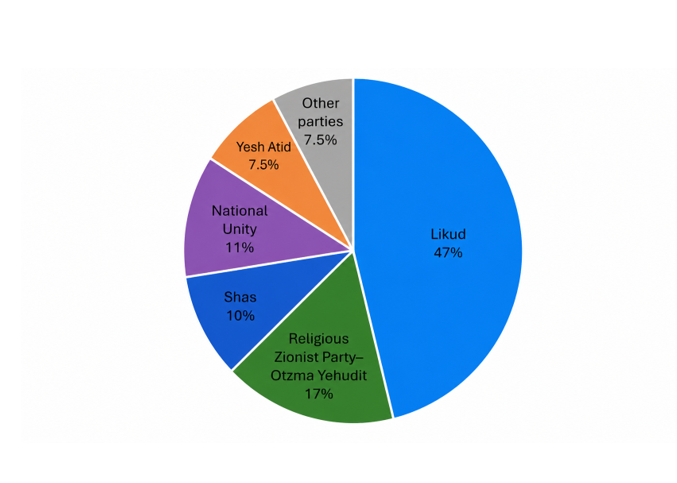
The next two charts present the distribution of voting while distinguishing between the different types of traditional voters.
Breakdown of voting among the traditional-religious public in the 2022 elections, by list (%)
Breakdown of voting among the traditional non-religious public in the 2022 elections, by list (%)
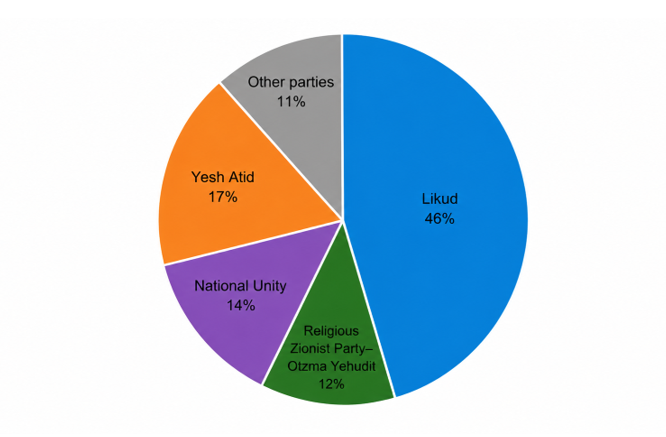
The rate of voting for Likud among the traditional-religious public and the traditional non-religious public is almost entirely identical (47% compared with 46%). By contrast, differences can be identified with respect to voting for other lists. Among the traditional-religious public, there is a greater tendency to vote for religious lists: 17% of the traditional-religious public voted for Religious Zionist-Otzma Yehudit, and another 10% voted for Shas (as well as 1.5% for United Torah Judaism). By contrast, among the traditional non-religious public, the dominant lists after Likud are centrist lists: Yesh Atid (17%) and National Unity (14%), while there is almost no voting for the Haredi lists (2% together for Shas and United Torah Judaism).
The Secular Public
The following chart presents the distribution of voting among the secular public in the 2022 elections.
Breakdown of voting among the secular public in the 2022 elections, by list (%)
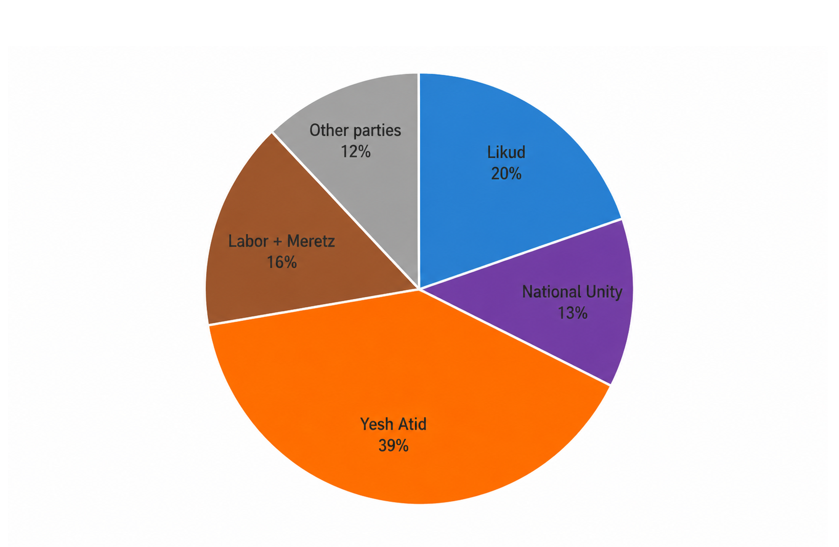
The most dominant list among the secular public was Yesh Atid, which won 39% of the secular vote, followed by Likud, which received 20% of the secular vote. National Unity received 13% of the vote among this public, and the Labor and Meretz lists (which ran separately) together received 16% of the secular vote.
A comparison with the 2021 elections shows a substantial increase in the share of secular voters who voted for Yesh Atid (from 31% to 39%) and a slight increase in the share of secular voters who voted for Likud (from 17% to 20%); conversely, there was a decline in the share of secular voters who voted for National Unity (from 18% to 13%) and for the Labor and Meretz lists (from 19% to 16%).
Distribution of Voting by Political Camps: Analysis of Religious Groups
Beyond presenting voting data at the level of lists, it is important to analyze voting also by political camps or blocs. This is because in recent election cycles, and particularly before the 2022 elections, the lists operated within clearly defined camps: on one side stood Likud, Shas, United Torah Judaism, and Religious Zionist-Otzma Yehudit. On the other side, one could identify a single camp comprising the following lists: Yesh Atid, National Unity, Yisrael Beytenu, Labor, Meretz, and the Arab lists. In accordance with this bloc division, a coalition composed of the four lists making up the first camp was formed immediately after the elections; therefore, we will refer to this political bloc as the coalition camp, while the lists making up the second bloc will be referred to as the opposition camp. Although during the Knesset term there were slight changes in the bloc division (for example, the move of New Hope into the coalition), the discussion here refers to the camps as they operated during the election period and the period of government formation. In cases of lists that did not pass the electoral threshold but were clearly identified with one of the camps, the voters were assigned to the relevant camp (for example, the assignment of Meretz and Balad to the opposition camp). As for several lists that did not pass the electoral threshold but were not clearly identified with one of the blocs, foremost among them The Jewish Home list headed by Ayelet Shaked, the voters were defined as “unidentified.”
The following chart presents the distribution of voting among the different religious groups in Israel’s Jewish public in the 2022 elections, by political camps.
Religious groups in Jewish society in Israel by distribution among political camps in the 2022 elections (%)
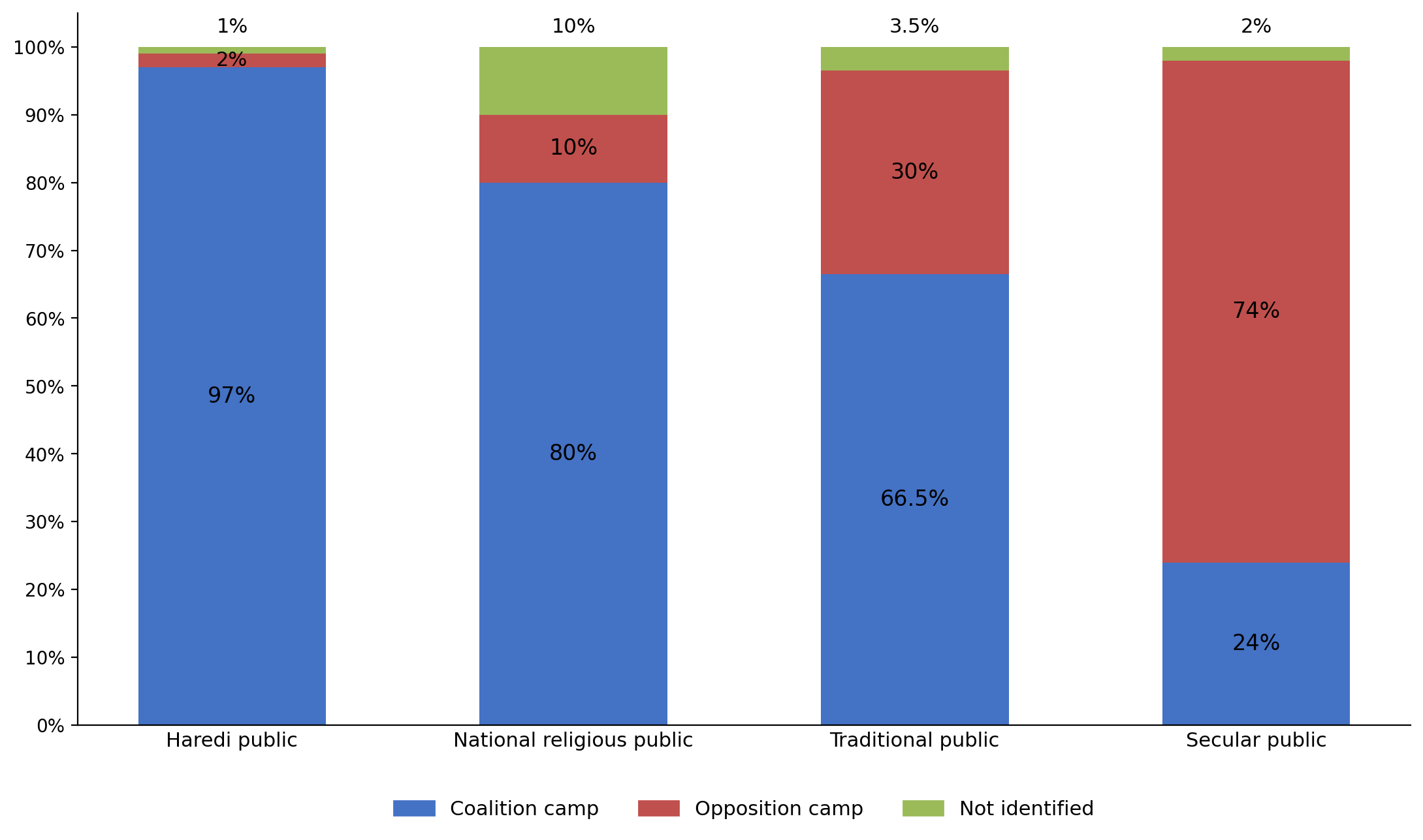
The findings in the chart show that there is a clear correlation between religious/secular self-definition and affiliation with one of the political camps. Among Haredim, among national-religious voters, and among traditional voters, there is a majority for voters of the coalition camp; however, this majority becomes more pronounced as one moves toward the Haredi end of the religious-secular continuum: 97% of Haredim voted for lists in the coalition camp, compared with 80% of national-religious voters and 66.5% of traditional voters. By contrast, among secular voters there is a clear majority of 74% who voted for the opposition camp.
A similar picture was also observed in the 2021 elections, but because at that time the Yamina list—which was not clearly identified with either bloc before the elections—achieved greater success than the unidentified lists in the 2022 elections, the picture was somewhat more complex.
Part B: Breakdown of Voters for the Large Lists
Introduction
While in the previous part the analysis examined the distribution of voting among the different groups in society by religious self-definition, in this part the analysis is conducted from the perspective of the lists and presents the distribution of the Jewish voters of the lists by religious self-definition. Because of the deviations that may result from sample size, the discussion will address only the large lists: lists for which the sample included at least 1,000 respondents—Likud, Yesh Atid, Religious Zionist-Otzma Yehudit, and National Unity. These four lists are the only ones that received more than 400,000 votes in the 2022 elections.
For convenience and simplicity, in this part the focus will be on the four main religious self-definition groups, combining the definitions traditional-religious and traditional non-religious into one group (traditional), and jointly analyzing the Torani/Hardal group and the national-religious group that is not Hardal as one national-religious group.
Likud
The following chart presents the distribution of the Jewish voters of the Likud list.
Distribution of the Jewish voters of the Likud list in the 2022 elections, by religious self-definition (%)
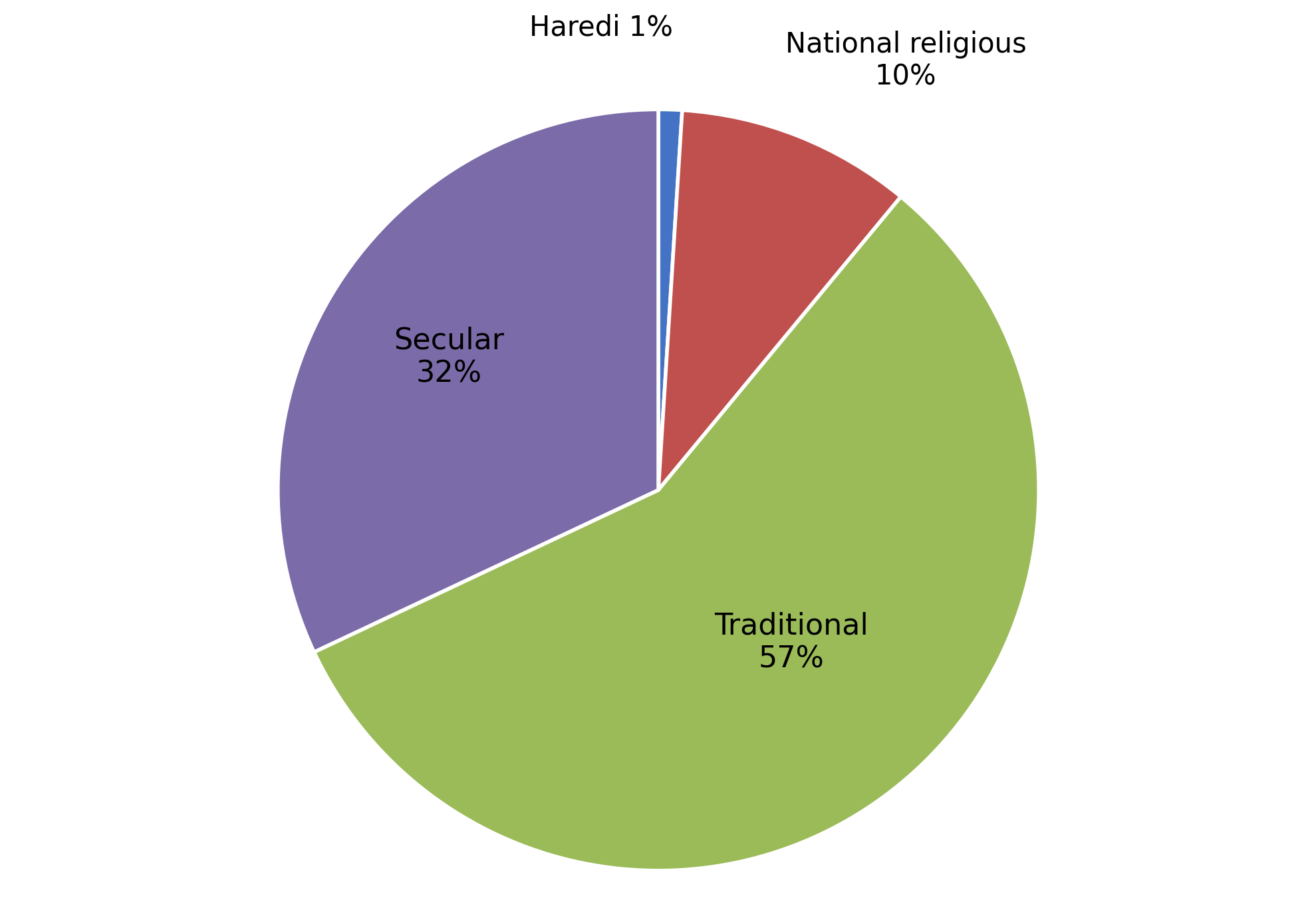
A clear dominance of the traditional public can be identified among Likud voters: 57% of Likud voters defined themselves as traditional, 32% as secular, 10% as national-religious, and 1% as Haredi. These figures are almost entirely identical to the distribution of Likud voters observed in the 2021 elections, when the share of traditional voters among Likud voters stood at 56%, and the share of secular voters among Likud voters stood at 31%.
Another interesting figure is that among Likud voters who defined themselves as traditional, 64% defined themselves as traditional non-religious, compared with 36% who defined themselves as traditional-religious; accordingly, 34% of Likud voters are traditional non-religious and 23% of Likud voters are traditional-religious. This distribution is very similar to the distribution of the overall traditional public between traditional-religious and traditional non-religious.
The Center Lists: Yesh Atid and National Unity
The following chart presents the distribution of the Jewish voters of the large center lists in the 2022 elections: Yesh Atid and National Unity.
Distribution of the Jewish voters of the large center lists in the 2022 elections (Yesh Atid and National Unity), by religious self-definition (%)
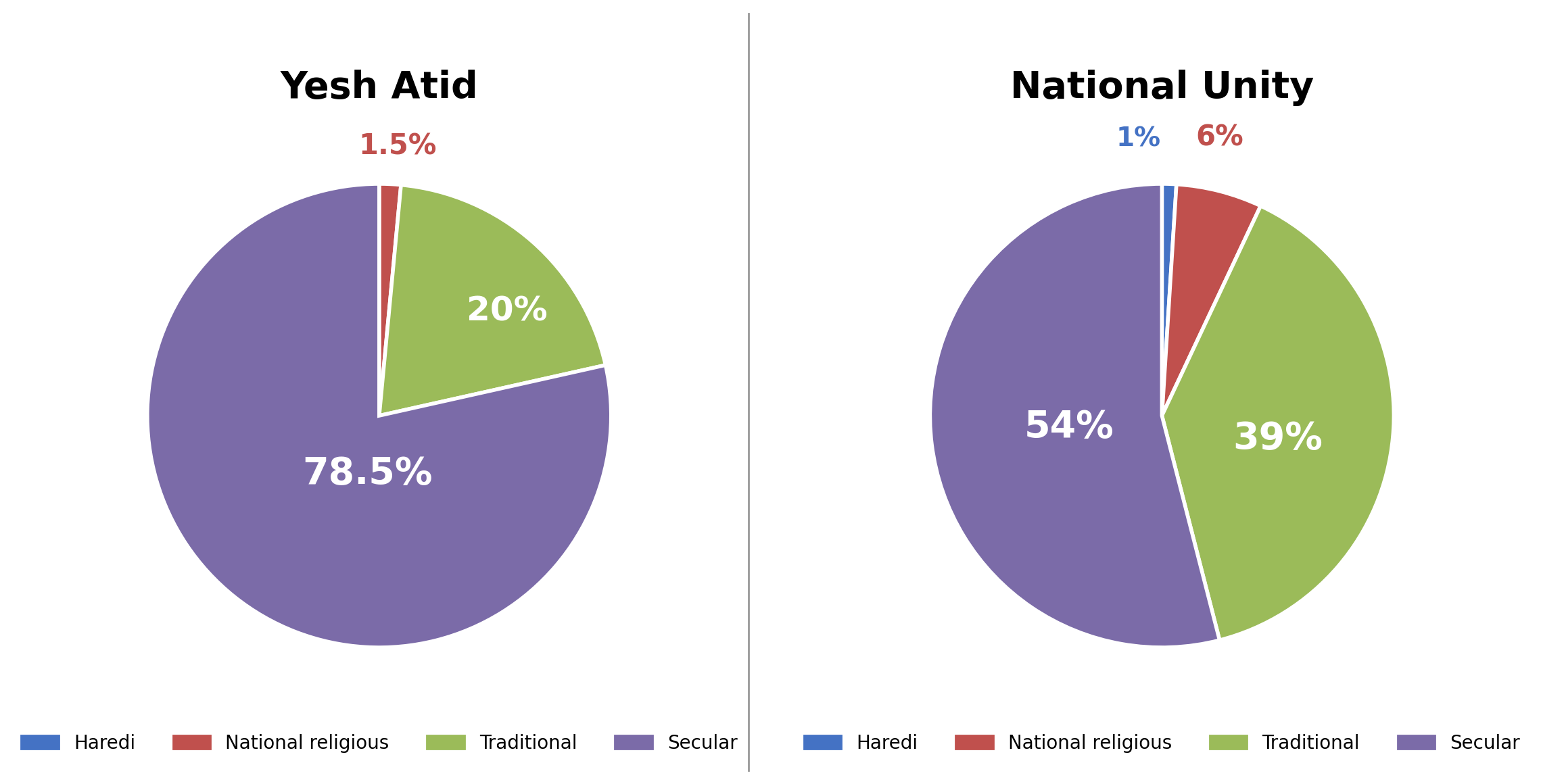
In both Yesh Atid and National Unity, a majority of secular voters can be identified, but there is a notable gap between them. The profile of Yesh Atid voters is more distinctly secular: 78.5% of the list’s voters are secular, compared with 20% traditional, 1.5% religious, and a negligible percentage of Haredi voters. By contrast, among National Unity voters, secular voters constituted 54%, so that the share of traditional voters among the list’s voters was much higher than in Yesh Atid, at 39%, and the relative share of religious voters was also higher, at 6%.
A comparison with the 2021 elections shows that with respect to these lists as well, there was almost no change in the profile of voters. Although Yesh Atid rose significantly from 17 to 24 seats, its voter profile remained almost entirely identical: 79% of the list’s voters in the 2021 elections were secular, 20% traditional, and 1% religious. National Unity was in effect a merger of two parties that ran separately in the 2021 elections: Blue and White and New Hope. In the 2021 elections, the two parties together won 14 seats, whereas the merger in the 2022 elections won 12 seats. Despite the change in the form of competition, combining the voter data of these two parties in the 2021 elections shows a similar picture of the voter profile in terms of religious self-definition compared with the 2022 elections: in the 2021 elections, 54% of Blue and White and New Hope voters were secular, exactly as in the 2022 elections. The share of traditional voters for the two parties was then slightly higher (41% in the 2021 elections compared with 39% in the 2022 elections), while the share of religious voters was then slightly lower (4% in the 2021 elections compared with 6% in the 2022 elections).
The Religious Zionist-Otzma Yehudit List
The following chart presents the distribution of the Jewish voters of the Religious Zionist-Otzma Yehudit list in the 2022 elections.
Distribution of the Jewish voters of the Religious Zionist-Otzma Yehudit list in the 2022 elections, by religious self-definition (%)
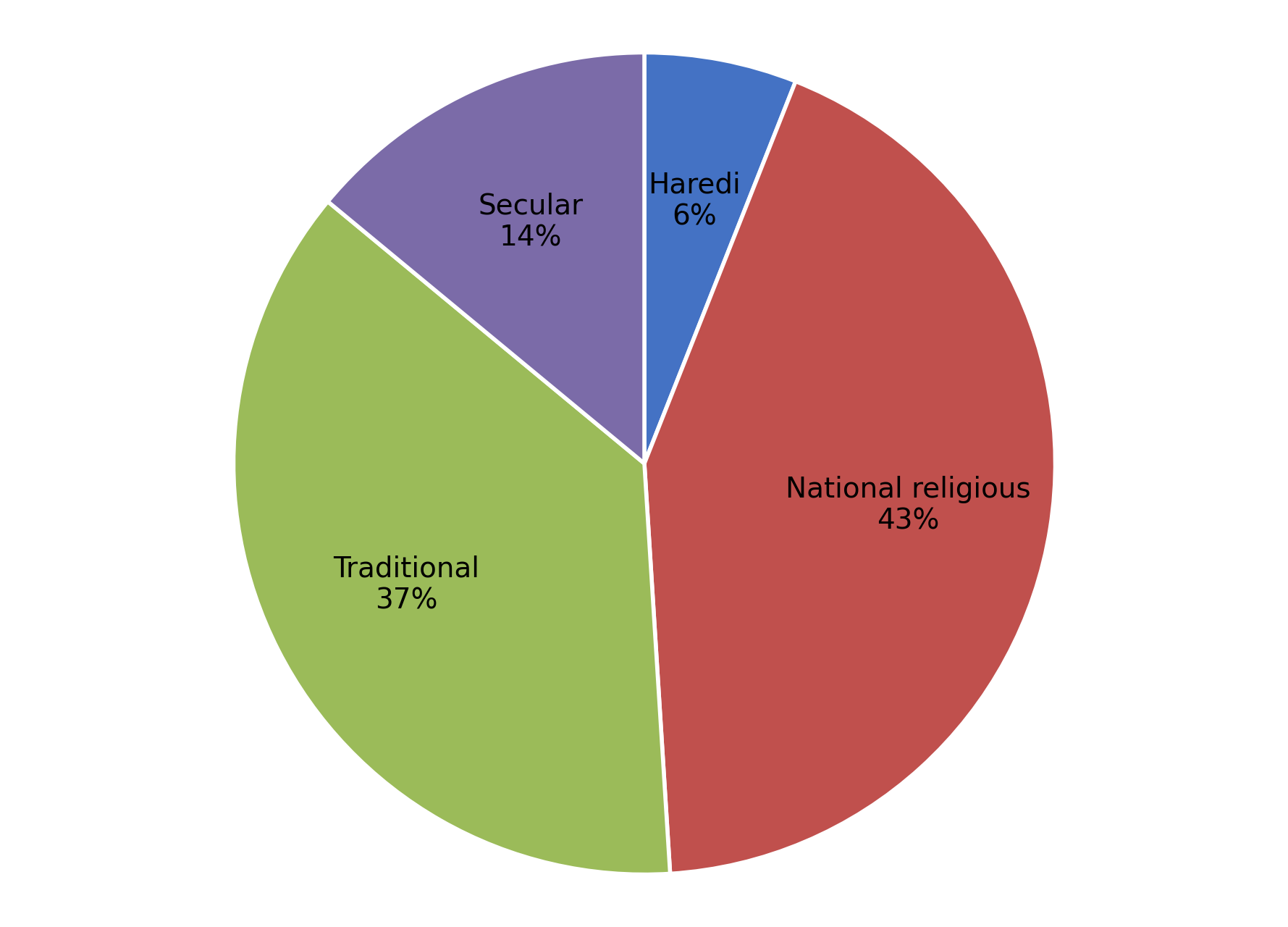
Unlike the previous lists presented above, for which it was found that one group (secular or traditional) constitutes a dominant majority among the list’s voters, the picture for Religious Zionist-Otzma Yehudit is more varied: the two most dominant groups among the list’s voters are national-religious voters (43%) and traditional voters (37%); the list also has 14% secular voters and 6% Haredi voters.
Unlike the previous lists surveyed, where no substantial changes occurred in the religious profile of voters between the two election cycles, this list saw a significant change in its voter profile in the 2022 elections compared with the 2021 elections, reflected in a higher share of traditional and secular voters. In the 2021 elections, 70% of the list’s voters came from the religious camp: 61% national-religious and 9% Haredi, so that the share of traditional and secular voters among the list’s voters stood at 30% (25% traditional and 5% secular). By contrast, in the 2022 elections, the share of national-religious and Haredi voters declined to 49%, while the share of traditional and secular voters rose to 51%. Considering that the list became much stronger in these elections (rising from 6 to 14 seats), it succeeded in these elections in appealing to the non-religious public to a much greater extent than in the 2021 elections.
Distribution of Voting by Political Camps
To conclude this part, we seek to present the distribution of the political camps by the religious self-definition of Jewish voters.
Distribution of the political camps by religious self-definition of Jewish voters in the 2022 elections (Jewish sample, %)
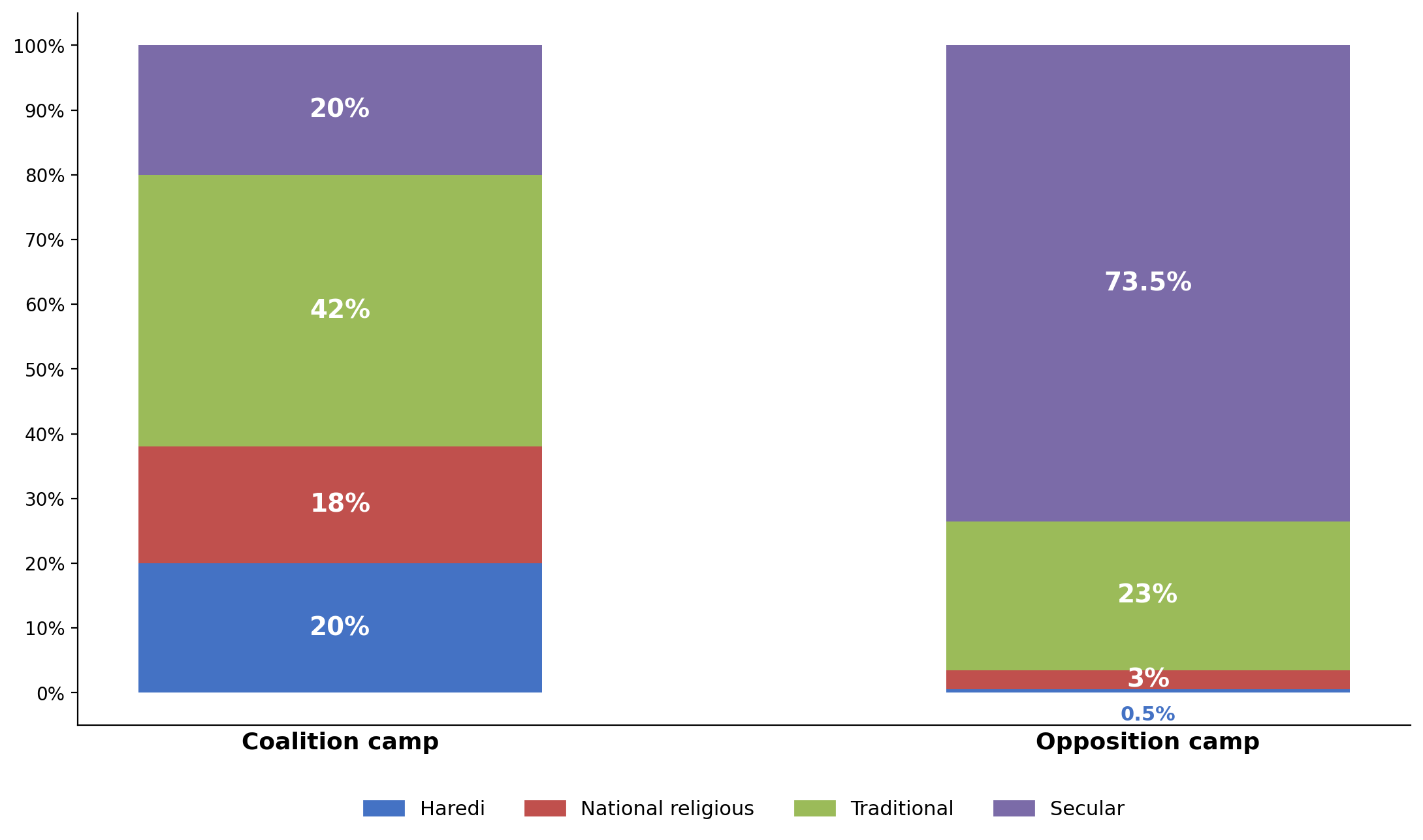
The chart shows a clear difference in the religious self-definition profile of voters in the two political camps: among voters for the opposition camp, there is a clear majority of secular voters (73.5%), while among voters for the coalition camp there is broader diversity among the different groups in the Jewish population: 42% are traditional, and the rest are divided almost equally among secular, national-religious, and Haredi voters. As noted, the data refer to the Jewish population only. An analysis that also included voters from Arab society would show that the picture of the distribution of voters in the opposition camp among the different population groups is more diverse.
Summary
This review demonstrates a clear correlation between religious self-definition and voting in elections. The review shows that the further one moves toward the secular end of the continuum between Haredim and secular Jews, the greater the likelihood of voting for a political camp currently identified with the opposition, and vice versa. An analysis of voting by lists shows that different groups are dominant in different lists: in Likud, most voters are from the traditional public (57%); in National Unity and Yesh Atid, most voters are from the secular public (54% and 78.5%, respectively); and in Religious Zionist-Otzma Yehudit, the dominant public among voters is the religious public (43%).
¹ Ariel Finkelstein, Voting Patterns by Religious Self-Definition, Israel Democracy Institute website, October 23, 2022.
² A party is a permanent political body that is registered by law with the Registrar of Parties, operates throughout the year and not only during elections, and has internal institutions. By contrast, a list is the specific slate and the named list of individuals competing in Knesset elections. A list may be submitted by one party or by a combination of several parties.
³ The Torani/Hardal group is small relative to the other groups examined in this study, and therefore its sample is also relatively small, comprising 254 respondents, unlike the other groups, each of which has a sample of more than 1,000 respondents.
- Tags:
- Elections and Parties,
- Ultra-Orthodox,
- National Elections 2026,
- Surveys and Polls,
- opposition,
- Coalition,
- Elections 2022,
- Elections 2021,
- Ultra-Orthodox in Israel Program,
- Religion and State Program,
- Civil Service and Governance Reform Program,
- The Joan and Irwin Jacobs Center for Shared Society