

A Political Commission of Inquiry Will Not Truly Investigate or Heal
The establishment of a politicized commission of inquiry into the failures of October 7, as in the legislation currently making its way through Knesset, would harm the ability to uncover the truth and the Israeli publics' ability to heal.
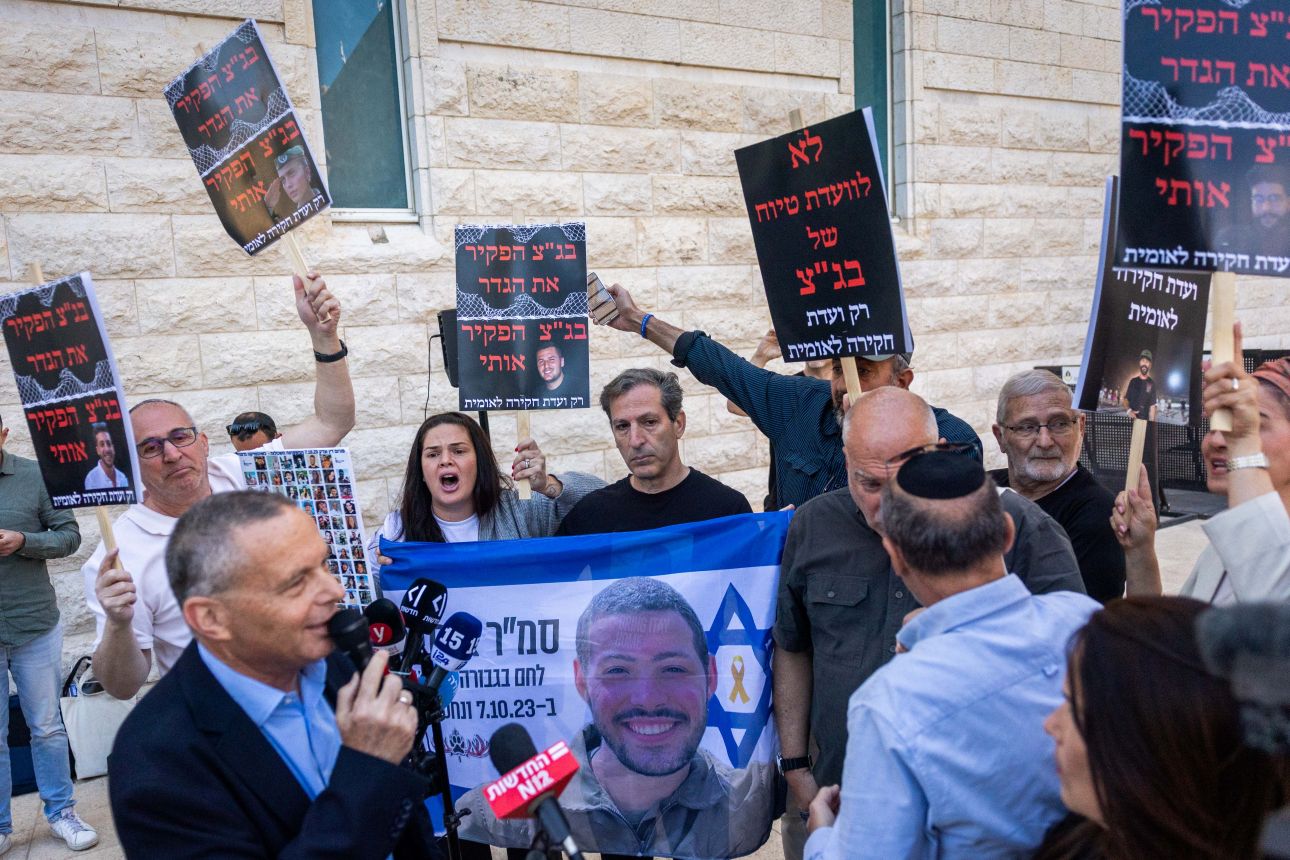
Photo by Yonatan Sindel/Flash90
The Knesset is advancing a bill that would establish a “state-national” commission of inquiry into the October 7 massacre. This bill has a single purpose: to avoid the appointment of a full, independent state commission of inquiry in accordance with the Commissions of Inquiry Law. Unfortunately, the political commission proposed by the Knesset will actually harm legitimate attempts to finally clarify the circumstances that led to the events of the October 7 and the ensuing war. Sadly, it will also hamper the ability of Israeli society to begin to heal the wounds of October 7, or at least to allow them to scar over.
Some of the flaws in the proposed legislation include: the way the composition of the commission is to be determined, which includes various scenarios, all of which lead to the establishment of a commission controlled by the governing coalition; the fact that the commission will have two chairs each with the power of veto over the other; and a clause that disqualifies in advance a long list of officials—judges, generals, ministers, and legal advisors—including those who held these offices in the last 18 years (i.e., since the plan for the disengagement from Gaza was approved). Curiously, the bill does not restrict the possibility of Knesset members and others with political affiliations from serving on the commission. Political appointees are in, professional appointees are out.
In addition, the bill states that observers – 2 hostages and representatives of the bereaved families identified with coalition and 2 affiliated with the opposition - would also sit on the commission. This would mean not only the politicization of bereavement, but worse, its hierarchization, as the commission would have to decide which form of bereavement would be represented. According to the wording of the bill, these observers will be released hostages or bereaved families as defined by law, but will they also include families of those murdered at the Nova festival, or parents of the female surveillance soldiers? The families of combat soldiers killed in the war in Gaza or Lebanon? Representatives of the residents of the Gaza border region? Of the kibbutzim or other rural settlements? The bill also excludes the thousands of people who have been physically and mentally injured during the war. The divisions and conflicts that this bill will arouse are not yet fully clear, but the mere thought of having to choose who will represent the bereaved and the hostages arouses deep discomfort.
Beyond the significant difficulties it presents, the reason this particular bill is being advanced reflects the extent to which the Knesset has renounced its obligation to represent the public and promote the public interest, and the extent to which the coalition’s conduct ensured that the Knesset – Israel's legislative branch – is completely controlled by the government – the executive branch.
One of the reasons the coalition is advancing the bill for a state-national commission is to evade the legal petitions against the government, on the grounds of its failure to establish a commission of inquiry into the events of October 7. In order to circumvent the formal system of legal advisors, the government is advancing a private bill rather than government legislation, and remarkably, it has chosen to promote a bill that lacks both internal logic and external validity, with ideas such as two chairs, two reports, and the possibility of the commission operating with just three members, all representing the coalition. The clear danger from such a commission is that it will be focused on a predetermined narrative and identify predetermined culprits.
In the current era in which Knesset committees and the plenum have become grounds for aggressive discourse, conspiracy theories, and inflammatory language, it is to be hoped that the next Knesset will once again serve as a vital arena for open dialogue between all sides of the political spectrum. But any commission compromised of representatives of the coalition and the opposition cannot objectively investigate the terrible failures that occurred prior to, during, and after the terrible events of October 7, 2023. This is why the next government formed after this fall's elections must finally establish a state commission of inquiry in accordance with the Commissions of Inquiry Law. This is the only type of commission whose members will be appointed according to principles of professional independence, objectivity, and transparency and not according to political or partisan affiliation. And this is the only type of commission that will not only allow our society to heal, but for our leaders to learn from the mistakes of the past.
This article was published in The Times of Israel.