
The Knesset’s Work During the Election Recess
Everything you need to know about what happens to the Knesset between the end of its summer session and the 2026 elections, scheduled for October 27, 2026.
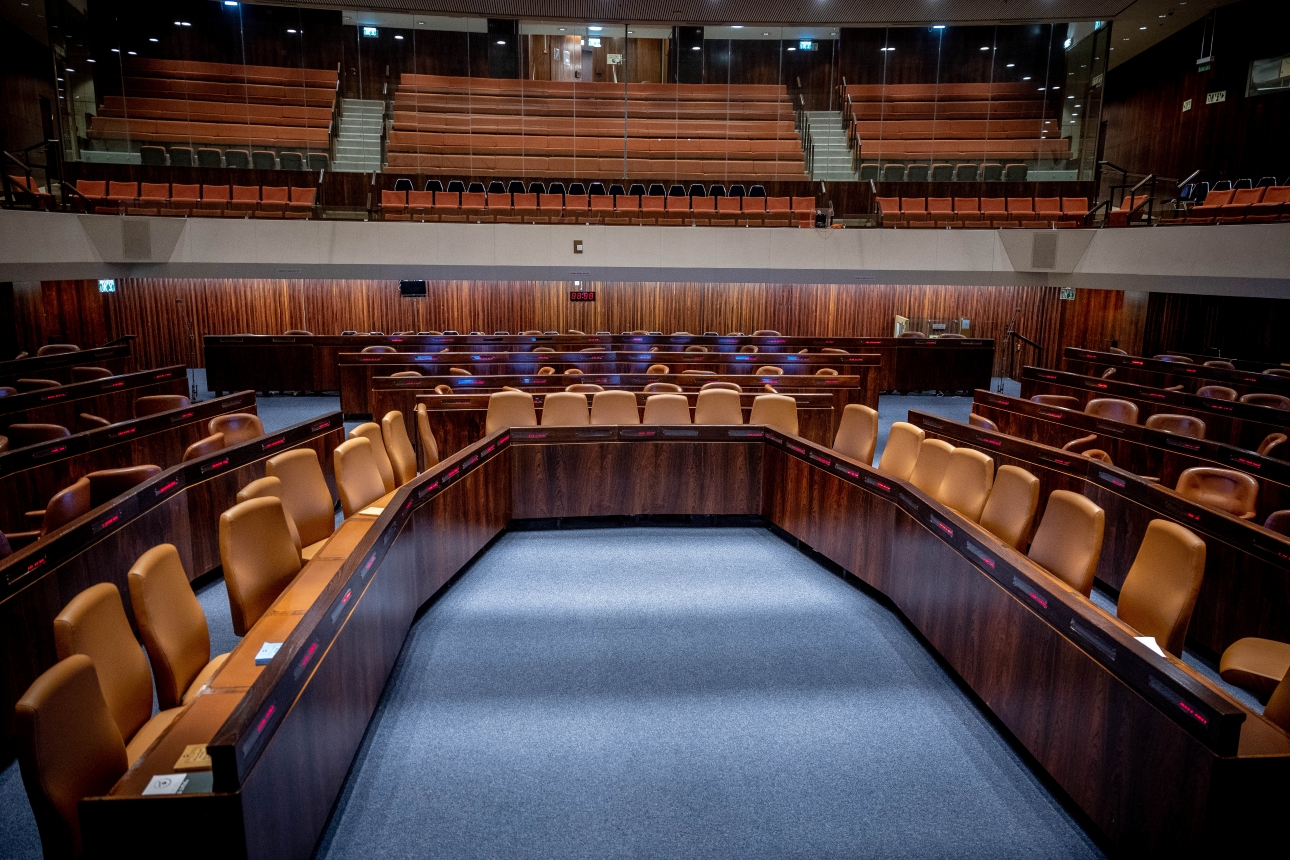
Photo by Yonatan Sindel/Flash90
Ahead of the elections to be held in October, the Knesset went into election recess on July 18. What is the election recess, and how is its start date determined? Can the committees and the plenum operate as usual, especially with regard to legislation? How have the conventions governing the election recess developed and changed over the years?
What is the election recess?
The election recess is the period between the end of the Knesset’s regular activity before elections and the swearing-in of the new Knesset after the elections. During this period, the Knesset continues to serve in accordance with the principle of continuity, under Section 37 of Basic Law: The Knesset, but the nature of its activity changes significantly.
The rules that apply to the election recess are the same rules that apply to the “regular” recesses held during the year, between the summer and winter sessions. But the election recess is also based on additional traditions and practices that have developed over the years.
At least since the late 1990s, the most prominent feature of the election recess has been the more limited activity of the Knesset, even more limited than during regular recesses. This is subject to exceptional cases, mainly when parliament is required to respond to urgent matters or to issues that enjoy broad consensus.
When does the election recess begin?
The precise date is not set in legislation or in the Knesset Rules of Procedure. When the Knesset completes its term, the election recess begins when it adjourns, following the end of the final summer session of that term. In such a case, what is effectively a regular recess becomes an election recess. Under Section 18 of the Knesset Rules of Procedure, recess dates are determined by “the Speaker of the Knesset, after consulting with his deputies and with the approval of the House Committee.”
The upcoming elections will be the first to be held on schedule since 1988. The recess following the summer session, which is also the election recess, began on July 18 and will end on the day the 26th Knesset convenes. The decision was set in actual legislation: the Parties Financing Law (Amendment No. 46) (Temporary Provision), 5786–2026, provides that the election recess will begin on the determining date under the Parties Financing Law, namely 101 days before election day, which falls on July 18. In this case, the House Committee merely approved guidelines regarding the Knesset’s activity during the election recess.
By contrast, when the Knesset dissolves early, the start date of the election period is determined by the event that led to the Knesset’s dissolution: a law dissolving the Knesset, dissolution of the Knesset by order of the prime minister, failure to approve the state budget on time, or exhaustion of the procedures for forming a government.
Of Israel’s 25 Knessets, only seven, including the current one, have completed their terms. In such cases, the election recess may also begin in the middle of a parliamentary sitting and effectively interrupt the Knesset’s regular work. Even then, however, the official election recess is determined according to the ordinary procedure for setting a recess, as anchored in the Knesset Rules of Procedure, or in legislation.
How long does the recess last, from its beginning until the elections?
As noted, the current election recess will begin 101 days before the Knesset elections. The history of recent Knessets reveals very significant differences between different election recesses.
The previous election recess, in 2022, began 119 days before the elections: the Knesset dissolved itself by means of a Knesset dissolution law, which provided that the elections would be held more than four months later. When the Knesset dissolves itself by law, the election date may be set for up to five months after the law’s approval. By contrast, the recess before the 2021 elections began only 78 days beforehand, because the 23rd Knesset dissolved due to the failure to approve the state budget on time. In such a situation, elections are held within approximately 90 days, and even after the dissolution it took the House Committee nearly another two weeks to approve the start of the recess.
Do Knesset debates take place during an election recess, and if so, when?
According to a practice that has taken root since the late 1990s, the “practice of restraint” applies to parliamentary activity during an election recess. This practice is intended to prevent misuse of the parliamentary arena for election campaigning, or exploitation of parliamentary tools to advance narrow political interests connected to the elections.
With regard to the plenum, the rules are similar to those that apply during a regular recess. As a rule, the plenum does not convene during a recess, unless the government asks to hold a debate, or at least 25 members of Knesset demand that a debate be held on a particular issue. The Supreme Court has clarified that the arrangement allowing the plenum to be convened at the request of MKs does not include debate on private members’ bills.
As for Knesset committees, during a regular recess the House Committee permits committees to hold a predetermined number of meetings, and the Knesset Speaker may allow a special meeting to be held at the request of the committee chair, the government, or one-third of the committee members. During an election recess, by contrast, the practice is that every committee meeting, with certain exceptions, as discussed below, requires individual approval by an “Agreements Committee,” established by a decision of the House Committee when the Knesset enters election recess. The Agreements Committee is composed of two MKs: the coalition chair and a representative from the faction of the leader of the opposition. In addition, in especially exceptional and rare cases, the Knesset Speaker is empowered to approve the convening of a committee meeting contrary to the position of the Agreements Committee, for special reasons and after receiving a legal opinion from the Knesset legal adviser.
The current Agreements Committee is composed of the coalition chair and chair of the House Committee, Ofir Katz of Likud, and the opposition coordinator, Merav Ben-Ari of Yesh Atid. It was also decided that meetings of the House Committee, the Joint Committee on the Defense Budget, the Joint Committee on State Audit and Foreign Affairs and Defense, known as the “Committee of Two,” and three subcommittees of the Foreign Affairs and Defense Committee would not require approval by the Agreements Committee. In addition, the Finance Committee was approved to hold one meeting during the first two weeks of the recess.
In general, there has been a decline over time in the number of plenum meetings held during election recesses: from dozens of meetings in the early decades to only a few meetings in most Knessets dissolved from the 15th Knesset (1999-2003) onward, with exceptions such as the 16th, 21st, and 23rd Knessets, which held many plenum debates. The 21st Knesset did so because of its unexpected dissolution and the need to complete urgent matters, and the 23rd Knesset did so because of the coronavirus crisis. Beyond that, the extent of plenum activity during the election recess was also linked to the way in which the Knesset’s term ended: in Knessets that completed their terms, plenum activity was usually very limited. In Knessets that dissolved early, by contrast, the picture is varied, ranging from two meetings in the 17th Knesset to 38 meetings in the 8th Knesset.
By contrast, meetings of Knesset committees during recesses have actually increased over the years. Since the 16th Knesset in particular, there has been a significant rise in the number of such meetings. This may be due to the establishment of the informal mechanism of the Agreements Committee, which enables controlled activity by the committees even during an election recess.
What about legislation during the election recess?
As noted, during this period the Knesset is supposed to exercise general restraint, and the Knesset legal adviser instructs that particular restraint be exercised in legislative proceedings. This is intended to avoid advancing legislation for the purpose of gaining a political advantage during the election period, known as “election legislation,” and to avoid binding the discretion of the future Knesset. There are areas in which legislative restraint during an election period is especially justified and customary, particularly legislation dealing with election law.
But there are exceptions. In particular, there is justification for advancing bills that enjoy broad support, including from the opposition; urgent bills; and bills whose legislative process has already begun. In certain circumstances, there is also justification for advancing bills that will not be completed in the outgoing Knesset, provided they enjoy broad support, because continuity may be applied in the next Knesset to bills that were approved in a first reading. It should be noted that following the High Court of Justice ruling, according to which the plenum may not be convened at the request of 25 MKs for the purpose of advancing legislation, in practice only bills that enjoy government support can move forward during this period.
A historical examination shows that there has been a significant decline in the volume of legislation during election recesses since the “principle of restraint” became established in the late 1990s. The decline is especially pronounced with regard to private members’ bills, and this makes sense, because legislation during an election period should deal mainly with urgent issues, and such issues should properly be advanced through government bills. A difference was also found between Knessets that completed their terms, such as the current Knesset, in which legislation was limited and focused on completing legislation that had already begun, and Knessets that dissolved early, in which the volume of legislation initiated during the recess was far higher.
Is legislation during an election period passed by consensus?
Generally, yes, but there have been exceptions.
Most of the laws approved by recent Knessets during election recesses were passed with full or broad consensus, and a substantial share dealt with urgent issues. For example, during the election recess of the 24th Knesset, the Assets of Holocaust Victims Law was passed, extending the period during which the Administrator General works to locate rights-holders in the assets of Holocaust victims and return those assets to their heirs. The amendment was intended to allow the state to complete the handling of these assets efficiently.
But there have also been other cases. For example, during the election recess of the 19th Knesset, before the 2015 elections, the Prevention of Infiltration and Ensuring the Departure of Infiltrators from Israel Bill was approved. It was controversial and passed with the support of 47 MKs to 23. On the other hand, it can be argued that the law was urgent: it was advanced and passed following a September 2014 HCJ ruling ordering the closure of the Holot facility, and the state therefore urgently legislated a new solution, with the attorney general’s approval, in order to prevent the release of thousands of unlawful residents. The failed attempt to approve the “cameras law” at polling stations, just days before the elections for the 22nd Knesset, is perhaps the clearest recent example of an attempt to pass controversial legislation during an election recess.
Is Israel unusual, or do other democracies handle the pre-election period the same way?
Most democracies scale back parliamentary activity before elections, but the arrangements differ, and comparative analysis points to three broad models. Under a dissolution model, the strictest, the legislature's term ends formally once elections are called, and all parliamentary activity halts until the new parliament is sworn in. In the United Kingdom, for example, parliament essentially ceases to exist upon dissolution: members lose their status, legislation and discussions stop entirely, and committees cannot meet. Under a continuity model, the most permissive, parliament keeps functioning through the pre-election period, if sometimes at lower intensity. In Sweden, for instance, the Riksdag serves continuously until the new parliament's first session, and committee meetings may still be held. Under an intermediate recess model, routine activity is curtailed, yet parliament continues to exist and can act on urgent matters through dedicated mechanisms. In the Netherlands, the plenum stops convening during the recess, but committees may still meet at the request of two or more members. In this respect, Israel is not exceptional; it sits alongside countries such as Portugal and Hungary in the middle of the spectrum, pairing constitutional continuity of the Knesset's powers with a practical, restraint-based slowdown of its work.