
The Central Elections Committee: What You Need to Know Ahead of the 2026 Elections
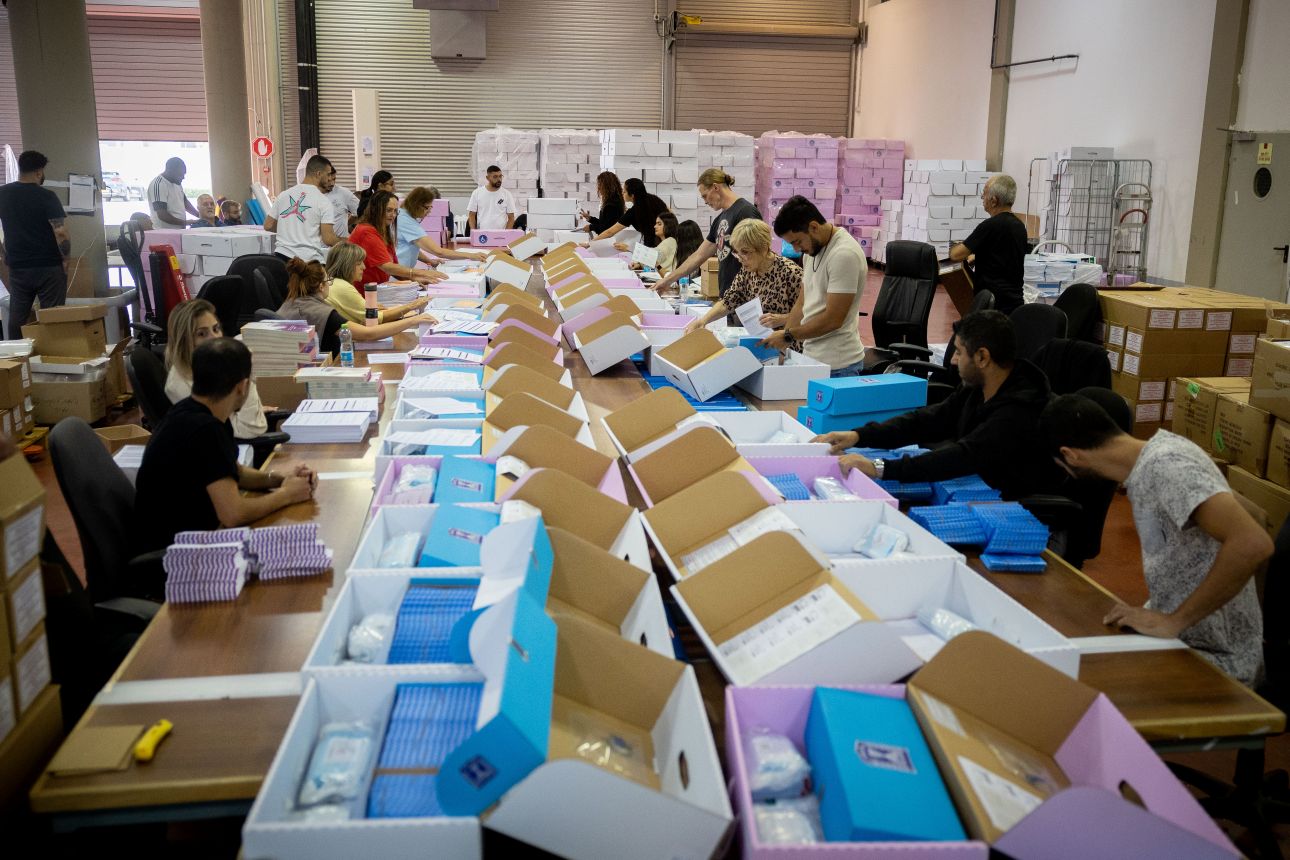
Photo by Yonatan Sindel/Flash 90
The Central Elections Committee is the election management body (EMB) responsible for Knesset elections. It operates as an independent statutory body under the Knesset Elections Law [Consolidated Version], 5729-1969. Administratively, the Committee has a special independent status, similar to that of the State Comptroller’s Office; it is not subordinate to any government ministry. The Central Elections Committee is established 60 days after a Knesset convenes and serves until the next Knesset is elected.
The Committee combines three arms: legal, political, and administrative-professional:
- The judicial arm (the Committee chair): The Central Elections Committee is headed by a justice of the Supreme Court, selected by the justices of the Supreme Court. The current chair of the Central Elections Committee for the 26th Knesset is Deputy President of the Supreme Court Justice Noam Sohlberg. The Committee chair, together with four representatives of the largest Knesset factions, constitute the Committee presidium. The current presidium includes representatives of Likud, Yesh Atid, Shas, and National Unity.
- The administrative arm (the professional staff): This is an institution whose employees are professional and have no political affiliation. In ordinary times, the Committee employs several dozen staff members; during election periods, it employs tens of thousands of additional temporary workers. In the elections for the 25th Knesset, around 70,000 additional workers were employed during election week. Senior permanent officials include the Committee director-general, the legal advisor, and the accountant. The director-general is responsible for all logistical aspects of election administration and for the Committee’s work processes. Adv. Dean Livne currently serves as acting director-general of the Committee, following the retirement of director-general Orly Adas.
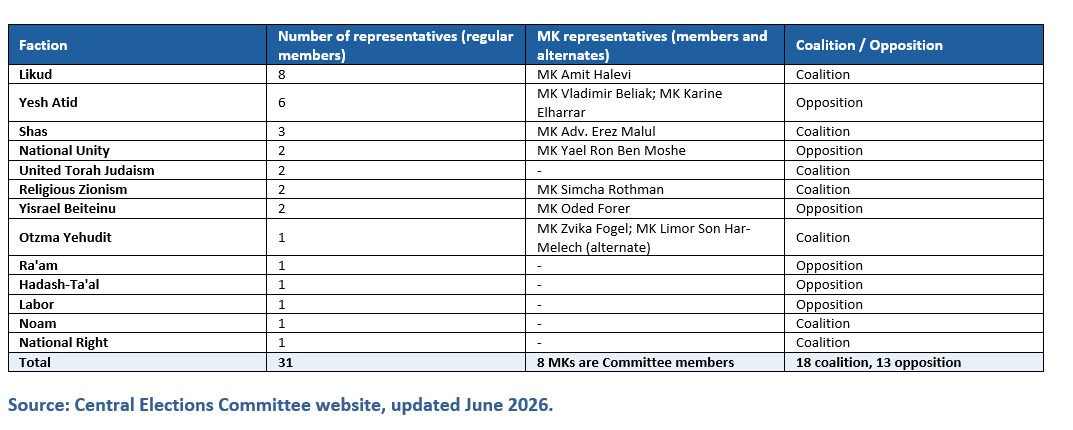
- The political arm (the plenum): The Committee is composed of representatives of the factions of the outgoing Knesset. The number of Committee members is usually around 30 and varies according to the number of factions represented in the Knesset. The composition of the plenum is determined according to a factional allocation formula: every faction with four or more members has one representative for every four MKs, while smaller factions are represented by one member. This system creates an inherent advantage for the coalition and replicates the balance of power among the parties. From a global comparative perspective, it is highly unusual that sitting members of parliament may serve - and in practice do serve - as voting and deciding members of this plenum, which functions as a kind of “mini-Knesset.”
For example, the Central Elections Committee for the 26th Knesset (i.e., the upcoming 2026 elections) has 31 members. About one-quarter of them (8) are sitting MKs. Of the Committee’s 31 members, 18 are coalition representatives; in other words, the coalition has a majority on the Committee, including the majority required, for example, to disqualify candidate lists and individual candidates.
Table 1: Composition of the Plenum of the Central Elections Committee for the 26th Knesset
Watch the explainer video here
The budget of the Central Elections Committee is approved through a special procedure by the Knesset Finance Committee, similar to the procedure for approving the budget of the State Comptroller’s Office, in order to ensure the Committee’s independence. The budget is characterized by enormous gaps - “jumps” - between routine years and election years:
- The current 2026 budget: The Finance Committee approved a budget of approximately NIS 690 million for the Committee. The approval process was accompanied by confrontations, and the budget was cut by NIS 50 million from the Committee’s original request, which stood at NIS 740 million. This left the Committee with no defined reserve items and with a very tight budget structure, given the challenges of dealing with cyberattacks, foreign influence, and fake news.
- Compared with previous years: The Committee’s budget has risen sharply over the past decade. For comparison with other years in which Knesset elections were held, in 2009 (the 18th Knesset) the budget was only about NIS 206 million; in 2015 (the 20th Knesset), about NIS 241 million; in 2020 (the 23rd Knesset), it jumped to about NIS 402 million; and in 2021 (the 24th Knesset), it reached the exceptional peak of about NIS 675 million, of which around NIS 237 million was defined at the time as a “COVID supplement.”
The current budget growth trend reflects increasing investment in computing systems, enhanced cybersecurity, and the unit of election integrity inspectors who carry body cameras.
The Central Elections Committee is responsible for administering the election process in all its various aspects: planning and managing the entire election system; determining the distribution of polling stations; appointing regional committees; determining the composition of polling station committees, polling station secretaries, and election integrity inspectors; training officials; printing ballot slips; operating information systems; organizing voting in Israel and abroad; managing the vote count; and publishing the results.
Most of the Committee’s work is carried out through five statutory subcommittees appointed from among the members of the plenum:
- Subcommittee for Finance and Administration: Responsible for preparing the Committee’s budget and overseeing logistical expenditures.
- Subcommittee for Legislation: Reviews legislative amendments, election regulations, and temporary provisions before they are brought to the plenum for approval.
- Subcommittee for Special Voting Arrangements: Oversees the complex voting arrangements outside ordinary polling stations - polling stations for IDF soldiers, hospital patients, prison inmates, diplomatic envoys abroad, and women staying in shelters.
- Subcommittee for Training: Responsible for setting threshold requirements, simulation materials, and professional training for tens of thousands of polling station committee secretaries and election integrity inspectors.
- Subcommittee for Polling Station Locations and Voter Transportation: Determines the distribution of polling stations, their physical accessibility, and oversees the free transportation provided to voters who are more than 20 kilometers from their polling station.
The Committee has a significant quasi-judicial power: the approval and disqualification of candidate lists and individual candidates under section 7A of Basic Law: The Knesset. Under the law, the political plenum is authorized to disqualify a list or candidate if their objectives or actions include negation of the existence of Israel as a Jewish and democratic state, incitement to racism, or support for armed struggle against Israel by an enemy state or terrorist organization. A request to disqualify an individual candidate requires the signature of at least one-third of the Committee members. If the Committee disqualifies the candidate, its decision is not final; it requires mandatory approval, known as “election approval,” by the Supreme Court. By contrast, disqualification of a list does not require Supreme Court approval, but the disqualification decision may be appealed to the Supreme Court, which has the final say. In certain cases, even if the Committee approves the candidacy of a list or candidate, the decision may be appealed to the Supreme Court. The Committee is also authorized to decide on the approval or disqualification of candidates in cases involving secession from a faction (EA 6615/22 Chikli v. Chair of the Central Elections Committee for the 25th Knesset, Nov. 3, 2022).
The chair of the Central Elections Committee, who is a Supreme Court justice, heads the Committee in all its arms - the professional staff and the political plenum. The chair has a range of powers relating to both substantive and organizational aspects of the elections. The chair may summarily dismiss disqualification requests that do not establish a legal cause under the law; is the sole authority empowered to determine whether a criminal offense committed by a candidate who was sentenced to more than three months in prison in the preceding seven years carries moral turpitude that bars the candidate from running; and has exclusive authority to issue “real-time” injunctions against violations of the Elections (Modes of Propaganda) Law and the Knesset Elections Law. The chair is also authorized to require non-party associations and organizations engaged in targeted political activity to register with the State Comptroller as a “Body Active in the Elections.” Decisions of the chair of the Elections Committee are subject to judicial review.
On Election Day itself, the Committee chair, together with the Committee presidium, has the authority to order voting to stop at polling stations and to resume if there is suspicion of irregularities, and to extend voting hours at particular polling stations if necessary.
The regional election committees are the executive, logistical, and supervisory arm of the Central Elections Committee in the field. While the Central Committee, headed by a Supreme Court justice, sets policy, rules, and instructions at the national level, the regional committees are responsible for implementing them in practice and for managing the election system on the ground. No later than 38 days before the elections, 19 regional committees are established, each of which is responsible for a list of localities and polling stations in its area.
As with the Central Elections Committee, the regional committees combine a chair who is a judge, usually a district court judge, professional staff, and faction representatives according to the representation formula used for the plenum of the Central Committee; that is, according to the representation formula in the outgoing Knesset. The committees are responsible for preparing the field and physically approving polling station locations, operating an Election Day situation room, and responding to problems that arise on the ground. At the end of voting and vote counting at the polling stations, all sensitive materials - protocols, ballot boxes, and envelopes - are physically transferred to the headquarters of the regional election committee, and from there the information is transferred to the Central Committee.
The polling station committee is the body responsible for administering voting at the polling station and counting the votes at the end of Election Day. Section 21 of the Knesset Elections Law provides that the Central Elections Committee determines the number of members of each polling station committee and its factional composition from among the factions represented on the Central Committee. It also determines the factions from which the chair of the polling station committee and the deputy chair will come, provided that no fewer than three factions are represented at each polling station, in order to create balance and mutual oversight among the political forces. The staffing of polling station committee members according to the formula set by the Central Elections Committee is carried out by the regional committees, in accordance with lists provided to them by the parties. Polling station committee members undergo training by the Central Elections Committee before Election Day. On Election Day, the polling station committee is responsible for ensuring that voting is conducted in accordance with the law, maintaining the order and secrecy of voting, documenting the day’s proceedings in the protocol, and participating in the vote count and approval of its results. Polling station committee members are therefore faction representatives, and they receive their pay from the parties through a budget transferred by the Central Elections Committee.
Alongside the committee members, each polling station has a polling station secretary, who is a professional official appointed by the Elections Committee and is not a party representative. The secretary must meet threshold requirements set by the Elections Committee, including a minimum age of 21 and the absence of party affiliation during the three years preceding the elections, and must undergo a screening and training process. The secretary is responsible for the organizational management of the polling station, voter registration, management of the protocol, and assisting the chair of the polling station committee and committee members in the proper administration of voting and the vote count. In recent election cycles, there has been a tendency to appoint two secretaries at sensitive polling stations.
In addition, any candidate list that is not represented on a particular polling station committee may appoint an observer on its behalf. The observer may watch what takes place at the polling station and alert officials to defects, but is not a member of the polling station committee and does not participate in its decision-making.
The composition of the polling station committee therefore reflects the combination of the professional and political dimensions at the polling station committee level as well.
Election integrity inspectors are professional officials appointed by the Central Elections Committee. Their role is to help safeguard the proper conduct of the election process and strengthen public trust in election integrity through oversight, documentation, and reporting, particularly at polling stations defined as “sensitive” from the standpoint of election integrity.
The inspectors undergo dedicated training by the Elections Committee and are required to meet the threshold conditions set by the Committee, including the absence of a criminal record, participation in training, and full availability on Election Day. Their role is to be present at polling stations, oversee the conduct of voting and vote counting, identify unusual incidents or suspicions of harm to election integrity, and report them in real time to the Elections Committee’s control center. In cases and under conditions determined by the Elections Committee, they are also permitted to document events using body cameras.
The use of election integrity inspectors began in the September 2019 elections, following the affair involving the placement of cameras at polling stations in the elections for the 21st Knesset in April 2019. Initially, there were around 3,000 election integrity inspectors, and the inspector system has since been expanded significantly. In the elections for the 25th Knesset in 2022, there were around 12,500 polling stations in Israel, alongside which the Central Elections Committee deployed thousands of election integrity inspectors. In all likelihood, in the election campaign for the 26th Knesset, an election integrity inspector will be appointed for every polling station; in other words, there will be more than 10,000 election integrity inspectors.
- The volatile combination of legal, professional, and political functions: Among election management bodies in democratic countries, Israel’s Central Elections Committee is exceptional because its plenum is political and it has the power to disqualify lists and candidates. In most democracies, this function is carried out by independent, professional, and nonpartisan committees. The staff of the Central Elections Committee is professional and politically unaffiliated, but the Committee plenum is not only political - it also reflects the composition of the outgoing Knesset, meaning that the coalition has a majority. The fact that the Committee is headed by a Supreme Court justice is intended to balance and moderate the political bias inherent in the Committee by virtue of its composition. However, in an era of criticism of the judiciary and the civil service, and given the political baggage of the Committee plenum, public trust in the Committee and in the electoral process is precarious.
- The challenges of the digital revolution and artificial intelligence: The election laws, including the Election Propaganda Law and the powers vested in the Committee and its chair, have not been adequately updated to account for technological developments and therefore may lack the appropriate tools to manage modern election campaign challenges. The campaign advertising and election laws must be updated to enable transparency regarding machine-generated content and to provide protection against harms to privacy and the secrecy of the vote.
Immediately after the elections for the 26th Knesset, a fundamental and comprehensive structural reform should be advanced, establishing a National Elections Authority. In place of the factional composition of the Committee plenum, an independent, fully professional national authority should be established, based entirely on expertise, similar to the leading models in Australia and Canada. This authority would consolidate under one roof all the powers currently dispersed across different bodies: the administration and execution of both national and local elections, independent management of the voter registry, and centralized oversight of party financing and donations, which is currently mostly under the responsibility of the State Comptroller.
Until this comprehensive reform is advanced, the authority to disqualify candidates and lists under section 7A should be removed from the Committee in its political composition and transferred exclusively to the Supreme Court or to a neutral legal-public committee. At the same time, sitting MKs should be barred from serving on the Committee, and professional threshold requirements and cooling-off periods should be set for representatives.