

Reserve Service during the Swords of Iron War by Religious Self-Definition, 2023-2025
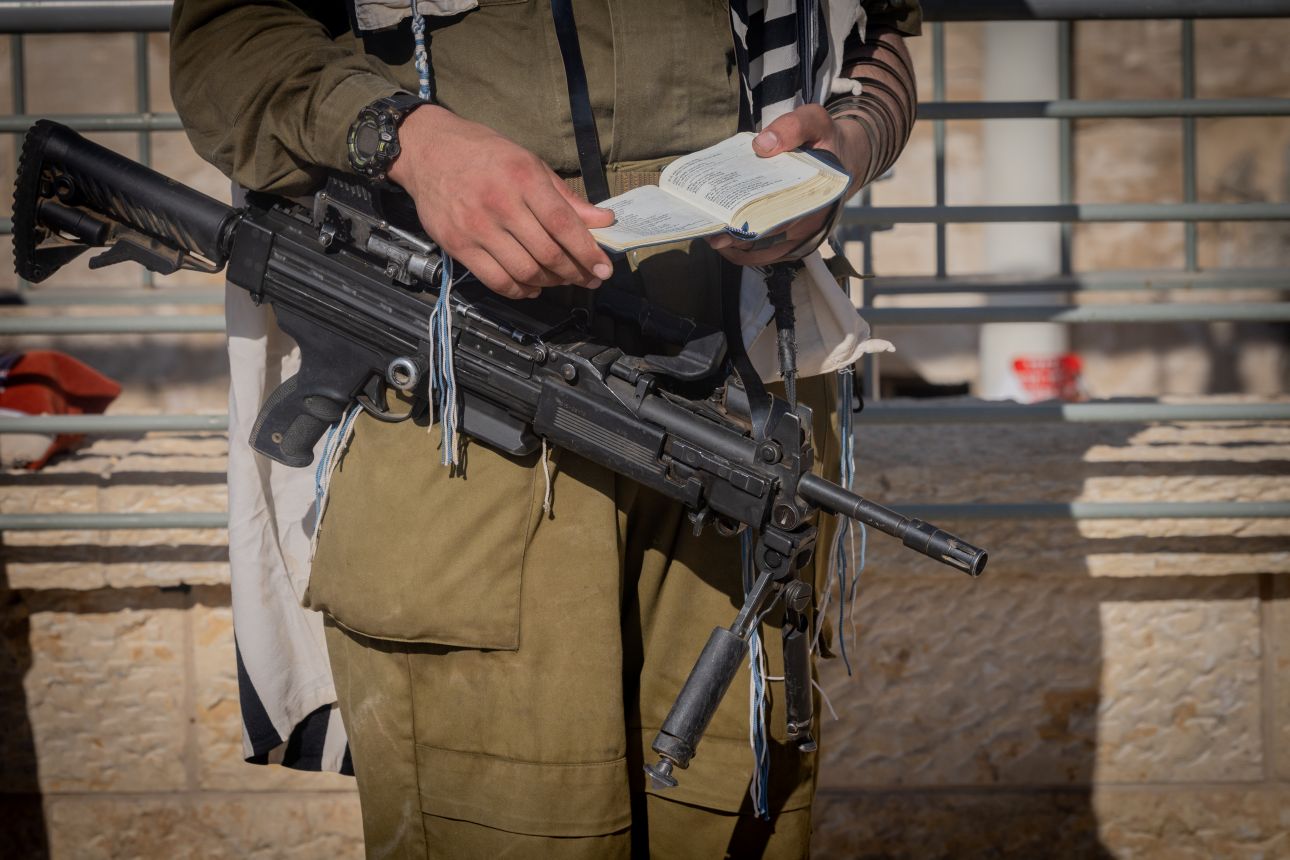
Photo by Chaim Goldberg/Flash90
This executive summary presents the central findings of an Israel Democracy Institute review of reserve service during the Swords of Iron War, broken down by religious self-definition among the Jewish population. The analysis focuses primarily on the Jewish population aged 21–44; because of data and sample-size constraints, the analysis of women focuses on 2023–2024 and ages 18–44. For that reason, the main measure throughout the review is the share of each group serving in an average month.
The central finding is that the distribution of reserve service changed substantially as the war continued. In the first months of the war, secular men were the largest group of reservists and were somewhat overrepresented relative to their share of the relevant Jewish male population. Religious men were much more strongly overrepresented from the outset. By 2025, however, the relative weight of religious men in reserve service had risen sharply, the share of traditional men had risen more moderately, and the share of secular men had declined substantially. Even so, secular men remained the largest single group of male reservists in an average month in 2025.
The Israel Defense Forces does not publish data on reserve service by religious self-definition and, it appears, does not collect reservists' self-defined religiosity. The review is therefore based on analysis of the Central Bureau of Statistics Labor Force Survey, a comprehensive monthly survey that included about 80,000 respondents per year in the relevant age groups. The analysis uses the final three months of 2023 and full-year data for 2024 and 2025. Some labor-market analysis also uses quarterly data through the first quarter of 2026.
A respondent was classified as a reservist if he or she answered “reserve duty” as the main reason for being absent from work during the previous week, being unable to start work, or working fewer hours than usual. Most classified reservists were employed people who were absent from work. The survey generally does not capture reserve service among people outside the labor market, unless they reported that reserve duty prevented them from starting a new job. The survey does not identify the character of the service, such as combat or rear-echelon roles. Nor is it a full count of all people who served over the course of the war: because the survey is conducted separately each month, a person who served in another month may not appear as a reservist in the sampled month. The measure is therefore best understood as the average monthly distribution of the burden of service. Longer or repeated service is reflected more heavily in the data. This is precisely why the indicator is useful for assessing the continuing social and labor-market burden of reserve duty.
The review focuses on the Jewish population, including the CBS administrative population group “others,” composed mainly of non-Jewish immigrants from the former Soviet Union. Ninety-one percent of this group's members have no religion, and the remainder are non-Arab Christians. For convenience, the review labels this group “no religion”; unlike the other categories, this is an administrative classification rather than a self-definition. Survey data indicate that Arabs accounted for about 1% of reservists. The religious categories are secular, traditional, religious (combining “religious” and “very religious”), Haredi, mixed/unknown, and no religion. In a few analyses, categories are combined or omitted because sample sizes were too small to meet confidentiality rules.
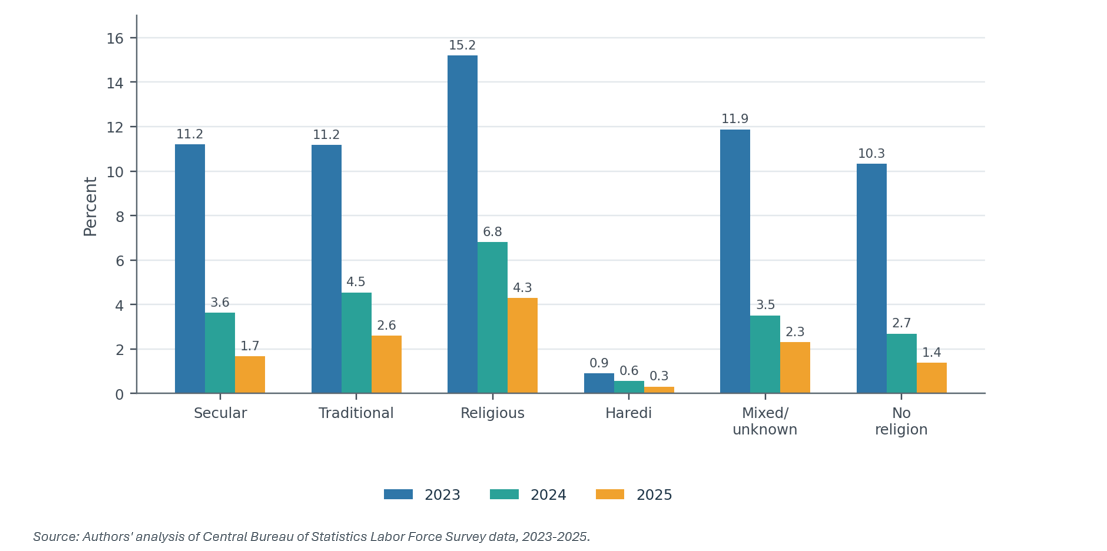
The first months of the war saw extremely broad reserve mobilization. In October-December 2023, 11.2% of secular men and 11.2% of traditional men aged 21-44 served in an average month, compared with 15.2% of religious men. Rates fell in all groups in 2024 and again in 2025 as the IDF reduced and rotated mobilization. But the relative gap between groups widened. By 2025, 4.3% of religious men served in an average month, compared with 2.6% of traditional men, 1.7% of secular men, and 0.3% of Haredi men.
Figure 1. Share of men aged 21-44 who served in the reserves in the "Swords of Iron" War in an average month, within the religious group to which they belong, 2023-2025 (%)
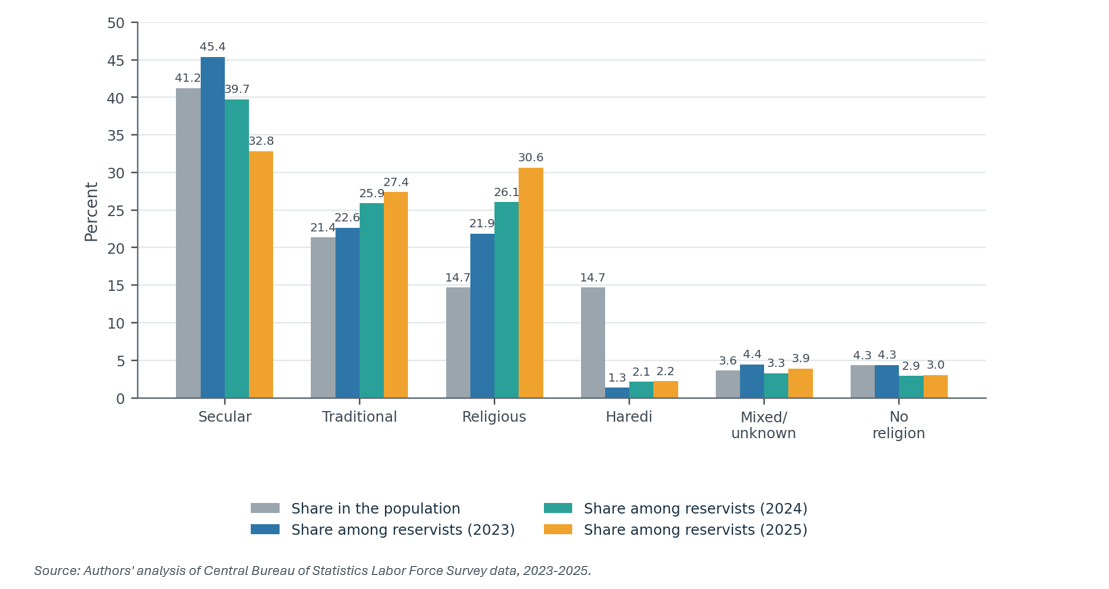
The distribution of male reservists therefore diverged more sharply from the distribution of the male population. In 2025, religious men represented more than twice their share of the relevant population, while Haredi men remained almost absent from the reserve burden. The fall in the share of secular men should not obscure scale: secular men were still the largest group of male reservists, and the combined secular and no-religion population remained a major component of the reserve force.
Figure 2. Distribution of men aged 21-44 in the overall population compared with the distribution of reservists in the "Swords of Iron" War (monthly average), by religious self-definition, 2023-2025 (%)
In 2023–2024, women served in reserve duty at much lower rates than men and accounted for 13.5% of reservists in an average month. This differs from other published figures showing women as 18%-22% of reservists during the war because the average-month measure also weights the number of days served; women, on average, served fewer reserve days than men.
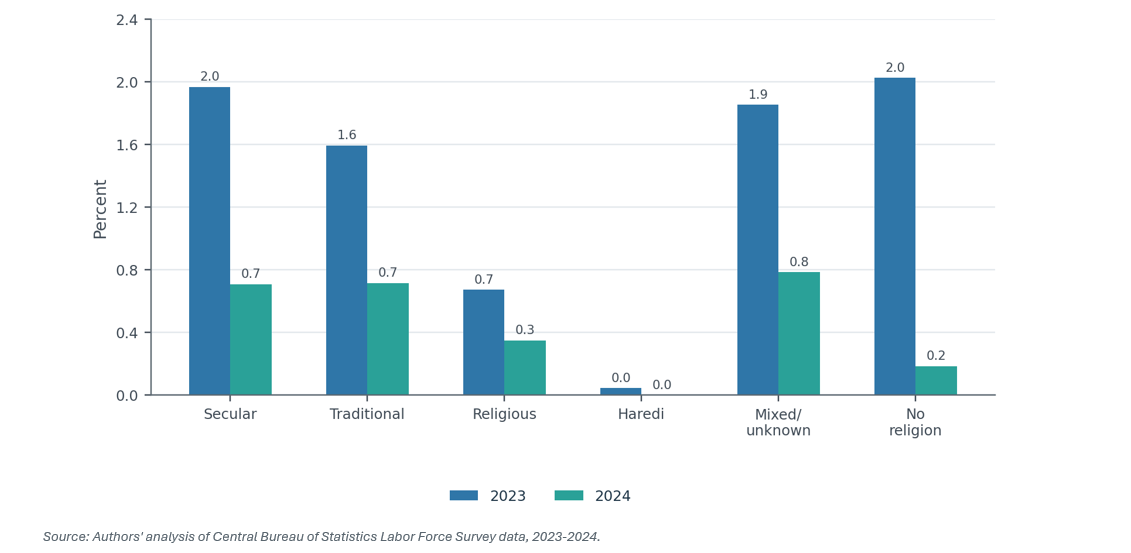
Among women, the pattern differs sharply from the pattern among men. Secular and traditional women were overrepresented among women serving in the reserves in 2023–2024, while religious women were underrepresented. In 2023, 2.0% of secular women and 1.6% of traditional women served in an average month, compared with 0.7% of religious women. In 2024, the rates were 0.7% among secular women, 0.7% among traditional women, and 0.3% among religious women. This is consistent with the lower rate of regular IDF service among religious women, who are entitled to an exemption on religious grounds.
Figure 3. Share of women aged 18-44 who served in the reserves in the "Swords of Iron" War in an average month, within the religious group to which they belong, 2023-2024 (%)
Because women are a smaller share of average-month reservists and because religious women serve at lower rates, combining men and women modestly raises the secular share of the overall reserve population compared with an analysis of men alone and modestly lowers the religious share. The combined-gender picture nevertheless preserves the main trend: rising relative weight for religious reservists, a more moderate rise for traditional reservists, a decline in the secular share, and very low Haredi participation.
The overrepresentation of religious men is especially pronounced among older reservists. Men aged 35-44 made up about 35% of male reservists aged 21-44 in the average year examined, and their share grew over the war - from 29% in 2023 to 41% in 2025. Within this older age group, religious men were 13.1% of the Jewish male population but 28.7% of reservists. Among younger men aged 21-34, religious men were also overrepresented, but the gap was smaller: 15.9% of the population versus 25.1% of reservists.
Figure 4. Distribution of men aged 21-34 (younger) and aged 35-44 (older) in the overall population compared with the distribution of reservists in these ages in the "Swords of Iron" War (monthly average), by religious self-definition, annual average 2023-2025 (%)
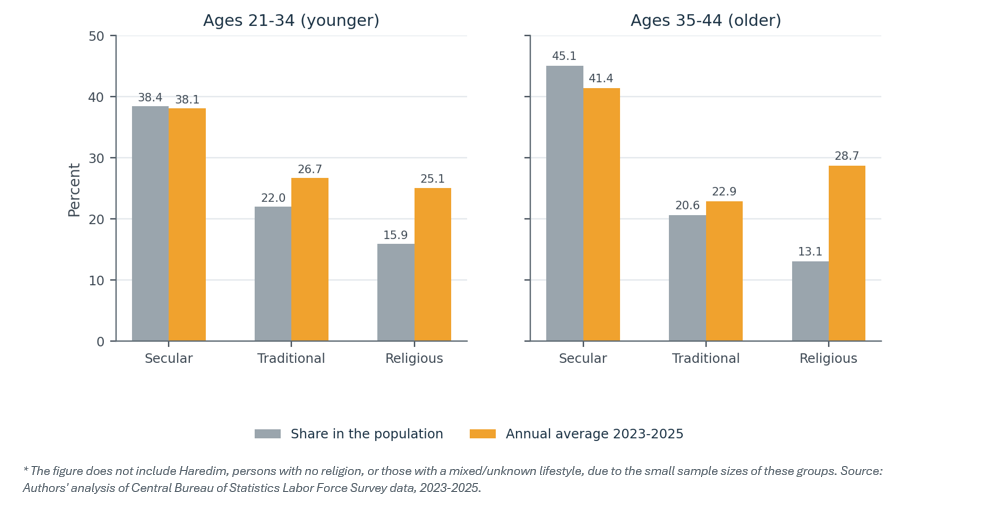
This age pattern matters because men aged 35-44 are more likely to have established careers, spouses, and children. Prolonged reserve duty among this group therefore carries a particularly heavy family and labor-market burden. The finding also helps explain why community support may be part of the story: families facing long reserve absences often rely on relatives, friends, and local networks.
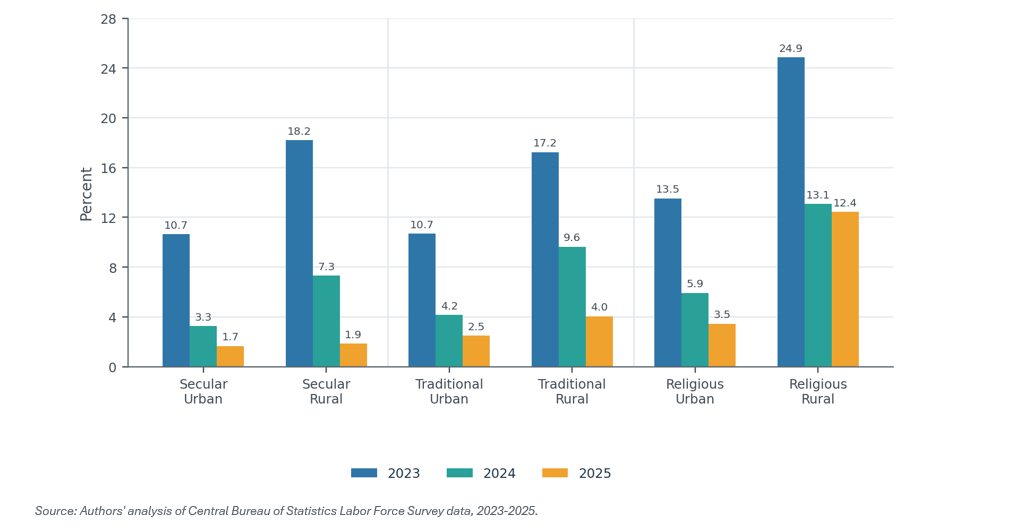
Locality type adds another layer. Across the secular, traditional, and religious groups, men living in rural localities served in reserve duty at higher rates than men living in urban localities. The pattern was strongest among religious men. In 2025, 12.4% of religious men living in rural localities served in an average month, compared with 3.5% of religious men in urban localities. Among secular men, by contrast, the rural advantage nearly disappeared in 2025: 1.9% in rural localities versus 1.7% in urban localities. Even so, because most Israelis live in urban localities, most reservists still came from urban localities.
Figure 5. Share of men aged 21-44 who served in the reserves in the "Swords of Iron" War in an average month, by religious self-definition and locality type, 2023-2025 (%)
Reserve service has direct implications for employment, employers, and household income. The review therefore examines employed Jewish men aged 21-44 in three broad sectors: the public sector, high-tech, and the rest of the business sector. At the outbreak of the war, high-tech had the highest rate of workers absent due to reserve duty: 16.5% in 2023, compared with 14.9% in the non-high-tech business sector and 9.4% in the public sector. By 2025, however, the high-tech rate had fallen to 2.3%, below both the public sector (2.6%) and the non-high-tech business sector (3.1%).
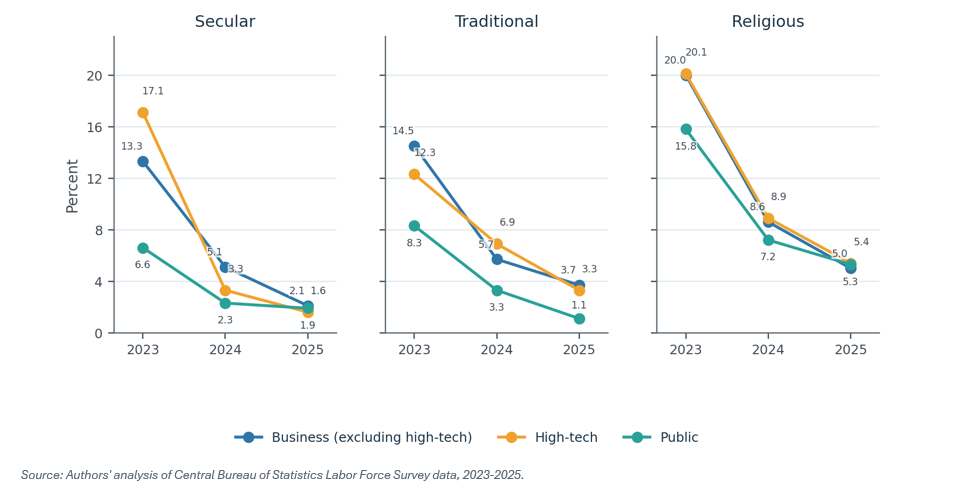
The sectoral pattern is important because high-tech has high labor productivity, so reserve absences there may have a disproportionate macroeconomic effect. But by 2025, the larger story was not a single sector; it was the religious self-definition of workers. Gaps between secular, traditional, and religious men were larger than gaps between sectors. In 2025, religious men had similar reserve-service rates across all three sectors, ranging from 5.0% to 5.4%. Secular men were at 2.1% in the non-high-tech business sector, 1.6% in high-tech, and 1.9% in the public sector. Traditional men stood between the two groups in the business and high-tech sectors, though their rate in the public sector was lower.
Figure 6. Share of men aged 21-44 who served in the reserves in the "Swords of Iron" War in an average month, among labor-market participants, by religious self-definition and industry, 2023-2025 (%)
Quarterly labor-force data, which extend through the first quarter of 2026, show spikes during periods in which the war intensified, including Operation Northern Arrows in the fourth quarter of 2024 and Operation Roaring Lion in the first quarter of 2026. In the first quarter of 2026, the average-month service rate among employed men was 2.4% for secular men, 4.1% for traditional men, and 6.5% for religious men.
Several possible explanations should be treated as hypotheses rather than proven causal findings. One clear background factor is the higher rate of combat service among men from the religious state-education system. As the war continued and the IDF reduced some headquarters, rear-echelon, and Home Front Command reserve roles, the remaining reserve burden may have been increasingly concentrated among combat and combat-support units. This may help explain the overrepresentation of religious men, but it does not fully explain the further shift from 2024 to 2025.
Additional factors can be pointed to - with appropriate caution. Reserve service has formal and informal elements of voluntarism: some reservists serve despite exemptions, some extend their service, and in practice there is more flexibility in reserve duty than in regular compulsory service. Over a long war, motivation and the ability to absorb repeated absences become more important. Differences between groups may reflect differences in trust in the government and in the way the war was managed, differences in education and ideology, and differences in community support. The review notes, for example, that a CBS survey of reservists' families found that 83% of religious women who were partners of reservists said they relied on family and friends, compared with 74% of secular women and 71%-73% of traditional women.
The data should not be read as a simple moral ranking of social groups. Secular Israelis remained central to the reserve force, religious women served at lower rates than secular and traditional women, and Haredi men continued to carry only a very small part of the reserve burden. The strongest conclusion is structural: as the war became longer, the burden of reserve service became increasingly uneven across Israeli Jewish society. That unevenness has implications for social cohesion, family life, employers, and public policy.