

Overwhelming Majority of Israelis Think There is Danger to the Integrity of Israel's Elections
72% of Jewish Israelis and 58.5% of Arab Israelis say there is danger to the integrity of Israel's elections. Israelis are split on how best to handle Iran. Laws passed in the legislative blitz prior to Knesset dissolution were broadly unpopular.
Photo by Olivier Fitoussi/Flash90
The survey was conducted by the Viterbi Family Center for Public Opinion and Policy Research at the Israel Democracy Institute between July 28 and August 2, 2026. It was based on a representative sample of the population in Israel aged 18 and above, comprising 600 Jewish interviewees and 151 Arab interviewees.
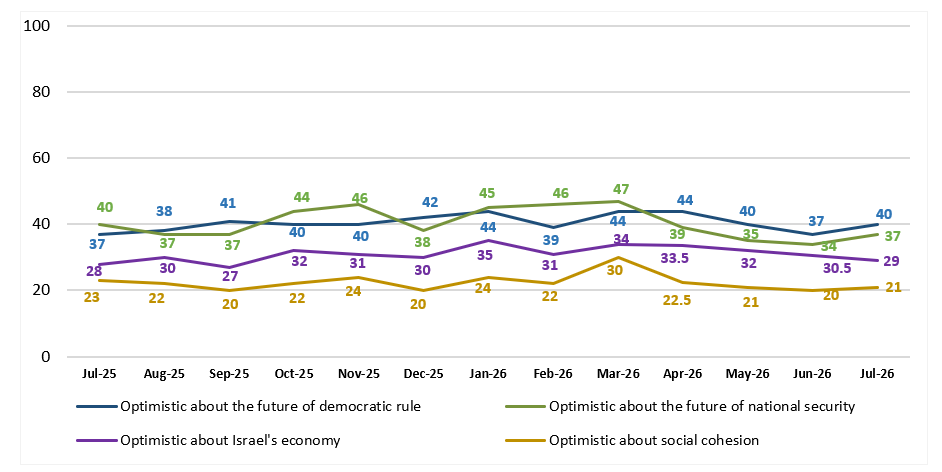
- This month, we found only minor changes in levels of optimism regarding the two topics which always receive the lowest optimism ratings (as they did this month): the future of social cohesion and the future of Israel’s economy (up 1 percentage point and down 1.5 points, respectively).
- By contrast, there was a slight increase in optimism regarding the two topics which always have the highest optimism ratings: the share of those optimistic about the future of democratic rule in Israel rose from 37% last month to 40% this month (back to the level recorded in May of this year), and the share of those optimistic about the future of Israel’s security increased by a similar degree, from 34% last month to 37% this month.
Optimistic about the future of democratic rule, national security, the economy, and social cohesion (total sample; %)
- As in previous months, the share of optimists in the Jewish sample is larger than that in the Arab sample for all four topics. The largest difference between the two groups is in optimism regarding the future of national security (at 27 percentage points, as compared to 24 points regarding the future of the economy, 18.5 points regarding the future of democratic rule, and just 2 points regarding the future of social cohesion).
Optimistic about the future (Jews and Arabs; %)

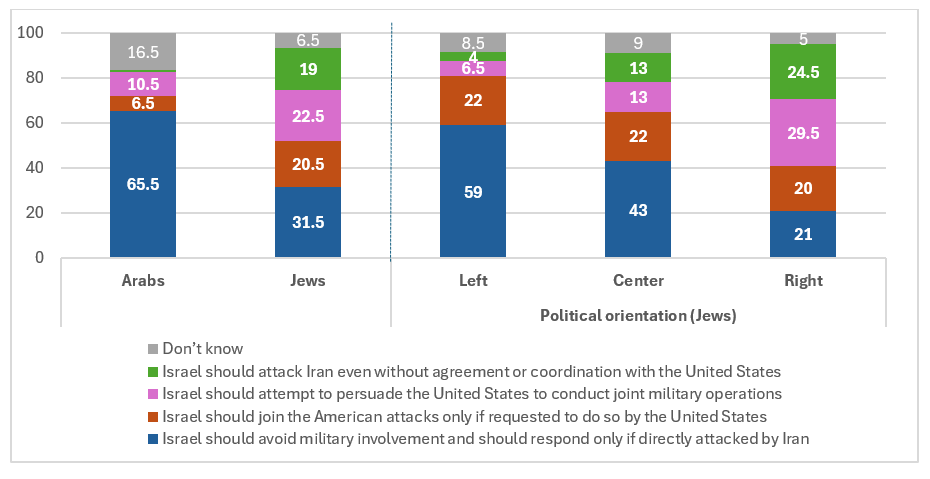
- In the total sample, the largest share of respondents—more than a third (37%)—think that Israel should avoid military involvement in the American attacks on Iran, and respond only if it is attacked directly. Meanwhile, 20% are in favor of Israel working to persuade the United States to conduct joint military operations, a similar percentage (18%) think that Israel should join in with the attacks only if requested to do so by the United States, and 16% think that Israel should attack even without American agreement or coordination.
- There is a striking difference between Arabs and Jews: A significant majority of Arabs (some two-thirds) support avoiding military involvement and responding only in the event of a direct Iranian attack. By contrast, though this is the most common view among Jews, only about a third hold it, while the distribution among the other options is fairly equal, with all of them receiving similar rates of support of around 20%.
- A clear difference emerges in the Jewish sample when broken down by political orientation: On the Left, the majority (almost 60%) support refraining from involvement unless Israel is attacked, and around one-fifth think that Israel should join only at the request of the United States. In the Center, too, the largest share (albeit not a majority) support staying out of the conflict, and one-fifth (as on the Left) think that Israel should join in only if asked to do so by the United States. On the Right, by contrast, there is much stronger support for taking action, whether by persuading the United States to conduct joint operations or by attacking even without American consent.
In your opinion, how should Israel act with regard to the Iranian issue? (%)
Likelihood of an agreement:
- We asked: “In an interview with Al Jazeera, the president of Syria announced that Damascus is seeking a security agreement with Israel that could pave the way to a comprehensive peace. In your opinion, what is the likelihood of reaching a comprehensive peace treaty with Syria?” We found that the public is largely pessimistic: 62% of the total sample rate the likelihood of this happening as low, compared to only around 30% who think that the chances of achieving a comprehensive peace are high.
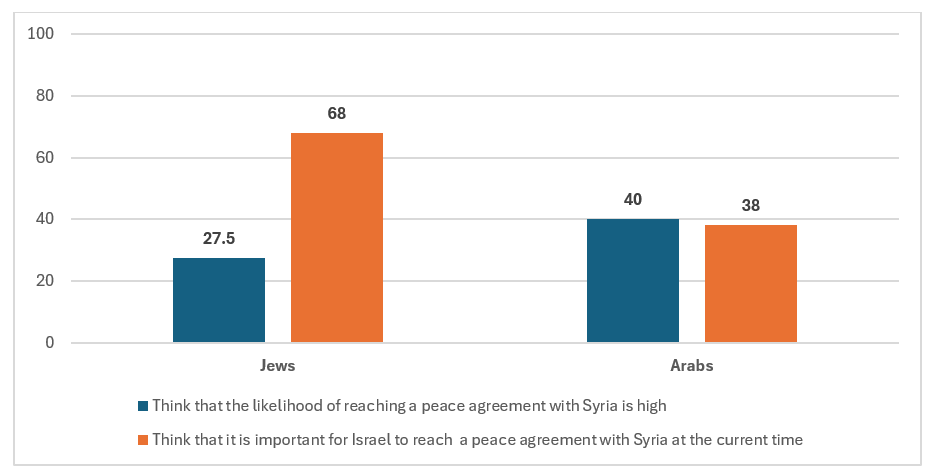
- Arabs are more optimistic than Jews: 40% of Arabs rate the likelihood of peace with Syria as high (48% rate it as low), while only 27.5% of Jews agree (65% rate the likelihood as low).
Importance of an agreement:
- We further asked: “How important or unimportant is it for Israel to reach a peace agreement with Syria at the current time?” In the total sample, a significant majority (63%) think it is fairly important or very important for Israel to reach such an agreement, while only 28.5% think it is not so important or not important at all.
- Here, too, we found a significant difference between Jews and Arabs: The majority of Jews (68%) think that reaching an agreement is fairly important or very important (only 24% think it is not so important). Among Arabs, the picture is reversed, and only 38% think it is important to reach an agreement, while around one-half think it is not so important or not important at all (51%).
- An analysis of the two questions together reveals that Jews are more pessimistic than Arabs about the likelihood of reaching a peace agreement with Syria, but they also attach greater importance to doing so. Arabs are more optimistic about the prospects of reaching an agreement with Syria, but consider it less important.
Think that the likelihood of reaching a peace agreement with Syria is high, and think that it is important for Israel to reach such a peace agreement (%)
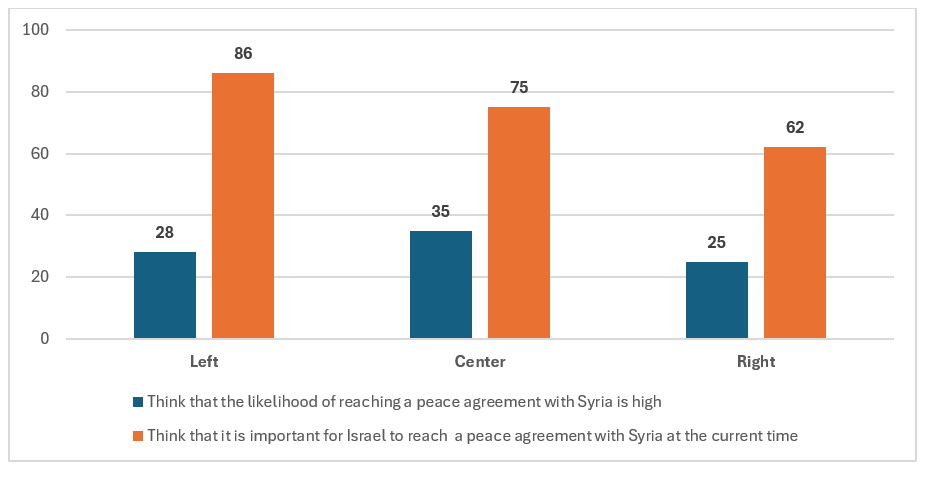
- Breaking down responses in the Jewish sample by political orientation reveals that a significant majority in all three camps attribute importance to reaching a peace agreement with Syria. However, the differences in the size of this majority are considerable: the Left has the largest, followed by the Center, and then the Right (86%, 75%, and 62%, respectively). On the other hand, when it comes to assessments of the likelihood of reaching such an agreement, the differences between the camps are relatively small: the Center is slightly the more optimistic of the three, while the Left and the Right are close to each other and slightly less optimistic.
- In each of the camps, the share of respondents who think it is important to reach an agreement is much larger than the share who think that the likelihood of this happening is high. The largest difference between the two shares is on the Left, at fully 58 percentage points. In the Center and Right, the gaps are less pronounced, but still large (40 and 37 percentage points, respectively).
Think that the likelihood of reaching a peace agreement with Syria is high, and think that it is important for Israel to reach such a peace agreement (Jews, by political orientation; %)
Likelihood of a popular uprising (intifada):
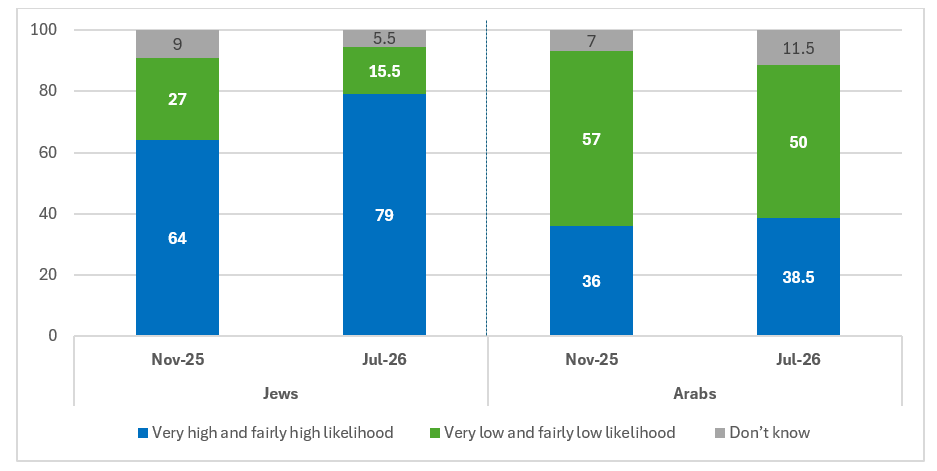
- A large majority of the total sample (72%) think there is a high likelihood of a Palestinian popular uprising in the foreseeable future. Only 22% rate the chances of this happening as low. This is a significant increase from the last time we asked this question, in November 2025, when 59% thought there was a high likelihood of a popular uprising breaking out in the foreseeable future.
- There is a considerable difference between Jews and Arabs on this issue: Around 80% of Jews think that a Palestinian popular uprising may be imminent, more than in the previous measurement, when “only” around two-thirds held this opinion. Among Arabs, the share anticipating an uprising is much lower—less than 40%, similar to that found in the past.
In your opinion, what is the likelihood that in the foreseeable future, a Palestinian popular uprising (intifada) will erupt in the West Bank / Judea and Samaria? (%)
- In all three political camps (Jews), a large share of respondents think there is a high likelihood of a popular uprising breaking out, and the differences between the camps are small (Left, 84%; Center, 76%; Right, 78%).
Security forces’ treatment of settlers involved in violence against Palestinians:
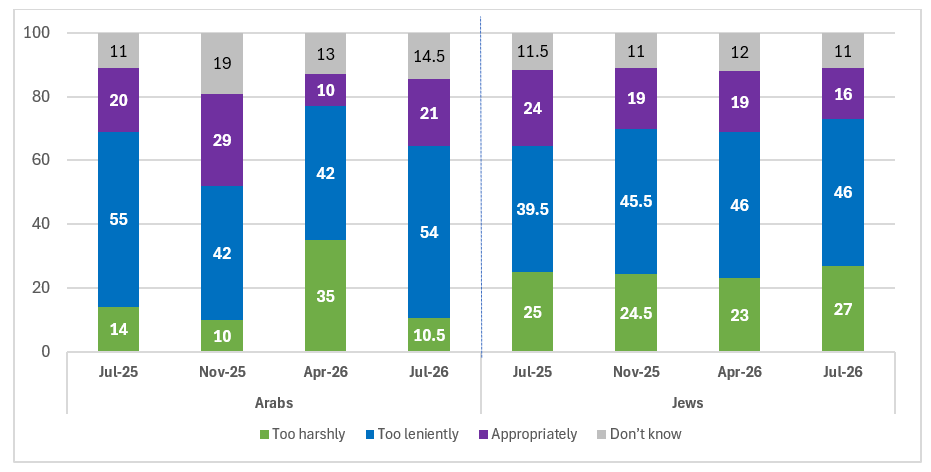
- For the past year or so, we have been monitoring the public’s attitudes on the question of how the security forces deal with settlers who act violently against Palestinians in the West Bank. Among Jews, views have remained fairly stable, and in each of the last three measurements the largest share of respondents said that such settlers are being treated too leniently (around 46%). Around one-quarter now believe that the treatment handed out is too harsh, similar to the previous three measurements.
- Among Arabs, more than half think that the security forces are too lenient, a figure similar to that found a year ago. Meanwhile, 10.5% think that the treatment of violent settlers is too harsh, similar to the percentages found in November and July 2025, and different from the last measurement in April 2026, which turns out to have been an outlier.
Are the security forces and enforcement agencies treating groups of settlers who are involved in acts of violence against Palestinians too harshly, too leniently, or appropriately? (%)
- As expected, there are large differences on this issue between political camps (Jews): On the Left and in the Center, a clear majority think that the treatment of settlers involved in violence in the West Bank is too lenient (86.5% and 63%, respectively). On the Right, by contrast, the share who hold this view is smaller (31%), while the share who think that violent settlers are treated too harshly is larger (37%).
Are the security forces and enforcement agencies treating groups of settlers who are involved in acts of violence against Palestinians too harshly, too leniently, or appropriately? (Jews; %)

- However, a more detailed examination of responses on the Right reveals that on the Center-Right, a larger share think that the treatment is too lenient (45%, compared to 26% who rate it as too harsh), while among those identifying as Strongly Right, the picture is reversed (too lenient, 26%; too harsh, 41%).
- Before the dissolution of the Knesset, a number of controversial laws were passed. We asked our respondents about the extent to which they supported or opposed three of them:
- The law to halt arrests of deserters, which states that for a limited period, no arrests or enforcement activities will be pursued against yeshiva students who fail to present themselves for military service.
- The gender segregation in higher education law, which permits the expansion of gender segregation in higher education to advanced degree programs in all disciplines, and to anyone who wishes to study in segregated environments.
- The attorney general law, which states that the attorney generals’ legal opinion will no longer be binding on the government, and removes the exclusivity of the attorney general’s representation of the government in court.
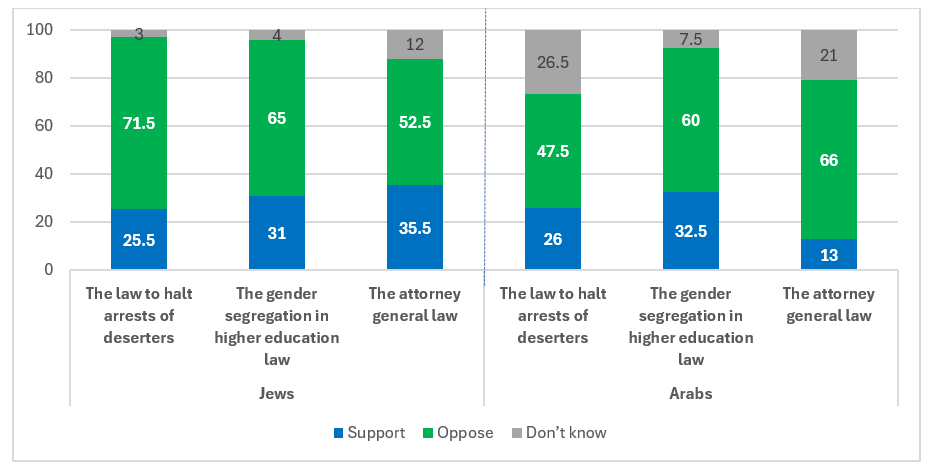
- We found that in the total sample, the level of support for each of these laws is very low: 32% expressed support for the attorney general law, while 55% oppose it. Regarding the gender segregation in higher education law, 31% support it and 64% are opposed, while regarding the law to halt arrests of deserters, 25% are in favor and 67% are opposed.
- Among Jews, support for the attorney general law and the gender segregation in higher education law (around one-third in both cases) is slightly stronger than support for the law to halt arrests of deserters, which stands at only around one-quarter.
- Among Arabs, approximately one-third expressed support for the gender segregation in higher education law, slightly higher than the level of support for the law to halt arrests of deserters, and much higher than the level of support for the attorney general law, which recorded the strongest opposition. It is important to note the large percentage of Arab interviewees who selected the “don’t know” response with regard to the law to halt the arrests of deserters and the attorney general law.
Do you support or oppose each of the following laws, which were passed by the Knesset before its dissolution? (%)
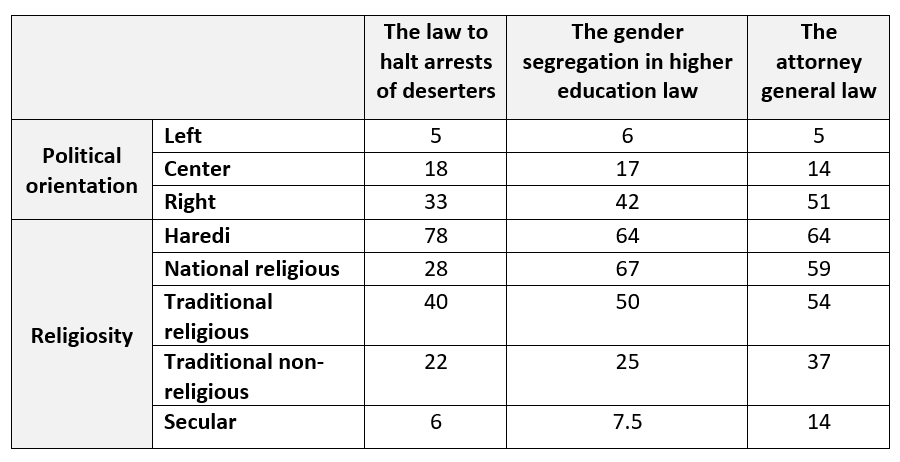
- Breaking down responses in the Jewish sample by political orientation reveals that support for each of the laws is very low on the Left (5%–6%) and in the Center (14%–18%). On the Right, support is higher but not uniform: there is less support for the law to halt arrests of deserters and the gender segregation in higher education law, but a small majority are in favor of the attorney general law.
- Segmentation by religiosity (Jews) reveals very high levels of support among Haredim for all three laws, especially the law to halt arrests of deserters. There is also a huge difference of opinion regarding this law between the Haredim and the other groups, in each of which only a minority of respondents expressed support for the law.
- In the national religious public, the majority support both the gender segregation law and the attorney general law, and around one-half of the traditional religious Jewish public also support both these laws.
- Support for all three laws is lower among traditional non-religious Jews, and to an even greater extent among secular Jews.
Support each of the following laws, which were passed by the Knesset before its dissolution (Jews; %)
Party Primaries
- Whenever Knesset elections come around, the question arises of the best method for determining each party’s candidate list. In the Israeli Voice survey of July 2022, we found that the method preferred by the majority of the Israeli public (58%) is to hold party primaries of various types. In the same survey, the method in which the party leader chooses the list candidates received only 11% support, followed in the rankings only by the method of a party selection committee (7%). A quarter of the respondents said that they did not know what the best method was.
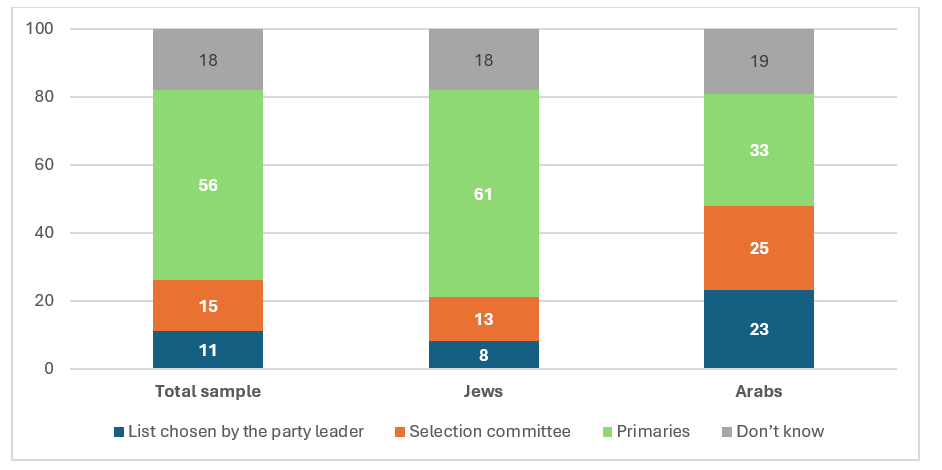
- The findings this time were very similar: in the total sample, the majority (56%) indicated party primaries as the most appropriate method, 11% favored the candidate list being chosen by the party leader, and 15% expressed a preference for a selection committee. Once again, a large share of respondents (18%) selected the “don’t know” option.
- There is a large difference between Jews and Arabs: While a clear majority of Jews favor primaries, in the Arab sample the distribution among the various options is fairly even: around one-third prefer primaries, but a much larger share than among Jews are willing to entrust the determination of the candidate list to the party leader (23%, compared to 8% of Jews). The same applies to candidate selection by a committee (Arabs, 25%; Jews, 13%). In both publics, a similar share of respondents selected the “don’t know” option.
Which of the following methods do you think is best for choosing a party’s candidates for election to the Knesset? (%)
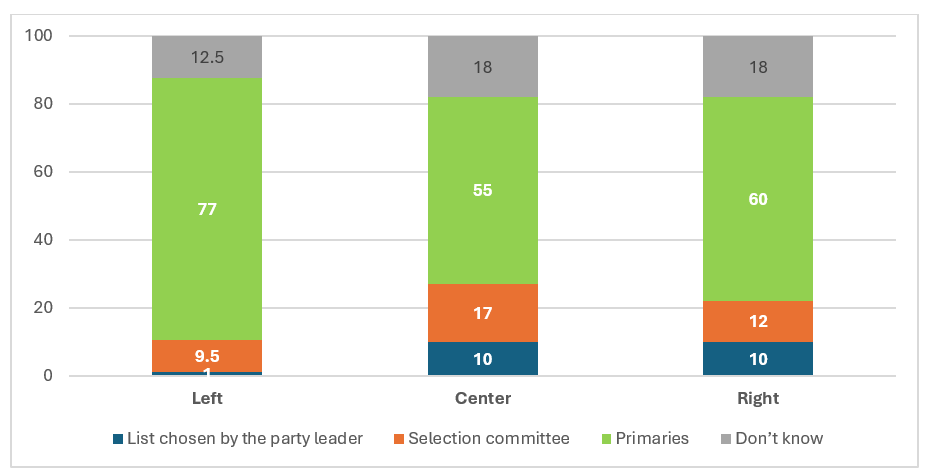
- Breaking down responses in the Jewish sample by political orientation reveals considerable differences. Though the preference of the majority in all three camps is for primaries, the Center is closer to the Right on this issue than to the Left, where the percentage of those who support party primaries as the preferred method is the highest (Left, 77%; Center, 55%; Right, 60%).
Which of the following methods do you think is best for choosing a party’s candidates for election to the Knesset? (Jews, by political orientation; %)
- Segmentation by voting intention for the next Knesset elections reveals a majority who prefer primaries among voters for all parties—with the exception of United Torah Judaism (where identical shares expressed a preference for the list being chosen by the party leader and for primaries) and Hadash/Ta’al (where identical shares prefer a selection committee and primaries). Among Shas voters, the share in favor of primaries is not a majority, but is nevertheless the largest (42%).
Which of the following methods do you think is best for choosing a party’s candidates for election to the Knesset? (total sample, by voting intention at the upcoming elections; %)
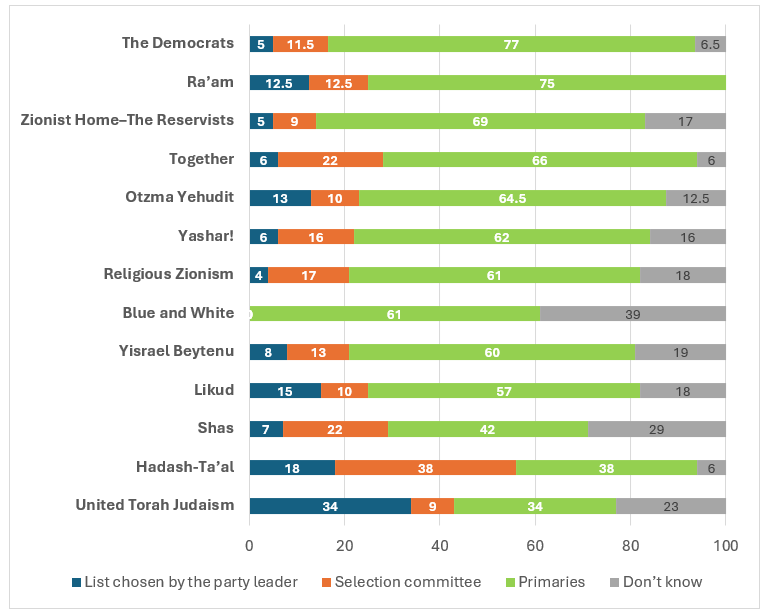
*The number of respondents who indicated an intention to vote for Blue and White or for Ra’am was too small to support generalizations.
Integrity of the Elections
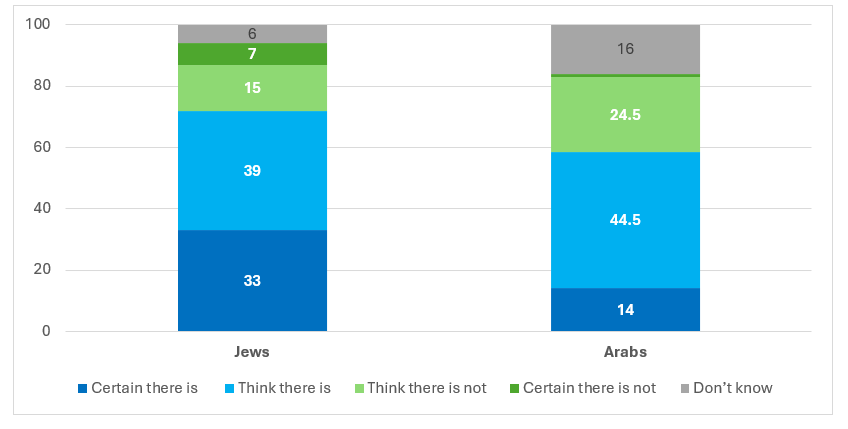
- An issue that is increasingly the focus of public debate in Israel is whether or not various interest groups will attempt to harm the integrity of the upcoming elections. We asked: “Recently, in a speech marking the beginning of the election campaign, President Herzog warned of threats to the integrity of the elections, both from within Israel and from without. In your opinion, is there or is there not a danger to the integrity of the elections in Israel?” We found that a majority of Israelis think or are certain that there is a danger of this happening.
- The share of respondents who think or are certain there is a danger of interference in the election results is larger among Jews (72%) than among Arabs (58.5%).
- Though in all three political camps (Jews), the majority think or are certain that there is a danger to the integrity of the elections, we also found some differences: Those on the Left are most concerned about this possibility (90.5%), followed by the Center (76%), and finally the Right (66%).
In your opinion, is there or is there not a danger to the integrity of the elections in Israel?
Including Ra’am in the Next Government
- Against the backdrop of rumors that the Ra’am party is not planning to join with the other Arab parties in a joint Arab electoral list, and reports that MK Yoav Segalovitz (currently a member of the Yesh Atid faction) will join the party ahead of the upcoming elections, we examined the status of Ra’am among the Jewish public at the current time, especially in light of the recent announcement by its leader recognizing Israel as the state of the Jewish people. We asked: “Do you support or oppose the inclusion in the next government of the Ra’am party, headed by Mansour Abbas, following his statement that the State of Israel was created as a Jewish state and that it will remain as such?” We found that even in these circumstances, the majority of the Jewish public (61%) are not supportive of including Ra’am in the government.
- The surprising finding is that a similar share of Arab respondents hold the same view (60%).
- Segmentation of the Jewish sample into five political camps reveals that the majority of those identifying as Strongly Left and Center-Left support the inclusion of Ra’am in the next government. However, among those in the Center, the Center-Right, and even more so Strongly Right, only a minority are in favor, with the size of this minority varying by camp.
Support the inclusion in the next government of the Ra’am party, headed by Mansour Abbas, following his statement that the State of Israel was created as a Jewish state and that it will remain as such (Jews, by political orientation; %)
The Right to Vote of Arab Citizens of Israel
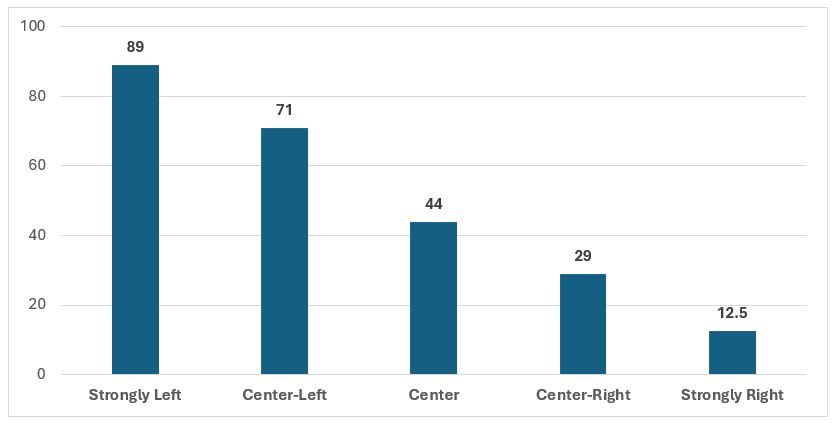
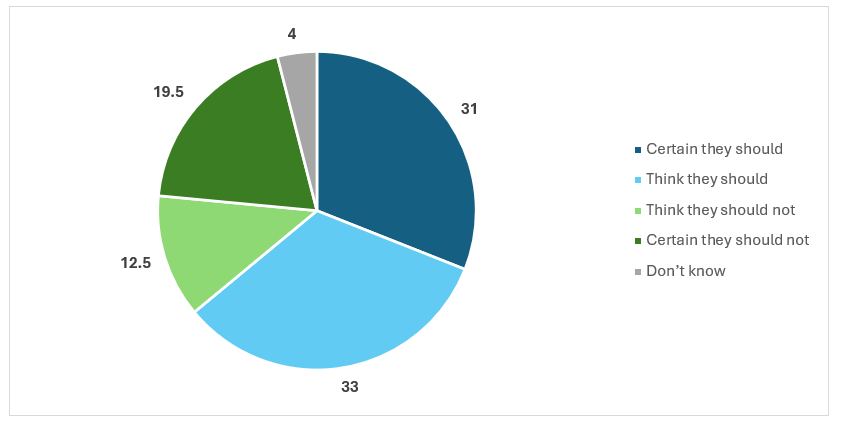
- Against the backdrop of the repeated questioning in past and present election campaigns of the right of Arab citizens of Israel to participate in elections, we asked our Jewish respondents: “In your opinion, should Arab citizens of Israel have or not have the right to vote in Knesset elections?” We found that a clear majority of the Jewish public think or are certain that Arabs should have the right to vote in Knesset elections.
Should Arab citizens of Israel have or not have the right to vote in Knesset elections?
- Segmentation by political orientation reveals that a large majority in all camps, except for those in the Strongly Right grouping, think or are certain that Arab citizens of Israel should have the right to vote in Knesset elections (Strongly Left, 89%; Center-Left, 92%; Center, 74%; Center-Right, 75%; Strongly Right, 46%).
- The lowest level of support for the right of Arab citizens of Israel to vote in Knesset elections was found among Jews intending to vote for United Torah Judaism (22%). Slightly higher support was found among Otzma Yehudit voters (32%). Among voters for the other coalition parties (Likud, Shas, and Religious Zionism), the share of respondents who think that voting in elections is the right of Arab citizens of Israel stands at between 46% and 48%.
***
The July 2026 Israeli Voice Index was prepared by the Viterbi Family Center for Public Opinion and Policy Research at the Israel Democracy Institute. The survey was conducted via the internet and by telephone (to include groups that are under-represented on the internet) between July 28 and August 2, 2026, with 600 men and women interviewed in Hebrew and 151 in Arabic, constituting a nationally representative sample of the adult population in Israel aged 18 and over. The maximum sampling error was ±3.58 % at a confidence level of 95%. Field work was carried out by Shiluv I2R. The full data file can be found at: https://dataisrael.idi.org.il.