
Election Campaign Financing in Israel
In every Israeli election, parties spend tens of millions of shekels each on their campaigns. Where does the money come from, and when is it paid? How do the rules differ for large and small parties, and for established and new ones? Is there a spending ceiling? And what happens when a party runs a deficit?
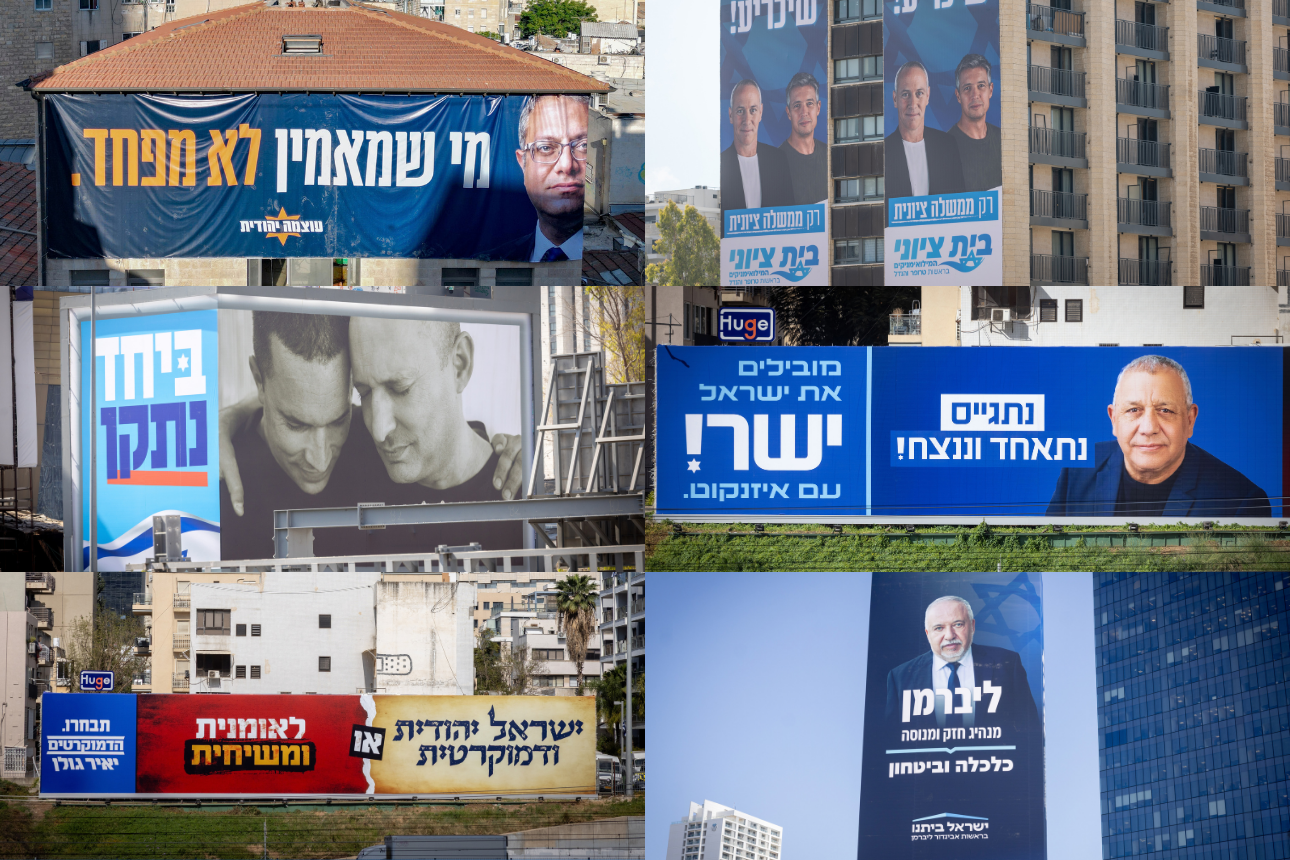
Photos by Miriam Alster, Chaim Goldberg/Flash90
In principle, parties can finance their election campaigns from three types of sources:
- Public campaign funding provided by the state
- Donations from the public
- Other sources, such as registration fees paid by candidates seeking to participate in party primaries
In practice, almost all campaign financing comes from state funds. According to State Comptroller reports, approximately 99.7% of parties' income in the 2022 election came from the state. Their total income was NIS 207 million, of which more than NIS 206 million was state funding, approximately NIS 250,000 came from donations, and approximately NIS 370,000 came from other sources.
This is the result of generous public campaign financing, even by comparison with other democracies, combined with exceptionally strict limits on donations. In an election year, a party represented in the Knesset may accept a donation only from Israeli citizens and may receive no more than NIS 2,800 from a single household. A party not represented in the Knesset may receive five times that amount.
Parties also have sources of ongoing funding unrelated to elections. These include ongoing public funding for parties represented in the Knesset, which is also substantial; donations, although in practice parties receive almost none; and other income, such as membership dues.
The funding is paid in three installments:
- Advances before the election, as explained below.
- Immediately after the election results are published, parties must receive 85% of the funding to which they are entitled. If an advance has already been paid, the post-election payment merely brings the total up to 85%.
- The remaining 15% is paid only well after the election, once the State Comptroller has issued the election audit report. The timetable is as follows: within 24 weeks of the election, parties must submit a report on their election accounts to the State Comptroller; within an additional 24 weeks (in total, 48 weeks), the State Comptroller issues the audit report. At that point, the parties should receive the remaining 15%. The State Comptroller may, however, impose sanctions and fines for breaches of the Parties Financing Law or for submitting a report that does not meet legal requirements.
The amount of public campaign financing is calculated using a funding unit. The diagram below shows the current value of a funding unit and how the number of units allocated to each party is determined.
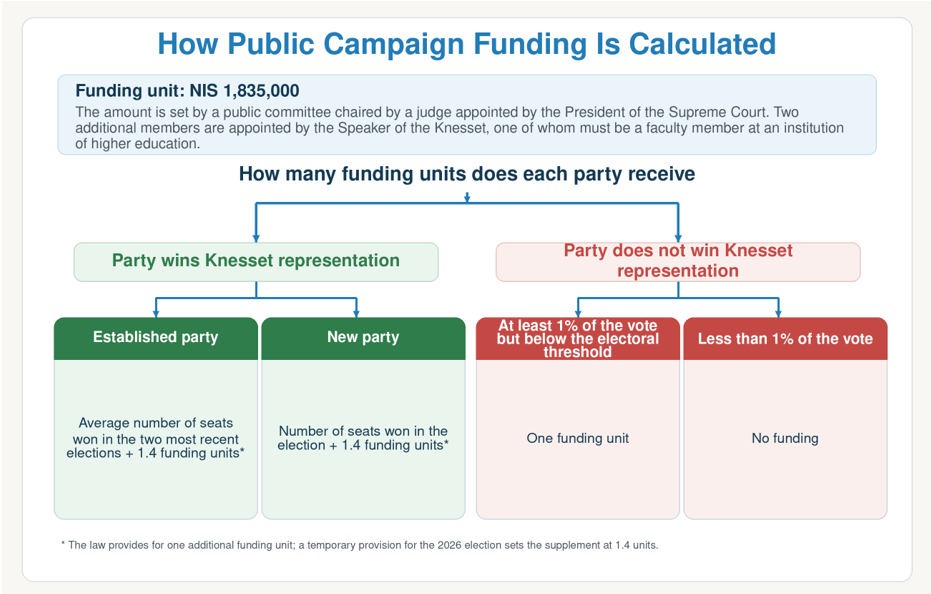
For established parties (that were elected to the outgoing Knesset), the calculation is based on the average number of seats won in the two most recent elections. This helps protect parties whose support has fallen sharply since the previous election.
Yesh Atid's campaign financing was calculated by averaging the 24 seats it won in the 2022 election and the 17 seats it won in the 2021 election, giving an average of 20.5. After the addition of one funding unit, which under the current rules would be 1.4 units, the party received campaign financing worth 21.5 funding units. Based on the value of the funding unit at the time, this amounted to approximately NIS 35 million.
Using the same calculation, Likud received approximately NIS 57 million, while the smaller Ra'am party received approximately NIS 19 million.
Parties are eligible to receive advances. Here too, the rules distinguish between new and established parties.
New Parties
- New parties are entitled to advances worth ten funding units, or NIS 13,850,000. The standard amount is seven units, but a temporary provision for the 2026 election increased it to ten.
- They may receive an advance only against a bank guarantee. To secure the bank guarantee, they obtain private guarantees, sometimes totaling millions of shekels.
- Of the advance to which they are entitled, they may receive two funding units as early as the statutory reference date. For the 2026 election, this date fell 101 days before election day, meaning in July. The remainder of the advance is paid immediately after the candidate list is submitted.
Established Parties
- Established parties—that is, parties that were represented in the outgoing Knesset at the reference date— may receive an advance equal to 0.8 funding units for each MK they had on the statutory reference date, immediately after submitting their candidate list. The standard amount is 0.7 funding units per MK, but a temporary provision increased it for this election.
- Parties with fewer than ten MKs may receive an advance calculated as though they were represented by ten MKs, provided they supply a guarantee for the difference.
In other words, established parties generally do not have to provide a guarantee, or must guarantee only part of the amount, on the assumption that they have already demonstrated their ability to win seats in the Knesset.
Examples
- Likud is represented by 32 MKs in the current Knesset.
- Its advance is calculated as follows: 32 x 0.8 = 25.6 funding units, or almost NIS 47 million.
- Shas is represented by 11 MKs: 11 x 0.8 = 8.8 funding units, entitling it to an advance of approximately NIS 16 million.
Parties often enter an election owing money to the Knesset (explained below). By law, this debt should be deducted from the advance. In every recent election, however, temporary provisions waived the deduction and allowed indebted parties to receive the full advance. For the 2026 election, a temporary provision stipulates that only half of a party's debt will be deducted from its advance.
After each of the recent elections, the overwhelming majority of parties ran substantial deficits. In the most recent election, for example, Likud received approximately NIS 51 million in campaign financing but spent approximately NIS 57 million. In some cases, deficits also arise because the advance a party received before the election exceeded the amount of financing to which it was ultimately entitled, a figure that, as noted above, is determined only after the election.
For a party represented in the Knesset, its deficits and debts are repaid primarily from the ongoing public funding it receives each month. After an election, a party may take a loan from the Knesset and repay it from future ongoing funding, under a mechanism established by law. Even so, deficits are sometimes so large that a party cannot repay them during a single Knesset term, especially when the term is short, as has happened several times in recent years. The party then carries the debt into the next election and the next Knesset.
Immediately after the 2022 election, following a succession of elections and short-lived Knessets, almost every party elected to the Knesset had substantial debts.
Nevertheless, as long as a party remains represented in the Knesset, it can be expected eventually to repay the debt from its ongoing public funding. It should be noted, however, that funding was originally intended for entirely different purposes: routine party activity such as operating local branches, holding conferences, maintaining contact with party members, and conducting ideological work.
For a new party that received an advance but failed to win Knesset representation, the Knesset may call its guarantees because the party remains in debt. This happened, for example, to Eli Yishai's Yachad party after the 2015 election.
For a party that was represented in one Knesset but failed to win representation in the next, repaying deficits and debts is extremely difficult because the party receives no ongoing public funding during the incoming Knesset's term. In theory, it can and should raise donations and sell assets for this purpose. In practice, this almost never happens, sometimes creating what are effectively bad debts. Parties including Jewish Home, Ehud Barak's Independence party, and Tzalash, the party through which Yamina and New Right ran, were left owing the Knesset millions of shekels, with no clear prospect of repayment.
The Parties Financing Law sets out formulas for calculating each party's spending ceiling. The formula depends on whether the party is new or established and on the number of MKs who represented it in the outgoing Knesset or will represent it in the incoming Knesset.
For example, an established party represented by no more than five MKs may spend up to ten funding units on election expenses, or close to NIS 14 million. Likud, by contrast, may spend approximately NIS 97 million. Every new party may initially spend up to ten funding units. If it wins more than five seats in the upcoming election, however, its spending ceiling increases retroactively and is calculated according to the number of seats it wins. The retroactive calculation naturally makes it difficult to plan spending in advance.
If a party exceeds its spending ceiling, the State Comptroller may withhold part of its public campaign financing.
Party Funding
In principle, funding is allocated separately to each party, including when several parties run as a joint electoral list. Each party's allocation reflects the number of that party's MKs included in the joint list, although the parties may sign an agreement that changes the formula. The additional 1.4 funding units, by contrast, are paid only once to a joint list, regardless of how many parties it comprises. For example, the Joint List of Arab parties, composed of Hadash, Ta'al, and Balad, will receive the 1.4-unit supplement only once.
For these purposes, by contrast, a joint list is treated as a single entity.
For example:
The Together (Beyachad) list does not receive one advance for Yesh Atid, based on the 24 seats it held in the outgoing Knesset, and a separate advance for Bennett's new party, which would otherwise be entitled to an advance of ten funding units. Instead, the joint list receives a single advance, calculated according to Yesh Atid's number of seats.